In the Second RAAT AKELI HAI, the Genre Reaches its Saturation Point
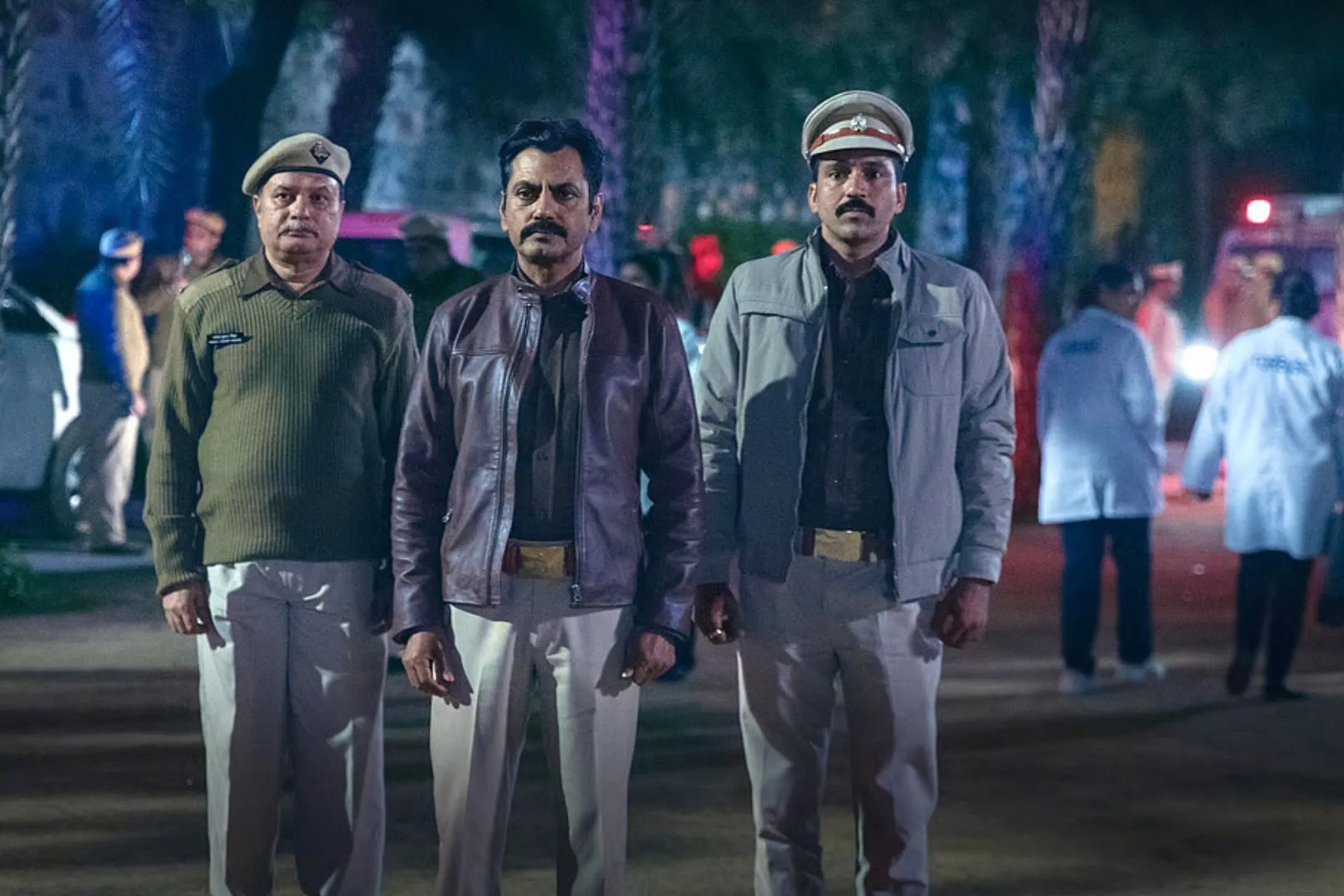
The crimes are bigger and bloodier in Raat Akeli Hai: The Bansal Murders, and the motives even messier; but at its core, the film is a hollow reproduction of its genre predecessors, a familiar formula traced into an inferior product.
At the beating heart of any good work of genre fiction is its familiarity. Whether it’s a romance, a thriller, or sci-fi, a work of genre will rely on predictable tropes and formulas to provide a comforting blanket, a safe space of sorts, an escape from the erratic real world into the lap of a familiar narrative arc. It helps interpret the cacophonous dissonance of the world into a harmonious, steady rhythm.
This need for regulate cacophony into easily-digestible bites has been a major reason why true crime stories and police procedurals have quickly become the most popular visual storytelling genre in India. We are a country where the daily news provides a deluge of chaos every morning: political corruption, complex racketeering schemes, street-level crime related to larger socioeconomic intricacies, and an overflowing and diverse population facing vast economic inequalities, with the forces of religion and gender and caste and more each imposing their own gravity. It can be too much to take even for the most engaged and incisive mind—and it is no surprise, then, that many Indians have found solace in a sharply-written piece of fiction, one that is able to present a neater version of these complexities, tying these many intricate webs into smaller, human stories, daring to condense the entropy of our nation into a compact little box.
With the advent of streaming services, the police procedural genre has found exciting new life on the screen, allowing storytellers to take their time, build an intimate bond between the viewers and the characters, and—for the longer episodic narratives—show a glimpse of the larger web of societal horrors lurking behind each ‘smaller’ crime.
The grandpapa of Hindi language crime TV shows is CID, one of the longest-running television series in India, first seen in 1998 and now past over 1,600 episodes. Despite its often-oversimplified plots and many half-baked scripts, CID has gained a cult following, an inspired many spinoffs and copycats in its wake. But the show predated the ‘slow burn’ OTT era, a revolution that spawned films and series that have pushed for greater production value, top-tier acting talent, and storylines that seek to challenge the intelligence of the audience, often concluding with a literary flourish that allows for no neat denouement. In the past decade or so, stories like Delhi Crime, Pataal Lok, Dahaad, Kohhra, Indian Predator, The Great Indian Murder and many more have capitalised on this trend, creating little noir universes, each presenting an inciting criminal act that is slowly unravelled to reveal a greater societal rot.
I have seen enough of these shows/films to spot the uniquely Indian marker of genre elements in each such crime drama: 1. A hard-nosed investigator who may be flawed personally but has an ideal for the truth (Delhi Crime’s Vartika Chaturvedi, Pataal Lok’s Hathi Ram Chaudhury, Kohhra’s Balbir Singh), 2. A crime that on the surface seems ‘straightforward’ but says something deeper about India’s class/social inequalities (a home invasion, an NRI’s murder in the farmlands, a wealthy young man assassinated at a party), 3. Lots of blood, gore, bodies, shocking scandals inspired from real life Indian news but slanted just enough to deny any exact similarity, 4. The abuse of disenfranchised innocents, and special treatment to the culpable and influential rich, 5. Side-plots that feature a few details of the protagonist’s personal life to humanise and complicate them—usually focusing how the intense zeal of their quest creates friction with their personal relationships, and 6. A grand revelation, where we see that forces of politics and capitalism making the chief investigator (and us) feel ultimately powerless.
Despite these emerging predictable patterns, the best narratives among these are still able to surprise and delight, laden with intricate puzzles, top-notch acting performances, and breathtaking cinematography that has allowed some of India’s finest directors to excel in this genre and in the OTT medium.
Every trend, however, must reach its saturation point, flooded with the same genre elements, until what was once novel begins to feel predictable, until each formulaic output becomes a more dressed-up version of CID. And so, this long-winded preamble finally brings me to Raat Akeli Hai: The Bansal Murders, the Honey Trehan directed late-2025 Netflix film that served as the sequel to his original Raat Akeli Hai (2020). Featuring Nawazuddin Siddiqui as Inspector Jatil Yadav, these films are the closest Indian companion watch to Rian Johnson’s Knives Out series (another Netflix offering), featuring the investigations of an intrepid lead investigator who must solve a high-profile murder (or murders) against the many challenges of untrustworthy suspects, unclear motives, and personal entanglements.
Jatil is the latest in the series of persistent detectives tasked to solve a intricate whodunnit, picking the guilty from among a large cast of colourful suspects, usually within a closed or limited space, and most importantly, explain the why of it all—the motive that helps makes his case airtight.
It’s the type of crime narrative that we’ve encountered often in prose and screen, most-famously in the tales of Agatha Christie (also being streamed on Netflix). From Poirot and Colombo to Jessica Fletcher and Benoit Blanc, Jatil is the latest in the series of persistent detectives tasked to solve a intricate whodunnit (‘Jatil’ means knotty or complicated), picking the guilty from among a large cast of colourful suspects, usually within a closed or limited space, and most importantly, explain the why of it all—the motive that helps makes his case airtight.
We first meet Jatil in the original Raat Akeli Hai when he is tasked to solve the murder of a rich aristocrat, leaving a trail of unanswered questions to ponder about the family that survives him. This formula repeats itself in the sequel, where the inspector again finds himself at the scene of a crime, attempting to figure out the missing pieces of a mysterious jigsaw. The murders are bigger and bloodier in TBM, and the motives even messier; but at its core, Trehan’s latest release is a hollow reproduction of its genre predecessors, a familiar formula traced into an inferior product.
TBM introduces the wealthy Bansal household in Kanpur, Uttar Pradesh, a family that runs a powerful media conglomerate—which provides foil for scriptwriter Smita Singh to take many potshots at the corrupt circus plaguing much of contemporary Indian news media. The Bansals are devoted to a cultish spiritual leader, and seems to have multiple thorny complications prickling their pristine social reputation. In the opening sequence, Meera (Chitrangada Singh), the eldest daughter of the family patriarch Mahinder Bansal (S.M. Zaheer) discovers that Mahinder’s beloved birds have been poisoned; it is a mysterious warning from a potential nemesis, and a surprising breach of household security. This is when Jatil walks into the picture to investigate and crosses paths with the many members of the Bansal family and orbit, including Meera’s drug-addict brother Aarav (Delzad Hiwale), Mahinder’s brother-turned-competitor Rajesh (Sanjay Kapoor) and the spiritual leader Guru Maa (Deepti Naval).
The following night, there is another security breach, and Jatil discovers that most of the members of the Bansal family are brutally murdered by a machete in their large bungalow. Meera is one of the only survivors, and an eyewitness, who explains that the culprit was Aarav—before he fell to his own death after a tussle with the security guard Om Prakash (Rahaao).
And so, Jatil begins his restless crusade to get to the bottom of the case, and seems to be the only one not in a hurry to wrap up the investigation with a neat bow. The rest are satisfied to conclude that Aarav committed the murders, punishing his family members for keeping him encaged at home. Fellow police officers, superiors, the forensic expert, and surviving family members all dissuade Jatil, but he perseveres.
We’ve seen it all before, as the best detective stories present a protagonist who makes expert deductions that go unseen by the untrained eye. In TBM, the cast around Jatil consists of many flat characters caricaturised into familiar tropes: the noble, one-tone social worker, the untrustworthy spiritual guru, the business mogul who cares more about profit than people, the short-fused corrupt policeman, and more. The one other standout performance is by Revathi as the forensic specialist Dr Rosie Panicker, who brings a perceptive, intelligent energy to the investigation. But every conversation between her and Jatil is written in the manner of an episodic soap-opera: She is always annoyed by his pursuit and questions, until he manages to convince her, and aha!, she reveals more details to help piece together the puzzle. It’s a technique to advance both character development and plot, but when employed too many times, becomes frustratingly predictable.
The formula seems to bog down Siddique, too. One of the great actors of his generation, he is reliably engaging as Jatil but low on effort, saying his lines but rarely evoking any depth in his character. The energy is low across the board through much of the cast, which mirror the surface-level hollowness of the titular Bansal household: beyond the glittery outer-veneer, each character is ultimately marred by a weightlessness and lack of inspiration in their performance.
Awkwardly shoehorned in are the scenes of Jatil in his home life, which are included to add complexity to the one-tone detective, but instead, come off as dissonant with the rest of the film. Every scene of Jatil at home with his mother (Ila Arun) and his love interest Radha (Radhika Apte—who returns in her role from the first film) feels forced, as if they are pages from a romcom that spilled into a grisly crime thriller. Jatil’s conversations with his mother about marriage are always accompanied by a light-hearted soundtrack, before TBH switches flips back to noir without any hint of self-aware irony. Jatil’s scenes with Radha, in particular, are an earnest effort to present him as a more three-dimensional character, but any attempt to create tension in their relationship feels thoroughly unconvincing.
Finally, Singh’s script fully articulates itself, allowing us to ruminate on tragedy not in the simple terms of an individual Christiean mystery to be solved, but as a larger condemnation of India’s institutional evil, where the poor suffer unjust daily tragedies and the rich are left (largely) unprosecuted for their crimes.
Flipping back to the case, we return to the usual markers of a suspenseful thriller, featuring action chases through a slum neighbourhood, new characters shedding light and filling in the blanks of Jatil’s investigation, and conflicting testimonies that keep him uneasy and alert. Still, we are never left in doubt that Jatil will eventually ‘solve’ this case, and that assurance provides viewers a feeling of comfortability in the narrative, without being truly challenged.
It is in near the climactic moments of the film when the story picks up new momentum. In a school in a low-income neighbourhood, Jatil discovers how a calamitous gas leak that kills several young children is associated to an earlier death in the Bansal family—and to the high-profile murders that launched the current case. A greater conspiracy is unearthed, the cover-up of a larger disaster, connecting public tragedy to a private one.
TBM finally provides a somewhat-satisfying tangent from the tropes. Singh’s script fully articulates itself, allowing us to ruminate on tragedy not in the simple terms of an individual Christiean mystery to be solved, but as a larger condemnation of India’s institutional evil, where the poor suffer unjust daily tragedies and the rich are left (largely) unprosecuted for their crimes.
And even after the Bansal case is solved, TBM leaves us with a knot in our stomachs, a reminder that—in a complex country like India—there is no neat alignment between crime and justice, that the closing of one case is only a reminder of the millions more left unresolved.
It’s a thought-providing ending; alas, these new layers of complexities arrive a little too late. It takes too long for TBM to attempt and become the film that it aspires to be. There are simply too many better police procedurals out there, who have conversed with the thorny institutional and social concerns of India in a more interesting and intricate manner. TBM is a mediocre new entry into the genre, one like so much else available on the algorithm-driven streaming era: a show that provides familiar adrenaline boost or dopamine rush, but hardly pushes the form forward.
***
Karan Madhok is a writer, journalist, and editor of The Chakkar. He is the author of Ananda: An Exploration of Cannabis In India (2024) and A Beautiful Decay (2022), both published by the Aleph Book Company. His work has appeared in Epiphany, Sycamore Review, Gargoyle, Fifty Two, Scroll, The Plank, The Caravan, the anthology A Case of Indian Marvels (Aleph Book Company) and The Yearbook of Indian Poetry in English 2022 (Hawakal). You can find him on Twitter: @karanmadhok1 and Instagram: @karanmadhok.