Red Streaks on the Silver Screen
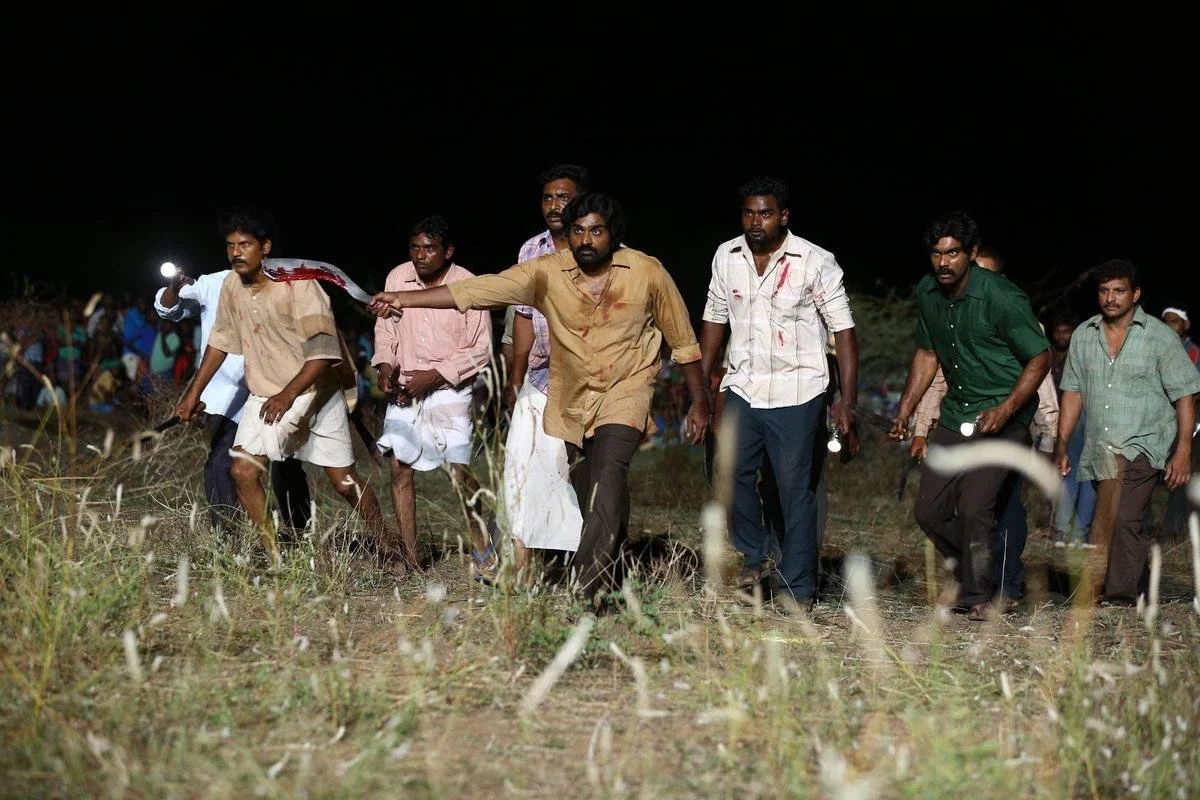
A still from Viduthalai 2 (2024).
Through films like Viduthalai, Hazaaron Khwaishein Aisi, Virata Parvam, and more, Marnina (Avirup) explores how portrayals of the Naxalite Movement in Indian cinema confront the many under-represented fractures of our democracy.
A brief scene in Vishal Bhardwaj’s Matru Ki Bijlee Ka Mandola (2013) depicts a gathering of farmers reading a pamphlet issued by Maoist groups, expressing solidarity with their struggle against corporate land acquisition. The film does not position this moment as central to its narrative, nor does it aspire to sustained political critique; rather, it conforms largely to the conventions of mainstream commercial cinema. Yet, this casual inclusion of Maoist presence within its imaginative rendering of rural India is fascinating.
Similarly, in Koratala Siva’s Acharya (2022)—starring Chiranjeevi and Ram Charan—Naxalites function as a subdued narrative device, confined to a simplified image of armed actors defending the land rights of the rural underprivileged. There is little engagement with the historical, political, or ideological complexities of the movement. The individiuals are not portrayed as subjects of any further ideological exploration.
These instances reflect the broader positioning of the Naxalite Movement within Indian cinema, where, rather than engaging with the movement as a stable political formation or attempting a systematic documentation of its historical trajectory, filmmakers have often mobilised it as a narrative and symbolic device to explore questions of justice, ideology, violence, and the human costs of resistance. In this sense, the movement functions less as a subject of representation and more as a framework for interrogating the ethics and consequences of political dissent.
But there has been political cinema in India that has engaged with these concerns more directly and rigorously, placing the movement at the centre of its narrative, to examine the deeper tensions and contradictions inherent in radical politics, and the conditions that produce said politics. These filmmakers have turned to the oxymoron of the world’s longest-running insurgency within the world’s largest democracy. While the commercial fates of these films have varied, there is much to learn from how different generations of directors grappled with the impact of the Naxalite Movement, and what stories they have chosen to tell through it.
Rarely is the question of why people take up arms asked; and when it is, the answer is often condescending: They are too naïve to recognize their own interests. This reasoning denies the subaltern agency, reducing them to objects of pity or rehabilitation, rather than subjects of history.
Starring Mithun Chakraborty and Seema Patel, Khwaja Ahmad The Naxalites (1980) is among the early stories that brought the movement to the big screen. Its editing is rough, and the technical execution modest, yet the film tells a simple, compelling story: Individuals from varied backgrounds (most notably a homeless young man shaped by a past full of injustice) are drawn into the movement as a form of moral redress and personal reckoning. Today, very little information about the film remains, and only a low-quality copy survives on YouTube. Its significance lies not in obscurity but in its early attempt to bring the Naxalite question to popular cinema. Though it differs greatly from later treatments like Chakravyuh or Viduthalai, The Naxalites features a common narrative device: the “Sheltered Protagonist,” or, as some screenwriters call it, the “Cabbagehead”, ie, a character who discovers the world of the story as the audience does.
The recurring presence of this archetype in political cinema is neither accidental nor a sign of creative laziness. It is a conscious choice shaped by the politics of perspective. Most viewers, long accustomed to mainstream reporting (both fictional or factual), may recognize the term “Naxalite,” yet the stories they encounter almost always originate from the State’s point of view. Within that dominant frame, Naxalites are often depicted as remnants of a bygone ideology, insurgents obstructing the national project of development, even as that very project displaces the communities the movement claims to protect. The figure of the rebel as a disruptive anachronism has become so normalised that we rarely see portrayals of those who, driven by conviction or desperation, abandon ordinary life to engage in a prolonged armed struggle against one of the world’s most powerful states. Their motives are either erased or flattened into the caricature of a deluded, anti-development antagonist.
In his 1961 book The Wretched of the Earth (1961), philosopher Frantz Fanon anticipated this kind of representational bias. Writing on colonial violence, he notes how the French Colonial media—serving the interests of the ruling class—treat the violence of the oppressed, especially during the Algerian War of Independence, as an aberration, as if it erupts unprovoked in an otherwise orderly society. What is erased, Fanon argues, is the long history of systemic brutality that gives rise to such outbursts. Though Fanon wrote in a colonial context, his insights translate readily to postcolonial India. Here too, the violence of insurgent peasants and Adivasis is often stripped of historical cause. The violence perpetrated by the State and society, through land dispossessions, corporate alliances, or feudal patronage, disappears from view. Rarely is the question of why people take up arms asked; and when it is, the answer is often condescending: They are too naïve to recognize their own interests. This reasoning denies the subaltern agency, reducing them to objects of pity or rehabilitation, rather than subjects of history.
For any filmmaker or scholar seeking to engage seriously with the Naxalite Movement, the question of why individuals join becomes central and unavoidable. This is where the audience surrogate comes into play. The protagonist’s initial ignorance mirrors that of the viewer, and their gradual political awakening provides a pathway for audiences accustomed to the mainstream’s moral framing. This device is not unique to political cinema; it is also common in fantasy, where a novice hero learns the rules of an unfamiliar world alongside the audience (think Harry Potter, Percy Jackson, or Ben 10). Both Prakash Jha in Chakravyuh (2012) and Vetrimaaran in Viduthalai (2023-24) employ this narrative structure, though with very different ideological intentions. In Chakravyuh, Kabir, a young software engineer infiltrating a Naxalite group as a police mole, undergoes a slow reversal after witnessing state atrocities against Adivasis. In Viduthalai, Kumaresan, a newly-appointed constable, discovers the brutality of his own comrades through direct encounters and the testimonies of others.
Yet the function of this trope diverges between the two films, revealing the two filmmakers’ distinct political and aesthetic sensibilities. Chakravyuh presents the Naxalite movement mainly as a moral struggle for social and economic justice by groups (Adivasis, rural Dalits, etc) who have been pushed out of the framework of liberal democracy. His radicalism, while earnest, remains confined to reformist ideals, portraying injustice as something that can, in principle, be rectified by a just state (particularly good officers). The film stays focused on documenting the immediate injustices faced by marginalised communities like socio-economic deprivation, land dispossession, police violence, and economic exploitation by corporations and local landlord-esque figures. However, it rarely engages with the ideological reasoning behind the insurgency.
Vetrimaaran, by contrast, approaches the subject from a Marxist perspective in his two-part film Viduthalai, making the political rationale of the movement central to the narrative. Through the dialogues of his characters, their choices, and the narrative voice, he foregrounds the intellectual and political reasoning that motivates people to join the insurgency. This allows the audience to see how the insurgency is both a response to oppression and a deliberate, and ideologically informed struggle. Jha’s cinema observes events; Vetrimaaran’s interrogates them. Where Jha’s style recalls the journalistic clarity of Arundhati Roy’s Walking with the Comrades (2011), Vetrimaaran allows social conditions and political consciousness to organically emerge together.
When Vaathiyaar and Comrade KK mobilise agricultural labourers to demand fair wages, the landlord enlists men from his own caste in neighbouring villages to undermine the strike. This is not a dramatic rupture, but a gradual unveiling of how social hierarchy reproduces itself, through alliances of caste, control of labour, and the threat of force.
For comparison, filmmakers like Anubhav Sinha take a more declarative approach: in Article 15 (2019) and Mulk (2018), political arguments are often spelled out in monologues or courtroom speeches, leaving little to emerge from the lived realities on screen. Sinha’s films are characterised by many such long monologues by his protagonists, explaining their frustration with the exploitative nature of society. This is observed in SP Ayan Ranjan’s (Ayushmann Khurrana) burst of anger in Article 15, after realising the extent to which his own officers are taken over by caste ideology. Sinha is disseminating his personal political vision through these monologues, and the audience is being told directly what his politics are. Sinha’s antagonists also become a medium for dissemination of political discourse, specifically of how Sinha views the conservative or right-wing elements in Indian society.
Back to Viduthalai: Part 1 of Vetrimaaran the film begins with a train derailment, which is blamed on the militant group Makkal Padai (People’s Army), who are opposing the displacement of a hill village for a mining project. The incident leads to a counter-insurgency effort by the government to capture the group’s leader, Vaathiyar Perumal (Vijay Sethupathi) called Operation Ghosthunt. We witness the story through the perspective of Kumaresan (Soori), a newly recruited constable posted to the operation. As the crackdown intensifies, he witnesses systematic custodial torture and mass arrests. The film’s first part closes with evidence of custodial atrocities surfacing. The second part opens with the police escorting the arrested Perumal through forest terrain. Perumal recounts his transformation from a schoolteacher into a revolutionary following the killing of Karuppan, a Dalit farm labourer who was lynched along with his partner after the police colluded with landlords to enable an extrajudicial murder. This betrayal of legal justice radicalises Perumal, who is subsequently mentored by Comrade KK, a trade-union organiser. Through labour struggles and unionisation efforts in a sugar factory, Perumal’s politics evolve from reformist resistance to armed struggle after KK’s assassination, leading to the formation of Makkal Padai. In the present, Perumal reveals secrets about the train derailment. The film closes with Perumal's execution in a staged encounter and subsequently Kumaresan rejecting the police apparatus altogether as a final moral stand.
In his film(s), Vetrimaaran shows how caste, class exploitation, and resistance to that exploitation takes shape in rural India, such as the Brahmanical practice of “Right of the First Night” in Viduthalai 2. Unlike Article 15, caste and class are not articulated through expository dialogue, but embedded in the film’s very texture. Vetrimaaran reveals these structural hierarchies in the rhythms of everyday lives of his characters that quietly map the architecture of power. When Vaathiyaar and Comrade KK mobilise agricultural labourers to demand fair wages, the landlord enlists men from his own caste in neighbouring villages to undermine the strike. This is not a dramatic rupture, but a gradual unveiling of how social hierarchy reproduces itself, through alliances of caste, control of labour, and the threat of force. Even the reactions and body language of the characters bear the imprint of a deeply-entrenched order.
A similar tension permeates the sugar factory sequences, where fiery exchanges among workers, minor acts of betrayal by the factory owner's loyalists, and the apathy and ignorance of the police work together to build a subtle tension that finally explodes with KK’s death. By the time landlords and industrialists unite to isolate KK and Vaathiyaar, or when the two debate the morality of armed resistance, the audience requires no explicit commentary. The political stakes of the moral debate have already been embodied in the characters’ lived realities.
The killing of Karuppan shortly after his surrender, encouraged by a young Vaathiyaar’s faith in procedural justice, feels less like narrative shock, but rather, the inevitable consequence of trusting a system designed to punish dissent. The death of Vaathiyaar’s comrades follows the same tragic logic. These are not contrived tragedies inserted for emotional effect; they are structural outcomes of the world that Vetrimaaran wants to build, where resistance is criminalised and compromise is fatal. In this way, Vetrimaaran transmutes ideology into sensory and emotional experience.
Despite their stylistic and ideological differences, both Chakravyuh and Viduthalai remain products of and for the commercial mainstream. Their directors have used popular cinema as a kind of Trojan Horse to smuggle in questions of justice and revolt, and thrust perspectives and themes that are usually ignored or pushed to the margins in the national zeitgeist. Each, in its own way, enacts what Fanon described as the “reclamation of the Ideological Space”: the struggle to wrest the camera’s gaze from the loudest most dominant voices and turn it toward the margins.
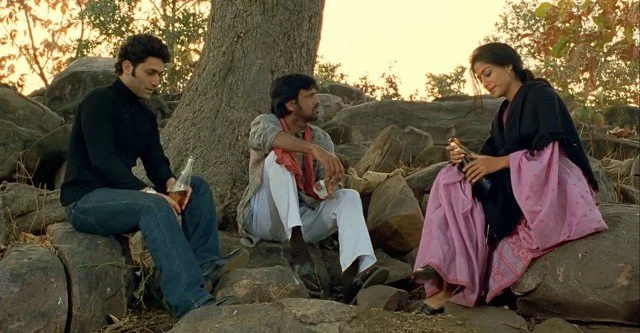
A still from Hazaaron Khwaishein Aisi.
Yet another strategy has emerged in films like Hazaaron Khwahishein Aisi and Virata Parvam. In both projects, the politics of their makers are evident, not as mere thematic undertones but also undercurrents within the narratives that shape the characters and the story.
Directed by Sudhir Mishra, Hazaaron Khwahishein Aisi (2003) opens with a Star Wars-like introductory crawl, situating its story in the era of the death of the Nehruvian dream. The Naxalite movement, in this framework, becomes an instrument through which Mishra examines the character and bond of his protagonists, Siddharth (Kay Kay Menon) and Geeta (Chitrangada Singh). Siddharth is the son of a judge, who emerges from an upper-middle-class background, and yet, is deeply drawn towards the Naxalite movement that had taken root in Bengal and Bihar. His commitment to its political cause is neither naive nor impulsive; rather, it stems from a familiarity with Marxist and particularly Naxalite literature. His ideological grounding ensures that Siddharth is no passive vessel awaiting political awakening; rather, he enters the narrative already aware of the structural injustices that define rural India.
Alongside him stands Geeta, a woman from a middle-class family, unconnected to any overt political lineage. Her involvement with the movement is not born of theory but of her love for Siddharth and empathy for the suffering of the rural poor. Through her, the film gestures towards an emotional, even moral, entry into the political. Yet this sentiment, rather than revolutionary praxis, becomes the dominant register through which politics is mediated. Shiney Ahuja plays the third protagonist Vikram, who is the son of a Congress politician, and thus, a political insider.
Within the film’s triptych of characters, there is no cabbagehead figure, no surrogate through whom the audience encounters the violence of the state or the hierarchies of society for the first time. Hazaaron Khwahishein Aisi does not attempt to construct a counter-narrative to the mainstream discourse on revolution. The injustices faced by the marginalised appear, but only in passing, framed as the backdrop against which personal emotions unfold.
Their directors have used popular cinema as a kind of Trojan Horse to smuggle in questions of justice and revolt, and thrust perspectives and themes that are usually ignored or pushed to the margins in the national zeitgeist.
In comparison, the period drama Virata Parvam is loosely based on the life of Thumu Sarala, a teenage girl who quits her studies to join the Naxalite cause in Telengana. The film features Vennela (Sai Pallavi), a village woman who is no outsider to caste or class oppression—she inhabits it. Her understanding of the social order does not arise from ideology but from lived experience. Vennela is born—both figuratively and literally—in the middle of the state’s conflict with Naxalism, and grows up as a direct witness to the routine excesses of the police. Her earliest encounter with the Naxalites occurs in a context where they intervene to protect her and her village from state violence.
Hence, if Siddharth’s politics from Hazaaron Khwahishein Aisi is textual, Vennela’s is embodied. Yet, in both films, the cinematic gaze privileges the emotional and the romantic over the political. The result is not a denial of oppression, but its quiet subordination to the affective drama of those who witness, love, and endure it.
The characters in Hazaron Khwahishein Aisi emerge from markedly different social locations, each driven by distinct ambitions and ideological compulsions to align with the Naxalite movement. Yet, despite these divergences, their trajectories converge toward a shared fate: variations of a single archetype. In my view, Hazaron Khwahishein Aisi’s two male protagonists—Siddharth and Vikram—embody contrasting yet complementary facets of the director Mishra himself. Siddharth represents the radical idealist within Mishra, the part that seeks rebellion and transformation, while simultaneously exposing the privilege that makes such rebellion possible. This privilege, in turn, finds its mirror image in Vikram, the consummate insider, navigating corridors of power with discomfort and disgust. Mishra, like Vikram, is no stranger to the political establishment, as the grandson of Dwarka Prasad Mishra, the fourth Chief Minister of Madhya Pradesh and a Congress stalwart.
This dual inheritance—of empathy for the marginalised and intimacy with privilege—produces a complex ambivalence within Mishra’s cinematic vision. He identifies with the oppressed, yet cannot wholly belong among them; he recognises the mechanisms of privilege yet remains alienated within its structures and Vikram’s persistent dissatisfaction, even amidst proximity to power, becomes an externalisation of this estrangement. Hence Hazaron Khwahishein Aisi may be read as Mishra’s self-reflexive narrative—something he hints to in the film’s introductory crawl.
At the other extreme of the spectrum is Virata Parvam: There are many divergences from Sarala’s true story that inspired the film. What remains on screen is not her biography, but rather an interpretation influenced by the convenience of filmmaking. Vennela does not have a divided consciousness like Siddharth. As a gesture of reclaiming narrative space and articulating the lived realities of those who have historically been spoken about but rarely heard, the first act of Virata Parvam can be interpreted through a Fanonian lens, much like Viduthalai or Chakravyuh, too.
This dual inheritance—of empathy for the marginalised and intimacy with privilege—produces a complex ambivalence within Mishra’s cinematic vision. He identifies with the oppressed, yet cannot wholly belong among them; he recognises the mechanisms of privilege yet remains alienated within its structures.
Both Hazaaron Khwahishein Aisi and Virata Parvam examine the same wound: the personal cost of being a soldier of the Naxalite movement and how it moulds individual lives. It is the grand pressure of history on personal becoming.
Can these movies be interpreted as authentic investigations into the Naxalite Movement, its beginnings, its breaks, and its aftermath? I would argue that the answer is yes. Both conduct a subdued but tenacious analysis of the Movement, viewing it as a lived experience filtered through close human ties rather than as a historical abstraction; their focus is on the impact of revolution on the private sphere, the gradual deterioration of love, faith, and conviction, when juxtaposed with the unstoppable demands of struggle, rather than sociological reporting or ideological propaganda.
The rise of the Movement is unmistakably presented in both movies as a response to systemic injustice. These stories are set against a moral backdrop of poverty, caste oppression, and state violence. Thus, they resist the simple categorization of ‘propaganda’; their political inclinations are clear but never overly joyous. They are more interested in the revolution as a cost rather than as a spectacle. Their protagonists’ lives are replete with echoes of the question that haunts them: What does one lose by choosing resistance?
In one of the early scenes in Hazaaron Khwahishein Aisi, Siddharth tries to convince his friends in Delhi to leave their comfortable city lives and join the revolutionary fight in rural Bihar. His belief is strong and almost moralistic. He views those who hesitate with thinly veiled condescension, believing their reluctance to be born out of cowardice. For Siddharth, choosing comfort over the revolutionary cause feels like a betrayal of ideology. What he doesn’t realise is that such surrender takes a heavy psychological toll, one that will eventually weaken the very convictions that support his beliefs.
This scene sharply contrasts with two later moments, both expressed through Siddharth’s letters to Geeta. These ‘letter scenes’ appear as voice-over montages and serve as reflective pauses in the story, showing how Siddharth’s revolutionary idealism slowly fades under the weight of real-life experiences. In the first letter, written from Bhojpur, Siddharth expresses shock and despair at the divide between Delhi and rural India, a divide so wide that it feels like a temporal divide instead of a geographical or cultural one. Living in Delhi and then in Bhojpur feels like living in two different eras. He laments about exploitation so brutal and well-entrenched that it exceeds any anticipation based on intellectual analyses. This experiential awakening leaves him unable to disengage from the situation in Bhojpur. Siddharth admits that his political imagination underestimated the vastness of what he aimed to change. The letter does not show overt regret, but a subtle disillusionment runs through its words. His message highlights the limits of his ideological preparation, he expected injustice, but not its intensity, nor its persistence over centuries.
This realisation deepens later in the same letter, where he recounts a troubling event, the sexual assault of a Dalit woman by the local landlord’s (Thakur’s) son triggered an agitation that initially appeared to his naive mind as a moment of imminent revolt, only for the collective anger of the villagers to dissipate when the landlord suffers a heart attack. Despite their outrage the villagers are compelled—by a compassion that is seemingly beyond Siddharth’s comprehension—to prioritise saving the life of the very landlord whose family had exercised oppressive authority over them for generations.
In this moment, Siddharth faces the contradictions of caste and servitude that challenge his revolutionary viewpoint: The villagers’ compassion for their oppressor disturbs him, and it complicates the simple ideas of right and wrong through which he views history. His use of the word “naïve” indicates a small but important shift: an instance of intellectual humility. He starts to understand that the realities of Bhojpur are more complicated than his ideological language can express. He finds that revolution cannot be theorised from the cafés of Delhi nor forced upon people still tied to old hierarchies of obedience and faith.
Siddharth’s letters to Geeta highlight his gradual loss of certainty. His experience in Bhojpur shows the gap between revolutionary wishes and social complexity. What starts as passionate zeal in Delhi slowly turns into self-doubt, a realization that his grasp of struggle was theoretical, untested, and perhaps even presumptuous.
These doubts finally culminate into action in the climax of the film, which shows Siddharth at his most broken, following the depiction of the Naxalite movement’s brutal suppression during the Emergency. The weight of what he has witnessed—police atrocities, the movement’s shift into desperate politics, and the physical and mental torture endured by Geeta and his comrades—lead to collapse. Faced with the certainty of being caught, he escapes, hoping to reach his father and get rescued from Bhojpur.
This escape completes a sad circle. The young revolutionary who once scolded his peers for clinging to bourgeois comforts now seeks help from the same bourgeois father. What he once saw as moral weakness becomes, in the end, a human reaction to the unbearable. It is not weakness, but exhaustion, an existential breakdown caused by the clash between revolutionary ideals and state violence. Siddharth’s failure is not just personal—it represents a generation that entered the struggle without fully understanding the consequences of its beliefs.
In his later letters to Geeta, written from London, Siddharth's tone changes significantly. He stops describing the movement and its surroundings. Instead, he looks inward, facing his own feelings and failures. He admits he is disappointed that “the world hadn’t changed in the ways he had wanted it to.” Yet, he finds some comfort in knowing that Geeta and Probir-da—his mentor and friend—still believe in the struggle. His words carry a quiet resignation, a realisation that he may never go back. The uncertainty in this letter, mixed with self-awareness and weariness, hint at disillusionment and a sense of shame. This guilt feels different from what he expressed in his prior letters: Earlier, his regret focused directly on Geeta; now, the wound is deeper, ideological. His failure isn’t about love, but about belief. He betrays not an individual, but a cause.
This pattern of valuing the abstract over the human repeats in Siddharth’s political and moral journey. In his first letter, he mentions a Harijan girl, a victim of sexual assault, only in passing. Her pain is not a source of empathy but a trigger for revolution. Her suffering disappears inside the larger story of historical change and when society fails to transform, Siddharth mourns the failed revolution more than the violence itself. As the film shows, his loyalty is not to people, but to the concept of revolution. This conflict becomes clear in his second letter when he writes, “The world hasn’t changed in the ways I had hoped… I know you are right when you say that no one can rape a Harijan woman so easily anymore... They might get a certain body part chopped off. It’s a leap of 5000 years… But still—”
The young revolutionary who once scolded his peers for clinging to bourgeois comforts now seeks help from the same bourgeois father. What he once saw as moral weakness becomes, in the end, a human reaction to the unbearable.
Siddharth recognises real progress made through collective resistance. Still, he feels unsatisfied. The reforms he sees don’t match his ideology. For him, the revolution is no longer a path to justice—it has turned into an abstract goal in itself. The suffering masses, once seen as the beneficiaries, are now secondary to the purity of the ideal.
Through the character arc of Siddharth, Mishra critiques the idea of the intellectual approach to revolution disconnected from the masses. It’s a critique that addresses both political and personal dimensions. The film reveals the risks of a revolutionary mindset based on theory isolated from political practice. This attitude, common especially in student movements, can lead to quick disillusionment: revolutions that are envisioned as straightforward or immediate changes often falter against the complexities of human experience. Mishra’s critique aligns with observations by Kobad Ghandy, who pointed out that an “ideological absolutism” can alienate the revolutionary project from the very people it aims to liberate. Through Siddharth, Mishra highlights the weariness of a generation that wanted to change the world but struggled to blend revolution with empathy and praxis.
But Mishra does not deliver a unidimensional moral judgement that dismisses revolution as a futile or romanticised pursuit. Instead, while critiquing Siddharth’s dogmatic rigidity, he simultaneously offers an alternative through Geeta. This alternative is not merely ideological but deeply human. This is where I believe that the two protagonists represent two distinct but interdependent facets of Mishra’s own self; and Geeta, by extension, embodies his ideal woman.
This claim rests on two interrelated grounds. The first is almost self-evident: If both Siddharth and Vikram are drawn to Geeta, then her role transcends that of a narrative accessory. In a film as personal as Hazaaron Khwahishein Aisi, such narrative convergence cannot be accidental but symptomatic of authorial affection. The second, subtler, basis for this claim emerges from a close observation of how Mishra frames and treats Geeta throughout the film. Her character is endowed with a moral gravity that no other figure in the narrative possesses; she is the emotional and ethical centre around which the film’s political tensions revolve.
My reading of Geeta’s treatment within Mishra’s film reveals a subtle but persistent narrative warmth, a gaze that is gentler, more humane, and untainted by the political cynicism that surrounds her male counterparts. Throughout the film, Geeta approaches others as living realities, with an uncalculated empathy that neither ideology nor disillusionment can erode, be it Siddharth who’s so absorbed in his revolutionary abstraction that he fails to love her, her husband whom she cannot love yet treats without contempt, or the villagers whose lives she encounters not as data or symbols of social classes. Here lies her fundamental distinction from Siddharth: He views the people of Bhojpur as abstractions within a socio-political schema, but Geeta sees them as real people with agency, contradictions, and dreams.
For Althusser, the individual was a function of structure: a cog in the ideological machinery of society, defined and limited by class and other social positions. Transformation of one’s political consciousness in this framework was possible only through a change in one’s social position, or else the potential of said political consciousness was bound by the ideological framework that best suited their class position.
This distinction can be illuminated through a philosophical digression, one that juxtaposes Jean-Paul Sartre and Louis Althusser, two towering Marxist thinkers of the twentieth century. For Althusser, the individual was a function of structure: a cog in the ideological machinery of society, defined and limited by class and other social positions. Transformation of one’s political consciousness in this framework was possible only through a change in one’s social position, or else the potential of said political consciousness was bound by the ideological framework that best suited their class position.
Sartre, by contrast, as an existentialist, insisted on the irreducibility of human agency, the capacity of individuals to act against the grain of their social instincts. He pointed to figures such as Engels (an industrialist who championed the cause of workers) but this can be extended to Lenin (who came from an aristocratic family) and even Subhash Chandra Bose (the son of a loyal bureaucrat of the Raj), as evidence that one’s political consciousness could transcend the boundaries determined by their class origins or social position.
Siddharth’s second letter to Geeta invokes what he calls the “great mystery,” the element of human unpredictability he could not account for earlier, it is precisely this element of agency. When the Harijans of Bhojpur choose to aid their landlord rather than celebrate his death, their act resist easy ideological explanation which Althusser might reduce to ideological reproduction; Mishra, through Siddharth’s bewilderment, exposes the inadequacy of such reductionism. He attempts to point out—in echo of Sartre—that although people generally act within ideological bounds, but their actions are not wholly consumed by them.
In this sense, Siddharth himself becomes an ironic illustration of this human agency: a judge’s son who defies his class destiny to join a revolutionary movement. Yet, his failure lies in his abstraction of the very people he wishes to liberate. Geeta, conversely, embodies Sartre’s faith in human freedom. Her politics arise not from dogma but from empathy, from her proximity to lived suffering. For her, ideology is a means and not an end. The reforms she witnesses are not dismissed as partial victories; for her, they are gestures of transformation rooted in humanity rather than a pursuit of utopia.
I believe that both Siddharth and Vikram, though seemingly opposed ideologically, are bound by a similar blindness. Each is trapped within his respective absolutism: one ideological, the other material. Both, in their own way, dehumanise those around them: Siddharth through revolutionary idealism, Vikram through cynical opportunism. Mishra’s film, then, becomes a study in contrast between two and not three different paths, the contrast between apathy and empathy, between the cynical and the humane.
In the final reckoning, it is Geeta’s endurance and refusal to abandon the struggle despite immense personal loss that signals the film’s ethical core: a synthesis of humane empathy and political conviction. She has come to love the people as equals, not out of naivety or resignation, but as an ethical commitment. Through her, Mishra seems to argue that true revolutionaries must be animated not only by conviction, but by compassion, too. Without the latter, the revolution risks becoming indistinguishable from the tyranny it seeks to overthrow.
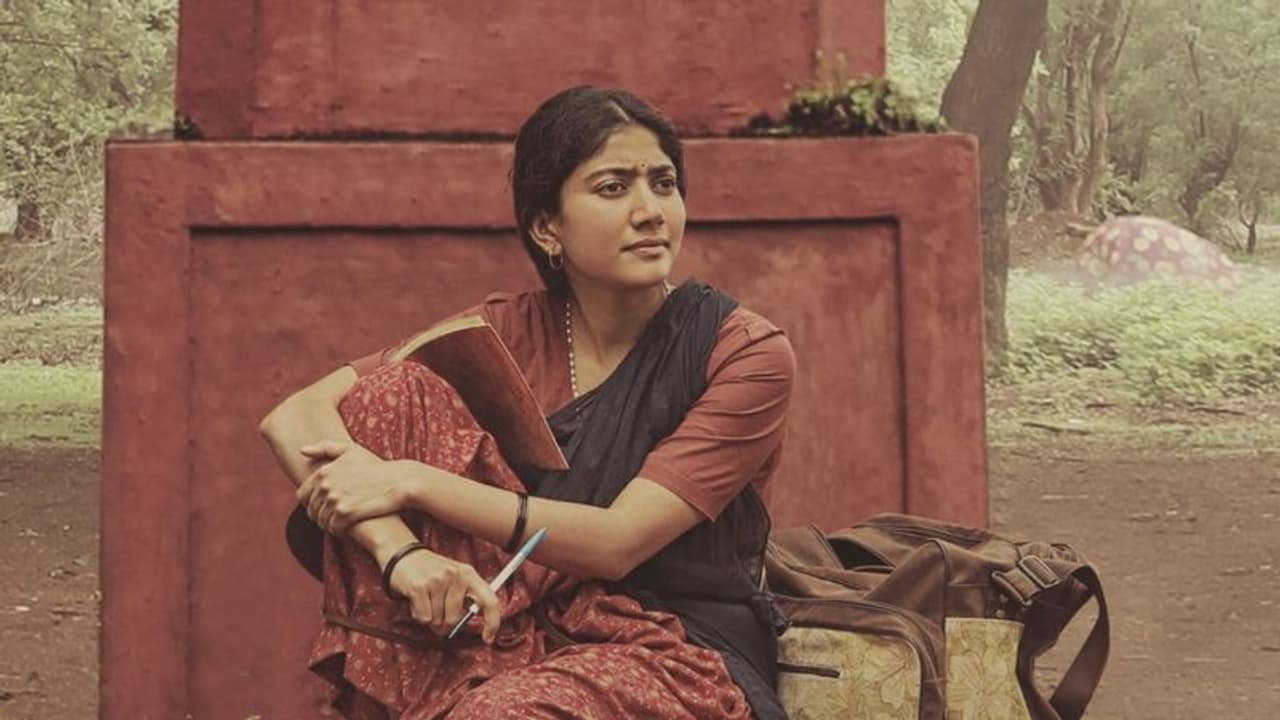
A still from Virata Parvam
Hazaaron Khwahishein Aisi is composed of a depth and complexity that might be lacking in some of the other narratives about the movement, such as Virata Parvam. Instead, Udugula’s film instead raises a more practical question within a poetic romantic story. The film sets its tone early on with a powerful opening scene that shows Vennela’s birth amid a shootout between the Naxalites and the police. This moment not only hints at her later involvement with the movement, but also effectively introduces the film’s social and political context.
Warangal, the film’s setting, is portrayed as a war zone during that time. The opening sequence skilfully conveys this by contrasting something both sacred and ordinary— childbirth—with the violence of armed conflict. The perspective shifts between childbirth and gunfire, where each effort to bring life into the world is followed by a scene of violent death. Here, the war is not a disruption, but part of everyday life, woven into the ordinary.
However, this sense of tension and continuity does not last long. The film struggles to maintain the contrast between the everyday and the catastrophic. Later portrayals of conflict feel disconnected from the villagers’ daily lives, as if they belong to separate worlds—one of daily routines, and another of sporadic violence. While the opening shows clarity and skill, the subsequent scenes lose that precision. Consequently, the haunting image of the setting as a war-torn landscape gradually fades, especially in the first half of the film.
This trend is not new for Udugula. His debut feature, Needi Naadi Oke Katha (2018), also had trouble maintaining the environmental sincerity needed to ground its story. In Virata Parvam, the issue becomes more noticeable when Vennela starts forming a para-social relationship with Ravanna. The film’s earlier promise of blending love, ideology, and the reality of conflict shifts to a more conventional romantic focus, reducing the world of struggle to little more than background noise.
Vennela’s admiration for Ravanna starts not through direct interaction but through his written works (pamphlets, manifestos, and revolutionary texts). She sees, or perhaps imagines, in his writings the hope for a better world. However, the film struggles to place this admiration in a believable social context. The passion that should come from witnessing systematic oppression feels abstract, almost decorative, as the film rarely takes the time to show with any detail the socio-economic and caste-based exploitation fuelling the Naxalite movement.
This gap is significant and implies Vennela’s idealism to mere infatuation. Without evident structural violence, she comes off less as a woman driven by revolutionary beliefs and more as a naive romantic captivated by the idea of rebellion.
In Virata Parvam, police brutality appears as a rare, isolated incident rather than a part of daily life. The film’s failure to maintain the tension presented by the violence and authority of its opening scene weakens its larger ideological foundation.
The comparison to Viduthalai is telling. In Vetrimaaran’s film, both Tamilarasi and Lakshmi exist within the system’s cruelty, facing its hierarchies and humiliations. Their suffering gives weight to their choices. In Virata Parvam, however, police brutality appears as a rare, isolated incident rather than a part of daily life. The film’s failure to maintain the tension presented by the violence and authority of its opening scene weakens its larger ideological foundation.
The issue worsens as Vennela’s political awakening stays linked to her fixation on Ravanna. Her revolutionary dedication seems copied from love, instead of genuine belief and she rarely connects with the cause beyond its link to him. The occasional outbursts of ideological speech—where she cites Marxist texts or comments on love’s role in rebellion—feel jarring and unearned. This reflects a screenplay struggling to add political weight to a romance that lacks grounding. Her intellectual shift is neither demonstrated nor hinted at. It simply happens because the plot requires it.
The contrast with Viduthalai highlights this difference, where Tamilarasi’s love for Kumaresan grows gradually, shaped through care and shared vulnerability amidst violence. Their closeness flourishes alongside the political struggle. In Virata Parvam, love is presented as an abrupt statement, disconnected from real experiences. When the police raid Vennela’s village and assault her father for supposed Naxal ties, Ravanna steps in to help the villagers. Instead of serving as the first link between them, this moment feels out of place: Vennela is in love and has already made her choice. Her decision to end her engagement and join Ravanna in the forests seems narratively premature and emotionally unconvincing.
The outcome is a romance lacking ideological depth or narrative flow. Where Viduthalai manages to blend personal warmth with political urgency, Virata Parvam fails to do convincingly. What could have delved into how love intersects with revolution, how intimacy and ideology shape each other, falls apart into a series of gestures that neither touch the heart nor provoke thought.
Virata Parvam stays true to its principle of beginning and ending with intensity. The final clash between Vennela and Ravanna reflects the brilliance of the film’s opening scene, both visually and thematically. It captures the tragic cost of war, particularly a long-lasting one, and the decay of idealism due to the burdens of conflict. Ravanna, a soldier shaped by nearly a decade of war, exemplifies this change within himself caused by his struggles. His paranoia is justified, stemming from a constant need for vigilance, a psychological residue of violence that lingers long after the fighting stops.
This paranoia becomes even worse due to immediate betrayal. Within hours, Ravanna and his fellow soldiers face treachery from two people connected to Vennela: Sammiah, who had once recruited her, and the police insider she had saved. When the police spread a forged letter claiming there is an informant in their group, it is no surprise that suspicion grows and Vennela becomes the target. In this moment, the film expresses one of its main ideas: War, no matter how just its cause, has an unavoidable human cost. This film reveals that this cost transforms its participants in ways that are not as noble as the cause itself.
What unites them stories is their refusal to ignore a part of India that rarely finds itself in the centre of such media attention. Each film discussed here carries its own archive of contradictions, interpretations, and analytical speculations.
The moment of judging Vennela’s innocence is where Ravanna begins to break under the weight of paranoia and necessity. He momentarily gives up the ideological vision that once defined him much like Siddharth, who also gave up his ideological dreams in the climax of his film. The irony is striking in this case because he rejects the idealism he admired in Vennela when she chose to save a stranger over herself during a police shootout. While the psychological pressure from the police sets the stage for tragedy, Ravanna’s breakdown is as much about his inner conflict as it is about external influences. However, unlike Siddharth in Hazaaron Khwahishein Aisi—who falls victim to the state’s coercive power and completely forgoes his revolutionary zeal—Ravanna becomes a target of manipulation, his mind subdued before his body or will and his misjudgement is a temporary defeat (albeit one that will haunt him forever).
The emotional weight of the confrontation sequence comes not from the plot but from the actors’ performances. Pallavi and Daggubati maintain the scene’s intensity with unyielding precision. The viewer gets pulled into the tragic cycle of misunderstanding, betrayal, and loss, creating a Shakespearean cinematic effect of emotional immersion. Udugula’s scenes do more than invite empathy: They demand participation. The audience feels an almost physical urge to step in, to stop Ravanna’s actions, to change the outcome. Still, this participatory energy, so alive during moments of crisis, is uneven throughout the film. It shines brightly but struggles to maintain its momentum, like a moment of moral clarity lost in confusion.
This sequence takes a dip at Ravanna’s confession of love. The declaration comes without any previous indication and hence feels unearned, and even out of place. The film offers barely shows a deepening bond between Ravanna and Vennela beyond her idealised view of him; rather their exchanges are limited to brief meetings that cannot support such a claim. The film also spares very little screentime for the pair to interact with each other since most of it is dedicated to Vennela’s search for Ravanna. If the climax had centred on Ravanna’s guilt for having killed a loyal comrade, the ending would have resonated more deeply. This conclusion would have maintained the integrity of his character, a man whose commitment to revolution overshadows personal feelings.
Udugula aimed to humanize Ravanna, tracing a psychological journey from revolutionary zeal to emotional vulnerability. Yet, without narrative support, the change feels forced rather than earned.
Udugula, Mishra, Jha and Vetrimaaran have all used the Naxalite Movement to tell their own stories, some personal, some political. What unites their stories is their refusal to ignore a part of India that rarely finds itself in the centre of such media attention. Each film discussed here carries its own archive of contradictions, interpretations, and analytical speculations. I do not approach the movement with any predetermined ideological affinity, nor can we deny that the Naxalite project is at its lowest ebb since its inception. It hardly shapes the nation’s political mood or occupy its cultural imagination.
Yet, as both the state and many of its critics reluctantly acknowledge, the Naxalites still stand (however diminished) as a force that articulates the unaddressed claims of those historically excluded from the nation’s democratic processes: The Adivasis of Bastar, the Dalits of Bhojpur, and countless others who rarely find representation in both governance and cultural production. Their current marginality does not diminish the structural injustices they point to; if anything, it sharpens them. To speak of them, therefore, is not an indulgence, it is a political and ethical necessity especially when a section of society becomes so absent from our collective imagination that it must resort to violent means merely to be heard. The problem does not lie in their “silence,” but in our refusal to listen.
***
Marnina(Avirup) (they/them) is an independent queer writer and reviewer from Kolkata. They have written stories, poems and articles on subjects of Politics, Philosophy, and Contemporary Electoral Politics. A student of Political Science, they're interested politics, philosophy, political theory and social commentary through fiction. You can reach reach out to them through on Instagram @lacanpremi or on ishanavi2004@gmail.com.