The Storm and the Storyteller: Arundhati Roy’s MOTHER MARY COMES TO ME
Through her memoir, Arundhati Roy revisits the foundry where her courage was forged, to the mother who didn’t prepare her for success, but inadvertently trained her to withstand both adoration and hatred to determine her survival.
It’s a given that an extraordinary woman like Arundhati Roy would be birthed and honed from an extraordinary woman herself. But you see, extraordinary people create their own gravitational fields. They bend the space around them and pull everything into their orbit, reshaping the very physics of relationships. Some become suns that others revolve around, others black holes that consume everything. Mary Roy was both—simultaneously the centre that held Arundhati’s world together, as well as the force that would tear it apart.
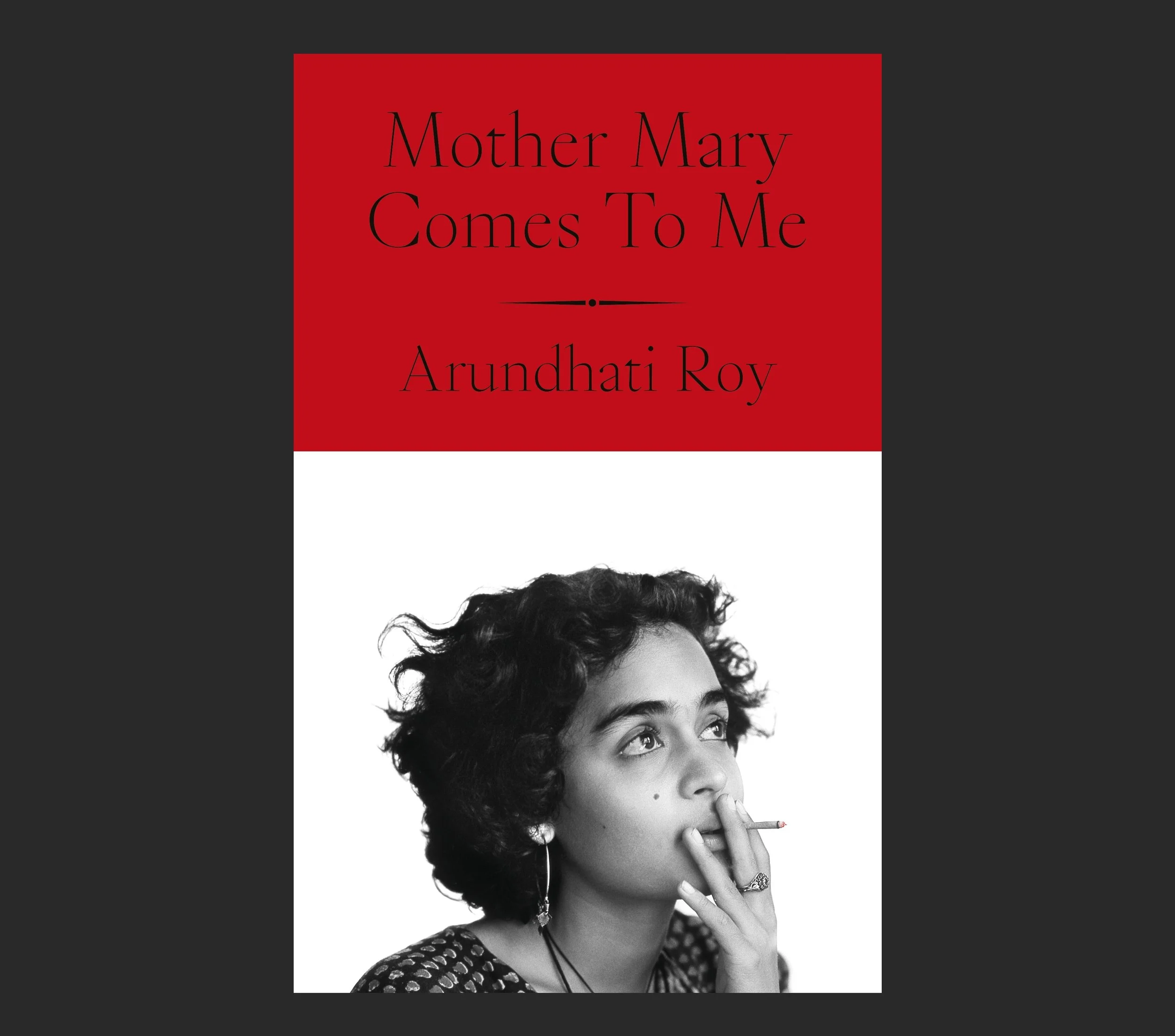
Arundhati Roy’s memoir Mother Mary Comes to Me (Penguin Random House India, 2025) arrives at a moment when Roy faces sedition charges for her political speech, when her decades of dissent have made her simultaneously extremely beloved and extremely reviled. The title is borrowed from the evergreen Beatles song “Let It Be,” where Paul McCartney sings, “When I find myself in times of trouble, Mother Mary comes to me…” It’s ironic, however, how the Mother Mary of this tale salts the wounds rather than soothes.
Through the book, Roy revisits the foundry where her courage was forged. Mary Roy wasn’t preparing her daughter for success but inadvertently training her for a life where adoration and hatred would arrive in equal measure, where the ability to withstand both would determine her survival.
Mary Roy, or Mrs Roy, as Arundhati calls her, defies easy compartmentalisation. She was the epicentre of a cult she formed around herself, one that included her two children. She was loved and dreaded in equal measures by those around her. Brilliance and cruelty shared the same foundation in her, the same hands that created could destroy with equal artistry. This was a woman fighting patriarchal structures while wielding her own forms of power over those most vulnerable to her.
Mrs Roy was shaped by her circumstances, and in turn, shaped her circumstances. Because her husband was a drunkard, she would take it out on her son, singling him out, calling her 10-year-old child a “male chauvinist pig.” Because her own father was merciless, she gave that cruelty a new life with her mothering. Because she was chucked out of her family’s property, she would successfully challenge the inheritance law of the Syrian Christian community in Kerala.
The past is a collaborative fiction between what happened and what we need it to have meant. In a way, through this memoir, Roy is negotiating with her own capacity for mythmaking, and observing how we change the people who shaped us into the stories we need them to be.
Memory is the unreliable narrator. It edits ruthlessly and embellishes shamelessly. It presents its fiction with the confidence of documentary evidence. We build entire identities on its testimonies, forgetting that recollection is always reconstruction, that every remembered moment is a story, telling itself to itself. Each wound became a weapon, each injustice a justification.
Roy approaches Mother Mary with the wariness of someone who knows well the tricks of memory. The past, after all, is a collaborative fiction between what happened and what we need it to have meant. In a way, through this memoir, Roy is negotiating with her own capacity for mythmaking, and observing how we change the people who shaped us into the stories we need them to be.
The memoir stretches from Roy’s earliest stirrings of memory to the final days with her mother. It walks through her brief foray into acting—a role as a goatherd in Massey Sahib (1985)—followed by a longer stint writing screenplays that earned her a National Film Award for In Which Annie Gives It Those Ones (1989). Then came that once-in-a-generation success with her novel The God of Small Things (1997), which overturned her career from a struggling artist to a literary superstar overnight. The memoir then opens onto her activist life: where she displays a turbulent love for a changing India, faces the relentless court and media battles that came with a public life of speaking truth to power, speaks against nuclear testing, dam projects, caste brutality, and state violence. The private storms that shaped her childhood prepared her for the public tempests of her later life.
Unlike many readers, The God of Small Things didn’t need to create a storm for me—I was already caught in my own tempest, a tumultuous relationship that would, for better and worse, remake the person I was. I was carried in those nights of fever dreams and García Márquez’s cholera haze to Ayemenem and Anjum’s Jannat Guest House, in the voice of my Roy. ‘Arundhati’ and ‘my Roy’ would become indistinguishable—a mishmash of beauty and destruction. Reading Mother Mary Comes to Me was like returning to that submerged world of intimacy and violence, the kind that clasps your finger, twirls you dizzy, hurls you against the wall, remakes you whole.
Like her characters, Roy presents herself in the memoir as limitless and fierce. She lives freely, loves fiercely, unbound by conventional constraints. Her existence straddles extremes: moving seamlessly between the most elite social circles and the harshest realities of poverty. There is no neat division between privilege and hardship in her life story; it is a continuous negotiation between them. A life seemingly abandoned to the chaotic tides of circumstance, yet meticulously constructed brick by brick, word by word. It is this interplay between surrender and control, chaos and craftsmanship, that lies at the heart of her memoir—much like her literary voice.
Mother Mary understands this terrain of contradiction intimately. In her final days, Mrs Roy uttered to the younger Roy, “There is no one in the world whom I have loved more than you.” But love, in Roy’s telling, is never simple. This was the same voice that had punctuated the author’s life with refrains of “I wish I had dumped you in an orphanage,” (82) “You’re a millstone around my neck,” (82) and “All my sickness is because of you.” (309)
The book holds both realities without trying to explain them away. Instead, Roy presents them as data points to explain the emotional ecosystem she grew up in. Roy internalised a voice that contained multitudes, that could shift from tenderness to brutality mid-sentence. Her capacity to hold space for both Mary’s love and Mary's violence, to refuse to choose between competing truths about the same person, is the same capacity that allows her to write about India. She can love the country fiercely while documenting its atrocities because her mother taught her that you can fight what you cherish; that contradiction is the constant reality of our lives.
Philip Larkin wrote in his poem This Be The Verse, “Man hands on misery to man / It deepens like a coastal shelf.” It’s a sentiment that applies to Roy’s life, too, a coastline reshaped by the waves of suffering. Her flight to Delhi to pursue higher education in architecture was to put distance between herself and the complex, traumatising gravity of her mother’s presence and insults. The hardship she would face through much of her early adult life was the price she willingly paid for avoidance.
Unbeknownst to Mrs Roy, however, she was training a daughter for a life of public scrutiny, a life where hate would always accompany adoration. But how does one live with such contradictory inheritances? How do you carry both love and damage from the same source, the source that overshadows every other?
“We either house all our ghosts, as I do, or unhouse them all, as my brother does,” (312) acknowledges Roy. Rather than exiling them, she chooses to cohabitate with her hauntings. This memoir, then, becomes her attempted exorcism—though the ghosts remain.
Far from a mawkish confessional, however, Mother Mary also contains many comic moments, hilarious in a characteristic Roy way: sharp and unexpected. For instance, during her initial days of learning Hindi, she would repeat the only sentence she remembered from school as a “reply to any question anybody ever asked… Where are you going? What class do we have today? Can I hold your hand? Subah uthke dekha to kutiiya mari padi thi, ‘When he woke up in the morning, he saw the bitch was dead.’” (74)
Later in life, when someone offered to employ her in exchange for owning everything she wrote, she would snap back, “Mere maathe pe chutiya likha hai kya? ‘Does it say “asshole” on my forehead?’” (191)
Like its author, the book is many things at once. It’s at once a writer’s diary, a chronicling of her memory. Writing of conceptualising The God of Small Things, Roy recalls that it was “Like a seed that had been lying in a drawer for years and had suddenly landed in fertile soil, I felt the first stirrings of germination.” (215) Describing her second novel, The Ministry of Utmost Happiness (2017), she notes, “The Ministry folded me into itself. It was the city I lived in. The river I swam in. Its characters crowded into my home and refused to move out.” (306)
Mother Mary is a thrilling coming-of-age journey, too. “Read this book as you would read a novel,” she tells the reader in the very first chapter. (7) And then, it is also a book about a woman’s self-examinations. I learned that day that most of us are a living, breathing soup of memory and imagination—and that we may not be the best arbiters of which is which.” (6)
Simultaneously, the story is also of a daughter recollecting her storm, her gangster of a mother, her safest and her most dangerous place: “She loved herself. Everything about herself. I loved that about her.” (326)
Her capacity to hold space for both Mary’s love and Mary's violence is the same capacity that allows her to write about India. She can love the country fiercely while documenting its atrocities, because her mother taught her that you can fight what you cherish; that contradiction is the constant reality of our lives.
Through all this complexity, Roy captures something fundamental about love, about life itself. She shows how love can blind you to one’s faults, how it doesn’t ask for perfection, how it goes beyond binary moralities of right and wrong, of saints and sinners, how it is something wilder and more dangerous than sentiment would suggest, and how it can destroy you just as much as it heals.
To quote McCartney’s song again, “Speaking words of wisdom, let it be…” Those famous words of comfort serve as a promise that Mother Mary will soothe your troubles with her wisdom. But Roy’s own Mother Mary stormed, didn’t offer wisdom, and certainly didn”t let things be: not patriarchal inheritance laws, not the comfortable categories of a world that wanted to contain her.
Underneath its complicated relationships, the memoir shows how certain kinds of damage can become certain kinds of preparation. Roy’s childhood wasn't healthy by any therapeutic standard, but it was precisely built—though entirely accidentally—to prepare her for the life she would lead. One doesn’t learn to be a dissident in a democracy sliding toward authoritarianism from books or ideologies. One learns it from surviving a home where they were loved unreliably, where praise and cruelty came from the same source. One learns the ability to love what harms them, essential for loving India while documenting its atrocities; the capacity to lock horns with their very creator, necessary for challenging the literary and political establishments that celebrated and condemned Roy simultaneously; the skill of holding contradiction without tumbling into simplification, required for any honest political writing; and the perseverance to withstand hatred from the source of one’s identity—which becomes inevitable, when charged with sedition from one’s own nation.
Roy houses all her ghosts because exile was never an option. She doesn’t escape what has shaped her; she remains in entangled, fighting and loving simultaneously. Her memoir, thus, becomes something more than a personal history—it is an origin story of her political and literary courage.
Most of all, Mother Mary, is an accounting of inheritance: not just what Mary Roy was, but what she made possible. Neither mother nor daughter let things be. Both refused the comfort of acceptance, the safety of conformity. The storm didn’t destroy the storyteller. It made her capable of standing in every storm that followed.
***
Amritesh Mukherjee is a writer and editor. He is a content writer at a marketing agency and the long-form lead at Purple Pencil Project, a platform to promote Indian literature (and languages). You can find him on Instagram: @aroomofwords and Twitter: @aroomofwords.