The Pendant of Exile and Inherited Memory: How the Dejhoor Chronicles the Passage of Kashmiri Pandit Women
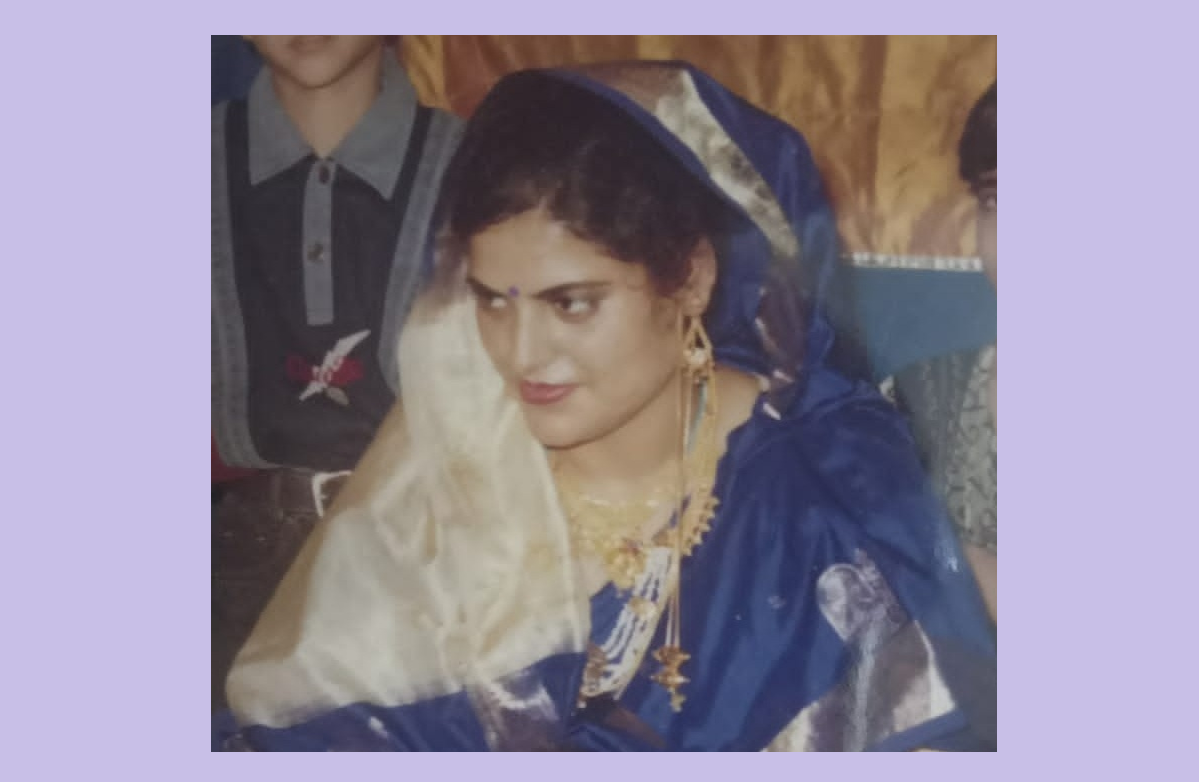
Photo courtesy: Prerna Bhat
The dejhoor had been an ornament for Kashmiri Pandit women for thousands of years, narrating a story of continuity under pressure, womanhood refracted through history, and identity surviving the corrosion of displacement.
The dejhoor, a slender, almost ascetic earring of gold, was once a ubiqutious ornament swaying from the ears of many Kashmiri Pandit women, like a small piece of the sun beaming close to the face. It glinted in wedding courtyards, in kitchens scented with noon chai and dried fish, in the slow winters of Srinagar where frost clung to the windowpanes. It has been part of the Kashmiri Pandit woman’s body for more than a thousand years, a ritual thread between birth, marriage, and death.
Today, in the scattered geographies of exile from Delhi to Pune, from Faridabad to Houston, the dejhoor has begun to vanish. Not abruptly or dramatically, but with a quiet, almost imperceptible disappearance that mirrors the community’s own slow retreat from its homeland. In this vanishing lies a story far greater than jewellery or ritual: it is the story of continuity under pressure, of womanhood refracted through history, and of identity surviving the corrosion of displacement.
To understand the dejhoor is to understand a civilisation’s grammar. The object itself is minimal—no flamboyant ornament, no spectacle of wealth. It is a small, hexagonal gold pendant, a yantra symbolising the union of Shiva and Shakti, suspended from the upper ear by a red silk thread called the nairwan. When the bride crosses into her new home, the nairwan is replaced by a gold chain, the ath, gifted by her in-laws. A tiny dangling piece, the atahur, completes the trinity. This transition thread to chain, girl to wife marks the woman’s shift from the house of her mother to that of her husband. The dejhoor, therefore, is both sacred geometry and social contract, the visible axis of a marriage sanctified by fire. For centuries, it carried with it a language of belonging that needed no words: to see a woman wearing it was to recognise her faith, her lineage, and her world. In photographs from the 1940s, one sees grandmothers in embroidered pherans, faces half-shadowed by the winter sun, the dejhoor catching a small gleam near the temple. It is as much a part of their being as their surname, as their spoken Kashmiri. When these women left their homes in 1990 walking with children, trunks, and photo albums through the snow-laden roads of Habba Kadal or Baramulla, they carried the dejhoor with them. It was not removed in the refugee camps of Jammu. Amid the heat, the loss, the smell of damp tents and rationed rice, the dejhoor still swung from their ears. It became more than ornament: it became testimony.
But time, in exile, does what conflict cannot. It thins memory, erases the context in which symbols breathe. The daughters born in Delhi and Noida, the granddaughters in Toronto or Bengaluru, have inherited stories but not landscapes. The ritual of the Devgoan, where the mother ties the red nairwan before the wedding, has become more symbolic than lived. The language of the chants is recited from transliterations, not spoken from instinct. Once a daily sign of womanhood, the dejhoor sleeps in jewellery boxes, worn occasionally for nostalgia or cultural festivals. Its disappearance is a quiet adaptation of a survival instinct, in a world where heritage often feels like a weight too heavy to carry through the metro or the office corridor.
Once a daily sign of womanhood, the dejhoor sleeps in jewellery boxes, worn occasionally for nostalgia or cultural festivals. Its disappearance is not a rebellion, but a quiet adaptation of a survival instinct in a world where heritage often feels like a weight too heavy to carry through the metro or the office corridor.
The erosion of the dejhoor reflects a deeper shift in how Kashmiri Pandit women navigate identity. In the old valley, their role was anchored within the geometry of the family and faith. In exile, the map changed. The same women who once prepared haakh and nadru yakhni in Srinagar kitchens began teaching, working in government offices, studying journalism, law, and medicine. Displacement demanded reinvention, and women led that transformation. Yet in this new landscape, the dejhoor became both too sacred and too fragile. The gold that once symbolised protection became a risk in cities where snatch thefts are common. The ritual that once signified marital permanence felt out of step with modern relationships defined by choice and mobility. A younger woman working in Gurgaon or Pune no longer wears the dejhoor on the metro, as she may feel that it feels impractical, or even unsafe.
But behind this practicality lies a quieter unease: the fear of fading and forgetting. For the older women, the dejhoor was not simply adornment but invocation, summoning ancestors, stories, and a cosmology where the feminine was divine. When they see their daughters choose simpler earrings or none at all, they sense a rupture—not of faith, but of continuity.
One afternoon, I was only cutting through a quiet lane in Noida, the kind lined with half-finished houses and potted tulsi plants on verandas. An elderly woman was sitting on a plastic chair just outside her gate, peeling almonds with the slow, practiced ease of someone who had done it all her life. I might have passed her without a second thought, but she paused mid-peel when I walked by. Her eyes went straight to my left ear, the little piercing that most people never notice. “You’re a Pandit girl, aren’t you?” she asked, not accusing, not even curious, but with a certainty. Before I could fully answer, she added, almost to herself, “We used to recognise one another from far away. If we do not wear it,” she said, referring to the dejhoor, “how will anyone know who we are?”
The question was not about recognition by others, but about the self’s ability to remember itself in diaspora. The disappearance of the dejhoor is not a story of defiance but of redefinition. The women who no longer wear it are not rejecting their heritage but interpreting it anew. They are asking whether identity must always hang visibly from the body or whether it can live invisibly, in language, in memory, in resilience. They are, in essence, continuing the same conversation the dejhoor once began the dialogue between the sacred and the self, between belonging and becoming.
The hexagon of the dejhoor, with its central bindu, mirrors the Sri Yantra, the sacred geometry that maps the cosmos and the feminine principle. To wear it was to participate daily in that cosmology. To stop wearing it, therefore, is not just to abandon an ornament but to step outside an ancient metaphysical grammar.
Still, the loss carries a quiet gravity. Objects like the dejhoor are not just cultural accessories, they are archives. They store within their geometry entire belief systems, social hierarchies, and philosophies. The hexagon of the dejhoor, with its central bindu, mirrors the Sri Yantra, the sacred geometry that maps the cosmos and the feminine principle. To wear it was to participate daily in that cosmology. To stop wearing it, therefore, is not just to abandon an ornament but to step outside an ancient metaphysical grammar. It marks, perhaps unconsciously, the movement from a world where identity was given to one where it must be chosen anew each day.
For anthropologists, the dejhoor offers a microcosm of what happens when an indigenous culture is displaced from its soil. The physical landscape, the Jhelum’s bend, the saffron fields of Pampore, the walnut groves, once anchored the symbolism of such rituals. Displacement fractured that ecology.
In migration, rituals either transform or fossilise. The dejhoor sits precisely at that intersection: too sacred to discard, too impractical to continue. Its survival now depends not on continuity but on creativity.
In contemporary India, the story of the dejhoor also intersects with the broader narrative of womanhood’s evolution. Across the country, symbols that once defined women’s marital status like the mangalsutra, bindi, and sindoor are being renegotiated. The dejhoor’s retreat thus aligns with a nationwide shift: from prescribed identities to chosen ones.
Yet, unlike other communities, for Kashmiri Pandit women the stakes are higher. Their culture’s continuity has always rested on memory rather than numbers, on preservation rather than expansion. Every ritual abandoned feels like a piece of history fading. The dejhoor’s decline, therefore, reverberates far beyond aesthetics: It is a question of survival of meaning itself. Still, within this disappearance, there is also a remarkable assertion.
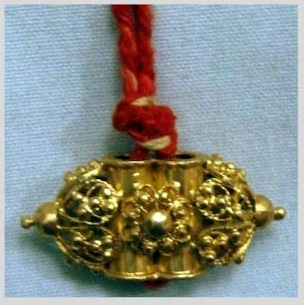
Photo courtesy: Prerna Bhat
The Kashmiri Pandit woman today exists between two worlds, one remembered and one real. She may not always wear the dejhoor, but she carries its symbolism in subtler forms: in her insistence on education, in her reclaiming of public spaces, in her refusal to be reduced to victimhood. The same resilience that once made her tie a gold talisman in times of exile now fuels her to redefine what heritage means in the digital century. She is both custodian and critic, refusing to let tradition ossify.
In recent years, as documentaries, exhibitions, and revival campaigns seek to revive Kashmiri Pandit traditions, such as the dejhoor. There is a growing awareness that the conversation cannot simply be about fashion or nostalgia. It must address the conditions that made its disappearance inevitable migration, insecurity, linguistic erosion, and patriarchy’s subtle shadow. For all its sanctity, the dejhoor was also a marker of control: tied by the mother, replaced by the in-laws, sanctified by fire. In its geometry lay a story of transfer a woman moving from one household to another, her identity validated through ritual possession. The modern woman—who chooses her education, her city, her partner—cannot fully inhabit that symbol without reconfiguring its meaning. The challenge, then, is not to restore the dejhoor as it was, but to reinterpret what it can signify in a world where women define themselves.
And yet, when I see my grandmother still wearing it—her hair silver, her face soft with memory—the sight carries quiet power. It reminds me that heritage is not an unbroken chain but a living current.
The dejhoor may vanish from the visible, but its spirit continues as an invisible inheritance, passed through gestures, lullabies, recipes, and resilience. The gold has been replaced by language, the yantra by the pulse of survival. If it once symbolised a woman’s sacred belonging to her homeland, its fading now symbolises the quiet erasure of a geography from memory—not the erasure of Kashmir from maps, but from daily intimacy. In exile, home no longer has coordinates; it has rituals. And when rituals begin to disappear, the idea of home itself begins to fray. In conversations with Kashmiri Pandit women across Delhi, Jammu, and Pune, I have heard the same gentle confession: “We still have it. But we never wear it.” Inside velvet-lined boxes, wrapped in tissue paper or folded cloth, lie hundreds of dejhoors, each one carrying the story of a woman who once crossed the threshold of her husband’s home to the sound of temple bells and wazwan simmering in copper pots. They rest now as artifacts of a life interrupted. In a way, they are exiles too—gold relics of belonging, without a landscape.
For all its sanctity, the dejhoor was also a marker of control: tied by the mother, replaced by the in-laws, sanctified by fire. In its geometry lay a story of transfer a woman moving from one household to another, her identity validated through ritual possession.
The generation born in exile after 1990 inhabits a paradox: they are heirs to a culture of memory rather than experience. Their mother’s stories, their grandmother’s objects, their father’s nostalgia all of it constitutes a homeland they have never lived in. For them, the dejhoor is both beautiful and foreign. They may wear it on their wedding day, often on family insistence, but it rarely continues beyond photographs. “It looks too traditional,” one young woman studying architecture in Delhi tells me, “and people ask what it is.” That question, What is it? becomes a wound disguised as curiosity. It is the reminder of how invisible the community’s markers have become in mainstream India. Once a visible declaration of presence, the dejhoor has become an unfamiliar curiosity in a country that has largely forgotten the displacement of the Pandits—except as a political point.
But it is not only neglect that threatens it but is also transformation. For modern Kashmiri Pandit women, identity is a construction, not an inheritance. Their sense of self is built through education, travel, work, and autonomy. They belong to a generation that refuses to define itself by marital status, which makes symbols like the dejhoor both powerful and problematic. The ritual of being adorned with it by the mother and then having it replaced by the husband’s family may no longer feel like continuity, it may feel like transfer of identity from one household to another, sanctioned by ritual. The same young women who write poetry about the exile, who visit temples built by their displaced community, and who still recite shlokas from memory, may hesitate to wear an ornament whose ritual script places them in a continuum they no longer unquestioningly inhabit. In this hesitation lies not defiance but evolution: it is an act of reclaiming agency over what symbols mean and who gets to wear them.
The older generation, however, reads this evolution with melancholy. They remember a Kashmir where identity was not a choice but a fact, woven into everyday life, in the language spoken, the food cooked, the rituals followed. They see in the disappearance of the dejhoor a metaphor for assimilation, a gradual melting into the anonymity of the urban middle class. For them, the dejhoor is the last visible thread tying their daughters to the valley’s centuries-old sacred geography, where temples, myths, and family lineages intertwined. The sight of bare ears feels to them like the silence after the song of Kashmiriyat, of belonging that survived wars, invasions, and winters but is now fading through the slow attrition of modernity.
Yet, even within this melancholy, there is movement. The symbolic power of the dejhoor is being rediscovered, not through revivalist nostalgia but through reinterpretation. A few young Kashmiri designers—especially women—are reimagining it as contemporary jewellery, minimalist silver pendants, geometric ear cuffs, even small tattoo motifs, each retaining the hexagonal yantra but shedding the heaviness of its ritual weight. These reinterpretations do not seek to recreate the past but to converse with it. A tattoo of a dejhoor on the wrist is not a mimicry of the old but a statement of continuity: the wearer may not follow the ritual, but she carries its form as resistance against erasure. These adaptations are acts of both loss and renewal, ways of saying: if we cannot wear the past as it was, we can still carry its shape into the future.
In these reimaginings, one can glimpse how cultures survive, not through perfect preservation but through adaptive reinvention. The larger question that arises, however, is not whether the dejhoor will survive, but what its transformation reveals about the contemporary condition of Kashmiri Pandit identity itself. Exile has rendered the community hyper-conscious of preservation; yet, preservation often requires change. The women who wore the dejhoor during the migration carried a world that was collapsing behind them, the temple bells, the fragrance of masala tchot, the rhythm of Kashmiri speech. For them, the Dejhoor was a vow of return. For their daughters, it is a fragment of a language they never spoke fluently. The loss of the Kashmiri language—now spoken by fewer than half the younger generation—mirrors the fading of such symbols. The ritual songs sung during Devgoan or Lagan ceremonies, once filled with layered metaphors of union and divinity, are today replaced by recorded bhajans in Hindi. Without the language that once held the symbolism, the ritual itself begins to feel ornamental.
In digital spaces, young Kashmiri Pandit women have begun documenting the dejhoor’s history, its geometry, and its metaphysical symbolism. Some are photographing it as part of visual archives, while others are writing about it in essays and oral histories.
And yet, even as the physical practice recedes, the philosophical essence of the dejhoor persists. In many ways, the Kashmiri Pandit woman embodies the metaphysical sense of the dejhoor’s yantra, keeping a balance between remembering and surviving, between continuity and change. She may no longer wear the gold hexagon, but she lives its meaning. She negotiates spaces that are simultaneously modern and ancestral, exilic and homebound.
In that sense, the geometry of the dejhoor has moved inward, becoming a map of resilience etched not on the ear but on the psyche. In the broader Indian context, this inward shift parallels the redefinition of tradition itself. Across castes and communities, young women are questioning the visibility of cultural markers, not to reject them but to reframe them.
The dejhoor, therefore, is more than merely a Kashmiri story; it is a microcosm of how Indian womanhood negotiates its relationship with heritage in a rapidly modernising society. It embodies the tension between pride and practicality, between visibility and vulnerability. For the Kashmiri Pandit woman, whose identity already carries the double weight of exile and expectation, the choice to wear or not wear the dejhoor is a negotiation between two worlds—one inherited through ritual and the other demanded by the modern city.
Still, as one visits Pandit households during wedding seasons in Delhi’s pocket communities like Janakpuri, Lajpat Nagar, Indirapuram, one sees small acts of return. Mothers bring out their own dejhoors, clean them, and whisper instructions about the nairwan to younger women. They perform the Devgoan with modern substitutions: synthetic threads, recorded chants, temple visits instead of home altars. The ritual may look different, but its intent remains to create a bridge between what was and what must continue to be. These moments of continuity—fragile yet persistent—suggest that disappearance in culture is rarely absolute. It is often a transformation disguised as absence.
There is another layer to this story, one that rarely finds mention: the role of fear and public space. In Delhi or Jammu, wearing the dejhoor in public can attract unwanted attention not only from potential thieves but also from the curious and the ignorant. Questions like “What religion is this?” or “Is it some temple jewellery?” carry undertones of alienation. For a community still negotiating its visibility, such encounters reinforce an unspoken hesitation. A piece of jewellery that once signified safety and divine protection now paradoxically marks vulnerability. The woman who chooses not to wear it is not turning away from her culture; she is, in fact, protecting it by ensuring her own safety. In that small act lies an inversion of its original purpose—a new kind of yantra for a changed world.
The exodus of 1990 is an inherited memory, transmitted across generations through silence as much as through speech. For the women who fled, the dejhoor was the one ornament they refused to remove, even when leaving behind furniture, books, and homes. It shone like a small declaration of self in the face of displacement. That a generation later, it often lies unused is not a contradiction; it is the natural fatigue of a culture forced into perpetual defense. No community can live forever in the mode of preservation without renewal. The silence around the dejhoor, then, is not indifference, but an exhaustion that comes from carrying too many symbols of survival.
And yet, from this exhaustion, a new language of heritage is emerging one that prioritises meaning over material. In digital spaces, young Kashmiri Pandit women have begun documenting the dejhoor’s history, its geometry, and its metaphysical symbolism. Some are photographing it as part of visual archives, while others are writing about it in essays and oral histories. This shift from wearing to narrating marks a subtle but profound change. The dejhoor has moved from body to discourse, from ear to word. Its visibility has changed form but not purpose. Where once it gleamed in the valley’s sunlight, now it flickers in pixels and prose, a digital gold that refuses to tarnish.
The story of the dejhoor is, at its heart, the story of continuity and reinvention, of memory surviving exile, and of identity negotiating between tradition and modernity. Though its gold may no longer glint daily in the ears of Kashmiri Pandit women, its shape, its symbolism, and its spiritual resonance endure in subtler, profound ways in the careful retelling of rituals, in the quiet preservation of ancestral stories, and in the inner landscapes of women who navigate life between worlds.
The absence of the dejhoor in daily wear does not signify loss alone, but transformation; it reminds us that culture is living, evolving, and carried forward not only in gold and ritual but in memory, creativity, and the courage to define one’s own place in the world. In this metamorphosis, the Kashmiri Pandit woman stands as both custodian and innovator, keeping the spirit of the dejhoor alive as an enduring emblem of survival, continuity, and the right to claim identity on her own terms, in a world that has demanded both adaptation and remembrance.
In the quiet spaces of modern life, between heritage and horizon, the dejhoor continues to speak, softly, insistently, and without compromise, echoing a thousand years of history while charting the uncharted future of Kashmiri Pandit womanhood.
***
Prerna Bhat is a and a Kashmiri Pandit pursuing her Mass Communication degree at Jamia Millia Islamia. Her narrative focus is centered on the exploration of themes that resonate profoundly with her heritage: the complex concept of ‘home,' the enduring quest for independence, and the resilience of the people who define these narratives. Her work offers a perspective on the displaced Kashmiri Pandit experience, transforming personal and collective memory into stories of identity and belonging. You can find her on X: @PrernaBhat3 and Instagram: @prerna__bhat.