How to Resist a Postmodern Zombification
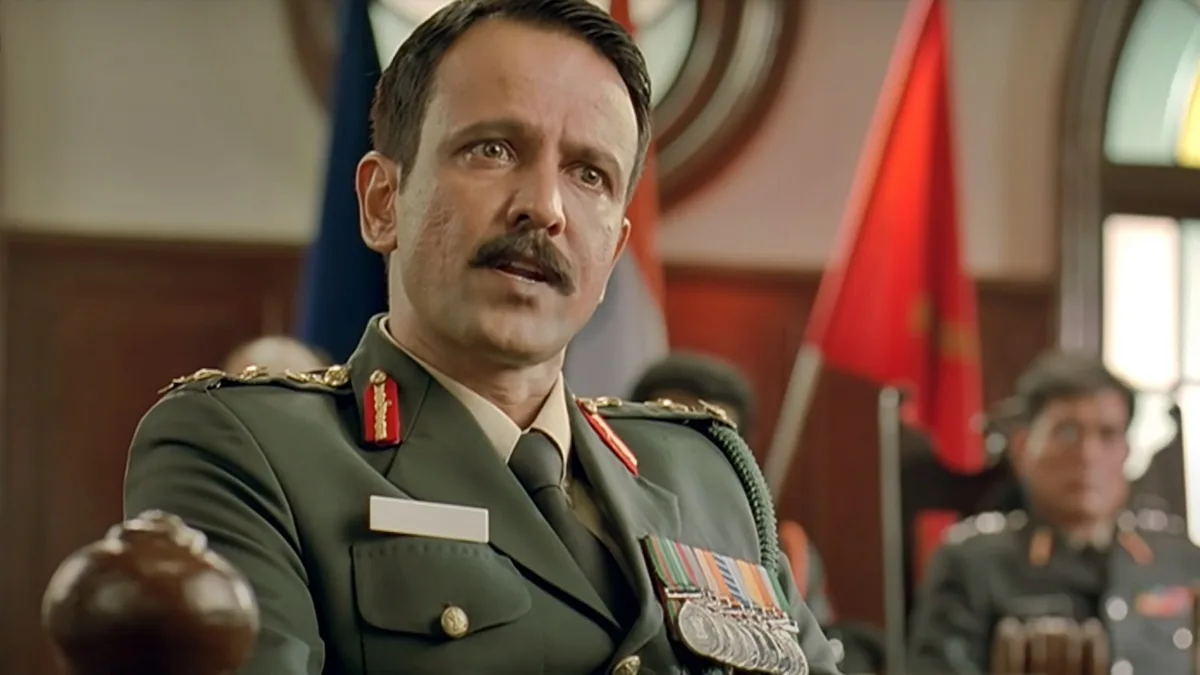
A still from Shaurya (2008).
From Dhurandhar’s Rahman Dakait to Shaurya’s Rudra Pratap Singh, Abin Chakraborty delves into Miltonic rhetoric to explore social media trends of heroism celebrated without moral rectitude.
Soon after the declaration of the results of the recent municipal elections in Mumbai, I came across a Instagram Reel by an Indian right-wing influencer, featuring a clip from Aditya Dhar’s Dhurandhar (2025). It was the viral sequence of the character Rahman Dakait (Akshaye Khanna) entering a Baloch wedding, accompanied by the song “Fa9la” by Flipperachi, with the caption, “Devendra Bhau entering BJP office after sealing another Victory in Elections.” The clip presented a bizarre juxtaposition of opposites: Why was this self-confessed, Hanuman worshipping Hindu male celebrating the BJP’s victory in the BMC elections by using a video featuring a ferocious criminal don? Why was this user not bothered by equating an Indian Chief Minister with a ruthless villain from Pakistan—one who was even supposedly involved in the heinous 26/11 attacks?
It was this conundrum that took me back to the dilemma involving the character of Satan in Milton’s Paradise Lost. Like many other students of English literature, I was also once a passionate supporter of Milton’s Satan, especially based on the early impressions associated with the first two books of the epic. As an atheist and a young man with many anti-establishment and anti-authoritarian ideas, Satan’s rebellion, the swagger and glory of his leadership, his never-say-die attitude, and his unwillingness to serve, obviously struck a chord with me. It forged connections between Milton’s verse and Bob Dylan’s songs like “The Times They Are A-Changin’” and “You Gotta Serve Somebody.” It was much later that I realised how his stubbornness and pride were less objects of admiration, and more pitfalls to avoids, so that one did not fall into the traps of a misguided sense of honour, heroism, and glory, which actually concealed a combination of narcissism, aggression, and thirst for power.
As Stanley Fish demonstrated in his famous book, Surprised by Sin: The Reader in Paradise Lost (1998) Milton’s text tests the readers’ perception and moral sense by continually exposing their susceptibility to a kind of perverted logic that makes them admire evil through the guise of rhetorical grandeur, all before eventually proceeding to a moment of shameful recognition that ultimately produces remorse. So, when we relate to the speeches of Satan in the first couple of books, Fish believes that we are actually ignoring Satan’s megalomania, amorality, and degradation because of the dazzling rhetoric previously associated with epic heroes, in contrast to the Christian virtues of humility, meekness, and self-sacrifice. As Fish states, as per his reading, the reader of Milton’s text
(1) is confronted with evidence of his corruption and becomes aware of his inability to respond adequately to spiritual conceptions, and
(2) is asked to refine his perceptions so that his understanding will be once more proportionable to truth the object of it. (1971: xiii)
He is repeatedly hailed by Islamophobe trolls and right-wing commentators as a spokesperson for an advisable course of action for the Indian state. What is portrayed as perverted hostility born out of ill-processed trauma thus becomes in social media a call for bigotry, segregation, and ethnic cleansing.
This is evident from the speeches of Satan in Book I of Paradise Lost, where almost every example of heroic rhetoric is immediately contradicted by a certain amount of narratorial admonishment. Thus, we never get the opportunity to forget that this apparently heroic figure is, after all, the Infernal Serpent responsible for the fall of Man. This is also evident from the first major speech of Satan in Book I, where the evidently heroic invocation of unconquerable will and courage never to submit or yield enclose between themselves “study of revenge, immortal hate” (Book I, Line 107), which cannot be seen as ethically agreeable objectives by any stretch of theological or philosophical imagination. In tune with the Shakespearean warning that sometimes the instruments of darkness lead us with small truths so that we can be beguiled into larger evil (Macbeth, 1.3), the attribution of heroic rhetoric to Satan is recurrently undercut by condemnable moral traps into which the readers are inexorably drawn. It is the subsequent recognition of such a surrender that eventually extracts from the reader both recognition of guilt and the quest for absolution through atonement.
The larger rationale behind this prologue is the contradiction between apparent heroism and moral evil, and how our moral compass often abandons us regarding contextually-detached audio-visual representations. There are two moments from Indian cinema which are particularly relevant to this contradiction, contributing to the cultural significances in the contemporary digital economy. The first is the concluding trial scene from the film Samar Khan’s Shaurya (2008) where Kay Kay Menon plays the role of Brigadier Rudra Pratap Singh. The second is Rahman Dakait’s entry sequence in Dhurandhar.
Like the court scene from Rob Reiner’s A Few Good Men (1992) that inspired it, the interrogation of Rudra Pratap Singh by the prosecutor Siddhant Chaudhary (Rahul Bose) has continued to have a popular afterlife on social media, particularly gaining currency after incidents of terrorist attacks, be it in Pahalgam, Delhi, or elsewhere. In the film, the Brigadier orders the indiscriminate shooting of civilians in Kashmir, perhaps based on ingrained hatred caused by the rape and murder of his family members at the hands of a Muslim servant named Jameel. In various social media posts, the Brigadier is hailed as a hero, even though the screenplay identifies him as a convict who is being taken into custody for further inquiry and verdict. The Brigadier identifies the entire Muslim community as termites, claims they have violence ingrained in their blood, and calls for the whole community to be wiped out of the country. And yet, he is repeatedly hailed by Islamophobe trolls and right-wing commentators as a spokesperson for an advisable course of action for the Indian state. What is portrayed as perverted hostility born out of ill-processed trauma thus becomes in social media a call for bigotry, segregation, and ethnic cleansing.
Moral outrage over a dastardly terrorist attack becomes a catalyst for endorsing similar or greater crimes of calculated savagery. However, unlike Paradise Lost, the technological and affective economy of social media Reels offer no scope for correction and contrition; instead, they use decontextualised stimuli for proliferation of vengeful sadism, disguised as righteous indignation. As opposed to Fredric Jameson’s theorisation of postmodern culture as being characterised by “a crisis in historicity” (1991: 10) and “waning of affect” (1991: 10), through such Reels, dehistoricised audio-visual representations—which brazenly ignore the history of human rights violations in Kashmir—produce exaggerated belligerent affects in keeping with the political project of Hindutva as championed by various wings of the Sangh Parivar.
The golf playing, Ray-Ban sunglass wearing Brigadier claims to be a god in the region of the military outpost near the border and carries a swagger and machismo that easily dismisses moral considerations as weak. Thus, despite the final ejaculations of “Bloody democracy!” he emerges as a truth-spitting hero, for countless people online, whose barbaric assaults and perverse hatred are celebrated instead of being abhorred.
Ironically, the same crowd that is entranced by Brigadier Rudra Pratap Singh’s bigotry and uncontrolled rage is also enchanted with Rahman Dakait in Dhurandhar, a character who portrays a lethal mafia don from Balochistan in Pakistan. Dhurandhar capitalises on jingoistic nationalism and contains a whole lot of violence associated with gang war and espionage and documents the nexus of politics, army, and terrorism in Pakistan. Dakait is among the many players within this heinous network, and the film features several scenes that document with vivid detail the gruesome violence that he perpetrates. There is no ambiguity in the film about his villainous nature and his heinous acts. As he himself admits in one of the scenes, the executions he orders are particularly butcher-like.
And yet, across social media, the character is celebrated by the same cultural circuit which revels in the figure of the Brigadier from Shaurya, despite Dakait’s famous entry scene being soundtracked with an Arabic song, sung by a Muslim singer from Bahrain. Here again, the process of dehistoricisation is at work, because of which neither the identity of the character nor the identity of singer nor the language of the song remains relevant. The celebratory rhetoric has completely delinked the sequence from either the cinematic context or the historical reality; instead, it is a spectacle of power, charisma and authority, enhanced by the captivating beats of Flipperachi’s song, which appeals to the unconscious narcissistic urge of the viewers who either aspire for such power, attention, and authority, or closely relate to the desire for such social stature—however elusive or far-fetched that might be. The slow-motion close ups in this scene, the distinctive black costume, the showering of rose petals, the all-around adulation from dancers and guests, the turban offered as a sign of prestige, altogether create an electrifying projection of power, magnetism, and riveting attention, which seductively embraces the spectator in a vicarious enactment of authority.
Bereft of all moral considerations, through these Reels that are often devoid of context or consequences, Dakait becomes emblematic of a certain kind of male fantasy generally fuelled by lack. Incidentally, as many have noted, this entry sequence is strikingly similar to the entry sequence of Abrar (Bobby Deol) in the 2023 film Animal, where the character swings to the beat of the Iranian “Jamal Kudu” song with a drinking glass on his head and cigarette in his mouth, for the celebration of his third marriage. In both cases, the lyrics, music, and choreography serve to dissociate the figure from either cinematic or historical context, making the musical sequence an international craze, and inflating the fandom of both Deol and Khanna.
Again, this becomes possible because of the version of masculinity they project, where authority, charisma, and adulation combine, without facing any moral considerations. Just as the threats to masculine superiority had propelled the rise of masculine action-packed heroes portrayed by Salman Khan in various films over the last couple of decades, or through films like Kabir Singh (2019), the cinematic magnetism of these clips stem from the wish-fulfilment of a kind of male ego, which seeks a deifying spotlight without feeling the need to embody moral virtues.
The celebratory rhetoric has completely delinked the sequence from either the cinematic context or the historical reality; instead, it is a spectacle of power, charisma and authority, enhanced by the captivating beats of Flipperachi’s song.
Fish states on virtue that it,
does not reside in any one stance, nor does heroism require a particular field of battle. True virtue is a state of mind— loyalty to the best one knows— and true heroism is a psychic (wilful) action —the decision, continually made in a variety of physical situations, to maintain that loyalty. To fix on any one posture, whether it be opposition to the laws of society or standing one’s ground in a hostile environment, as the heroic posture is to mistake a possible expression of heroism (any posture is potentially that) for the only one; and to seek opportunities to place oneself in that posture is to confuse self-aggrandizement with virtue... (1971: 184)
The trouble is that the economy of these social media clips has space for neither multiple perspectives nor nuance. They project martial prowess and self-aggrandizement as the only kind of heroism, and a kind of virtue by itself, irrespective of the moral considerations associated with such specificities as character, context, and event. Unlike hundreds of farmers, workers, journalists, civil society activists, and environmentalists who resolutely stand against injustices by state or state-sponsored actors through their commitment to peaceful, democratic resistance—often without the limelight—these clips only celebrate heroism as martial prowess, by responding to the viewers’ need for heroism without moral rectitude. Instead, they reduce heroism to terms like “aura farming”, “legend vibes” etc. This is why commentator and AAP’s National Joint Secretary, Akshay Marathe had said, “Being a Bhakt is not a political choice, it’s a personality type—they celebrate their leader’s bullying, bigotry and megalomania… because they relate with that kind of sick behavior.”
The simultaneous celebration of Pratap and Dakait point to the pervasiveness of such personality types in a grossly unequal society of extensive stratification where, of course, the majority remains entangled in relative unimportance. One is reminded of T.S. Eliot’s words in The Cocktail Party (1949), where he wrote:
Half of the harm that is done in this world
Is due to people who want to feel important.
They don’t mean to do harm but the harm does not interest them.
Or they do not see it or they justify it.
Because they are obsessed in the endless struggle
To think well of themselves. (Eliot 2004: 403).
The ephemeral economy of the Instagram Reel invites us to accept reducing heroism to bravado, performative stunts, or unidimensional, bigoted outbursts, all at the expense of in-depth analysis and moral integrity.
The antidote to such abusive self-aggrandizement is the practice of humility, to which the world of social media is generally allergic. Here again, one is reminded of both Milton and Paradise Lost. Not only did Milton write that “They also serve who stand and wait” (Sonnet 19, line 14) but in Paradise Lost, Christ also instructs the celestial angels to “stand only and behold” (Book VI, line 810). Fish therefore explains,
These too are heroes because they are submitting knowingly to a discipline imposed on them by a power they believe in; … Looking forward, one can see that, for Adam and Eve, life in Paradise, with the forbidden tree always before them, is such a discipline, calling again for a holding action which is physically unimpressive. It has been argued that because Paradise is ‘limited to hopelessly inactive virtues’ Adam and Eve must fall before they can be truly heroic, but this is to define ‘active’ much too narrowly, and to reduce heroism to bravado. (196)
The ephemeral economy of the Instagram Reel invites us to accept reducing heroism to bravado, performative stunts, or unidimensional, bigoted outbursts, all at the expense of in-depth analysis and moral integrity. This notion of moral integrity, however, is not one which is exclusively circumscribed by the Christian paradigm associated with either Milton or Eliot. Irrespective of whether one believes in any deity or not, it is possible to humbly dedicate oneself to a cause, an ideal, or a course of action where self-regarding considerations are replaced by considerations associated with others’ well-being, without either vanity or vaunting. It is this notion of self-sacrifice which animates the Gandhian vision of passive resistance, which remains one of the most significant tools of critical dissent within a democratic framework. Gandhi wrote in Hind Swaraj that
Passive resistance is a method of securing rights by personal suffering; it is the reverse of resistance by arms. When I refuse to do a thing that is repugnant to my conscience, I use soul-force. For instance, the Government of the day has passed a law which is applicable to me. I do not like it. If by using violence I force the Government to repeal the law, I am employing what may be termed body-force. If I do not obey the law and accept the penalty for its breach, I use soul-force. It involves sacrifice of self. (69)
However powerful a government may be, such self-sacrifice has the capacity to unsettle and shatter its foundations of force, even if after inordinate delay, by awakening in others that “soul-force” which generally ensures the glory of martyrdoms. In contrast, any resistance against the government which uses force or violence can obviously be easily crushed because of the superior force that the state can muster and such force is therefore never really a destabilising threat to a powerful nation state, even though it has the capacity to spread terror, bloodshed, and chaos for a limited period of time. Even something as superlatively evil as the 9/11 attacks did not destabilise the American state but rather ensured a consolidation of hegemonic authority. The same holds true for the Indian Maoists who are currently withering in the face of the assaults from the state (Bose 2025).
In contrast, individuals like the late G.N. Saibaba, Anand Teltumbde, Umar Khalid or Hany Babu remain haunting embodiments of anti-authoritarian defiance despite spending years and years in prisons. Likewise, the three recent farm laws (2020) were withdrawn precisely because the might of the state faced the united, non-violent resistance of the farmers, who refused to give an inch.
No wonder then that the right-wing cultural circuit which cultivates either the hype around the Dakait-Flipperachi combination, or the vitriolic rhetoric of the Brigadier, is so fond of films like Dhurandhar, Chhava (2025), etc. Such media assists in the political mobilisation of majoritarian hatred and conflates heroism with violence which dilutes any possibility of heroic, non-violent resistance—particularly since exhibitions of physical violence foster the kind of aggressive narcissism which is diametrically opposed to the self-sacrifice and humility demanded from a Satyagrahi choosing to practice passive resistance.
In the subcontinental cultural context, what applies to India is often equally applicable to the fundamentalist cultural circuits of Pakistan and Bangladesh. Thus, we confront a particular kind of postmodern cultural phenomena, where dehistoricisation goes hand in hand with waning of ethics and exaggeration of violent provocations, and not necessarily the kind of waning of affect emphasised by Jameson.
This is not to say that waning of affect is not visible. It appears in issues related to class, gender, caste, abuse of natural resources, etc., but is also heavily padded by aggressive affects that serve to fracture class-based solidarities on the one hand, and obscure pressing material crises on the other. Instead, there emerges a hysterical mobilisation of hateful collectives which, however, target neither the political elite nor their super-rich backers who have become brazenly integrated with the structures of the state in a quasi-fascist mode.
If the march of the zombies is to be resisted, one requires, not an equivalent congregation of committed mercenaries, but rather the slow, tedious, extensively frustrating yet indispensable work of raising consciousness and building solidarity, without much tangible gain in the immediate time.
In the terminology of popular culture, one can visualise the hateful collectives either as zombies or the White Walkers from Game of Thrones—hordes directed by megalomaniacs and exclusively geared towards murderous mayhem. This is precisely what postmodern zombification indicates: A collective action catering to elite political-economic considerations without rational, critical inquiry.
The only alternative would be the sensitisation and formation of subaltern counterpublics (Fraser 1990) which might subsequently converge for the sake of emancipatory collectives of a radically different dimension. While formation of subaltern counterpublics is itself rather difficult, their popularisation, their ascent towards a hegemonic status necessarily requires the kind of consciousness-raising which is often quite arduous, especially in the face of administrative crackdown on the one hand and entrenched socio-political divisions on the other.
This is easier said than done—but not impossible. Citizens have organised against the administration in various notable protests in recent years, including the 2020-21 farmers’ protests, the civil society movements against CAA and NRC, the calls for justice for the raped and murdered doctor from R.G. Kar Hospotal in Kolkata, and more. All of these testify to both the viability of organised dissent and the successful use of social media for popular mobilisation. However, unless one can produce and sustain an ecosystem of synergising dissent, such examples are likely to be relegated to the realm of isolated incidents without lasting political dividends. Any gap in public consciousness will immediately be targeted and saturated by diverting, distracting, or distorting content, which will simultaneously dilute the urgency of dissent.
Herein lies the significance of constant vigilance on the one hand and a dynamic vanguard on the other. If the march of the zombies is to be resisted, one requires, not an equivalent congregation of committed mercenaries, but rather the slow, tedious, extensively frustrating yet indispensable work of raising consciousness and building solidarity, without much tangible gain in the immediate time.
It is only through a humble commitment to such an exacting course that one might eventually exorcise the ghosts of Rahman Dakait, Brigadier Rudra Pratap Singh, and such other icons of megalomania and rage. Whether we are able to undertake and execute this demonstrably Herculean task will determine the future of our polity.
***
Abin Chakraborty is an established academic who has published in magazines and journals including Cafe Dissensus, Madras Courier, Setu, Borderless, Kitab, Acumen etc. He is also the co-founder of Plato's Caves and the editor of Postcolonial Interventions, an online journal. You can find him on Twitter/X: @AbinChakraborty, Instagram: @platoscavesonline, and (Instagram) and Facebook: @Plato's Caves Online.