“Storytelling Saves My Life Every Day” – An Interview with Sanjana Ramachandran
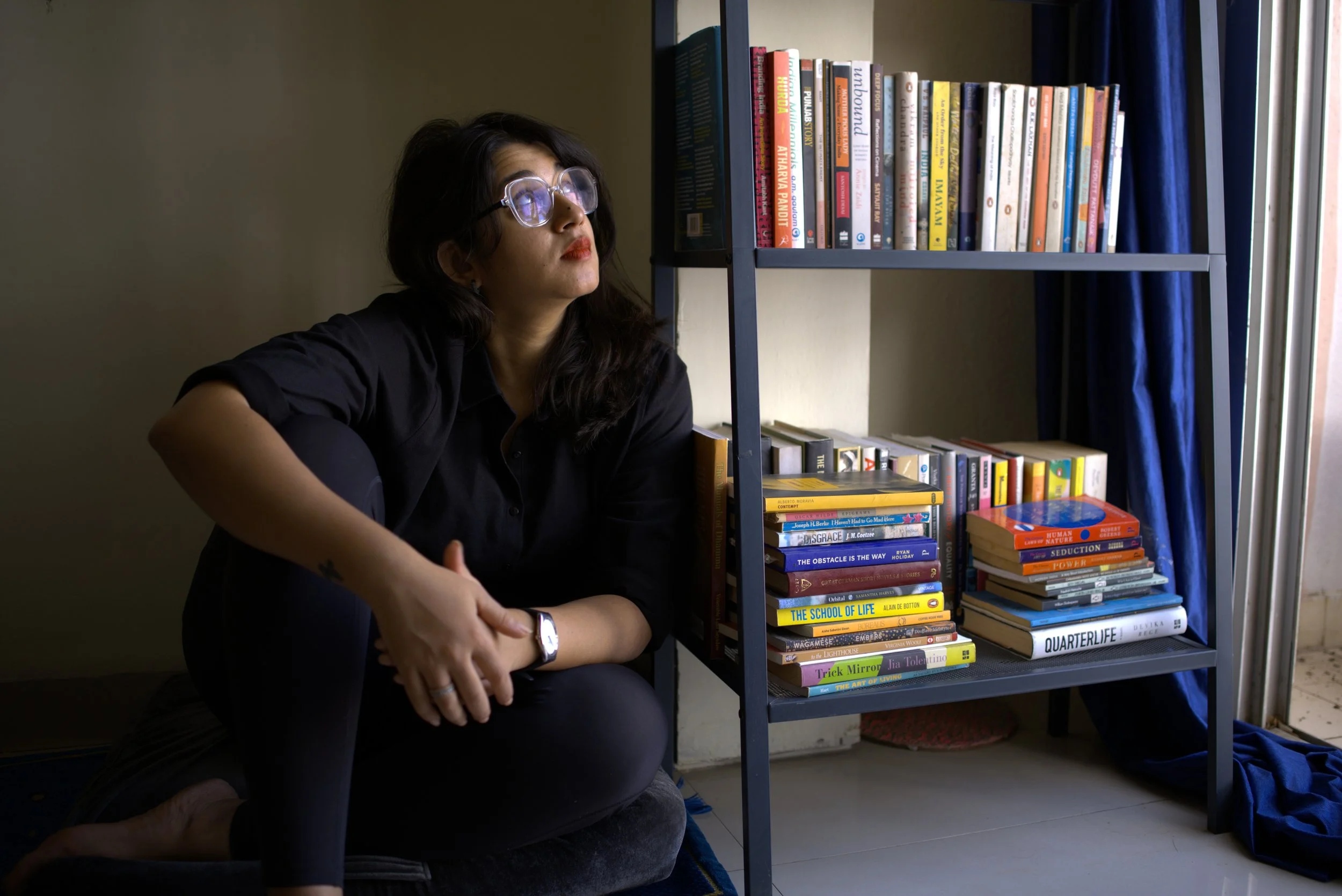
Photo: Junaid Rahim
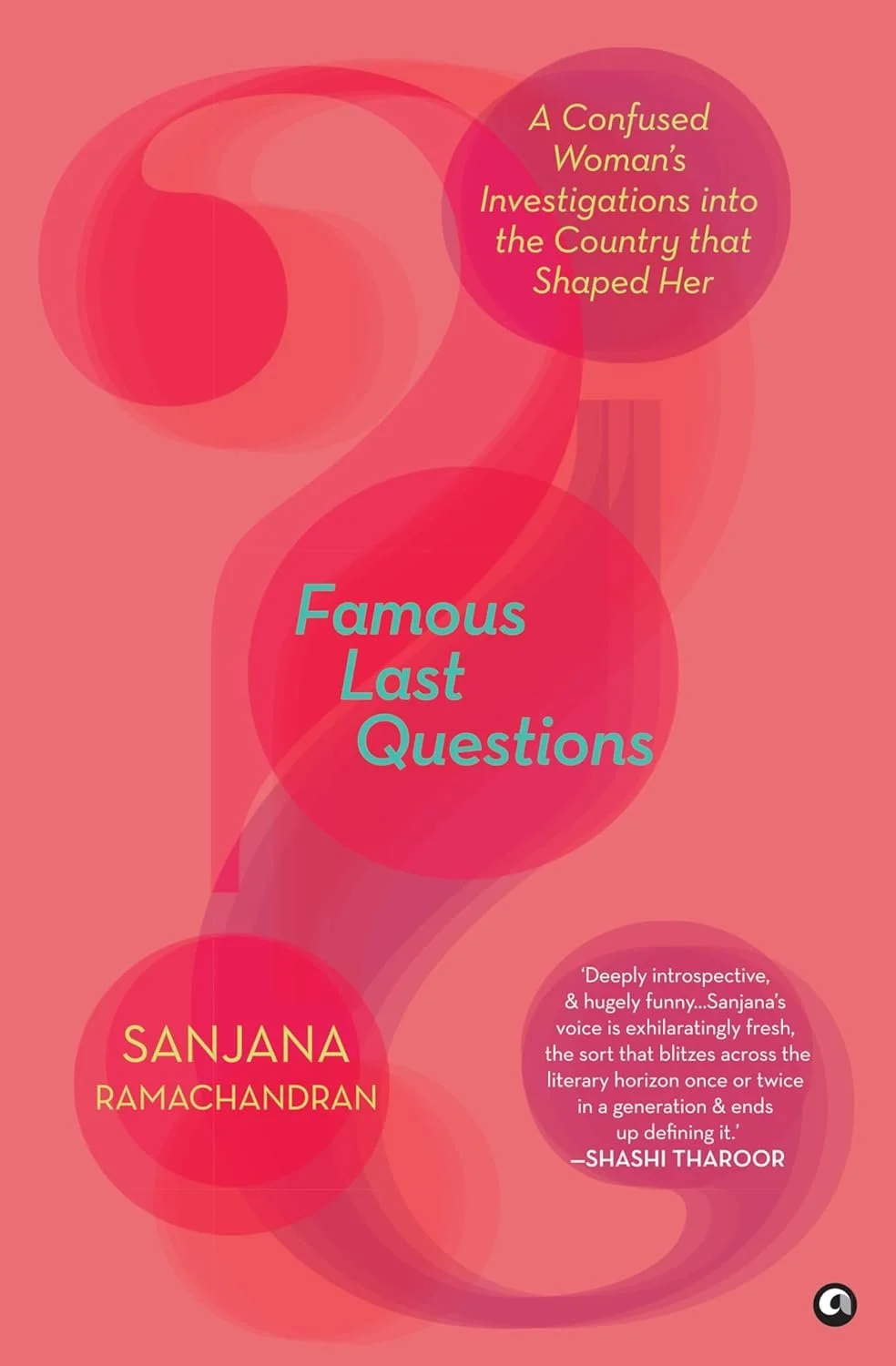
Sanjana Ramachandran’s debut Famous Last Questions investigates the clash of the personal with the sociopolitical. The author speaks about masking and unmasking herself, finding comfort in contradictions, and the flawed institutions of marriage, relationships, and work.
In the introduction to her book Famous Last Questions: A Confused Woman’s Investigations into the Country that Shaped Her (Aleph Book Company, 2025), author Sanjana Ramachandran mentions her many “innocent, half-serious, mostly helpless attempts” to kill herself (xi). “It is immoral. It is wrong. Never do it,” she instructs readers, a few sentences later; and instead, suggests that they find meaning in suffering, to turn suffering into stories, into “fun.”
Through the course of the seven essays that are part-memoir and part-cultural commentary, Ramachandran tells many true stories—personal, communal, national—as a way of finding that meaning. As hinted in the subtitle, these essays are her many ‘investigations,’ following a time-honoured human tradition of storytelling as a survival tactic, from Scheherazade’s sleepless nights to the tales Betal tells Vikram while straddled over the mythological king’s shoulders. From her social media presence to this collection of essays, Ramachandran does the same: relying on the power of stories to catch our attention, to turn that suffering into “fun,” to live more of a life.
In the essays in Famous Last Questions, Ramachandran engages the personal with the societal, exploring her fraught relationship with her family, the many rots within the TamBrahm (Tamil Brahmin) social structure, her experiences as a woman in patriarchal Indian workspaces, curiosities about spirituality, romance, caste, narcissism, fame, and more.
“I’ve found most comfort in literature and writing that elevates human vulnerability: the not-knowingness, the low-grade anxiety and alienation even when things are great, the ghastliness of adulthood and making big decisions—like it’s all nothing.”
In a Q&A with The Chakkar, Ramachandran spoke about the life life-affirming power of stories, masking and unmasking herself, the flawed institutions of marriage, relationship, and work, and finding comfort in contradictions.
The Chakkar: You open this book with a meditation on how you hoped to turn your suffering into stories. I truly feel that art/storytelling isn’t just a unique quality of our humanity: it's an essential way in which we preserve ourselves. I want to hear more about how storytelling has saved your life—and helped enhance it, despite what you have described as life’s “messiness?”
Ramachandran: Storytelling, or the idea of it, kind of saves my life every day, in the sense that whenever something bad happens, I’m like, ‘Well, at least I’ll get an anecdote out of this,’ or something I can weave into a character or essay at some point. The feeling of being ‘saved’ by it was definitely stronger before the book, because until then I had nothing to show for the suffering my life seemed to be lined with. But now that it’s part of something larger than me, I derive a lot of succour from the act of having written and published the book. Now, it’s more like I’d prefer if shit stopped happening to me; but, worst case, I can make something of it and that’s quite alright. It's powerful, in fact.
The Chakkar: I wanna extend that thought to the advent of A.I., and people turning to artificial intelligence to produce stories based on the human work it has been ‘trained’ on. Do you think we as readers could be moved by ‘artificially generated’ stories—if they don’t spring out of some desperate human need for self-preservation?
Ramachandran: I don’t think so, honestly. If you’ve read widely enough, you can’t really be impressed by A.I. writing as a form of ‘literature’—at least as the technology currently stands at the end of 2025. It is impressive that A.I. is conversational, that I can talk to it and it responds intelligibly about a whole host of problems; that it can, for all practical purposes, produce graphics and music and even some writing that isn’t easily distinguishable from human practitioners of the highest level. But the fact that you can tell A.I. slop apart from actually great writing is a testament to how writing is an art form that most resembles higher-order consciousness. In other words, it seems less obviously rule-based than code, math, music, more actual stream of consciousness, which is why we’re moved by writing that’s real.
Who knows, though… Perhaps with even more ingestion and training and reinforcement learning, A.I. writing will someday—maybe in just a few years—be genuinely complex and original?
The Chakkar: There is a wonderful passage in the “Who Am I” essay (24) where you talk about the many masks and insecurities and societal expectations of a young woman (such as yourself) early in the working environment: “Perhaps I really was ‘arrogant’ as Appa had called me. I am called, in addition to these adjectives, ‘emotional’ on a day my face betrays some emotion. On the days it does not, I am called ‘dead inside.’ What am I, then, why don’t you decide and tell me?” It is a great breaking of the fourth wall, and a way for you to hold a mirror up to the hypocrisy of patriarchy. It is also a refreshing moment of honest uncertainty. Most books classified in the nonfiction/memoir bracket—especially in India—end up being ‘guidebooks’ where people with some ‘gyan’ are sharing tips with the readers to emulate and aspire for their ‘perfect’ life. But here you are, showing flaws and warts, and a life without firm standing. Did you feel that pressure to help readers get their shit together—while still trying to keep that shit together for yourself? Or was the insecurity/uncertainty an intentional decision as you wrote these essays?
Ramachandran: It was definitely intentional. It was clear to me from the start that this book wouldn’t fit into conventional pop-nonfiction or self-help. I’ve found most comfort in literature and writing that elevates human vulnerability: the not-knowingness, the low-grade anxiety and alienation even when things are great, the ghastliness of adulthood and making big decisions—like it’s all nothing. In fact, I wonder if it’s only in this day and age where advice-giving know-it-alls and productivity huzz have found so much success. I’m suspicious of anyone who ignores mentioning that life is hard and skips straight into offering bite-sized answers. I feel like that kind of advice is more about the person giving it than about someone else’s problems, which has to start with understanding them first.
Generalisable advice may work especially well for practical spaces, like how to manage money, etc., but for the more intractable areas—happiness, purpose, peace, meaning, all that—how do I believe that your answer will fit me? I keep changing, I am unknown to myself on most days. Of course, with that caveat mentioned—“This is what works for me”—almost everything becomes vastly more palatable. This is what works for me: I have a need to know everything for myself, from the inside out, to know what to make of it.
“This kind of ‘CV-ready’ measurement of the self has created a lasting middle-class herd-mentality about what success and a good life is, so that few dare to question or live outside of it. Young Indians seem to find it hard to believe that it’s possible to lead an enriching life without chasing mainstream culture values.”
It is kind of an exhausting way to live, I’ll admit. It would be easier to be unconscious and deftly shepherded by the many cult leaders vying for believers out there. But I think questioning everything and arriving at your own answers and non-answers experientially is more robust, even if tedious.
The Chakkar: You write about masks: “Wearing one mask too many over time had confused my idea of who ‘I’ was,” (27-28), and later, expose your online persona ‘@ramachandranesk,’ meaning ‘in the style of, or resembling’ as a mask, too. We’re all always playing a role or are masked in any social interaction: Do you feel that writing this book has helped you unmask a bit? Do you feel like you’re still ‘resembling’ a Ramachandran, or do you feel like an original now?
Ramachandran: As I keep telling the handful of people who I think will understand me when I say this, I think writing the book was more a psychological act of healing than the creation of a product in any sense. It did help me unmask. I learnt I could survive even if I was honest—with myself and others—about everything I’ve been through. It’s like the only way I could stop being nonchalant about the violence of the patriarchy is by writing a whole-ass book about how my family and I were run down by it. Now, I’m not sure about ‘resembling’ a former self or a parent or anyone else, but I definitely feel more formless, which I explain towards the end of the book. Being broken and remade so many times over a life will dismantle the concept of a fixed self, allowing you to operate more as a process unfolding over time, in dialogue with inner and outer worlds.
The Chakkar: There is an amusing section in the essay “Science, Arts, or Commerce” where you give advice about the most-impactful kind of CV, where one must collect all the “CV points” use “power verbs,” and avoid words like second-place, etc. (66-67). This section focuses on the formulas that young Indians have devised to stay ahead of competition, the side result of which, often, is sacrificing one’s individuality. It’s a reduction of many human complexities into a neat checklist, a self-branding of sorts. On a grander scale, how do you feel that this ‘CV-ready representation’ of self has impacted young Indians now joining the workforce?
Ramachandran: I feel this kind of ‘CV-ready’ measurement of the self has created a lasting middle-class herd-mentality about what success and a good life is, so that few dare to question or live outside of it. Young Indians seem to find it hard to believe that it’s possible to lead an enriching life without chasing mainstream culture values. I used to think this attitude must have dissipated with the millennials, for whom IIT-IIM-secure-job-and-house-and-marriage-by-30s was once the aspiration. Zoomers, because they were born into a time where such norms were anyway shaking and falling apart, seemed like they would be more immune to the pressures that may be. But it seems like they’re trapped in their own matrix of achievement and success, whether it’s social media influencer-dom or needing to be a startup bro, or something else. Maybe it’s the human condition since we’ve all existed, but I do think about and long for a version of people where status isn’t so central to self-definition.
The Chakkar: In “Please get married before I die?” you make the admission (108-109) that your mother chose to stay in her “grotesque” marriage so as not to pass on the stigma on to you, so it will be easier for you to get married to someone someday. Why do you feel that even those who have been failed by the institution of marriage in India (such as your mother) feel this need to protect it?
Ramachandran: Honestly, I’m not immune to it either, despite everything I’ve understood and the awareness I’ve developed about how much of a construct everything is. There still are so many factors to this particular pressure to conform: A sense of belonging to a family unit, to be part of the majority who’ve chosen this life trajectory, the strategic ease of finding a home and fitting into society as a ‘normal’ person when you’re married. Maybe there’s also an archetypal element in longing to be part of a unit, just like dogs need to be part of a pack. It’s understandable, really.
The Chakkar: In the essay, “Work work work work work work,” you offer observations and insights about the changing face of the Indian workforce, particularly from the perspective of being a woman with any ambition, as they are often asked to remain subservient to the male ego, while also productive for the (mostly) male leaderships. You write that, “every time I have been authentically myself at work, I’ve faced some repercussions” (162). This is particularly heartbreaking, since the workplace is often where most of our waking hours are spent—and in this case, spent inauthentically. How do you find yourself balancing these juxtapositions without losing a sense of that ‘authentic’ version of yourself?
Ramachandran: Thanks for this question! I don’t know, I think life has made it easier for me over time… And also, “the times, they are a-changin.” Even a couple of years ago, I’d have been more despairing about not being able to be myself everywhere, including at work and other male-dominated spaces. But all the increased conversation and awareness today, about how women have had to bend over backwards to accommodate the male ego at great physical and psychic harm to themselves, has made it slightly easier for women to be themselves—or at least, choose spaces that accept them for who they are.
“The other sex is in crisis; they seem to not understand how the ways they’ve always naturally been encouraged to operate by has gotten them into so much trouble. People don’t necessarily appreciate the machismo, the claims to dominance, the traditional gender roles they’ve been taught to define themselves by.”
Men can now be left to deal with themselves—which, from all that I see, they’re not doing very well yet. The other sex is in crisis; they seem to not understand how the ways they’ve always naturally been encouraged to operate by has suddenly gotten them into so much trouble. People don’t necessarily appreciate the machismo, the claims to dominance, the traditional gender roles they’ve been taught to define themselves by. I think they feel persecuted now by the reputation of their gender, unable to consider the point and the merit behind the criticism, because they’re threatened by the changing world order and their lack of automatic power.
The Chakkar: One of the main themes from this book is how you have stressed the ability of a thinking mind to contain contradictions, to believe in one thing, as well as its opposite—whether it’s your thoughts on family, work, relationships, spirituality, and more. In my opinion, living on an unsettled spectrum like this is quite normal, as humans have the ability to reorient themselves and contain multitudes. But why do you feel that so many today are so polarised between extremes, preferring to choose a ‘black’ or a ‘white,’ instead of the nuanced shades of grey?
Ramachandran: Another great question. According to psychology, this ability to hold contradictions and not think in black-and-white is a sign of true adult development, which not everyone in society reaches. Black-and-white thinking is a cognitive distortion that can stem from such lack of maturity, or trauma, and is generally also actively fed and maintained by mainstream and social media, because polarisation breeds engagement and profit. Psychologically, it is easier to hate, feel victimised, disown a part of ourselves, and point fingers at another, rather than see the humanity in the points of view of even one’s ‘enemies.’
The Chakkar: Finally, let’s go back to the introduction, where you mention that you have written this book “out of love and for love.” Did you find that ‘love’—whether in the process of writing (the journey) or the end of the road of the book (the destination)—now that some 6-8 months have passed since publication, and your work has been out in the world?
Ramachandran: :D. I think I have! And not just in the shape or form I expected. There has been a lot of love from readers and people who found the book uniquely addressing their struggles with belonging as a ‘90s Indian kid. There’s been more automatic hate too, in that people who have seen me become an author suddenly think I must think I’m ‘all that’ and try to put me down (yes, I’m talking about men—former friends—from my social circles whose behaviour just changed after the fact; rather, I may have finally find the confidence to discern and not tolerate any backhandedness anymore).
Honouring my experience of life has given me a tremendous amount of satisfaction that nobody can take away from me. It is a kind of self-love that doesn’t have to do with validation or achievement or even purpose. I think it’s come from finally doing what’s right for me, no matter what it cost.
***
Karan Madhok is a writer, journalist, and editor of The Chakkar. He is the author of Ananda: An Exploration of Cannabis In India (2024) and A Beautiful Decay (2022), both published by the Aleph Book Company. His work has appeared in Epiphany, Sycamore Review, Gargoyle, Fifty Two, Scroll, The Plank, The Caravan, the anthology A Case of Indian Marvels (Aleph Book Company) and The Yearbook of Indian Poetry in English 2022 (Hawakal). You can find him on Twitter: @karanmadhok1 and Instagram: @karanmadhok.