HOMEBOUND, SABAR BONDA, and the Immeasurable Burden of One’s Roots
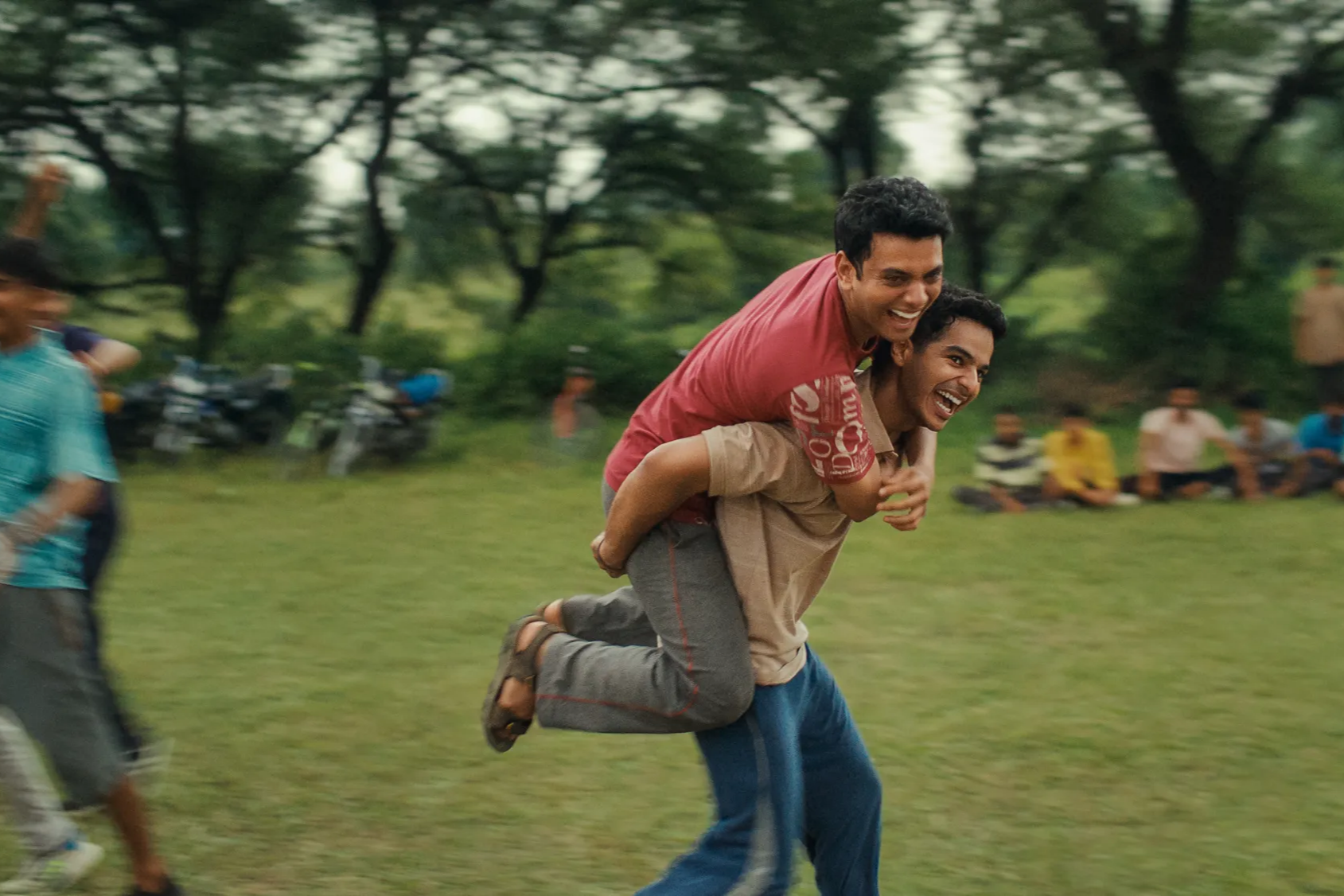
A still from Homebound (2025).
Through sensitive character studies and relationships, Homebound and Sabar Bonda pose urgent questions about migration and the life-altering distances between the metro and the village.
In Neeraj Ghaywan’s Homebound (2025), Chandan (Vishal Jethwa) observes his mother’s cracked heels, a result of her arduous profession as a daily wage labourer, and he speculates if she can afford to stop working, even at her advancing age. The heels are one of the major reoccurring leitmotifs in the film, as Chandan wonders if he will ever break the cycle and earn enough to ensure financial security for his mother.
Released in the same year, the Marathi film Sabar Bonda by Rohan Parashuram Kanawade features a young gay man named Anand (Bhushaan Manoj), who loses his father, and must give way to the stringent customs of his village. Anand is constantly reminded of all the things he cannot do while mourning the death of his dad: wear footwear, take refills in his meals, all before he must marry a woman, just as the man who left him once did.
In Sabar Bonda, bike rides turn into getaways, too, albeit romantic in nature. There is unfolding in both cases. Both films give the characters two shores just to themselves, with nobody walking in on them, enjoying the freedom to just be.
Chandan and Anand are just two of the main protagonists of two of India’s most acclaimed films in the past year. Despite their differences in their identities and idiosyncrasies, the characters of Chandan and Shoaib (Homebound) and Anand and Balya (Sabar Bonda) are all burdened and haunted by the weight of their roots. Homebound, in particular, poses hard-hitting, urgent questions that rarely find space in Hindi cinema: How much of India’s population can truly afford to educate their young ones? If metro cities run on the backbone of migrant workers, why did they have to take long, life-altering journeys back to their villages? Does a migrant ever become a native?
Sabar Bonda takes place in a remote Maharashtra village that both Anand and Balya call home. There is an inevitable expectation for both to find suitable women to marry. Instead, the two men find covert time together, making love to each other by the shores of a river, cloaked under a dwindling number of mango trees. The trees are a reminder of a childhood passed, of the decay of spaces that marked their togetherness. One wonders how long it will be before the river is polluted, too.
Mango trees aren’t the only thing disappearing; the titular sabar bonda (Marathi for cactus pear) has also become difficult to spot around the village. Even so, when Anand expresses a desire to eat one, Balya not only manages to find a plant but also removes the thorns from the fruit, leaving Anand free to devour it. In Sabar Bonda, Anand and Balya seem to create their own version of TikTok’s “Orange Peel Theory.” The question—would they peel an orange for you?—finds its answer here. Balya does something even more difficult, more exotic, for the man he loves.
In one scene in the film, there is a power cut, and sounds of clash from Balya’s house reach Anand’s house nearby and a loud question gives all the context needed: Why don’t you marry the girl your sister has chosen for you? In India’s hinterland, bachelorhood isn’t tolerated for too long. And mourning and social standing is clouded by quaint customs. Anand is prohibited from wearing footwear for ten days after the demise of his father. Balya sneaks out a pair of red chappals for Anand from his house. It isn’t as much an act of love here, as it is of friendship.
This moment is similar to the scene where Shoaib rents a bike to drop Chandan on the first day of his college in Homebound. Shoaib and Chandan frequently meet and unfold their oppressed selves by a water body, which is maybe not as cold or unpolluted as the one that Balya helps Anand walk into. In Sabar Bonda, bike rides turn into getaways, too, albeit romantic in nature. There is unfolding in both cases. Both films give the characters two shores just to themselves, with nobody walking in on them, enjoying the freedom to just be.
Roots in both films are tricky terrain. Anand travels to his village with the dead body of his father. He wears a grey T-shirt, but the colour is dark, and he is bickered at by fellow villagers for wearing an inauspicious black. No matter how hard he tries to correct them, he fails. It is not about the difference between black and grey. Rather, it acts as a premonition for the deeper truth: People who think that some colors are more auspicious than others are less likely to grant his homosexuality as an excuse against marriage.
Through Anand’s character, Kanawade expects the audience to be able to grasp this truth, too. Anand’s mother (like his dead father) is accepting of his identity, but when his cousin asks if a woman betrayed him for someone else, Anand has to go along with the lie. We realise that, despite all the beauty and glimmer of his village, there is no hope or freedom for him to love.
In this port-city by the sea, the lines of caste and religion look less evident. But there is another crisis connecting them: They are both migrant workers stuck in an alien space, and the government has announced an indefinite lockdown to curb COVID-19 cases.
Perhaps it isn’t all about the roots: Identity runs across both the films. Homebound’s Chandan is Dalit and struggles to put SC as his category in job and college forms. In a scene where he is conversing with an upper caste government official about the delay in the results of a Police Bharti exam, he lies to him that he is a Kayastha. The official proceeds to ask him his gotra (sub-caste) and Chandan replies ‘Bharadwaj.’ For the unaccustomed, it may seem that Chandan has been successful in his fallacy and gotten the caste solidarity support from the official. But the caste-conscious audience as well as the government official in the film are aware that ‘Bharadwaj’ is not Kayastha but a Brahmin gotra.
Meanwhile, Shoaib, a Muslim, works as a peon at a corporate office. On his first day at work, a ‘Tripathi’ tells him to not fill his bottles. In another scene, in a village cricket match, an argument over foul play leads to Shoaib being verbally and physically abused. “Go play with your kind,” he is told, as Chandan runs to protect him. Later, despite winning the deserving man of the match, Shoaib’s teammates don’t allow him to touch the winning cup. Ghaywan clearly suggests that untouchability and the idea of purity are not only rooted in caste, and that there isn’t a lot of difference between the untouchability that both Shoaib and Chandan are subjected to.
Sabar Bonda isn’t as blunt as Homebound in showing the oppression of its protagonists. Anand is clueless about processing the loss of his father through most of the 10 days of mourning. He is lost, and the lists of things he cannot do only makes it harder to get by. Having Balya by his side helps, even as their relatives keep wondering why they hang out so much with each other. Gladly for them, the relatives fail to join dots, and imagine that Anand-Balya could be doing riskier things than just goat-grazing together, that while the goats graze, they lie naked under a tree, juxtaposed besides each other, with specks of sunlight warming their cold, uprooted bodies. In the absence of sunlight, after they come out of the cold waters of the unnamed water body, their bodily warmth suffices.
Much of Homebound is based on Basharat Peer’s New York Times article about the pandemic, and in the second half of the film, Chandan and Shoaib find themselves in Surat, working at a textile factory. In this port-city by the sea, the lines of caste and religion look less evident. But there is another crisis connecting them: They are both migrant workers stuck in an alien space, and the government has announced an indefinite lockdown to curb COVID-19 cases. An old guard working in the factory tells them that the reason he isn’t going home is because he is afraid to lose his job. With factories not allowed to function and public transport redundant, both take the long way home in the middle of peak summer. Hysteria is rampant: only a lone veiled woman dares to offer water to the two thirsty friends, her cracked heels reminding Chandan of his mother.
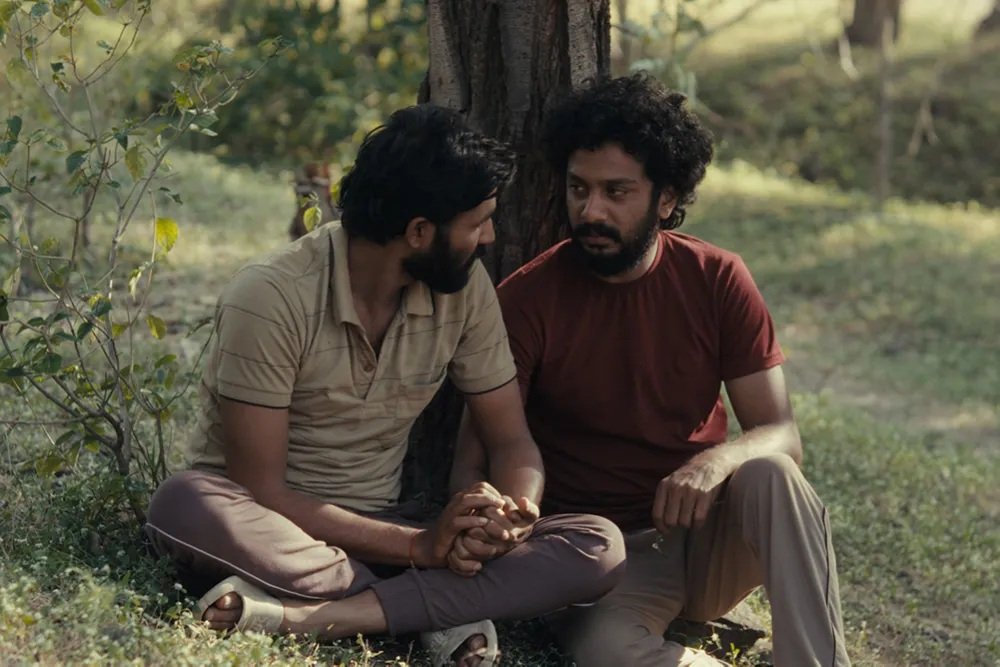
A still from Sabar Bonda (2025).
This the last trace of his mother he will ever encounter. Chandan dies of a heatstroke beside the highway and an aerial shot shows him lying dead in Shoaib’s lap. Perhaps for some like him, there is no homecoming.
In Sabar Bonda, Anand brings Balya to Mumbai, with the Arabian Sea having become a lore-legend of sorts. Balya asks him, “How far is the sea from your place?” Not only does he tell him that it’s half an hour away; he also tells him that he will take him to the beach over the weekend. Anand struggles to make sense of the loss of his dad until he is in Mumbai, perhaps because mourning back home was a performative act made of obscure rituals and prohibitions. In Mumbai, however, he breaks down in Balya’s arms, after almost two weeks since his dad’s death. Perhaps in a cramped apartment with dim-light and kitchen separating the sole room from the washroom, the pressure to marry a woman is as remote as his scenic village.
Education as a step towards social upliftment is common in both the films. The reason Anand does reasonably well for himself is because he studied in the city and knows English. Balya on the other hand didn’t study much, does meagre daily wage jobs, and aims to be a driver in Mumbai. Chandan joins college to spend time with the woman he loves, while Shoaib tells him to do a job to support his family. Education isn’t easy for any of them; every day attending school or college is one less day of dihaadi (daily wage). But Chandan realises that a good education can eventually make it easier to bridge the gaps created by society.
Near the end of Homebound, on the way back to their village in an ambulance, where Chandan lies dead beside him, Shoaib looks through Chandan’s belongings for his documents. Inside Chandan’s wallet, Shoaib finds a photo of B.R. Ambedkar and two filled college forms, one of which belongs to Shoaib and another to Chandan, with a tick against the “Scheduled Caste” column. Among Chandan’s belongings is also a box containing a new pair of slippers for his mother. It is the last symbol of the tremendous weight of the journey.
Shoaib hands the slippers to Chandan’s mother, who breaks down in tears, before the film cuts to Chandan’s funeral pyre. His ashes dissolve into the twilight sky, leaving us to hope that her cracked heels might heal with the gift she has received from her dead son. In death, the slippers succeed in binding Chandan to his home.
***
Sarthak Parashar is an alleged cinephile (even though he has neither watched Nolan or Scorcese), freelance journalist, unapologetic lover of art, and Lata Mangeshkar fanboy. The lovechild of Chanda from Anurag Kashyap's Dev D and Tara Khanna from Made in Heaven, he finds solace in films, the literature of Jhumpa Lahiri, ghazals sung by women, and gossip from r/BollyBlindsNGossip. Based in Delhi, you can find him on Instagram @curlsandmockery.