Flow of Conversation: Zahir Mirza’s podcast from Kerala’s waterways
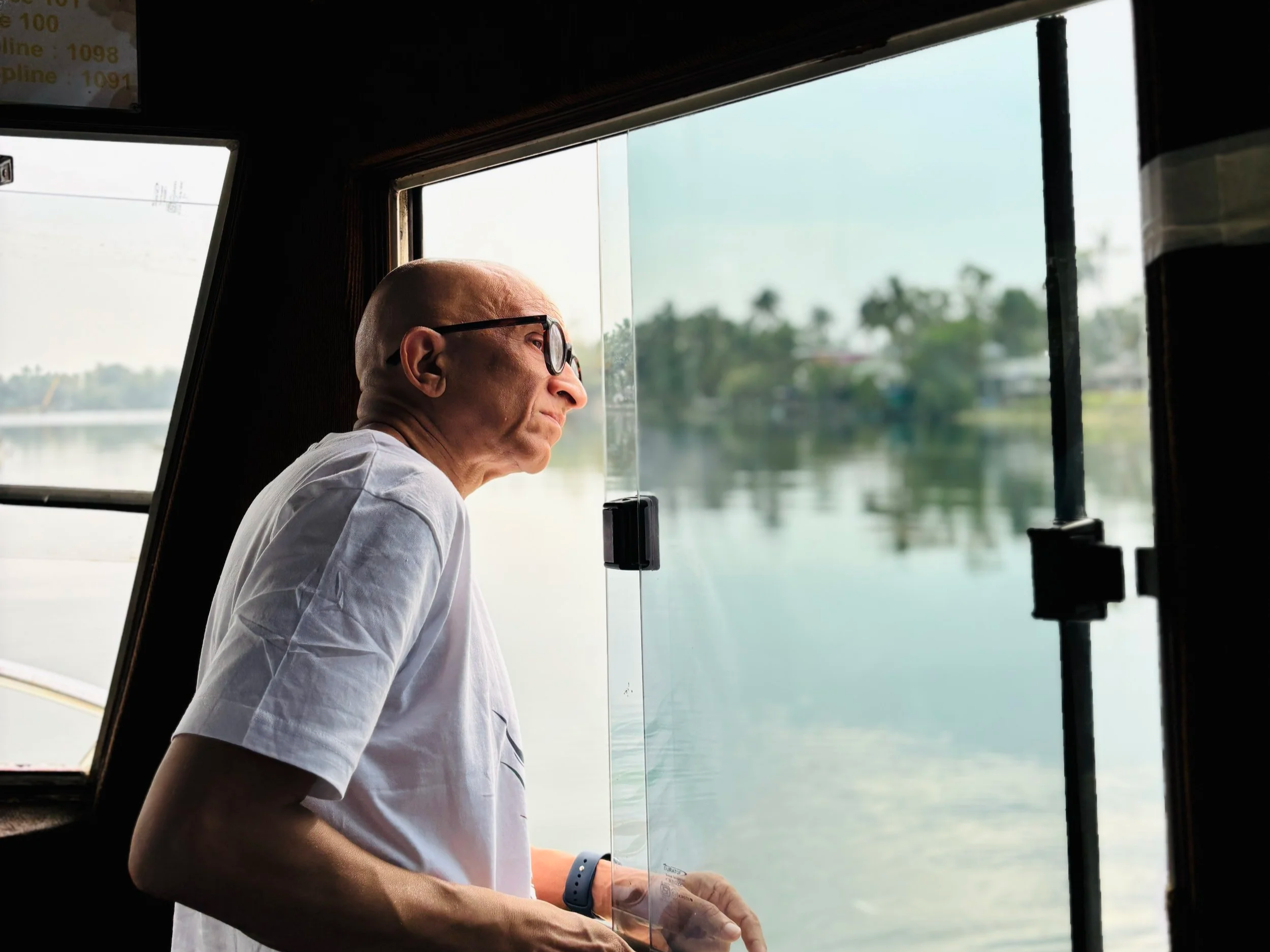
Interview: On “Float with Boatcast”, Zahir Mirza takes his guests on a cruise through lakes, rivers, and seas to discuss topics of interest on Kerala and beyond
Water bodies play an undeniable role in shaping culture, livelihoods, and lifestyles, especially in a country like India, which is home to numerous rivers and is surrounded by oceans and seas. More specifically, the Malabar region in the southern state of Kerala has had trade relations with far flung lands via sea routes. The ancient port of Muziris had facilitated trade with the Graeco-Roman world, as well as with West Asia, China, North Africa, and other far-reaching regions. The sea also played a major role in the development of religion in the region, with Christianity, Judaism, and Islam finding a foothold through trade and migration via the waterways.
It is the calling of the water that inspired Zahir Mirza’s Float with Boatcast. Instead of recording a podcast within the confines of a room or a studio, Mirza takes his guests on a cruise through lakes, rivers, and seas to discuss topics of interest on Kerala and beyond. This approach allows listeners to ‘float’ along with the host, experiencing the flow of the waters that define the region.
Mirza is an artist, brand consultant, educator, and mentor. The Boatcast initiative came about as part of the Amphibian Aesthetics exhibition, organized by Aazhi Archives at Ishara House, and supported by Muziris Heritage Project. So far, the podcast has included guests like Prof. Michael Thakaran, a historian and scholar of Development Studies, who spoke about Kerala’s early development; Sharon Veetil, the Managing Director of the Muziris project, who discussed heritage, tourism, and history, particularly with regard to the fabled ancient port of Muziris; Sreekala Sivasankaran, a former associate professor at the Indira Gandhi National Centre for the Arts discussed Kerala’s ancient Jewish traditions, shed light on one of the many communities that have been influential in Kerala’s history; and many more.
In an interview with The Chakkar, Mirza discussed the unique approach to podcasting, the many stories of Kerala, and how being on water influences his conversations. Edited excerpts:
The Chakkar: The idea of a podcast on a boat seems really unique, but it is also fitting, considering we’re discussing the history and culture of a region deeply influenced by the waterways. What made you pursue this concept?
Mirza: It was a no-brainer! For one, the number of waterways in the world is much higher than that of roadways. We are just not usually cognizant of that. Civilizations and cultures were built around water. While the podcast is about Kerala, this is not true just for Kerala. It is true for every other place. Look at its neighbours: the Kaveri’s water plays a major role in spiritual traditions in many nearby regions. It is similar in Maharashtra with rivers like Godavari. This was an idea waiting to be taken, and I took it!
The Chakkar: So, how did being on a boat during discussions affect the flow of conversation, if you don’t mind the pun?
Mirza: I love puns! The thing is, if you’re in a room and doing a podcast, you’re looking at a wall and thinking about something—looking into the future or the past. When you’re sitting in a boat, you’re looking at the horizon. You’re looking at the sea, and at never-ending imagination. You’re looking at the vast history. The sense of expansiveness comes in automatically. That’s the main difference. A podcast studio is a box. A boat isn’t a box. It is open and you can see the horizon. We float with the stories.
The Chakkar: You are based in Mumbai—but what made you decide to focus on Kerala?
Mirza: So, in Kerala there was the (Kochi Muziris) Biennale, and other exhibitions going on, and we were able to find an opportunity for funding. The ‘Boatcast’ needs funding—we need money to hire a boat, hire a crew etc. Any podcast requires some amount of sponsorship. Aside from that, Kerala itself has 44 rivers, right? So, there’s a lot to do in Kerala. Look at any part of Kerala, you’ll find a waterway!
“When you’re sitting in a boat, you’re looking at the horizon. You’re looking at the sea, and at never-ending imagination. You’re looking at the vast history. The sense of expansiveness comes in automatically.”
The Chakkar: What are some of the routes you take during the podcast sessions?
Mirza: In one session, we started from Fort Kochi, and went up to Mattancherry. Another time we started at Bolgatty and went around Kochi itself. Now I want to go to Alappuzha and Vembanad Lake as well.
The Chakkar: There have been lots of different topics discussed in the podcast, including development in the region, the ancient port of Muziris, and music. How do you choose the people you talk to, and the topics you discuss? Are there any particular topics you’ve found especially interesting?
Mirza: I do not choose the topics—the topics choose themselves. If someone has an interesting story to tell, we get them on the boat.
There are many scholars who participate, and their work is usually confined to scholarly archives, PhD tomes, or some conferences. I want it out in the open for the average young student, or enthusiast or anyone of any age, who’s interested in what they are saying. I don’t prefer any of these subjects over the other. Each one is my top preference!
The Chakkar: You have a background in advertising and communications. Has that influenced your work with the podcast?
Mirza: Yes… If it were not for [this background], I wouldn’t have been able to have sharp and focused conversations.
The Chakkar: Do you have a favorite podcast episode so far, you’d like to elaborate on?
Mirza: I honestly can’t pick a favorite episode. Asking me to elaborate on one feels a bit like asking a painter which colour in the composition matters most. They only work because they are all there together.
The Chakkar: Are there any specific challenges you faced while recording on water?
Mirza: Yes, recording on water was challenging, as it picks up the sound of the boat and the wind. Also, compared to a regular shooting situation, it was quite dehydrating.
The Chakkar: So, what are your future plans for the podcast? Is there anything new you want to do with it or any changes you’d like to make?
Mirza: I actually don’t think much about the future, I think only about the present, and that has kept me in a happy state. I am open to talking to the Government of Kerala as well about [the future], because there are stories that need to be told.
***
Nileena Sunil is a writer, journalist, and book reviewer. She has had her work published in Strange Horizons, Flash Fiction Magazine, On Eating, Usawa Literary Review and other places. You can find her on Instagram: @nileena_sunil.