The City and its Layers: An interview with Ruchir Joshi on GREAT EASTERN HOTEL
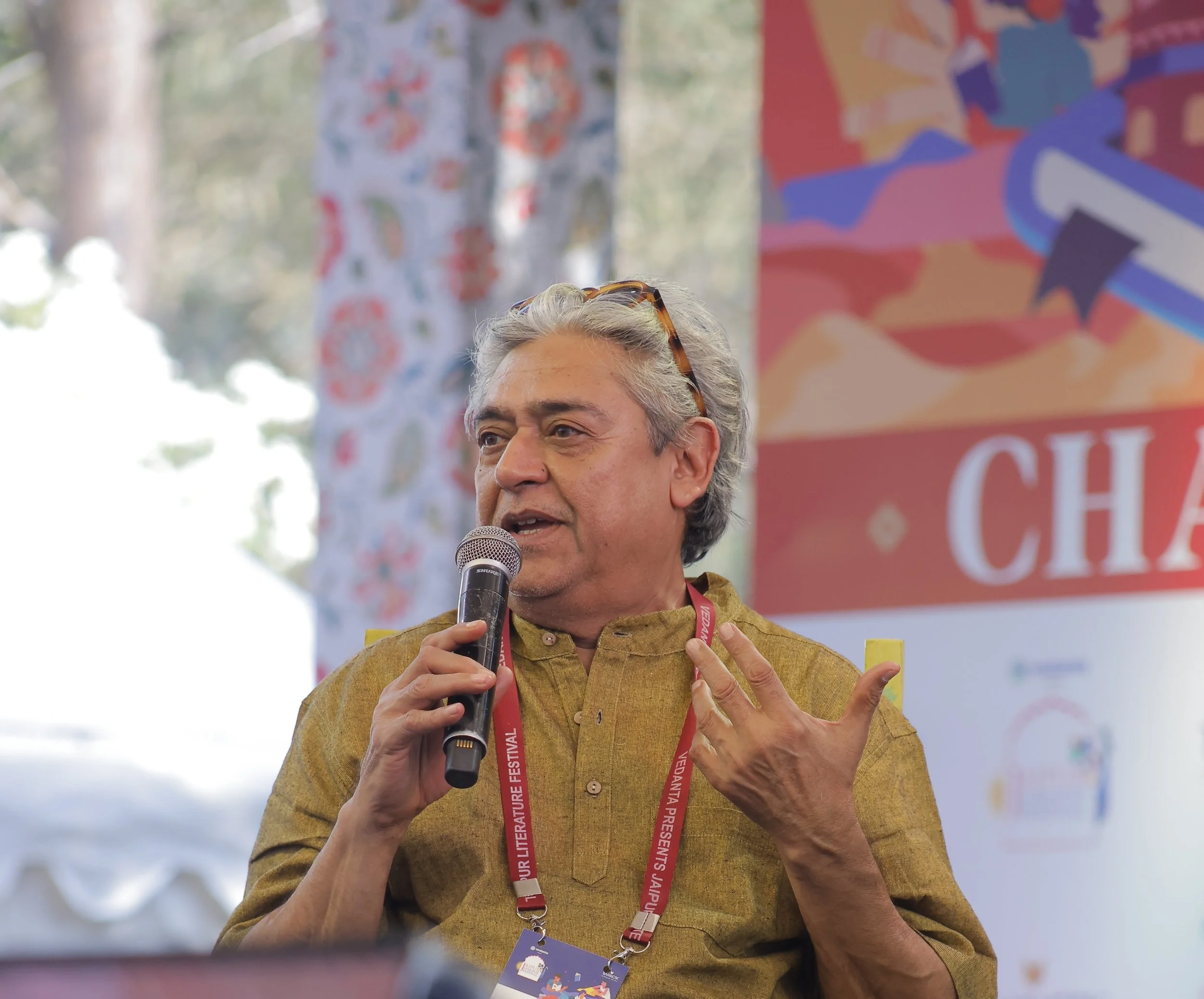
Q&A: Ruchir Joshi speaks about Great Eastern Hotel—a novel of changing times and changing minds—about Calcutta, and his inspirations from art and memory.
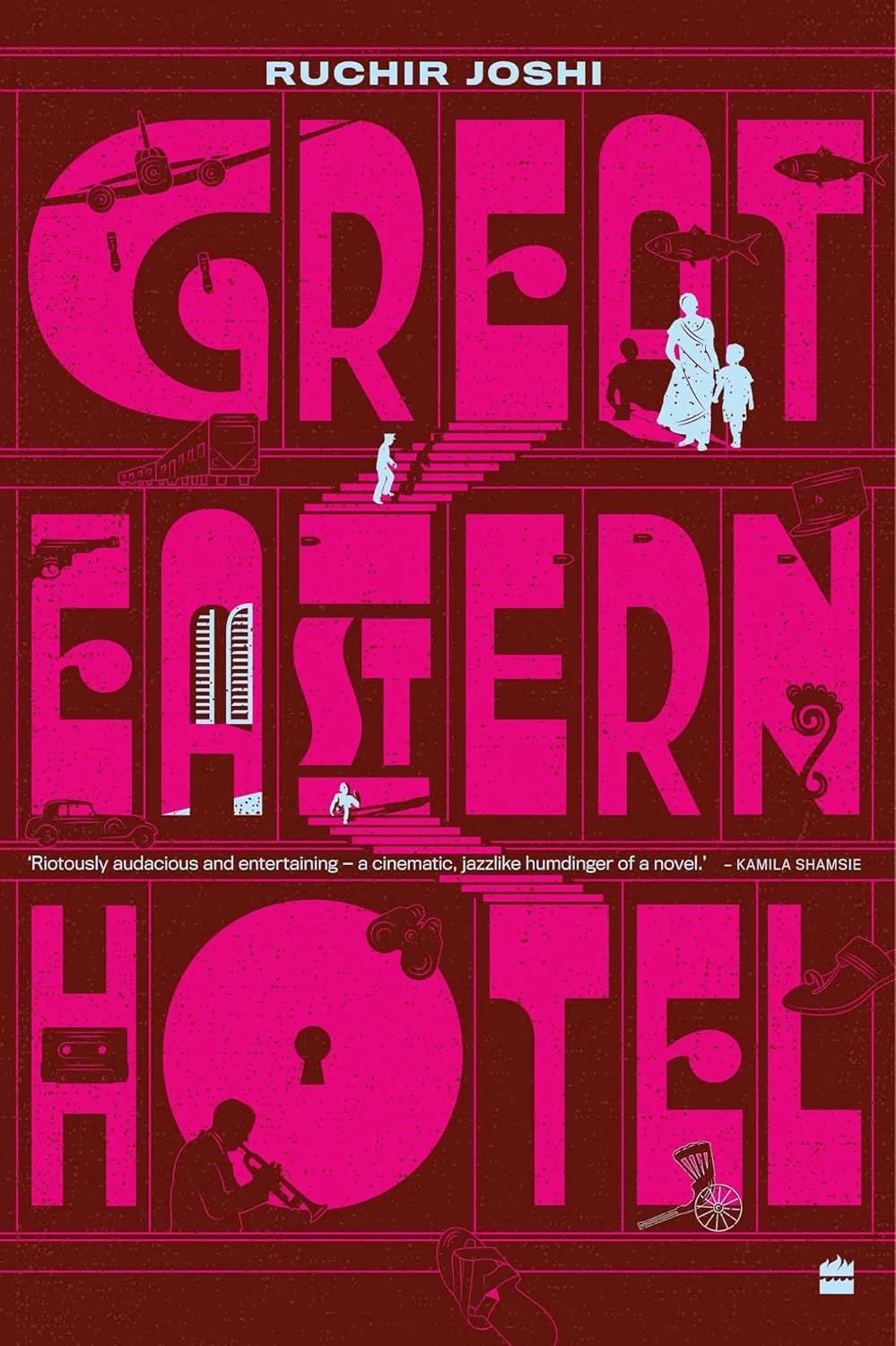
Ruchir Joshi’s Great Eastern Hotel (Fourth Estate, 2025) is a novel of changing times and changing minds. A sweeping, polyphonic story set primarily in 1940s Calcutta during World War II, it is framed in the late 1970s by a narrator, Saki, the “architect-engineer” piecing together the past, sifting through old tapes and letters to reconstruct the city’s history. Through the lives of four drastically different characters in a city facing military blackouts and the looming threat of a Japanese invasion, the book is an exploration of how art and memory persevere even when—especially when—a society is pushed to its absolute breaking point.
Their overlapping journeys are anchored by the titular Great Eastern Hotel (once called the “jewel of the East”), a luxurious microcosm where American and British military elites seek refuge, completely insulated from the violence knocking just outside its doors.
Amid fading lights and fading sounds of the Jaipur Literature Festival earlier this year, I met Joshi for a chat near a desolate staircase, away from the hush-rush of the media lounge (indeed, a microcosm in itself). We spoke about Calcutta, the people of the city, its music, the inspirations from art and memory, and of course, Joshi’s latest book, which won the Crossword Book Award for Fiction in 2025. Edited excerpts:
The Chakkar: Calcutta is often described in extremes—there’s decay, there’s romance, there’s intellectualism, there’s ruin. What has been your personal relationship with this city?
“As I was writing, I realised it was a metaphor for the whole city, because the whole city becomes like a hotel, receiving wanted and unwanted guests, guests who will check in and check out, or stay there forever.”
Joshi: Well, it’s many cities layered on top of each other. The time I’m talking about—at the beginning of the novel, at the beginning of the war—Calcutta is a city of 2.3 million people. The British had moved the capital to Delhi. They could move the bureaucracy and the viceroy there, but they couldn’t move the vibrancy of Calcutta. So, it is still the cultural capital; it is a political centre of great importance in the nationalist movement and supremely important for commerce.
All the head offices of international companies are there, the port is there, the jute industry, the tea industry, the steel industry, the construction industry... At that point, Calcutta and Bombay were not that far apart in terms of economic importance to the country, the two pillars on which the subcontinent stood. Nothing was comparable. Karachi was a port and all that, but Bombay-Calcutta was the axis.
My book begins the day Tagore dies. For me, that is the arc of a certain ending, of a certain period in Bengal, of the Bengal renaissance, of a certain sensibility. That sensibility is already fraying by the time Tagore is in his 70s; he dies at 80. At that funeral, everyone pours out onto the streets, and my four characters are there among them. One is a young English woman whose father is in the Raj—she is trying to engage with the city and understand what it’s about. One is a young man from a wealthy Bengali family who wants to be a painter, deeply interested in culture and the arts, and he is there because Robi Thakur has died.
Nirupama is a young, lower-middle-class girl whose father is a theatre set designer and whose mother is a school teacher; she is secretly a volunteer with the student wing of the Communist Party. She goes deeper and deeper into the communist movement. Kedar goes deeper and deeper into painting. Imogen goes deeper into her engagement with the people she meets.
And finally, the fourth character is a pickpocket called Gopal. He is working the crowd at Tagore’s funeral, but that night, he is pulled into a much higher level of crime, one from which he never returns.
There are other characters too, but these are the four main ones. Between them, the whole weave starts to happen. As the history of Calcutta unfolds—first the refugees from Burma, then the famine victims, then Partition—and by the end of 1950, it is suddenly a city of 8 million people, four times its earlier size. Try to imagine that with Bombay or Delhi today; the mind boggles. Whoever was living through it, that was the scale. Their city had quadrupled around them.
And then there is a person looking back from the 1970s, doing an archaeology of what happened, who happened, and when, meeting some of these characters in their older years, finding out what they were like in their early twenties, who they fell in love with, who they split up with, where the violence was, etc. So, that is that story. It’s a portrait of a city, but it’s also very much a story of four young individuals making their way through turbulent, dangerous times, where you don’t know what's around the corner.
The Chakkar: You build a novel where the hotel is both a setting and an instrument, like a machine that pulls strangers into the same weather system. Was that an evolution or something you had in mind from the very beginning?
Joshi: I was interested in Calcutta at this time, and I also knew that the Great Eastern Hotel was a hub for jazz and for all kinds of people passing through. There are many novels about Calcutta at that time, but they are mostly by Bengali writers writing about Bengali people. I didn’t know of any novels that talked about a mix of Europeans, Americans, Bengalis, Biharis, and others who were there.
So, I began with the idea of the Great Eastern Hotel, but as I was writing, I realised it was a metaphor for the whole city, because the whole city becomes like a hotel, receiving wanted and unwanted guests, guests who will check in and check out, or stay there forever. That’s why the book is called ‘Great Eastern Hotel’ and not ‘The Great Eastern Hotel’.
The Chakkar: In the novel, your narrator borrows an idea from the architect Louis Kahn: that you can only really see a building’s true bones when it becomes a ruin, because the daily hustle and bustle of a ‘live’ building distracts you. You construct this book like a ‘story-hotel’, intentionally treating the 1940s history of Calcutta as an abandoned, ruined structure. Did you choose this approach specifically to expose the plumbing—the hidden, messy human motives, survival instincts, and secrets of the era—that traditional history may not include?
Joshi: Yes. I was looking at that period of history as a building. When that time has passed, you’re left with the ruins of it—the traces, the markers of the architecture—and then you start to get a different idea of what that time was really about. There is also the artist M.C. Escher, who created precise drawings, optical-illusion etchings of stairways that move into each other or of birds turning into fish. The stories in the novel work the same way: they melt into each other and change shape across the book.
“In that sense, it’s important for every artist to have a bad moment, a crisis, an accident, an unexpected ambush in their work. Suddenly, you realise: if I do this, this is how I’m different. A lot of people start on a well-trodden path, stumble off it, and only then create their own”
The Chakkar: You are also a columnist, and novel-writing is obviously very starkly different from writing a long-form piece. Were there any struggles in that process, like the sensibility of a columnist or a journalist that came into play?
Joshi: No, because for me, column writing is a daily professional thing. I do it as a day-to-day way to pay the bills. It’s how I earn my money, one of my professions. That writing is of a very different quality. I’m commenting on current politics, current culture, travel, things I’ve experienced. I’m trying to explain things simply, explain them for a particular readership, or to bear witness.
Whereas in the novel… I can be poetic and free, let my imagination roam, and construct something from scratch. The voice and the tonality are completely different. It would be like doing two entirely different things, even though it’s the same keyboard, the same computer, the same Word document.
The Chakkar: In the book, the painter Kedar desperately wants to create ‘great’ art about the Calcutta famine, but his own conscious ambition and guilt get in the way. His first true masterpieces—the ‘Slippers’ paintings—happen entirely by accident, painted absentmindedly just to blow off steam. The German engineering term ‘Sollbruchstelle’, meaning ‘planned breaking point’, is used in the novel. Do you believe that when faced with immense tragedy, an artist’s ego has to reach a breaking point—and completely shatter—before they can stumble upon the real truth in their art?
Joshi: Well, I don't think the artist can have a planned breaking point of the ego. It always has to be an accidental one. When Kedar begins, his idea of painting is landscapes, still lifes, portraits—the kind of work done by the people he loves, the Impressionists. He’s very scathing about the Cubists, doesn’t really like the Surrealists, but he’s young and naive and, in that way, a little stupid. He has talent, but he’s not interested in that kind of art. He’s interested in a certain pleasure of rendering—landscape, light, colour.
From that aestheticism, he’s constantly surrounded by larger events. When later in life, he actually gets a chance to paint a landscape the way the Impressionists painted, he finds he can’t. He’s painting from memory the events he has witnessed, interpreting them as a painter would, making figurative narrative paintings he hadn’t expected to make.
And that’s the nature of art. You start somewhere, but if you follow your spirit—if you are honest and intelligent—you go where the work takes you. You can direct your work up to a point, and then the work directs you. It’s always a dialogue, a give-and-take. Your ego breaks, your preconceptions break, and that break is all-important. It’s a crack that lets the light in, as Leonard Cohen has said.
In that sense, it’s important for every artist to have a bad moment, a crisis, an accident, an unexpected ambush in their work. Suddenly, you realise: if I do this, this is how I’m different. A lot of people start on a well-trodden path, stumble off it, and only then create their own, accidentally, but through hard work too. It’s a mixture of the two.
The Chakkar: The novel has a non-linear, polyphonic structure, particularly in how the “dots” of memory for characters like Elko and Niru overlap without ever forming a neat resolution. Would you say it mimics or tries to mimic memory? As Nirupama suggests, memory is not like the rings of a tree but like an onion, where trauma acts as a knife that scatters the layers.
Joshi: Memory can be shaped differently, and you can have many different analogies for it. Memory is like architecture. Memory could be like the rings of a tree, or the layers of an onion. Memory could be like different rivers flowing into each other and out of each other. There are many metaphors available, and memory itself is, of course, a subject of the novel; it's the subject of many novels. Most novels are somewhere about memory: what you choose to remember, how you choose to remember it.
But the model for this novel was not so much memory as music. I started with one structure—an Indian classical structure—a khayal or a dhrupad raag performance; you start with an alaap in the madhyalay, then a dhaptal, then a prikartal. But at the same time, I heard a concert composed by Julius Eastman, a piece for four grand pianos, all equal, moving in and out of each other.
My four characters became like those grand pianos, moving in and out while the raag structure held beneath. These two musical ideas were running through my mind while I was writing. Maybe that was just for me, maybe the reader won’t get that, or perhaps they might on a second or third reading. But structurally, that’s what kept me going through the writing of the book.
“Memory is like architecture. Memory could be like the rings of a tree, or the layers of an onion. Memory could be like different rivers flowing into each other and out of each other. There are many metaphors available, and memory itself is, of course, a subject of the novel”
The Chakkar: Your sentences indeed have that sort of rhythmic intelligence, a musical riff going on in themselves.Do you find yourself editing for sense or for sound?
Joshi: I edit for both. Sound delivers sense, and sometimes to deliver sense, you have to shed extra sound. I generally don’t like using long words or too many descriptive sentences. I sometimes let dialogue do the talking. Sometimes, if you know enough about a character’s internal landscape, I’ll bring them into a situation and describe it without describing what the character is feeling, and let the reader work it out. This is why people refer to it as a filmic quality, which it is. But it’s not just filmic. You do get inside the characters, inside their psychology, and then you drop that and suddenly find yourself outside them again. Readers are expected to join some dots somewhere.
The Chakkar: The Great Eastern Hotel acts as a luxurious, air-conditioned sanctuary for the military elite, completely insulated from the blackouts, riots, and famine tearing apart the streets of Calcutta outside. You describe its atmosphere as a “classy cage” and a character calls it a safe “neutral territory” devoted entirely to “booze, broads, and billeting.” Did you design the hotel to function as a microcosm, a space successfully segregating the privileged from the suffering city, but still ends up mirroring the complex ‘parallel wars’ of race, colonialism, and global conflict being fought just outside its doors?
Joshi: It doesn’t mirror it exactly, because the wars in the street are very different from what’s inside the hotel. The hotel has a segregation of class: the lowest cleaners and waiters, then the senior staff, then the guests, and among the guests, the normally wealthy Indians, the Maharajas, and then the white people. So, you have all these hierarchies and colour bars inside. Outside in the street, it's much more of a mess, much more chaotic. It’s not an exact mirror, but it’s an island that reflects, is impacted by, and, in its own way, impacts what’s going on outside. The administration and the people who make the decisions are also at the hotel, so there is give-and-take between the city and the hotel.
The Chakkar: To conclude, tell us of the books you are reading right now.
Joshi: I’m reading Rahul Bhattacharya’s Railsong, which I think is a great book. It reads weirdly nicely alongside mine. They are linked in a strange way. I’ve just finished Jeet Thayil’s The Elsewhereans, which I think is one of the best books to come out of India, ever, but certainly in the last year. I’m looking forward to Anuradha Roy’s new book about the hills, and my friend Christian Kracht's book Eurotrash, and there’s a whole bunch of other novels piled up that I can’t wait to get to.
***
Amritesh Mukherjee is a journalist, writer and editor. He doesn’t know what to do with his life, so he writes. He also doesn’t know what to write, so he reads. Outside of his day job, he vociferates on his bookstagram: @aroomofwords. You can find him on X: @aroomofwords.