Curiosity Is a Liberating Force: A Conversation with Rahul Bhattacharya
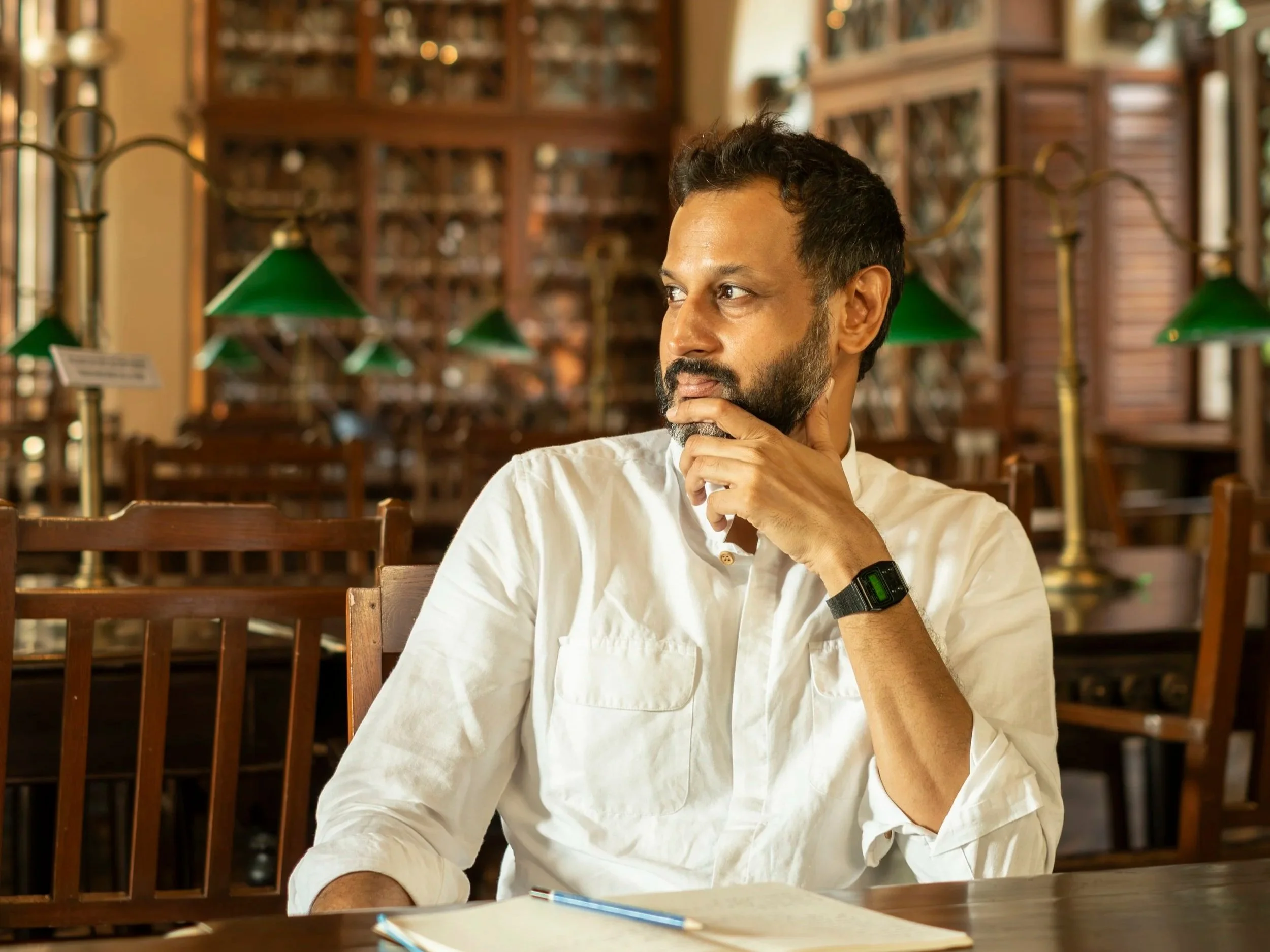
Photo: Neville Sukhia
Rahul Bhattacharya speaks about the musicality behind Railsong, the taxonomical motifs at the heart of his novel, cricket journalism, and finding inspiration in Toni Morrison.
The last national census conducted in India was in 2011, 15 years ago. A generation has passed without the nation discovering the specifics of its own demography. For an individual, the act of self-definition is largely qualitative. For a government or an institution, however, such numbers and metrics—the quantitative methods and the outcomes they reveal—are essential in everyday decision-making. The importance of this process is only underscored by its ultimate reveal: The image of the nation it helps construct, as opposed to its perceived self-image.
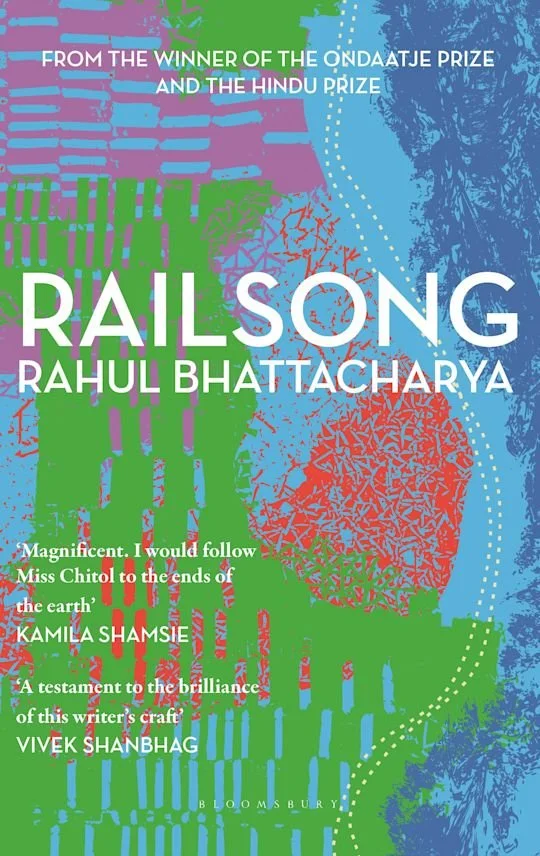
In this exercise, no matter how sophisticatedly conducted, what’s usually lost is an individual or collective journey, which no survey or census can capture: the emotional truth. The RSL Ondaatje Prize-winning author Rahul Bhattacharya’s Railsong (Bloomsbury, 2025) does a better job at presenting one such journey. Leveraging the railway metaphor, the author ties national memories from 1960s through 1990s with the personal ones of its principal protagonist, Charulata ‘Charu’ Chitol, presenting an alternate social history of the nation.
Railsong’s opening sentence reveals a three-year-old Charu’s desire to “count people”. The short chapter is titled Arrival, and towards the end one is informed about a lingering absence in Charu’s life—her mother, Jigyasa. Living in the railway township of Bhombalpur, the three siblings—Charu, Dhrubo, and Anando—are being raised by their grandmother, Nistarini Debi. Characteristically of her time and age, she’s baffled by what she considers Charu’s wayward ways. While Charu’s father, Animesh Kumar Chitol, isn’t entirely bothered by it, he wants to preserve familial peace. He speaks in moderation, is assertive, but reveals himself comical only in the presence of Mrs Pearl Flanger, making a young Charu wonder, “why was he being this way?”
Overcome by grief and familial duty, Mr Chitol is usually away at work. He’s a chargeman at the railway workshop. To manage the household in the absence of Jigyasa, Notun Dida arrives. She’s a nanny and a relative. She was compelled to provide these services ever since she was young, having lost her husband and being “widely held accountable for the excellent young man’s fate”. Chitols’ was her sixteenth house. Let us consider it for a moment: What will the census tell us about Notun Dida?
These moments of reflections are what Railsong offers as gifts, as the reader finds themself witnessing ghastly scenes of the Bihar famine of the late 60s in the early chapters, and the organizing and misgivings of officials when faced with the situation. Charu experiences signs of womanhood and feels giddy adventuring with her friend Salima. These moments are followed by her arrival in Bombay, where she hopes to make something of herself. She manages work amidst heartbreaks, and lives first with her maternal uncle and aunt, and then independently in a hostel. Through her journey, Railsong also captures an in-betweenness of a working woman’s life, at a time when India wasn’t used to having women earning outside their homes.
What does independence mean to Charu anyway? She finds herself clutched by her past, unable to reconcile with the death of her mother, trying to make a place for herself workwise and otherwise in the unforgiving city. What did her calculations amount to when she thought “freedom could be hers in three months” but it was nowhere to be seen? Or what sort of relationships she’d end up being in when she isn’t herself sure of who she is?
It’s fitting that many of the questions Charu has had over the years get addressed in an atypical fashion through the metaphor of this book. For example, a product of asavarna marriage, it “did not strike [Charulata] at all”, the “privilege of her caste going unrecorded”. It’s during her time at the railways as a welfare officer where she learns how your identity can be used against yourself because for the system there’s little difference between ‘life’ and ‘file’: “for one person the file is his life, for the other a life is just a file”. If your life can be dictated by files and documentation, then what becomes your worth isn’t posed, but alluded to in Railsong, which submits for its readers’ consideration: “In the end what becomes our truth is a negotiation.”
If your life can be dictated by files and documentation, then what becomes your worth isn’t posed, but alluded to in Railsong, which submits for its readers’ consideration: “In the end what becomes our truth is a negotiation.”
For this interview, Bhattacharya and I have had a series of negotiations as well. We discussed Railsong first at the Puri LitFest at the World Book Fair on 10th January this year. Then, we interacted at the Kerala Literature Festival, and followed it by telephonic and email exchanges, in which Bhattacharya talked about working on Railsong for over a decade, his previous works, cricket journalism, taking inspiration from Toni Morrison, and more. Edited excerpts:
The Chakkar: You wrote Railsong by hand. Was it an organic choice to capture the emotional register of the time?
Bhattacharya: The reason I could not write this novel on the computer is this horrible invention called The Internet. I should take responsibility here. I would want to check if I was getting something right, or search the subject matter, and I’d be going down rabbit holes. This kind of information-gathering destroys the sanctity of what you’re trying to create. Fiction asks that you sit still and descend into a space of creation.
I read that Toni Morrison wrote her first drafts by the early light, on yellow legal pads using 2B pencils. I bought myself these legal pads; I got myself 2B pencils, a sharpener. I started working at dawn. Having done that, I was able to tune into the time and place of the novel, so you’re right in a way. The paper and the pencils were the portal. The railway quarters where the novel begins in 1961 did not even have telephones. It was very much a handwritten era.
The Chakkar: Your mention of Toni Morrison reminds me of your interview with Samanth Subramanian in this anthology by Sonia Faleiro, How to Write: Writers on Their Craft. In it, you note how the voice element struck you reading Jazz. Did it inform you in capturing Charulata’s voice, craft-wise? Given that even the narratorial voice is markedly textured, Railsong appears like a cauldron of the ‘I’ book, interiority-heavy pages alongside traditional, classical storytelling.
Bhattacharya: I thought of using technique to create a layered reading of Charulata Chitol. By a sleight of hand within the omniscient third-person narration, we’re often following Charu in close-third person, the free indirect style. Sometimes, though, we’re observing her through other eyes. For example, in the chapter “Shameless”, Bhagmati Prasad, her mami, is watching her on the street from the terrace, fuming, and we happen to learn about the action at that point from the aunt’s perspective. Then, sometimes I break away from the free indirect style into the first person—that happens only twice in the novel.
About Toni Morrison: I think she’s invincible at the level of the sentence. The urban space in Jazz particularly, the coming into the city of country people, is described so vividly, with such poetic precision—that stayed with me and, if anything, that might have come into Railsong.
The Chakkar: I think musicality in writing interested Morrison. Whenever I think of musical prose though, I’m reminded of Paul Auster, who thought of writing prose as composing something, and it’s funny that the word ‘composition’ has been hijacked by the music industry.
Bhattacharya: I used to rely a lot on music for a sense of rhythm and how words work with each other and how sentences play off each other. For a sense of mood, too.
The Chakkar: Railsong begins with Charu’s curiosity to count people. Help us understand this taxonomical idea that’s central to the book.
Bhattacharya: The counting of people—literally, the census—is a definition-providing exercise. It offers us crucial details of how many we are; it subdivides those many into types, and how those types are distinct from one another. But Railsong, being a novel, is alive to the idea that people can be contrary to their definitions, that there are not-so-obedient instincts and experiences in us.
Charu is the product of a Bengali Brahmin and Bihari Kayastha marital union, brought up in the low-fi cosmopolitanism of an industrial township then a runaway in the booming metropolis. As Indians, we are very familiar with the experience of migration, whether voluntary or coerced. We carry these complications within us, and annoyingly have to report its implications to the state. The state wants to know who we are but what if we ourselves are not so sure? Or if we are more than one thing? Can the state tolerate that?
What I’m saying is that we kind of bleed into one another. How much of ‘us’ should be defined, and how much of ‘us’ is happy remaining undefined—that is worth thinking about. When the three-year-old Charu sees that people are interesting to count on line 1 of page 1, Railsong gives itself—if not a working manifesto—a large enough idea to explore across the length of a novel.
The Chakkar: And the rules that determine the running of the railways end up revealing a lot about our society.
Bhattacharya: Sometimes rules, like poems, tell you everything. At the working-women’s hostel for instance, the first thing you must do is to identify your type from five categories: Unmarried, Married, Divorced, Deserted, Widow. Then comes the rules. No speaking to males near the hostel compound. No ‘extra’ friendship with the staff, and so on. This, remember, is the monitoring at a hostel for earning women. So, yes, rules do reveal a great deal about society.
The Chakkar: There are select expositions in the book as well, say, railway-related procedurals. An array of them is placed in between the running narration, particularly in ‘In the P Branch’?
“As Indians, we are very familiar with the experience of migration, whether voluntary or coerced. We carry these complications within us, and annoyingly have to report its implications to the state.”
Bhattacharya: Yes. Charu’s working life is central to this novel, and Railsong is very much a novel about work, so if I am to take her work seriously, as she does, I need the reader to be persuaded by that too.
We see very little of work life in literature. The cannons are so much about the domestic space and the relationships of the family, between lovers or friends, but there are relationships at or with the workplace that are deeply interesting, too. To give these relationships, connections a basis, I found rules and procedures useful. I tried to stay away from expositions for the sake of them.
The Chakkar: The other thing I found interesting was that the men that Charu meets are rendered with only their initials. Was it playfully done, or was it a deliberate masking of their identities?
Bhattacharya: It’s in play with the idea of counting people census-style and the novelistic impulse of testing conclusions readers might draw. Since ‘who’ you are and ‘what’ you are concerns of this novel, in matters of the heart, how might a reader think of a character identified by an initial alone? What would she assume about their religion, or caste, or class? Our names say so much. In fact, one of the running gags in the novel is to do with her surname Chitol. What is a Chitol? But underlying that gag is a serious inquiry.
And we’re back to Toni Morrison. The only short story, a long one actually, she ever wrote in her life was called “Recitatif.” The conceit is that there are two characters, two girls who grow up in a shelter, then drift apart. One of them is black, the other is white. The story unfolds over decades, but we are never told which one is white and which one is black. It’s a game for the readers. I’d already written my novel when I read it but I felt, ‘Okay, Toni Morrison has given me permission again.’
The Chakkar: Having written on cricket so much, you still couldn’t leave it behind, right, as this new Assistant Personnel Officer (Law & Welfare), in Missing person, says to Smt. Chitol: “Once the cricket worm enters you, it doesn’t leave.”
Bhattacharya: Do you know there’s one more, too? A less pointed one. It’s from “Digital time”, when N and Charu are walking across the Oval maidan.
Consider this: Railsong is a 1,40,000-word text. For a novel set over three decades in India, to not mention cricket at all might even qualify as an act of wilful negligence.
The Chakkar: Cricket was familiar territory to you, so you could’ve easily written a fictional work on cricket instead of using railways as the metaphor for a state-of-the-nation novel.
Bhattacharya: My career as a cricket journalist found its literary expression in [the 2005 nonfiction book] Pundits from Pakistan. I say this because a tour book is a very giving form for a writer. The literary structure is already built in. It gave me characters, locations, movements from one place to another. A dramatic arc—of course, you don’t know what it’d be beforehand. Some characters will rise, some will fade, some may overcome hardships, established ones might embarrass themselves, some may get involved in controversies. And when the tour is finished, these characters recede, the curtains are drawn. A tour gives you a very complete world.
Having taken advantage of this form in that book, I was ready for a departure maybe.
The Chakkar: Or maybe a return?
Return to what?
The Chakkar: You went outside, to cover the tour, and for your first novel, too, but now you’re back to India.
Bhattacharya: That’s well traced. In [the 2011 novel] The Sly Company of People Who Care, through the experiences of indentured labourers and their descendants in Guyana, I was able to write about an imagined and recreated India. The first two books looked at Indianness in oblique ways. This time it’s India—rules, revolts, and all.
The Chakkar: Let’s talk about what the railways mean to India. It isn’t often lost on people that railway infrastructure is also a colonial legacy. There’s perhaps a shame attached to it alongside the pride. How does one negotiate with its chequered history?
Bhattacharya: Back then, I’m not sure whether it was as much shame as fear. We have to consider, first of all, how big and overpowering this idea must have seemed; these monstrous-looking locomotives, belching smoke, with metal wagons attached to them. Tracks across your forests and fields, taking you across rivers, to parts of the country that felt so distant, in a matter of hours or days. It must have been frightening in the way AI is now. What do big technological developments mean for civilization as we know it?
“How big and overpowering this idea must have seemed; these monstrous-looking locomotives, belching smoke, with metal wagons attached to them. Tracks across your forests and fields, taking you across rivers, to parts of the country that felt so distant, in a matter of hours or days. It must have been frightening in the way AI is now.”
That said, when the railways were introduced, they were enthusiastically welcomed by Indians. If you read descriptions about the first passenger line in 1853 that ran from Bori Bunder (Bombay) to Thane, 21 miles, there were thousands of people watching, cheering. And people did take to railway travel quite easily.
The Chakkar: Gandhi opposed the railways during his boycott when organizing against Britishers, didn’t he?
Bhattacharya: Gandhi’s point about the railways was that it was a way for the British to consolidate their rule. And in many ways, it was. They set this network up not to benefit Indians but themselves, getting raw materials out and finished products about more conveniently. The army could mobilize easily against any signs of rebellion. It’d help them administer the land. I came across a quote from 1893, just a few decades after the railways were installed, where one British authority felt that this had, in effect, shrunk the size of the colony to one-twentieth of its dimensions.
But we know that when Gandhi came back from South Africa, among the first things he did was travel the country by the railways to get a sense of the people and the land. And train travel enabled that which remains true of India even today; it gives you a pulse of the place and its people perhaps better than anything else.
Think of the millions of ordinary train journeys undertaken by Indians every single day. Or the extraordinary ones. We know trains were vehicles of communal slaughter during partition. There’s literally a novel called Train to Pakistan by Khuswant Singh that dramatizes this. I’m reminded also of the Dalai Lama’s escape to India, when he was taken up to Tezpur and a train was arranged for him to go to Dehradun. Along the way thousands of people congregated at stations chanting, ‘Dalai Lama ki jai, Dalai Lama ki jai!’
The Chakkar: No journey is too small or too big when it comes to. And, if I may, there are no major or minor characters in a novel about India, too—which brings me to Jigyasa, Charu’s mother. Tell us about constructing the mother-daughter relationship, which is sort of a defining one in Railsong.
Bhattacharya: I read a lot about what it is for women to lose their mothers when they are young. Losing mothers is usually more profound than losing fathers because of how much nurture the mother gives, helping her daughter navigate biological changes, negotiate society, manage emotions.
Charu’s mother was named Jigyasa deliberately. There is, for Charu, a curiosity that informs her relationship with the world, which allows her to make her way through it, as well as a curiosity about her mother. I didn’t dwell too much on it upfront because it’s a kind of origin drama that informs the rest of the book. Her mother is not there, but her absence is there.
In that session we had together at the World Book Fair, do you recall this question from the audience about curiosity and shame? Her point was that because of shame, ‘jigyasa’ ends. You are shamed by society into suppressing your curiosity. I tried to turn that around to a more optimistic take, that curiosity could be your way out of shame. An enquiring, questioning mind to find your way through the layers and traps of society. Curiosity is in itself a liberating force.
***
Saurabh Sharma is a Delhi-based queer writer and culture critic. They can be found on Instagram: @writerly_life and X: @writerly_life.