Legacy Projects: A Revaluation of Public Art in India
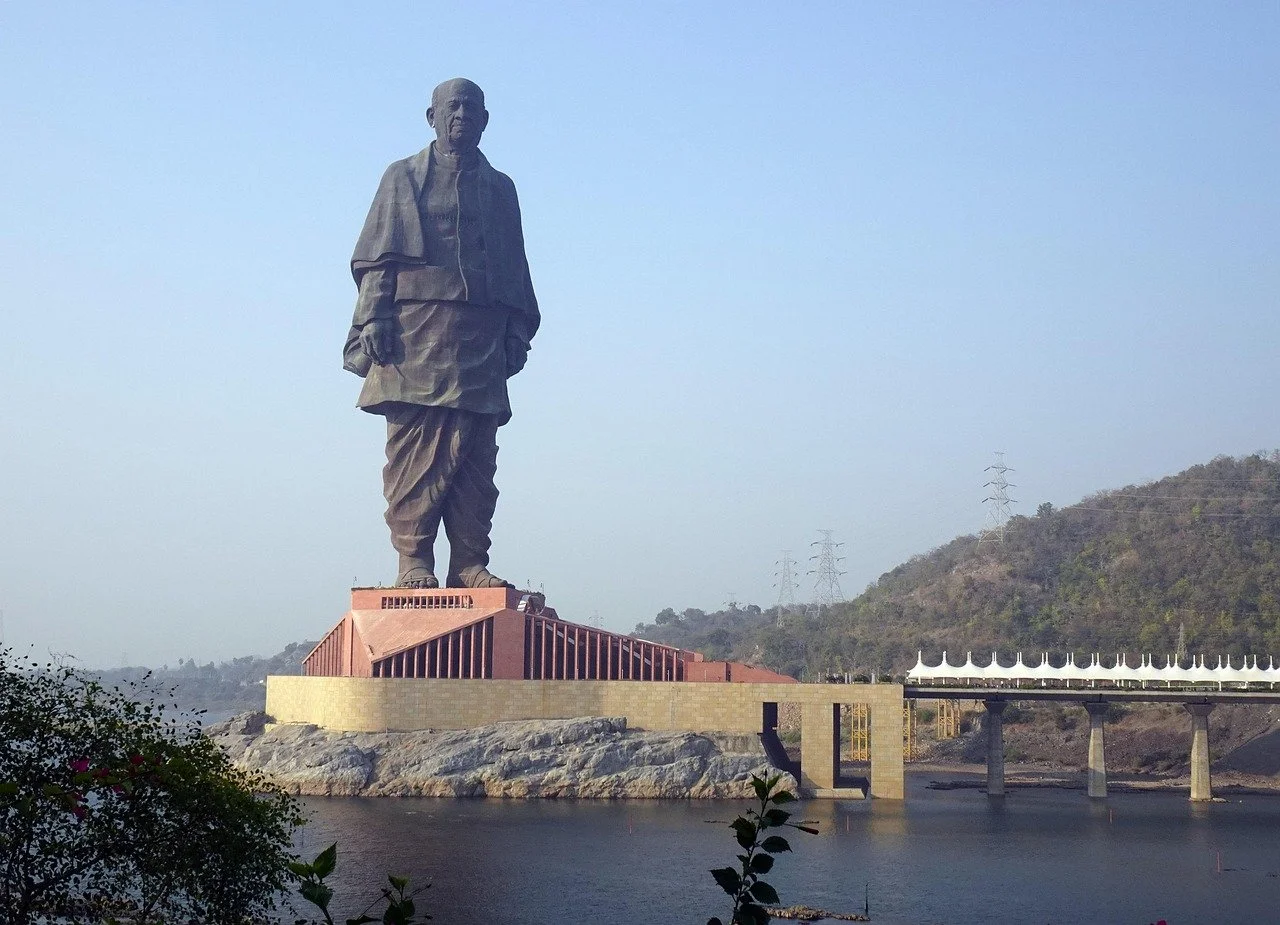
Statue of Unity. Photo: Bishnu Sarangi
What does artwork in Indian public spaces convey about our civic priorities, our mythologies, our heroes, and our gender biases? Nirali Lal analyses the cultural intention of works like “Santhal Family,” the Statue of Unity, figures of Puneeth Rajkumar, and more.
If the city is a matrix of straight lines stretched toward their crossroads, then the art housed in this square becomes a whimsical circle. Its symmetry acts as a quiet resistance to the city’s rigid geometry. It invites a pause, lifting itself beyond the mapped grid to form a space where direction loses urgency. All histories, visions, and nuances gather into a single breath, on a pedestal, both literally and metaphorically.
As a public work, art becomes a collective pulse: an opening. The legacy of public art, whether deliberate or incidental, directly or diagonally, pursues its own agenda: To connect us to who we are and who we might become.
To understand this, we must ask what truly defines a public space that hosts or accommodates visual art and culture within a city or a nation. Such a space is never neutral. It is shaped by governance, cultural intention, and ongoing social negotiation. The parameters that determine visibility in the public realm stretch across many layers: the communities the work addresses, the narratives it acknowledges or challenges, and the frameworks of regulation and policy that permit or restrict its presence. Public art thus occupies an area structured by civic priorities and controlled permissions, making it as much a cultural statement as a spatial one.
The becoming of any creation carries the weight of what came before. Whether erased, reworked or buried beneath new intentions, its layers remain. An artwork in the public realm becomes a place where dispersed meanings converge, forming a palimpsest whose depth unfolds into collective human history. Even as it accumulates new meanings, its origins, its sediments continue to shape it. As the proverb goes, “many streams make a river.” Every artwork is one such stream, merging into the larger current of memory, interpretation, and existence.
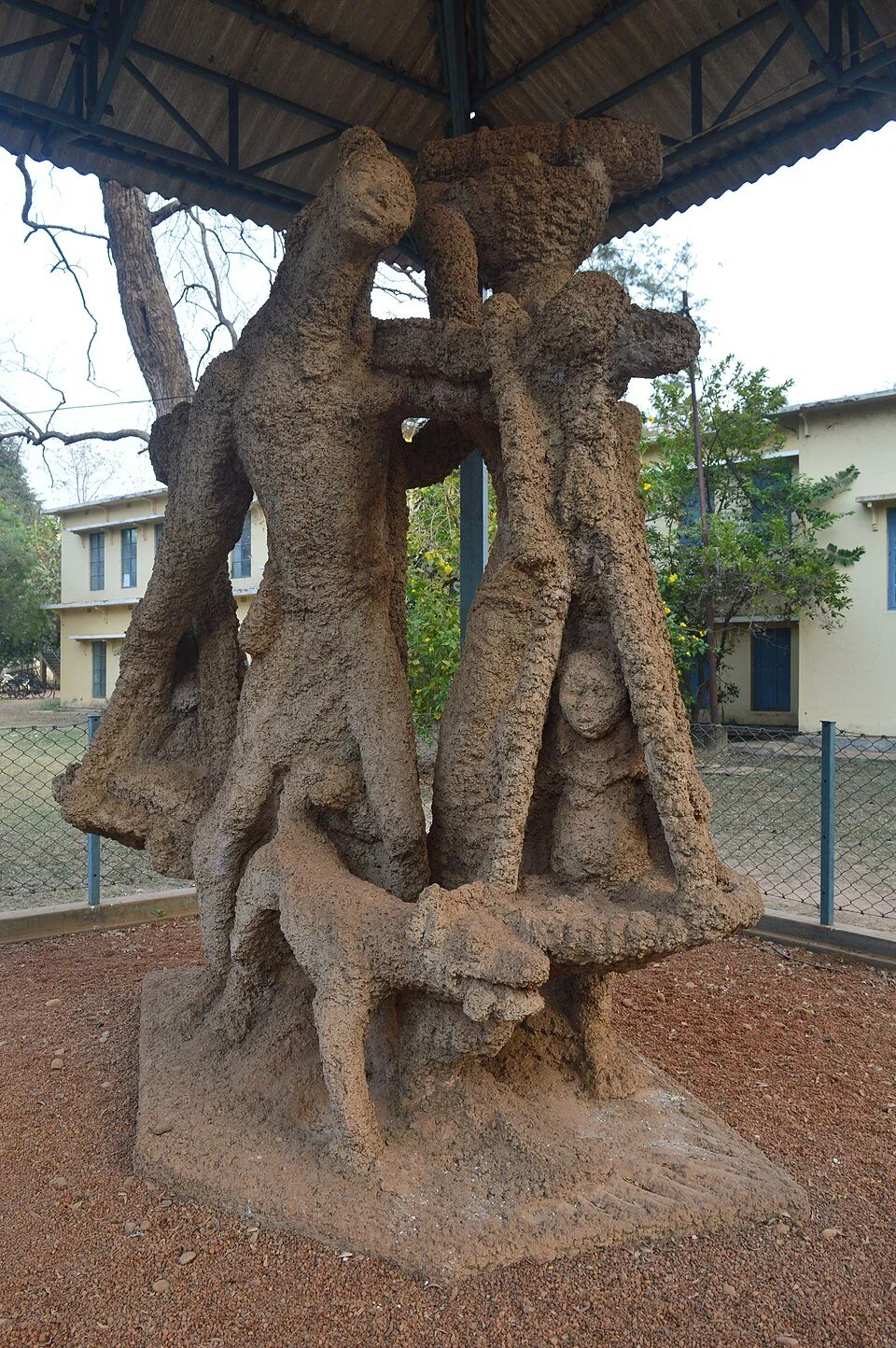
Ramkinkar Baij’s “Santhal Family.” Photo: Bodhisattwa / Wikimedia Commons
To briefly summarise the history of public art in India, I start by recalling its vastness which unfolds like a long, living tapestry. It begins in ancient times with stone pillars, carved gateways, and cave temples that rose from the earth as markers of faith and community. As centuries passed, temples grew taller, their towers crowded with sculpted stories, a ‘gallery of art,’ while mosques brought patterns of light and calligraphy into public view. The colonial era layered new shapes onto the landscape: statues, fountains, and grand buildings that changed the look of cities. Colonial-era public art in India introduced an imperial masculinity, a patriarchal assertion of power whose legacy survives in the buildings, statues, and memorials that reshaped public space and visibly affirmed colonial authority.
The gendered contours of public art in India come into focus once we see how public space itself has been shaped by a long, quiet inheritance of patriarchy. The notion of “space of appearance” reminds us that to be visible is to be political. In India, the stage has, for centuries been reserved for men, emblematic as national fathers, heroic guardians, and bearers of the nation’s memory. Their statues rise across the land: freedom fighters, mythic warriors, fixing masculinity as the face that history most readily recognises. Regulatory norms carry a built-in male privilege; they don’t just ‘mirror social hierarchies’ but actively preserve them, deciding who gets to be visible and who stays pushed aside.
In recent times, over the past two decades, this shift has gained momentum. Drawing on concepts such as ‘right to the city’ and the ‘city as a work of art,’ feminist and queer mural movements in sites like Lodi Colony in New Delhi, Church Street in Bangalore, and Sassoon Dock in Mumbai claim visibility for the ‘various’ and those long excluded. Across smaller towns, community murals honor women farmers, artisans, and schoolchildren, stitching their stories into local streetscapes. Together, these works loosen the old hierarchy, creating new legacies, widening public memory beyond elite masculinity and opening urban space to a more inclusive imagination of who belongs.
Gender politics are also embedded in its very language: the nation becomes a body, and that body is unmistakably male: towering, invulnerable, reinforcing a patriarchal imagination of leadership. In this sense, the Statue of Unity does more than commemorate; it intervenes, projecting a selective legacy of history-making.
Contemporary Indian artists are reshaping the gendered landscape of public art, challenging a history that centered visibility on male heroes and mythic protectors. To name a few, artists like Shilpa Gupta, Sheela Gowda, Gigi Scaria, Anpu Varkey and ‘mural groups’ like the St+art India Foundation, marginal collectives like the Aravani Art Project, and many others in the public domain, are creating different nuances of art including the use of technology and innovative materials.
Against this multi-layered backdrop of public art in India, I turn to three sculptural landmarks that have shaped the legacy of how history is held and felt in public space. They are monuments that preserve, reinvent, and propel history forward, and have aroused my interest further as they return me to the impressions that emerged during my own encounters with them.
During my visit to Kala Bhavan in Santiniketan, Ramkinker Baij’s iconic pre-Independence sculpture “Santhal Family” struck me not only for its modest materiality, but also for its dynamic movement. It stood as a deliberate counter to the static, monumental legacy of colonial imperialism. My first glance at the sculpture drew me back to the patriarchal notion that associates ‘the father’ as the ‘honor torchbearer’, a framework that has long shaped who is granted a legacy in public memory. Yet Baij’s work immediately begins to unravel this idea. Rather than centering a singular patriarchal figure, he presents a family moving together, each body carrying its share of burden and purpose. The woman steps forward with equal agency, the man does not singularly dominate the narrative, though he leads the way, and the child becomes part of the collective rhythm. In this way, the sculpture reframes legacy not as something inherited through male authority, but as a shared continuity rooted in resilience, labour, and community. At the same time, “Santhal Family” subtly unsettles the visual language of colonial imperialism, whose monuments celebrated static power, heroism, and control. Baij’s moving figures carve out a new, modern Indian legacy—a tribute to everyday lives, vernacular histories, and the quiet endurance of those long excluded from monumental representation.
From this terrain, I move to statutory erected in more recent years of public figures who have become contemporary legacies. Though the icons they commemorate emerge from different timelines, they now stand as statues, representing contrasting monumentality, both literal and symbolic. Their stories fascinate me for the contradictions and debates they provoke: the national and the local, the exceptional and the repetitive, the political and the supposedly non-partisan.
The first is the Statue of Unity in Gujarat, a national emblem of unification that demonstrates how a monument acquires new meanings over time. The tallest statue in the world, built in honor of Sardar Vallabhbhai Patel, ‘an architect of India’s independence and integration’, it towers at a scale that asserts national unity and political might. Yet this presumed neutrality is repeatedly questioned. For some, it is a symbol of pride; for others, it raises concerns about political messaging, public expenditure, and the state’s power to shape collective memory.
Gender politics are also embedded in its very language: the nation becomes a body, and that body is unmistakably male: towering, invulnerable, reinforcing a patriarchal imagination of leadership. In this sense, the Statue of Unity does more than commemorate; it intervenes, projecting a selective legacy of history-making.
The Statue of Unity also evokes parallels with the ‘Bilbao effect,’ using monumental architecture to draw tourism, reposition a region, and construct a new narrative of identity. But the comparison reveals contradictions. Unlike Bilbao’s integrated cultural ecosystem, the Statue of Unity relies primarily on scale and spectacle, its infrastructure designed to funnel attention toward the monument rather than cultivate a broader cultural landscape. What struck me most during my visit was its remoteness: It stands a 100 kilometres from the major city of Vadodara and 10 kilometers from the small town of Kevadia, the latter which now hosts government-funded attractions like a jungle safari to support the monument.
The drive itself formed a spatial crescendo, clean roads, orchestrated vistas, and the statue emerging larger with each turn. Yet standing at its base, I felt a quiet disappointment. The statue’s enormity seemed its primary artistic gesture. Its monumental engineering appeared to overshadow the more subtle aesthetic nuances. It appeared less a thoughtful public artwork, and more an attempt to assert legacy through sheer size.
The legacy of public art survives in this “grey zone,” a threshold where order thins and meanings begin to shimmer. Humans must recognise themselves as the intersection between extremes. Even as we pursue ant-like discipline and push through our own relentless excess, statues, images, murals, and other forms of public expression interrupt us.
Another example lies in Karnataka, in the statues of the beloved film icon Puneeth Rajkumar, who passed away in 2021. Across India, statues of actors and idols reveal a distinctive intersection of popular culture, politics, devotion, and regional identity. In states like Tamil Nadu, Andhra Pradesh, Karnataka, and Telangana, cinema has transformed stars such as M.G. Ramachandran, N.T. Rama Rao, and Dr. Rajkumar into political and cultural icons. Rajkumar’s memorialisation stands within this lineage. Fan groups across Karnataka have installed his busts, murals, and statues; grassroots tributes created not by the state but by public affection.
One such statue caught my eye in Hospet, northern Karnataka. Amid the bustle, a dark stone figure of Rajkumar stood on a pedestal. Our auto driver in Hampi noticed my recognition and turned to us with an excited, grateful smile, as if the apparent regional differences and the language barrier between us had momentarily dissolved. In that moment, public art became intimate, relational. Following his death, countless murals and sculptures emerged across Bellary, Bengaluru, and beyond, transforming him into both a physical and symbolic presence.
Yet this affection also illuminates a persistent gender bias: the ease with which male celebrities are monumentalised, while women artists, social reformers, and cultural workers rarely receive comparable public tributes. The aesthetic language surrounding the heroic poses, elevated plinths, and devotional gatherings around Rajkumar’s statues reinforce the masculine ideal of public presence, shaping emotional and civic landscapes.
Where Baij’s Santhal family offers a collective representation, structures such as the Statue of Unity and Rajkumar’s monuments stand as singular icons. The very name Statue of Unity gestures toward collectivism, even as it monumentalises a singlular figure.
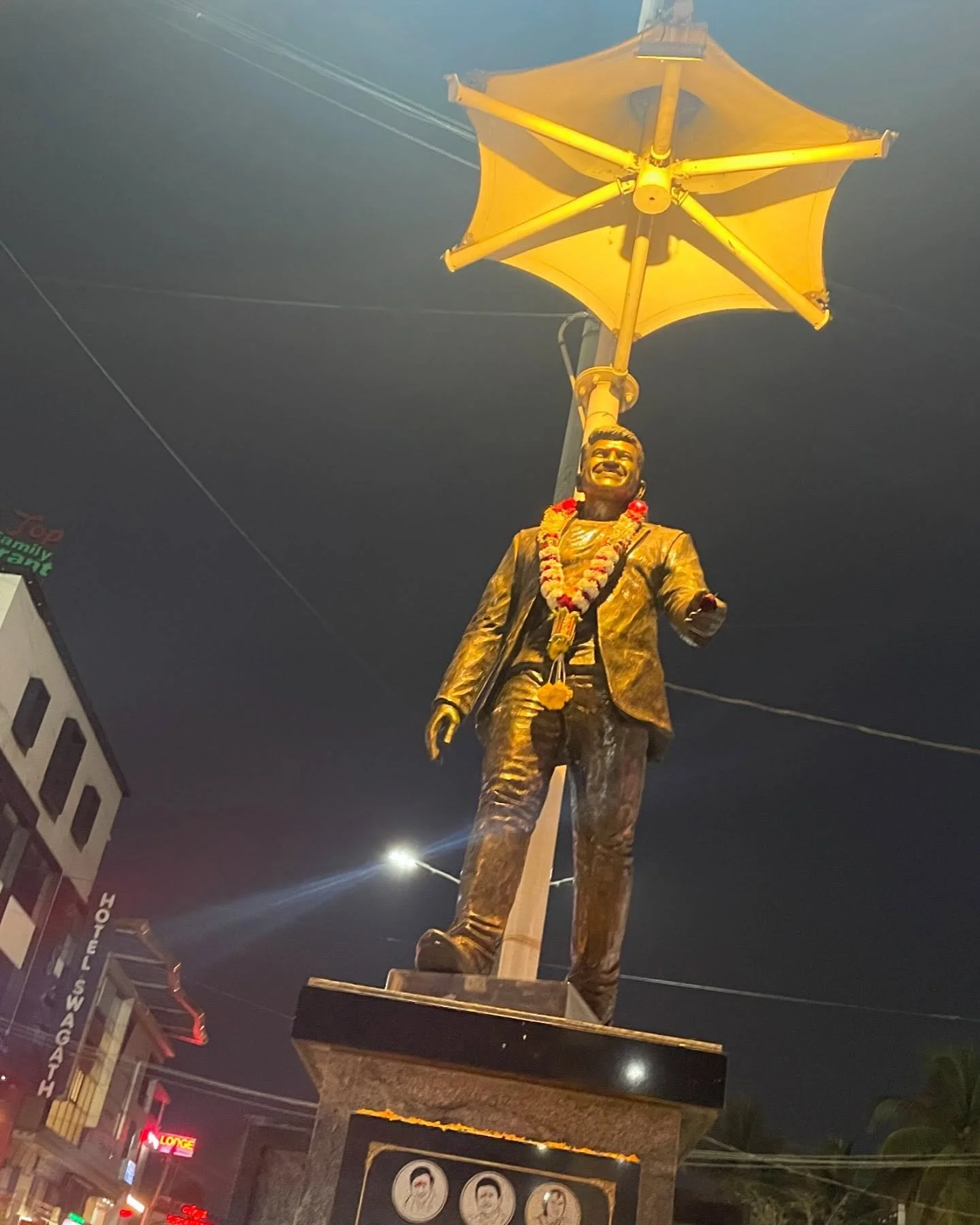
A statue of Puneeth Rajkumar. Photo: Nirali Lal
Another contradictory observation, at this juncture, is to recall Robert Musil’s claim that monuments become ‘paradoxically invisible’ over time. People cease to truly see them. The repetition of statuary risks saturation. I, too, might have overlooked the Hospet statue had the auto driver not pointed it out. Musil’s “muted aesthetic” suggests that traditional monuments struggle to assert themselves within the sensory overload of contemporary life.
As social ideas shift, patronage systems evolve, cities expand, and new technologies emerge, public art inevitably transforms. But the argument turns inward. Today, it is not only new media or transient technologies entering the public domain; but also, flashy hoardings, interactive murals, and the surplus proliferation of imagery spilling into the intimate pockets of our lives.
With ready-made access and relentless excess, these ‘temporary legacies’ create fleeting memories that consume our attention, causing us to overlook the grounded community-crafted surroundings around us. The dilemma is complex. As humans evolve, so do their aspirations, a hypothesis shaped, curiously and paradoxically, by our desire to resemble ants. Ants labour with tireless synchrony, an intensity we strive to imitate. Yet each human carries an individuality that resists such uniformity.
The legacy of public art survives in this “grey zone,” a threshold where order thins and meanings begin to shimmer. Humans must recognise themselves as the intersection between extremes. Even as we pursue ant-like discipline and push through our own relentless excess, statues, images, murals, and other forms of public expression interrupt us. These creations—poised in ambiguity—remind us of our core. They still our momentum, inviting us to pause and look again at our cities, at the histories and the biases we rush past… and to question them. In that interruption, we find not perfection, but what remains: a legacy of the fragile, nuanced, and unmistakably human.
***
Nirali Lal is an artist and writer based in Baroda/Bangalore. She previously worked with Saffron Art as a Bangalore representative and as the Art Manager for The Artist Pension Trust in India. Her recent projects include Five Million Incidents (Goethe Institut, New Delhi in collaboration with RAQS Media Collective, 2020), The Nest (Anant Art, New Delhi in 2021, Space Alumni show, Space Studio, Vadodara 2020) and the Baroda March (Rukshaan Arts 2021-2022). You can find her on Twitter: @nirali_lal and Instagram: @niwawi_wow.