War and the Indian News Circus: A Spectacular Theatre of Ignorance
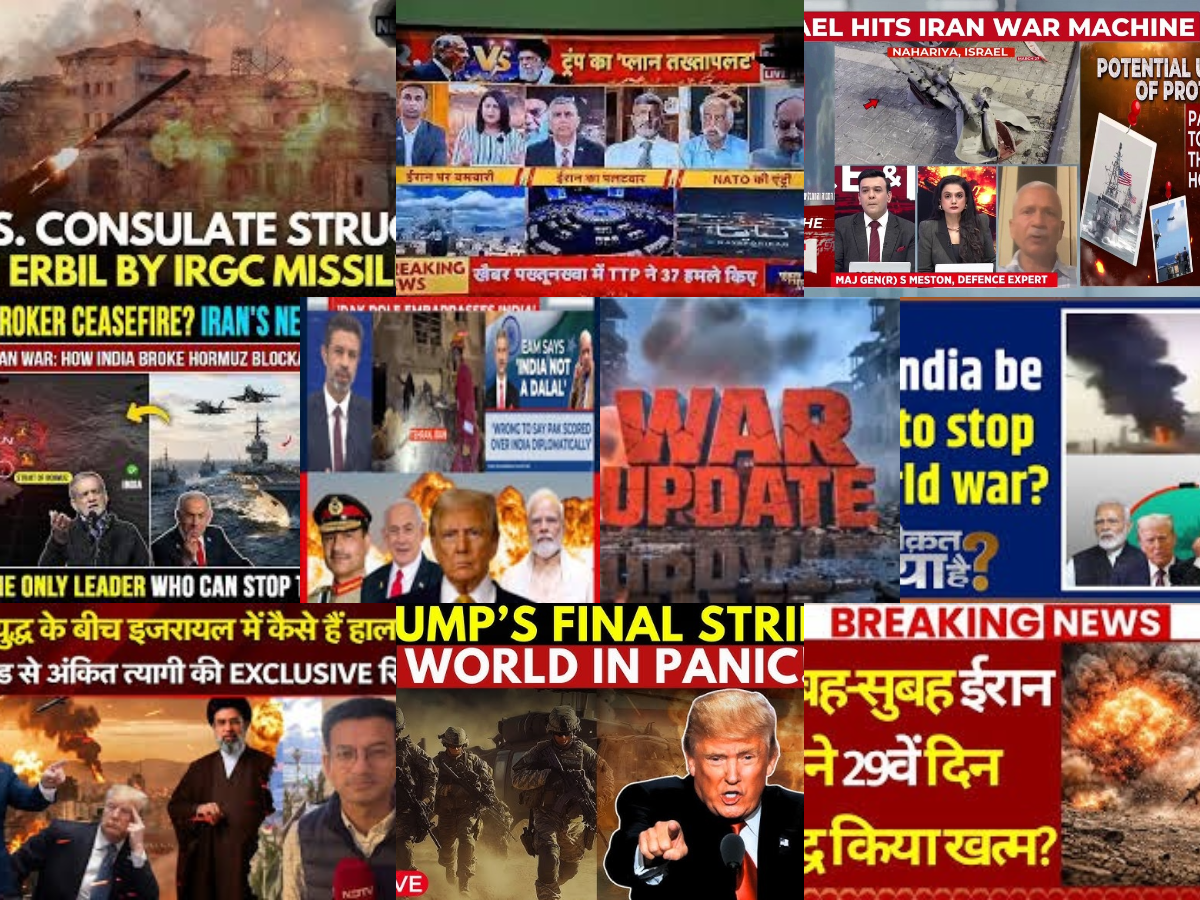
Opinion: ‘At a time when the world is watching missiles, sensitive diplomatic negotiation, and an escalating war, Indian viewers are treated instead to shrill theatrics, geopolitical illiteracy, and anchors screaming with the urgency of auctioneers selling discounted vegetables.’
Just about a week into the US-Israel-Iran conflict in West Asia, a prominent Indian news anchor, a leading face of a leading Hindi news channel in the country, announced with grave urgency to her audience that, “It’s a serious situation. Over 60 Americans have been taken hostage by Iran. It’s a dangerous situation.”
Before she could escalate the crisis further, the correspondent reporting on the split screen beside her intervened, “No, no you’re referring to an event from 1979, when Iran had taken 66 Americans hostage.”
A brief silence followed. The anchor, after processing the minor historical glitch, delivered what may be the most concise editorial response in the history of broadcast journalism. “Theek hai,” she responded.
From Operation Sindoor to the US-Israel-Iran war, TV channels in India—particularly Hindi language news—have yet again demonstrated their unique talent to turn global conflicts into prime-time comedy. At a time when the world is watching missiles, sensitive diplomatic negotiation, and the possibility of escalation, Indian viewers are treated instead to shrill theatrics, geopolitical illiteracy, and anchors screaming with the urgency of auctioneers selling discounted vegetables.
In fact, the programming could easily give Dada Kondke (known for his unique brand of satire, delivered through rustic humour and double entendres) a serious competition. The only difference is that Kondke knew he was making a comedy; Indian news channels apparently believe they are covering war.
Fierce competition for ratings, commercial pressure, and generous helping of televised nationalism, have converted serious security issues into high-volume entertainment. War is no longer analysed by Indian TV channels. It is packaged and performed.
On another occasion, the same anchor as above wondered aloud why Iran’s latest supreme leader, Mojataba Khamenei should be called “Ayatollah” if he was not a “religious guru.” The panellist, clearly struggling to remain polite, asked which “WhatsApp University” had awarded her this theological expertise. She promptly lost her temper. “Tameez se baat kijiye,” she thundered. After the panellist patiently explained the meaning of the title “Ayatollah” and how it is earned within Shiite clerical hierarchy, the anchor’s response once again was the now familiar intellectual mic-drop: “Theek hain.”
If journalism schools are looking for a new motto, they may consider this one. One is told that large posters of this anchor adorn the walls of now famous Galgotias University, where she reportedly teaches journalism. A lethal combination: the professor and the cautionary tale in the same campus.
Anyway, the factual confusion is only part of the spectacle. The real star of the show is the cringe-worthy graphics department, which appears to operate under the assumption that viewers will only understand geopolitics if it is presented like a trailer for an apocalyptic video game. Screens flash red sirens, digital maps show animated missile trajectories flying across continents, countdown clocks tick ominously, background music suggests the imminent arrival of aliens. One half expects Godzilla to appear somewhere between Teheran and Tel Aviv.
And the headlines are often masterpieces of creative fan-fiction: Iran causes destruction in Dubai, In a few hours Iran’s skies will be under US control, Trump preparing for final strike, and the evergreen blockbuster, World War III is about to begin. At one point, the hysteria became so intense that the Indian government decided to pause the weekly TRP rating, citing danger of public panic.
My personal award for the sloppiest coverage of the war goes to one plumpish anchor of a Hindi TV channel known for his enthusiastic disregard for knowledge and relentless bout of jingoistic drivel. In the heat of the conflict, he offered viewers an altogether different perspective. “Muskuriyae, kyunki aap hindustan mein hain, kyunki 4th March ko aap holi manayenge, rango se khelenge, bhujiya khayenge, kyunki aap Hindustan mein hain... Muskuriye kyunki kuchh aur desho mein bomb, barood aur dhuan hi dhuan hain.” Smile because you’re in India, on 4th March you'll be celebrating festival of colours, you’ll be eating sweets. Smile because you’re in India... In some other countries, it’s only bombs and smoke… Smile, because you’re in India. With his frantic commentary, he created a carnival atmosphere instead of covering a global tragedy.
Meanwhile, as the anchors continue with their histrionics, the studio panel resemble a gladiatorial arena, populated with professional arguers shouting over each other and at times abusing one another.
And then, there are serious factual bloopers. In early March, an English news channel confidently announced that an Iranian warship had been torpedoed by an US Navy submarine in the Indian Ocean near Sri Lanka. What the anchor didn’t say was that the ship was attending an event hosted by India. Indian strategic affairs expert Brahma Chellany wrote on X that the US torpedoing the warship in India’s “maritime neighbourhood” was “more than a battlefield episode.” He called it a “strategic embarrassment” for Delhi. But such accuracy, like moderation, rarely survives the TRP battlefield.
Of course, this is not the first time Indian television has turned a geopolitical crisis into a prime-time spectacle. We had seen this during Operation Sindoor, India’s military response to the April 2025 militant attack in Jammu and Kashmir. As the battle raged, several channels ran animated graphics, erroneously and excitedly declaring India had taken over Karachi and Islamabad, while another channel reported that an Indian naval ship had reached Lahore.
Beyond the obvious falsehoods uttered, I have often been mystified by the loud shouting voices of these anchors. Are their microphones defective? Are they literally attempting to be heard by viewers sitting several kilometres away? Or is volume now considered a substitute for verification? Perhaps, the louder the voice, the stronger the analysis?
The reasons behind this spectacle are hardly mysterious. Fierce competition for ratings, commercial pressure, and generous helping of televised nationalism, have converted serious security issues into high-volume entertainment. War is no longer analysed by Indian TV channels. It is packaged and performed.
In stark contrast to the grounded, on-the-scene reporting by global networks like Al Jazeera, BBC, and CNN, much of India’s Hindi television news continues to resemble a high-decibel spectacle rather than serious journalism. Studio screens flash with AI-generated missiles and fighter jets, dramatic sound effects blare in the background, and the focus seems tilted more toward theatrics than truth. Many correspondents are stationed in places like Israel or Dubai—not exactly the ground zero.
The real concern is the glaring absence of historical depth and geopolitical understanding. Complex conflicts are reduced to simplistic binaries, stripped of context, and repackaged for maximum visual impact.
Thankfully, even in the oppressive media environment in the nation, there is some hope. The idea of news as actual news is being kept alive by a handful of independent digital platforms, many of them on YouTube, including “Ravish Kumar Official,” Akash Banerjee’s “Deshbhakt,” “Newslaundry,” and more. These channels among others offer something which is becoming increasingly rare on television: calm reporting, context, and stubborn commitment to facts.
***
Sanjay Basak is the chief of bureau and senior associate editor at The Asian Age/Deccan Chronicle in New Delhi. He grew up between Kolkata and New Delhi. He has spent 30-odd years as a journalist, also working at The Telegraph, ZEE News, Doordarshan, and more. Basak now mainly writes on politics. He is also an amateur photographer and a painter. You can find him on Instagram: @sanjay1704 and X: @basaksanjay23.