Judging the Cover: An interview with award-winning book designer Bena Sareen

Bena Sareen, winner of the Oxford Bookstore Book Cover Prize, speaks about her latest honour and the “huge responsibility” of designing a memorable literary cover.
Growing up, the choice of Raj Comics (possibly Nagraj) that I picked up from the Wheelers at railway stations often depended upon how animated the cover was. Gradually, as I shifted towards writers like Ruskin Bond, what I still remember from the first book that I read of his is the beautiful cover of Rusty and his friend at a dock looking at a ship as it leaves them behind. This is how covers can leave a lasting memory in the minds of the reader. Today as I read books as a critic, will I pick up a title with a shoddy cover? Possibly not.
Despite the many forewarnings of “don’t judge a book by its cover,” don’t we all do that anyways? Nearly every reader has examined a book at a bookstore when an interesting cover piques our curiosity. When I learned about the Oxford Bookstore Book Cover Prize, I was happy that there was an honour that recognised the work of the human behind the cover design, the artist who is often ignored. Earlier this year, the 11th edition of the prize went to Bena Sareen for the cover of Amitava Kumar’s My Beloved Life (Aleph Book Company).
Sareen had also won the inaugural edition of the same prize many years ago. On further exploration, I discovered that she has designed many of my favourite covers over the years, like Amitav Ghosh’s Sea of Poppies, which featured a beautiful, maroonish poppy flower on a brown faded background and a small ship sailing in the middle; or Gopinath Mohanty’s Harijan which was a simple black circle on a white cover, with small splashes coming out of that circle that gave the illusion of a manhole with muck coming out of it. These apparently ‘small’ creative choices give a unique, new definition to her work.
“Book covers, especially for fiction, are open to multiple interpretations. I love working on this genre. Just as a reader’s experience can be quite subjective, so is the designer’s engagement with the manuscript.”
Sareen did her MPhil. in Sociology and then stumbled upon graphic designing which changed the course of her career. Around 1999 she started out as the first Art Director for Penguin India and since then has seen the world of graphic designing and book covers change right in front of her eyes.
In a brief interview, Sareen spoke to me about her recent award, practical advice to book designers, and the “huge responsibility” of designing a memorable literary cover. Edited excerpts:
The Chakkar: Congratulations on winning the Oxford Bookstore Book Cover Prize for Amitava Kumar’s My Beloved Life. Tell us about the inspiration behind this cover.
Sareen: Book covers, especially for fiction, are open to multiple interpretations. I love working on this genre. Just as a reader’s experience can be quite subjective, so is the designer’s engagement with the manuscript. As I read [Kumar’s] novel, I developed a special affinity for Jadunath, one of the two protagonists. The period—early 1940s onwards‑—brought a certain nostalgia for a time gone by. [For the cover], I picked the postcard as a metaphor for a way of life: for memory, for migration; themes that reflect in the novel across the lives of the two protagonists. The yellow postcard of the Indian Postal Service in its graphic form provided a natural perch for the title, and I was overjoyed that the subtitle, ‘A Novel’ fit perfectly into the six-digit pin code holder. I went on to add some authenticity by placing the postal seal bearing the name of the city, Patna, where much of the novel is set in. These small details bring a smile to my face, and I hope a discerning reader will derive the same joy.
I contrast this nostalgia with a modern rendering of the protagonist with coloured pops or patches. And in doing so, I hope to reach out to a wider audience, across generations.
The Chakkar: You also won the inaugural edition of the same prize for Leila Seth’s Talking of Justice (Aleph Book Company, 2014). How do you see the progression in your own artistic expression between these two covers?
Sareen: Ten years ago, when this award was instituted, it marked a long-awaited recognition of the art of book cover design. Oxford Bookstore was indeed the first to institute a cover prize; many others followed.
My work has evolved over the years. Trends change, experience and understanding deepens. I became more experimental, pushed myself towards cover solutions which were not necessarily my first instinct, failed many times. However, it did satisfy me to go against my grain and push the envelope, somewhat. And sometimes, it led to the most exciting outcome.
The Chakkar: People often say, “don’t judge a book by its cover” but when it comes to its literal meaning, what role would you say an attractive cover plays in the publishing industry?
Sareen: Cover designers carry a huge responsibility. I am at all times acutely aware of being true to the author’s voice, and at the same time reaching out to the target audience. While our canvas is small, covers are central to the life cycle of a book. Today, with social media taking the centre stage, and with fleeting attention spans, covers have become a critical marketing tool for the sale of a book.
The Chakkar: How do you handle self-doubt while finalising a cover? How do you decide that a concerned version is the best that you want to put out for the world to see?
Sareen: The veritable process of visualising is a rather amorphous one. There is no single path to a successful cover solution. It varies from book to book, not to mention our own inclinations. I tend to start the process with rough doodles, mostly on the margins of the manuscript I’m reading. I work on a few ideas simultaneously. And in the process of refining these options, I gain clarity, and begin eliminating whatever is not required until I have a design that I can present with full conviction.
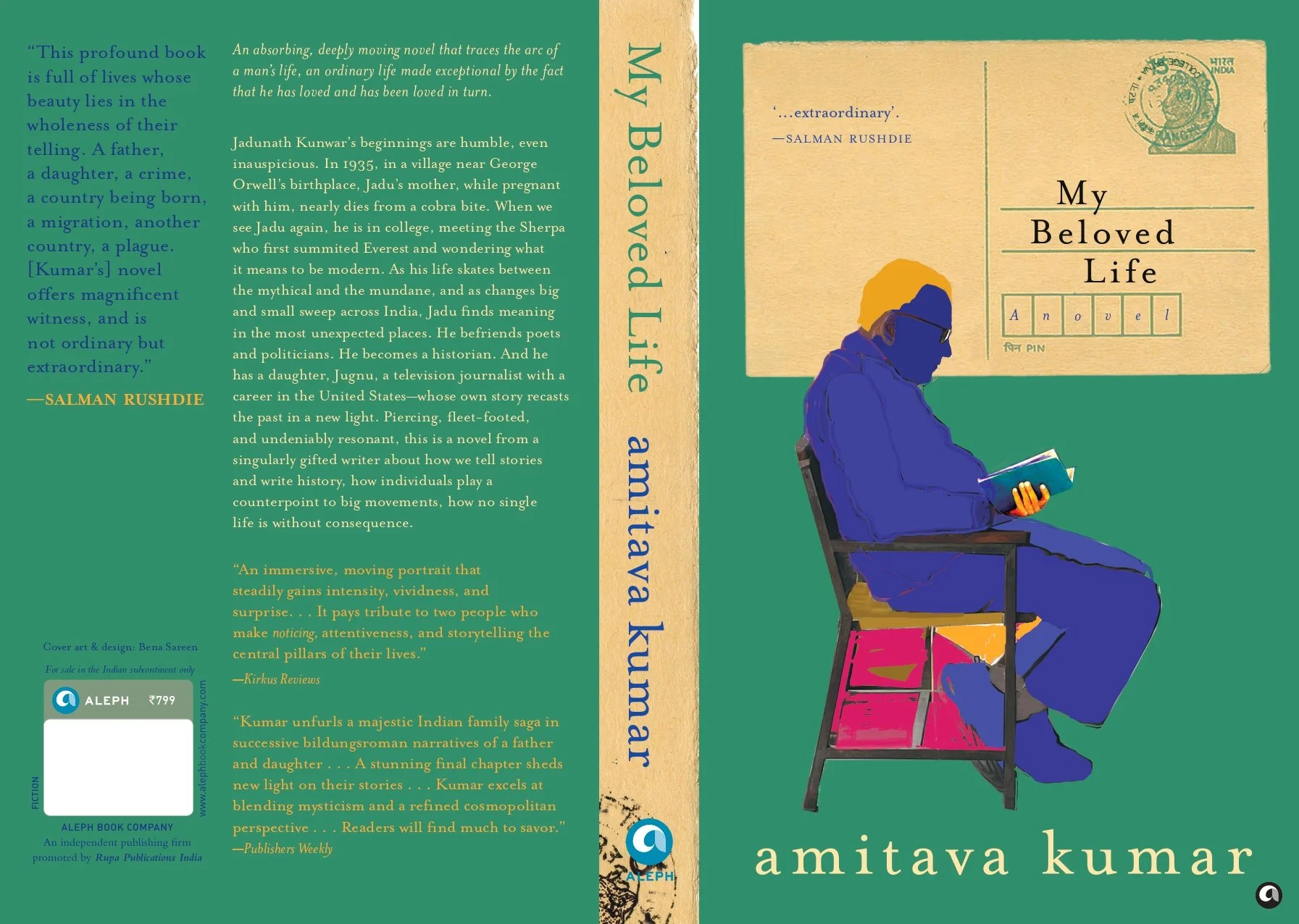
My Beloved Life cover art - by Bena Sareen
When there is doubt, or when I’m torn between options, I lean on the editor and publisher’s views. I often present two options to the author for the final say. Though I do make a recommendation, and keep my fingers crossed!
The Chakkar: What practical advice would you like to give to a newcomer who wants to enter into the publishing industry as a book cover designer?
Sareen: Read! Connect with the book because authenticity is very important. Be cognisant of what is happening in the art world in general. Do not ape the west as the visual art industry does often.
The Chakkar: AI has unscrupulously entered into the various aspects of the publishing world, what is your perception of this issue, and how do you see the future of book cover designing in this backdrop?
Sareen: The advent of AI is a significant intervention—it can add and detract in the creative process. AI does provide easy access at a low cost to authors, designers, and anyone else in creating visuals and cover design. I think this is particularly helpful for self-published authors and small publishing houses with limited budgets. However, I do feel that there will always be space for authenticity and originality which an experienced designer can bring with an understanding of their target audience.
We may see greater value accorded to hand-drawn illustrations, photography, hand lettering, etc., as a counter response to a certain ‘homogenisation’ that AI may bring. Just as there seems to be a comeback for physical books, vinyl records, knitting, and other tactile crafts, I think there will remain a space for us designers. That said, we will have to learn to use AI to our advantage, and combine insight with technological innovation.
***
Chittajit Mitra (he/him) is a queer translator, editor and writer from Allahabad. He has been working on issues of gender, sexuality and mental health with the team of Resistive Alliance for Queer Solidarity (RAQS) from the last five years in the city. A postgrad in anthropology, he is interested in constitutional ethics, social justice and human rights. He regularly reviews books on his Instagram: @cj_mitra. You can reach out to him on chittajit.mitra@gmail.com or Twitter: @cjmitra.