The Fraught Relationship Between Reality and Spectacle in Telugu Cinema
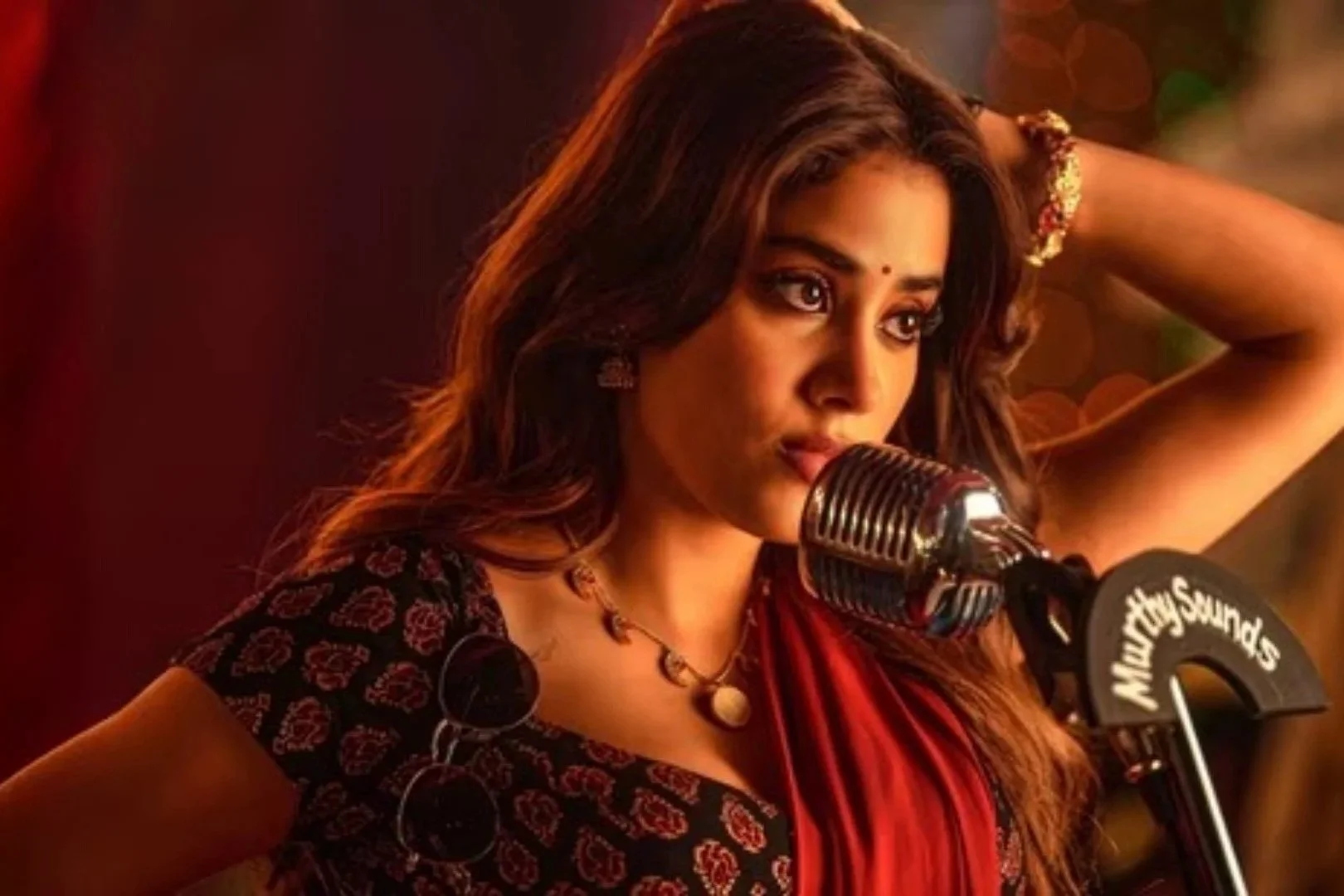
The problematic representation of women in many recent Telugu blockbusters like Peddi and the Pushpa films have stoked controversy. When mainstream commercial cinema consistently turns the sexualisation of women into entertainment, who should be responsible for the world these images help create?
Released in June 2026, the Ram Charan-starring Peddi—a sports drama directed by Buchi Babu Sana—became one of the highest-grossing Telugu films of the year. Yet, Peddi was soon mired in a controversy over its treatment of female characters. Critics and audiences alike castigated the film’s camera work, its body-focused framing, and its forced-kiss sequence, prompting director Sana to edit portions of the film after release.
The fiery debate over the film’s representation of the female protagonist, Janhvi Kapoor, has primarily revolved around familiar criticisms of objectification and sexualisation. But this debate has overlooked a more disquieting question: When images and performances from mega-budget pan-Indian blockbusters such as Peddi, Pushpa: The Rise, Pushpa 2: The Rule circulate through everyday culture, what if the real problems in Telugu cinema cannot be reduced to its representation of women?
Now picture this: A six-year-old girl walks to the stage of a widely televised dance talent show. The anchors gush over how gorgeous she looks. As the lights dim, she dances to a popular film song she does not yet understand, her sequined gown adding drama and fluidity to her movements. The judges gasp in astonishment. The audience clap and cheer. The girl’s parents watch on tensely with folded hands as if praying for their daughter to perform her best. Nobody asks whether the song belongs here. A song born in an adult cinematic context, now performed by a child, becomes applause-worthy entertainment on a family show.
That scene is not an imagined fantasy. Shows like Super Dancer, Dance Deewane Juniors, and other regional dance competitions showcase young talents dressed in adult costumes, mimicking movements fashioned for an adult world. Songs like “Hellallallo” and “Chikiri Chikiri” from Peddi, “Saami Saami” from Pushpa: The Rise, or “Peelings” from Pushpa 2—all of which have garnered millions of views on YouTube—are not even generic romantic dance numbers. They are flirtatious, sexually charged compositions filled with erotically suggestive lyrics and choreography. They transport particular ideas of masculinity, femininity, desire, and romantic or sexual behaviour onto stages where children are performing. A few young talents from these shows are even invited to perform at premieres and other film-related events attended by celebrities from the film industry. Such imitation transforms what is lascivious in one context into ‘cuteness overload’ in another, as eroticism is miniaturized, reproduced, and rendered adorable.
Who selected the song? Why are adults comfortable with it? Before the song reached the dance-show stage—stripped of its original framing—it belonged in a cinematic showcase of adult desire created for mass erotic appeal. It then travelled into living rooms, classrooms, talent shows and algorithmically curated feeds. Its popularity is sustained through repetition, imitation and circulation across connected media platforms, which contribute to making this migration into children’s entertainment feel natural. What might have once invited reflection and scrutiny now registers as normal and routine content consumption. No one questions or stops to think what the song conveyed or meant, and whether what it expressed was appropriate to be transported to other contexts. Across social media and streaming platforms in an ultra-wired world, children and adults alike copy ‘influencers’ who are often sponsored by film and music companies and produce song and dance reels designed to go viral.
At each stage, institutions and audiences permit coercive romantic contact, stalking framed as courtship, forced intimacy, and hypersexualised representations, quietly endorsing them on and off screen. These patterns point to a culture of silence in which patriarchal power is sustained through institutional failures of accountability.
When reel life spills into the real world, it muddle distinctions, and unsettles personal and social boundaries. Fan edits, mimes, lip-sync videos, and talent shows carry images across settings, making the child’s performance culturally intelligible, even socially acceptable, granting cinematic acts legitimacy beyond the big screen.
At its core, Peddi seems to address the issue of minority oppression and the historical injustice endured by marginalised communities, but even such a progressive theme becomes subordinate to the logic of spectacle. When the narrative operates under the rules of big-spectacle cinema, profit is the primary motive, and any social message becomes a token performance of social concern. The relationship between reality and spectacle is often fraught, as the spectacle in circulation begins to structure social relations in ways that we may not be able to easily fathom.
Reality and spectacle are not just mutually entangled, but as sociologist Jean Baudrillard might say, they dissolve into each other. In his reading of the Hollywood war classic Apocalypse Now, Baudrillard describes that it enacts a “mass-spectacle effect” of the Vietnam War and turns real violence into consumable entertainment without raising ethical questions about the war, its justification, or its human cost.
Yet spectacle alone cannot explain why cinematic images continue to acquire force beyond the screen. Unlike the spectacular violence described by Baudrillard, which largely remains something to experience vicariously, spectacular desire invites imitation. This is better explained by literary critic René Girard, whose concept of “mimetic desire” holds that desire is fundamentally imitative, as it is learned, reproduced, and reinforced through repetition. People desire what others desire, and cinema teaches both what is desirable and how intensely to desire certain things, so the culture of circulation can reproduce this at scale across everyday life. Such teachable desire exists both at the level of individuals and at the level of industry. What audiences respond to is produced by industries, which in turn shapes and reshapes how they learn to respond in a self-reinforcing loop.
When expressions from cinema in the form of film songs and performances move so easily across contexts, how can we reduce them to mere objectified, sexist portrayals? The boundary-crossing nature of cinema reveals a culture of permission that allows for this migration to happen, enabled by the absence of resistance at successive points of circulation. The expression begins at the production stage, gains legitimacy when performed by stars, before being amplified by PR and marketing campaigns, media influencers, and algorithmic recommendation, and is finally circulated by audiences. By the time it travels to the children’s stage, its effect and meaning have already been normalised. At each stage, institutions and audiences permit coercive romantic contact, stalking framed as courtship, forced intimacy, and hypersexualised representations, quietly endorsing them on and off screen. These patterns point to a culture of silence in which patriarchal power is sustained through institutional failures of accountability.
Even the most ambitious reform efforts struggle when faced with a system where no single actor is ever completely outside the system. When mainstream commercial cinema consistently turns the sexualisation of women into entertainment, who should be responsible for the world these images help create? The actor performs within commercial expectations, the director crafts within market logic, the producer balances business risk, the platforms prioritise consumption data, and the audience performs mimetic desire while participating in circulation. Every step appears as a rational response to commercial incentives, while simultaneously shaping what audiences come to desire, consume, and replicate. What else is this but a form of collective complicity: Everyone chose this, yet no one explicitly did?
Within this system, can we ignore the fact that blockbuster stars are not struggling actors taking any role that comes their way? These are men with extraordinary bargaining power to influence scripts, shooting schedules, casting decisions, release strategies, and promotions. Why must they be treated as powerless or permitted to disown responsibility for a film’s gender politics, and for how women are represented within it? The same extends to cultural figures with exceptional stature, including music composers, lyricists, and singers, who are embedded in the system and enable sexist slurs in song lyrics through suggestive and double-entendre phrasing. Doesn’t this amount to endorsement through participation in the objectification of the woman’s body? When men like the Peddi lyricist Anantha Sriram describe backlash as ‘trampling on creativity’, they become complicit actors in cinema’s sexualised regime of representation.
The important question then is whether patriarchal power can be separated from accountability. This concern is not new. Following the 2024 Hema Committee report that detailed rampant sexual harassment within the Malayalam film industry, there have been demands to make public a similar report on labour conditions and practices in Telugu cinema. Reports of sexual exploitation, workplace harassment, and weak grievance mechanisms have emerged repeatedly within the Telugu film industry, and extend beyond any single film or controversy.
More than what the current Peddi debate surfaces, I would be concerned about how Telugu blockbuster films in particular, and similar films across the country’s cinema industry more broadly, are creating a subliminal understanding of desire, consent, love, and its limits. When film after film tells you that a rugged man will use the grammar of love he knows, which includes coercion and assault, and subordinates the woman to concede to this worldview, we must fear what its imitators will take from this. I am not suggesting that a straight line can be drawn to connect the cinematic world with the real. What I am urging is for us to be discerning enough to comprehend that commercial cinema prizes and pitches hypermasculinity as desirable, normalises hypersexualised portrayals of women, while constantly priming audiences to feel in ways that are not merely regressive, but also out of touch with the times we are living in. The loyalty many stars enjoy often resembles a cult following, demanding both devotion and excess from its fans.
We are all complicit in some way or the other—actors, directors, film distributors, streaming platforms, financing companies, writers, music composers and audiences, each playing a role in what is being offered as entertainment. In a mediatised world, where the camera never stops looking, audiences everywhere become active participants, circulating cinematic moments as social media content.
Cinema, when allowed to organise behaviour beyond the screen, can become problematic, because the image on screen stops being representation, and starts functioning as instruction and as a template for how bodies are seen and treated. At one level is the aesthetic layer, which we can call aesthetic perversity that derives pleasure, attention, and value from making a spectacle of intensified desire. At another, there is the reality of someone like the six-year-old on the dance-stage, who has no interpretive distance from her performance. What cinema shows and feels do not remain static: it intensifies over time, with each succeeding film pushing further to achieve the same effect.
The logic of Girard’s mimetic desire naturally leans toward escalation. The hero entry needs to be grander than the last one, an action sequence more spectacular, a dance movement slinkier and sexier, a female actor more provocative, and an item number more explicit. Each film adapts to the yardstick set by the previous one and stretches its boundary by recalibrating what counts as normal, exciting, acceptable, and tasteful. This moves a culture already driven by excess toward an expanding cycle of perpetual intensification. Social media users follow the same intensity model and compete with other social actors for views and virality.
While cinema can weave magic by transporting us to diverse worlds, it is also becoming increasingly invasive in being able to transfer itself to different settings. The continuing influence of these films is sustained by existing gendered power structures and norms, which reproduce film narratives and meanings beyond the screen. Media convergence enables repetitions across platforms, allowing meanings to travel, change form, and detach from their original context, but what it really accomplishes is to normalise behaviours that would otherwise be deemed unacceptable for public display.
Sexualised spectacle operates as aesthetic perversity sustained by an industry predicated on enforced silence, and gendered domination is staged, aestheticized, and presented as entertainment. When patriarchal power is the organising principle, it becomes difficult to locate responsibility, because the system depends on countless acts of permission, participation, and accommodation. In the current structure, as consuming publics, we are all implicated in commercial cinema’s representational dynamics.
We are all complicit in some way or the other—actors, directors, film distributors, streaming platforms, financing companies, writers, music composers and audiences, each playing a role in what is being offered as entertainment. In a mediatised world, where the camera never stops looking, audiences everywhere become active participants, circulating cinematic moments as social media content.
We have seen the likes of Peddi before, only Peddi peddled a new low, and perhaps advanced a new normal. When a culture permits a child to perform adult desire on national television and calls it talent, something is deeply wrong. Do we even have the capacity to recognise the problem yet?
***
Sumithra Prasanna is a documentary filmmaker and writer, currently a doctoral researcher whose work explores media, gender and the politics of representation. You can find her on Instagram: @sumithra.prasanna.