Monsters and Men
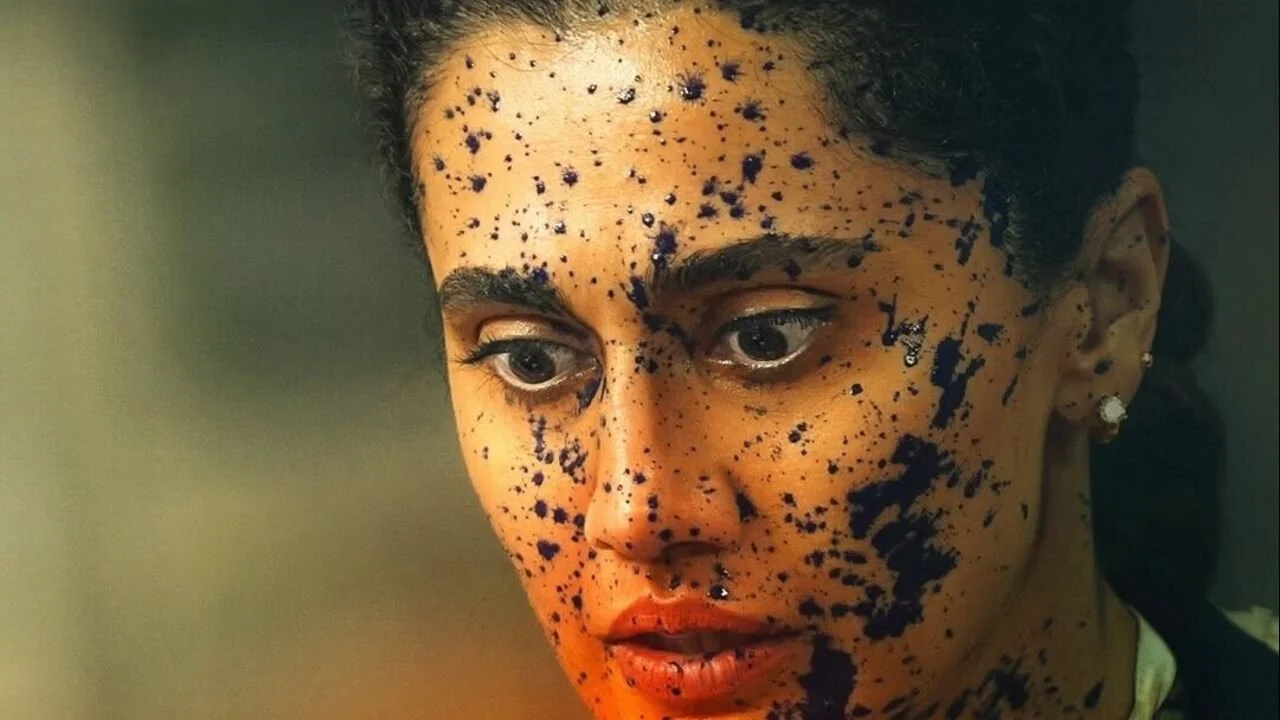
Despite a promising premise, Anubhav Sinha’s courtroom drama Assi succumbs to formulaic depictions of sexual violence, trading nuance and subtleties for shock value.
The Hindi film industry has a tried, tested, and tired formula for depicting sexual violence on screen. There is first a man, or a group of men, extraordinarily and utterly cruel. There is a graphic, violent assault, suffered by the victim. And then, there’s a saviour—often a lawyer or police officer.
Anubhav Sinha’s most recent release Assi (2026) is a courtroom drama centred around sexual violence. The title Assi (eighty) refers to the 80 cases of rape that are registered in India each day. While the premise holds promise, the film ultimately falls into the same formulaic depiction of sexual violence that has long plagued the industry, where nuance and subtleties are traded in for shock value, and faith in the audience is replaced by an oppressively preachy approach.
Assi opens with a shot of bleeding, bruised, and partially naked Parima (Kani Kusruti) lying on a railway track, barely conscious. This opening shot reveals everything one needs to know about the violence she was subjected to. The film ensures, however, to revisit the previous night, showing us how Parima was abducted off the streets by a group of young men. The scene that follows shows the assault unfold and a sickening contest between the men regarding who can rape her the longest.
All we see of Parima during this scene is her face and her limp legs. The graphic, prolonged scene is a few minutes long but seems to drag on endlessly. The cynical approach would be to believe that it was included in the film as a pragmatic measure to draw in more viewers by its sheer shock value. However, Sinha’s past credits—which include mature and subtle tackling of complex topics in films like Article 15 and Thappad—merit giving him the benefit of the doubt. In the case of Assi, Sinha’s choice to include the lengthy rape scene reveals something troubling about our society that has long been true, but something we rarely contend with. If Sinha felt compelled to include such a horrific scene in Assi to jolt his audience into acknowledging the horrors of sexual violence, then that only reflects poorly on us as a society. Are we only capable of understanding and acknowledging the violence of rape if we are shown a lurid, protracted gangrape scene, or if we are told every minute, sordid detail of the injuries that a rape victim has sustained in real life?
In August 2024, the rape and murder of a doctor at the R G Kar Medical College in Kolkata provided a jolt to much of the nation. But, just weeks later, there was another little-reported rape case in Bengaluru. While prime time debates raged on about women’s safety and state accountability following R G Kar, a media outlet writing about the Bengaluru case framed the incident about the victim’s decision to be at a party till late at night and taking a lift from a biker. While disheartening, this is hardly surprising. In our collective imagination, rape is often limited to gruesome instances of ‘stranger rape.’ While our society mobilizes after Nirbhaya or R G Kar, victims of many more instances of sexual violence are not afforded the same treatment.
Assi views rapists as innately evil, and thus, dilutes its own message about rape culture, and the complicity of the larger society and institutions in reinforcing and sustaining a culture where sexual violence is normalized and minimized. Its over-the-top, on-the-nose callousness of the rapists ultimately does a disservice. In a scene at the police station, soon after four of the five rapists are apprehended, the men are seen engaging in light banter regarding the colour of the scarves they are given to cover their faces. They begin to match the colours to their outfits, choosing what would look best. This scene does nothing except drive home the point that these men are ‘monsters’, which is a perplexing choice and leads one to believe that the film doesn’t have a firm grasp on what it is attempting to say.
The idea of the ‘evil’ or ‘monstrous’ rapist is not helpful. Perhaps the most chilling aspect of sexual violence is the fact that it is perpetrated by perfectly ordinary people. Fathers, teachers, doctors, artists, godmen—men whose disposition is utterly ordinary and entirely unremarkable.
In Apple TV’s The Morning Show, Steve Carell stars as journalist Mitch Kessler, who is outed as a rapist and predator. Kerry Ehrin, the creator of the show, said this of her decision to portray Carell’s character as a charming, harmless man, “I wanted men to watch the show and recognize themselves. And if you see a guy who is just a monster, you’re like, ‘Oh, I’m not that guy.’”
Enabling a social and cultural reckoning is a crucial component to measure the success of good art rooted in social commentary. No one is ever going to look at the caricature of an ‘evil’ rapist and recognize themselves or someone in their lives. Most people would agree that the Nirbhaya rapists or the rapist of the R G Kar victim should be held to account, just as they would condemn Parima’s rapists in Assi. However, the next time someone’s favourite artist or sportsperson is accused of sexual violence, will they choose to believe the victims, or defend the accused because they are charming, affable men, with an otherwise pristine public image?
Assi views rapists as innately evil, and thus, dilutes its own message about rape culture, and the complicity of the larger society and institutions in reinforcing and sustaining a culture where sexual violence is normalized and minimized.
Assi continues to double down on the ‘evil’ rapist trope. In a puzzling courtroom scene, visibly removed from reality, the defence counsel asks the young daughter of one of the accused if she thinks her father is a rapist. After repeated prodding, the child says yes, because he has raped her mother. The courtroom gasps, and the audience is agape.
The scene exists for its shock value, but why should it matter if a child thinks their parent is capable of rape? Doting fathers and loving husbands can be rapists. ‘Nice guys’ can be rapists.
Assi aims to shock, and nowhere is this more visible than in the inconsistent, confused callousness of the rapists and their enablers. Deepraj (played by Manoj Pahwa) is the influential father of one of the rapists, and his moral inconsistency will give viewers whiplash. Deepraj pays off cops, buys alibis, destroys evidence, and essentially creates an alternative timeline for the night of the assault to protect his rapist son and his friends. He makes desperate pleas to his lawyer to ensure his son’s bail, repeatedly saying that he’s only a child. However, when his son does come back home after receiving bail, Deepraj breaks down, handing his son a gun, asking to be shot, seemingly unable to face the truth that his son is a rapist.
However, a brief, cryptic conversation with his wife prompts Deepraj to discard all his moral qualms. In the very next scene, he proceeds to compare rape to store-bought chole bhature, with a confused analogy about ghar ka khana (home-cooked food), inexpensive street food, and sexual violence. Essentially, he justifies sexual violence as long as the legal fallout from it doesn’t follow one home. The film reinforces the idea that sexual violence is the unintentional product of a few rotten apples.
In a lot of ways, Assi is a stark departure from Sinha’s 2022 release Thappad. What made Thappad stand out was that the film rejected the idea that violence needs to be ‘bad enough’ to merit a response and that all violence, regardless of its nature or extent, is unacceptable. The film’s greatest feat wasn’t what was put on our screens, but the reckoning it forced by portraying the callousness of a society that has normalized domestic violence to such a great extent that our questions are directed at the victim, and none are reserved for the perpetrator.
Many dismissed Thappad as unrealistic, unnecessary, and even as ‘feminist propaganda’, but this response only validated the film’s core message, revealing how deep the patriarchal rot runs, and how abuse against women is often acceptable in our culture. Thappad caused a societal reckoning. Assi attempts to do so but fails because it lacks the former’s nuance, subtlety, and restraint.
However, there are a few things Assi gets right. Every 20 minutes, the screen fades to red and plain white text merely says “20 minutes.” We are told at the start of the film that a case of rape is registered in the country in this short span of time. The 20-minute warnings serve as a sobering reminder that, while the film might be a work of fiction, sexual violence is a quotidian reality for the women in this country.
Assi also excels is in its rejection of the myth of the perfect victim. In patriarchal societies, which victims of sexual violence are considered ‘worthy’ of justice is often governed by patriarchal and gender politics. Parima, for instance, is not the perfect victim. She comes home alone at night after attending a work party. The choice of event seems intentional, and that’s important. Women’s access to public spaces is limited and fraught with questions. They can access public spaces but only for ‘respectable’ reasons. They mustn’t access these spaces at night. They mustn’t access them alone. Parima does not have a patriarchally-sanctioned ‘respectable’ reason to be out at night or out alone, and the film makes a powerful statement by not having Parima put on trial for these choices.
Parima eventually removes the dupatta, forcing everyone at court to look at her. The defence counsel looks away, and everyone is visibly aghast. They don’t just see Parima’s face but a reflection of their own complicity.
Meanwhile, when two of the men who raped Parima are killed, a frenzy follows where the vigilante is hailed as a hero. Assi takes a firm stance against such vigilantism; its message, however, falls flat and feels forced. Furthermore, the film misses an opportunity to delve into the issue of institutional vigilantism. While the image of the lone vigilante who becomes a cultural icon plays well on screen, it isn’t rooted in reality. Especially in cases of sexual violence, the vigilantes are often the police. Perpetrators are often killed in ‘encounters’ with poorly constructed claims of self-defence. These extra-judicial killings are not a consequence of a resolute intolerance for sexual violence; they are merely a result of public pressure and outrage.
It is glaringly obvious that the film’s understanding of institutional problems is rudimentary. Sinha’s script is so focused on showing us the outrageous callousness of the rapists and their enablers, that it doesn’t spare time to explore how our institutions act as enablers, too, responding to the violence against women with the same callousness. While we are shown police corruption, Assi treats the judiciary as a messiah for survivors, calling into question the extent of its understanding of its own subject matter.
The second half of the film heavily features scenes in court, but instead of a trial, all we see on screen is grandstanding. The trial exists solely to make space for the prosecutor’s (played by Taapsee Pannu) trite, mawkish sermons, which hardly have anything worthwhile or new to offer. They are more reminiscent of social media commentary, rather than hard-hitting dialogue. Scenes like these make the film extremely self-aggrandizing, sacrificing all realism and groundedness to allow the makers to deliver an uninspired PSA.
These court scenes, however, do succeed in effectively capturingthe dehumanization of victims within the system. When Parima first appears in court, we see her head and face clad in a white dupatta. We hear her on the stand, speaking of horrific violence, while we stare at a white cloth with floral motifs. While this is done to protect the victim’s identity, it also quietly reduces them to a case number.
Parima eventually removes the dupatta, forcing everyone at court to look at her. The defence counsel looks away, and everyone is visibly aghast. They don’t just see Parima’s face but a reflection of their own complicity.
However, what could have been an otherwise powerful scene only further confuses the film’s intentions. If Sinha is attempting to make a statement regarding socio-institutional complicity, he fails to do so effectively, as Assi undermines that very message with its caricaturized portrayal of the rapists. Assi is no Thappad, and in an effort to elicit shock from its portrayal of a sensitive subject, it reduces complexities to formulas and exaggerations.
***
Akshita Prasad is a journalist who primarily writes about politics, law and policy, socio-institutional justice, gender, women’s health, and culture. Her work has appeared in various national publications, and she is the recipient of a Jury Appreciation Citation at the Laadli Media and Advertising Awards for Gender Sensitivity 2025. Akshita is also a Laadli Media Fellow. You can find her on Instagram: @akshitaprasad_ and X: @itsakshitap.