Rage, Rebellion, and the Beautiful Asymmetry of Human Imperfection
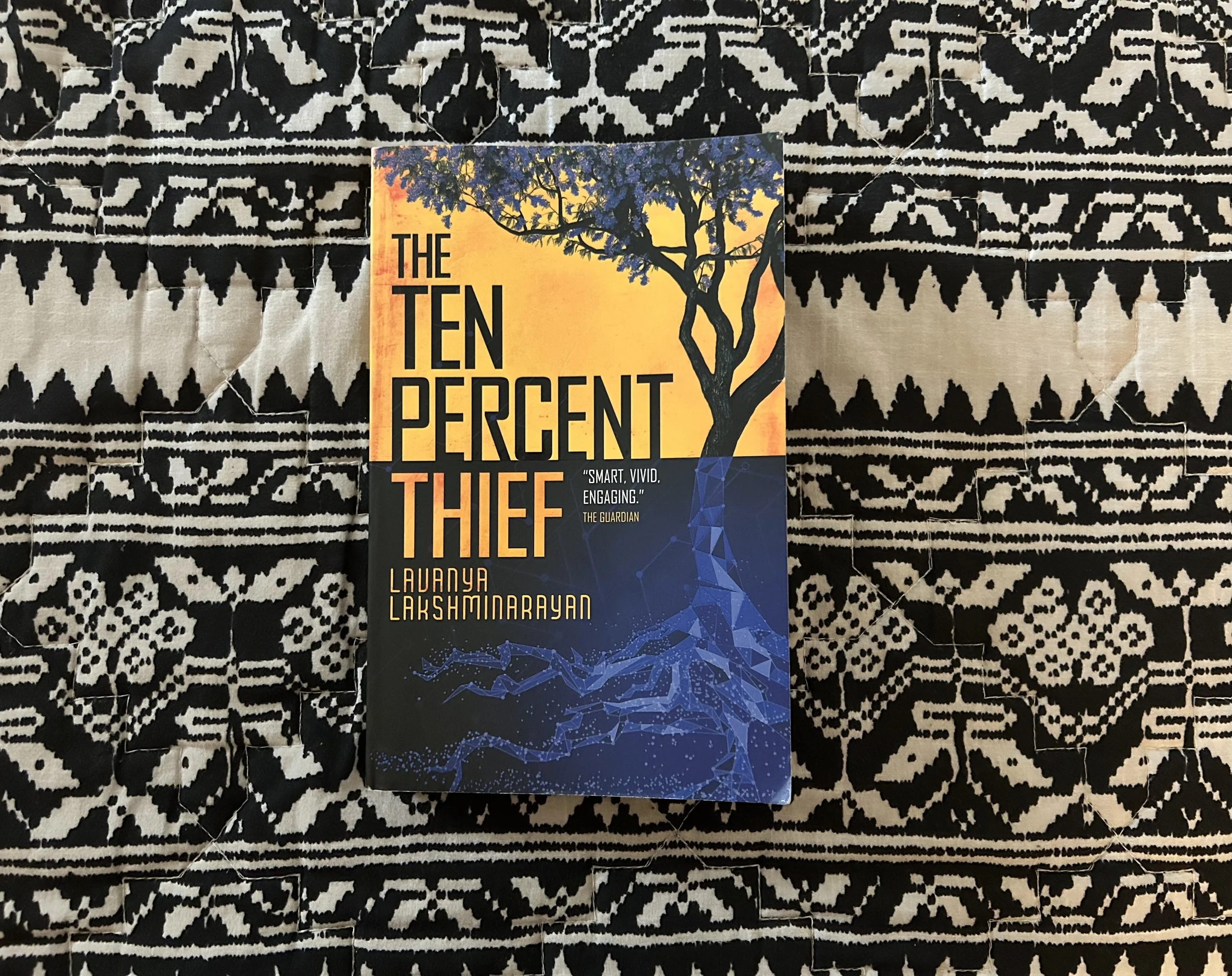
In Lavanya Lakshminaryan’s The Ten Percent Thief, a dystopic Indian future serves as the setting to explore existential dilemmas of human creativity in the face of an authoritarian technocracy.
Past the underground caverns of an erstwhile sewage system, an engineer-turned-artist builds a forest of spare parts and recycled metal. The artist Marie Fernandes’ proudest creation, The Amethyst Tree, is in progress, and it promises to become the final piece of a community art project by the ‘Analog’ humans discarded by the pristine ‘Virtual’ world. The Amethyst Tree has a trunk “welded together from metal pipes of all dimensions” and a flexible canopy that “rotates on gears and springs to help it withstand the dust storms that ravage this side of the city.” The other trees in this ‘Jewel Forest’ “feature fluttering scarves, decorated CDs, leaves made from broken glass…” (105) Each of these items once held a significant value to someone and have since been reinvigorated and reimagined. Each tree carries trans-communicators to keep the resistance of the Analogs connected. Each tree can be used as a hacking device.
It’s art as a literal form of rebellion.
Lavanya Lakshminarayan published the earliest version of the book that eventually became The Ten Percent Thief (Solaris 2023) six years ago, then called Analog/Virtual (Hachette India, 2020). The dystopian, science-fiction novel comprises of a collection of short, loosely-connected narratives that eventually land as jigsaw pieces of a larger puzzle set in Apex City, a place that was once known as Bangalore. Even before the rapid ascent of artificial intelligence learning models, Lakshminarayan stories displayed remarkable prescience of the many existential dilemmas that would face human creativity in the face of a meritocratic technocracy. How human can we possibly be without the true freedom of artistic human expression?
Through Marie’s Jewel Forest, Lakshminarayan argues for both the beauty and utility of the tangible, the weirdness of defying neat norms that couldn’t possibly exist in the Virtual world. She elevates imperfections that could only be human.
Lakshminarayan argues for both the beauty and utility of the tangible, the weirdness of defying neat norms that couldn’t possibly exist in the Virtual world. She elevates imperfections that could only be human.
Trees are an ongoing theme in The Ten Percent Thief, in a place where the authoritarian Bell Corp. has “instituted its algorithms and reshaped the world order” (274). The first chapter or story in the book presents the Virtual world, around the rare presence of real trees in an Arboretum, a setting that can only be accessed as an “exclusive right” (13) of the top twenty percent of society. The next seventy percent are allowed “Hyper Reality gardens” with an occasional houseplant. The bottom ten are the lowest in the social rung, who live outside the city with few resources and no technology, destined for the horror of having their organs harvested at vegetable farms.
In the chapter “Welcome to the Machine,” (76) a group of Virtual world school-children take a field trip to see how the Analogs live, like visiting a human safari. The guide tells the children that the Analogs are allowed their craft and their trade—their human creativity—as a “peacable way to pass their time.” Lakshminarayan writes, “The children do not understand this statement. The slow passage of time is inconceivable to them. They are trained to attain maximum Productivity.” (93)
The Virtuals mock the imperfections of the Analogs, or the time they spend making art and “trees from trash.” (116) A Bell Corp. executive says that, “Impeccable taste can’t be produced by democracy.” (130) Instead, Virtual Citizens are offered streamlined distractions, make-up tutorials from their influencers, or heavy investment in the sporting ‘League of Champions.’ In the chapter “Monsters Under the Bed,” John is a seventy-percenter raised by an Analog woman who yearns for admission into the top twenty percent. The only way up is to “repair his opinions,” (19) not have ideas or opinions that are too different from the recommended mainstream, to conform and accept simulations over reality. He has to give up all that makes him unique. Lakshminarayan writes, “They will love him because he is empty.” (39) In a later chapter, the children of the Virtual world are made to recite a literal ‘Pledge of Conformity.’
One of the main themes of The Ten Percent Thief is this sense of class insecurity felt by characters like John. It is a familiar extrapolation of the realities that already exist with the widening economic gaps in India (and abroad). Everyone is in flux, as the less-privileged classes strive for upward mobility, and those who enjoy life as twenty percenters often live in uncertainty to ensuring they aren’t relegated to the lower classes. To keep up their appearances, the Virtuals are often instructed to despise the Analogs, treat them like dirt, scoff at their art and their “printed newspapers,” use them in their pleasure domes, harvest them in their farms, reduce them to something less than human.
One such story of flux is about Nina, an Analog adopted by a wealthy family in the Virtual world. Introduced in the story, “Études,” the teenager is one of the most compelling characters in the book, a piano virtuoso who has achieved young brilliance without the assistance of the various technologies designed to ‘assist’ musicians like her towards greater efficiency, or ‘Productivity.’ At time of adoption, the agent refers to Nina as “it”—like a pet—and explains her gifts and flaws to the adoptive parents, while she listens in. It cold, clinical words, the parents are advised that they, “don’t permit it to refer to either of you on the basis of your filial relationship. First names are better than Mum and Dad. It leads to an easier separation should the child fail to qualify as a Virtual Citizen.” (179).
Now among the Virtuals, Nina faces familiar challenges of adolescence while also being bullied and mocked by her peers for being an outsider, a “servant,” as someone who doesn’t belong among their classes (it is an unsubtle nod to India’s structural caste crisis). Nina must also pass a “demi-Virtuoso exam” to qualify for an advance music programme and pass a Virtual Citizenship test, where failure could risk deportation back to the Analog world.
Using Nina’s perspective to peer at the Virtual world proves to be an inspired choice, expertly merging the worldbuilding element of sci-fi and dramatic forward momentum—a balance that doesn’t always succeed in the genre. Like Marie’s Jewel Forest, Nina’s story in “Études” is another example of Lakshminarayan’s penchant for elevating the inherent relationship between humanity and art, even in the face of technology’s soulless ubiquity. When asked about why she picked a particular piece for her performance, Nina can provide no coherent explanation to herself: “I panic. I don’t know how to answer. The reason—this piece—is so much bigger than me. It dwarfs everything that comes within its reach. It contains me, and all I can do when I play it is wander the halls of its melodies, lost within a magic unlike any other.” (215) But she must stop her train of thought, for what the jurors want to hear is “a neat, predictable, unemotional response.” Art defies neat explanations—and without neat explanations, where’s the Productivity?
Nina must sacrifice some of the very humanity that makes her a creative virtuoso to secure her Virtual Citizenship. During her Citizenship Test, she must discard her past, and with curt, disguised confidence, disavow the Analog world, labelling them as “filthy… slackers… lowlifes” (219). She must display “Alpha-Behaviour Characteristics” to prove that she can belong with the Virtuals.
In characters like Nina, Marie, and the mysterious rebel leader known as Nāyaka—the ten percent thief—Lakshminarayan also presents an explicitly feminist response the intersecting authorities of capitalism, patriarchy, and tech presented in the dystopic world of Apex City. The story “The Persona Police” (112) introduces a Virtual woman Tanvi Nair, who cancels her ‘PregaPod transfer,’ choosing instead to give birth the old-fashioned way—i.e., taking a maternity leave to carry the baby herself. Executives in the Corporation don’t want to encourage such Analog behaviour, and Tanvi faces the pressure of juggling upcoming motherhood with the pressures of keeping up her Productivity. In heated board meetings, men and women discuss keeping up the façade of gender equality without giving women like Tanvi the right to live a life of self-determination.
[Nina] must stop her train of thought, for what the jurors want to hear is “a neat, predictable, unemotional response.” Art defies neat explanations—and without neat explanations, where’s the Productivity?
There are many more tales in this world of Virtuals and Analogs that wrestle with thorny complexities of freedom and self-determination. In “The Seven-Year Glitch,” (280) Aditi, a Virtual, realizes that her Meta-Interactive Mental and Emotional Sentience Intelligence System (M.I.M.E.S.I.S.) is using data to try to break up her healthy human relationship with Abhay. In “The BE-Moji Project” (256), Bell Corp. introduces a “words free” system of communication through animated emoji that reveal every inner emotion of its user. Nothing is secret, and no thought is allowed to grow into greater complexity. Soon, BE-Moji education for school-kids becomes another way of segregating the opportunities for the Virtual young from their Analog counterparts. All thought is visible, and thus, all can be policed.
With the rules of the world well-established, Lakshminarayan builds a complex tapestry of narratives in The Ten Percent Thief, her own version of the Jewel Forest where shards and discards are stirred together to form a coherent, final work of art. But there is an unevenness to the narrative cohesion in the book, with no central character, loosely-connected settings, and chapters that leave us with a sense of asymmetry. Imperfections that can only be human.
The storylines finally crash into each other in the final chapter, “Ants” (316), where the larger ambition of the book reveals itself in greater clarity. Now, The Ten Percent Thief becomes a full-fledged sci-fi action thriller. The revolution begins, thrusting each character into greater flux. Lakshminarayan’s mysterious revolutionary heroine is featured front and centre, presented in cinematic fashion that begs for an on-screen adaption: “The sun shines bright upon her. She looks like an ancient warrior from a picture book, her face streaked with organic dyes of red and gold, her sword unsheathed and at the ready.” (339) Later, she even marshals her troops with Hollywood-ready lines of dialogue, “Tonight, we take back the streets. Tonight, we sack the Virtual City. Tonight, the Analogs run free.” (340). The pace accelerates towards a climax that befits a summer blockbuster.
And yet, despite the thrills, Lakshminarayan’s narrative rises above the genre in its careful consideration of the story’s true heartbeat: the unflappable resistance of human ingenuity. We see Nina, the teenage piano virtuoso, who has accomplished her Virtual Citizenship and is finally allowed access to tech enhancements. When she sits down to perform, however, she feels distracted by the artificiality of it all: her Biochip implant itches behind her ear, the DreamMusician software is too distracting, the Glimmer Keys are confusing, the InEar Metronome plug gives her a headache, and the Tactile+ feels restrictive, “like a straightjacket” (220). She uses some of the technology that she finds suitable for communication and comprehension, but discards the ones that only restrict her natural, creative self.
And then, she makes her music.
***
Karan Madhok is a writer, journalist, and editor of The Chakkar. He is the author of Ananda: An Exploration of Cannabis In India (2024) and A Beautiful Decay (2022), both published by the Aleph Book Company. His work has appeared in Epiphany, Sycamore Review, Gargoyle, Fifty Two, Scroll, The Plank, The Caravan, the anthology A Case of Indian Marvels (Aleph Book Company) and The Yearbook of Indian Poetry in English 2022 (Hawakal). You can find him on Twitter: @karanmadhok1 and Instagram: @karanmadhok.