A ‘Janus-like’ Being: The Long Shadow of “Vande Mataram”

Photo: Kanishk Agarwala
From ancient Hindu traditions of retributive violence as well as history of aid and inspiration from abroad, Abhimanyu Kumar explores the complicated associations of our national song with India’s revolutionary movement.
This article is the second part of Abhimanyu Kumar’s 2-part series on “Vande Mataram” and India’s revolutionary movement. Read Part 1 here.
It was through a Japanese art-critic Okakura Kakuzo’s connections that Abanindranath Tagore—nephew of the great poet Rabindranath Tagore—learnt the Japanese ‘wash’ technique. He used this technique to paint the image of ‘Banga Mata’ in 1905, which, later, would be changed to Bharat Mata, making it the first such painting of the goddess representing the personification of the nation, as conceptualized by Bankim Chandra Chatterjee in the novel Anandmath (Bose, 2024, 2).
Anandmath also featured the song “Vande Mataram,” written as a rallying cry for early nationalists. Now India’s national song, “Vande Mataram” was set to tune by Rabindranath Tagore and became popular in the same period when Western Orientalist praise of the Vedas and Sanskrit texts, Aryan civilization, and Hindu cultural accomplishments created the intellectual conditions for the Indian freedom movement to take root, as we read in the first part of this essay. By 1885, the Indian National Congress had come into being, dedicated to fighting the British, partly through petitions by Western-educated Indians but it also had conservative leaders like B.G. Tilak, who supported righteous violence against the oppressor.
Simultaneously, a revolutionary movement also took place in India and abroad. It had three centres: Bengal, Punjab and Maharashtra. Other than Anandmath, the movement was also influenced by the Arya Samaj’s Reformist take on Hinduism in Punjab and Tilak’s brand of Hindu Nationalism in Maharashtra. Tilak drew on the Gita’s message of dispassionate discharge of duty and praised the valour of Shivaji in fighting the Mughals to inspire Hindu youth.
The violent revolutionary movement developed in phases. Its first phase was mainly intellectual: from 1882, the year in which the Anandmath was published, until 1905, when the Swadeshi agitation took place all over India, to protest the Partition of Bengal. From the start, this movement had a dual existence; a ‘Janus-like’ being, as A.C. Bose has called it in the introduction to his book, Indian Revolutionaries Abroad, 1905-1922. (Bose, 1971, 8). With one head, it drew inspiration from home-grown Hindu traditions of retributive violence, as depicted in Bankim Chandra Chatterjee’s Anandmath (1882), which included “Vande Mataram”; with another, the movement looked abroad for encouragement, as well as help.
Hindu Nationalism was already popular in Europe, due to the rise of Indology and spread of the Aryan theory. Other than the German Romantics, the Russian spiritualist Madame Blavatsky and her organization Theosophical Society—headquartered in New York and Madras—also popularized Hinduism all over the world.
A revolutionary movement also took place in India and abroad. Other than Chatterjee’s novel, the movement was also influenced by the Arya Samaj’s Reformist take on Hinduism in Punjab and Tilak’s brand of Hindu Nationalism in Maharashtra.
Swami Vivekananda played perhaps the most important role in establishing it as an international movement by making it popular in the US, even as American Transcendentalists, following in the footsteps of Herder, had deeply admired India and its Hindu learning. A disciple of the Bengali mystic Ram Krishna Paramhansa, Vivekanand took part in the World Parliament of Religions, held in Chicago in 1893, where he received immense praise and became an international celebrity overnight, attracting many Western followers. In Chicago, he shared the stage with Buddhist intellectuals and preachers from China and Japan, who were also trying to emphasize the importance of Asiatic religious traditions.
In Japan, the Meiji Restoration of 1868 had led to the modernization of the country. In the 1880s, Japanese intellectuals started formulating the ideology of Pan-Asianism, which was similar to Hindu Nationalism: both were anti-colonial ideologies which drew on home-grown religious and cultural traditions, while accepting the need for Western-style modernization of their countries.
Pan-Asianism was first propounded by Kakuzo, who saw Asia as a united entity suffering under Western colonialism, despite its advances in fields of culture, arts, and even education. Kakuzo had also travelled to the West and knew well about Western artistic and cultural traditions. He, along with other Japanese intellectuals, fashioned a new language of Asian resistance to Western imperialism. For him, ‘Asia was one’, united by its Idealistic philosophy—based on Hinduism and Buddhism—and the region’s socio-cultural ties dating from the time of the Silk Route.
Indians noticed the growth of these international trends, especially Japanese nationalism. For example, Swami Vivekananda had visited Japan on his way to the World Parliament of Religions and was greatly impressed by it. Kakuzo visited India in 1901 to invite him to Japan for a series of lectures, as Sugata Bose has written in Asia After Europe. Vivekananda declined the offer but visited Buddhist sites in India with him. Kakuzo also met Rabindranath Tagore on this trip. Tagore was a supporter of Pan-Asianism, developing deep ties with the intelligentsia of the two countries over the years.
*
In 1902, the Anushilan Samiti of Bengal was established, with branches in both Dhaka and Calcutta, by Aurobindo and others. Somnath Guha writes in Bagha Jatin, the biography of Jatin Mukherjee, another famous revolutionary associated with the Samiti, that both Kakuzo and Sister Nivedita influenced the formation of the Anushilan Samiti. Nivedita was an Irish disciple of Swami Vivekananda, who had followed him to Calcutta after meeting him first in London in 1895, and became a part of the city’s intellectual and nationalist circles. Soon, this Samiti would become the main revolutionary organisation of Bengal. (Guha, 2022, 48)
Inspired by the lofty ideals espoused in Anandmath, the organization was a secret society which aimed to liberate India through an armed struggle. “The young men of Bengal would mould themselves as ‘santans,’ the children of the Motherland, and prepare themselves with unprecedented zeal for her liberation. The novel had laid the foundation for Indian nationalism, an amalgamation of patriotism and powerful religious fervour.” (26) Although Guha calls it Indian Nationalism, a more exact description would be Hindu Nationalism.
Inspired by the lofty ideals espoused in Anandmath, the organization was a secret society which aimed to liberate India through an armed struggle. “The young men of Bengal would mould themselves as ‘santans,’ the children of the Motherland.” Although Guha calls it Indian Nationalism, a more exact description would be Hindu Nationalism.
The revolutionary movement in Bengal gained momentum following the Partition of the state in 1905, and the Swadeshi movement which started in the same year; this can be called the Second Phase. According to Hem Chandra Kanungo, the revolutionary movement was a direct result of the failure of the non-violent agitation against the Partition of Bengal; and the victory of Japan over Russia in 1906, which showed that Western countries could be defeated militarily. Kanungo too was with the Anushilan Samiti, which followed the methods of Russian Anarchists when it came to practising revolutionary terrorism. The Hindu Nationalist revolutionaries became interested in Anarchism after the failed revolution in Russia in 1905, which was led by the Anarchists. He travelled to Paris in the first decade of the 20th century to learn bomb making. He wrote in his book, Account of the Revolutionary Movement in Bengal:
The agitation against the partition having failed to achieve its end, it, by way of retaliating the wrongs thus inflicted, took a new turn in the shape of the Swadeshi and boycott agitation and led to the final but inevitable appearance on the scene of the bomb and the revolver. (Kanungo, 2016, 143)
Aurobindo wrote a pamphlet called Bhawani Mandir, in 1905, which exhorted young men to emulate the Children of the Anandmath. The next year, Bande Mataram, a newspaper in English was published with Aurobindo managing it from the start, and writing articles at a prolific rate. A newspaper in Bengali, Yungantar, too was published around the same time: its editor was Bhupendranath Dutta, the younger brother of Swami Vivekananda. Both publications were known for their seditious content. Muslims remained excluded from the revolutionary terrorism of Bengal, inspired by the Anandmath (Sarkar, 2006). This was because the revolutionaries of Bengal insisted on taking an oath on the Gita and bowing down to the idol of Mother India (represented by goddess Durga), in order to show their loyalty to the cause. Muslims could not agree with this decision. Kanungo wrote about the decision of the Anushilan Samiti regarding Muslim participation in the movement:
It was resolved that if the Muslims joined this revolution it was all to the good; because when the country became free, privileges in proportion to the extent of their help would be conferred on them. But if they did not join they would be classed as enemies and were to be put in the same category with the English. (139)
The domineering attitude of Hindu revolutionaries towards Muslims is quite evident from this passage. They were supposed to prove their loyalty by joining the revolutionaries on their terms which meant accepting Hindu rituals; if they did, they would receive vague “privileges”. If they disagreed with this blatantly derogatory treatment, they would be considered “enemies”.
One of the first British officials whom the Bengali revolutionaries tried to kill was Bampfylde Fuller, then-Lieutenant Governor of Eastern Bengal and Assam. However, multiple attempts on his life failed, before Khudiram Bose and Prafulla Chaki succeeded in killing two female relatives of another senior British official, Douglas H. Kingsford, the magistrate of Calcutta. Khudiram was arrested and Chaki committed suicide. Later, Khudiram was hanged. The case led to widespread repression of the revolutionaries by the police and came to be known as the Alipore Conspiracy Case. Aurobindo, who was an accused in the case, shifted to Pondicherry and turned to spirituality. The noted lawyer and Congress leader C. R. Das argued on his behalf and managed to get him exonerated.
This created a sense of solidarity among the immigrants and led them to organize themselves, primarily at Gurudwaras. Their efforts at becoming united against racism, additionally driven by a hatred of the British culminated in the formation of the Ghadar movement.
Another sensational act was committed by the Bengali revolutionaries of the Anushilan Samiti when Rashbehari Bose, along with his associate Basanta Biswas, threw a bomb at the Viceroy’s ceremonial procession in Delhi in 1912. This was done to protest the shifting of the capital from Calcutta to Delhi in 1911. While Basanta Biswas was arrested, Bose escaped.
Due to growing police repression, the revolutionaries were starting to move abroad for training in bomb-making and other military disciplines, which was not possible at home. They also hoped to conduct propaganda; and, establish connections with Western revolutionaries.
In London, Shyamji Krishna Verma—an Oxford-trained scholar of Sanskrit and a wealthy Indian patriot who believed in violent resistance to oppression—set up the India House, a hostel, which soon became the central meeting place for the Indian revolutionaries. He also started to publish a journal called The Indian Sociologist, and instituted scholarships for Indian students to study in London. V. D. Savarkar was one of those who received such a scholarship on the recommendation of B. G. Tilak. His stay in the India House was eventful. He wrote a history of the 1857 revolt there, which many believe to be the first nationalist history of the Mutiny. The 50th anniversary of the revolt was commemorated with much fanfare in 1907 by him and others.
Savarkar was arrested following the assassination of Curzon Wylie, a senior British official, in London, by his protégé at the India House, Madan Lal Dhingra. Following Savarkar’s arrest and deportation, the revolutionary movement shifted to Germany, as many of the revolutionaries were aware of Germany’s interest in the Aryan theory and Sanskrit texts; and hoped for a fruitful collaboration with the German authorities. In 1911, for example, Lala Har Dayal, a peripatetic revolutionary from Delhi, wrote in Modern Review: “The Germans have learned to admire Hindu genius through Sanskrit literature, and I was surprised to find that a young man of no high educational attainments had read Shakuntala in translation”.
Har Dayal, being an exceptionally bright student like Shyamji Krishna Verma, too received a scholarship to study at Oxford. His initial influences came from the Arya Samaj, as well as from Anarchism. While at the Oxford university, he became involved in political activities at the India House. After the arrest of Savarkar, Har Dayal landed in the US.
Starting with the Californian Gold Rush of the 1850s and until the first decade of the 20th century, immigrants from Punjab had arrived in the US and Canada, looking for better opportunities. The White working-class population resented them for posing “a threat to their jobs” and conservative politicians fanned this sentiment for electoral gains. (Puri, 2011, 20) This created a sense of solidarity among the immigrants and led them to organize themselves, primarily at Gurudwaras. It has been argued that the experience of migration can have the effect of making migrant communities more politically conscious, and it can be seen in this case. Their efforts at becoming united against racism, additionally driven by a hatred of the British for not helping them despite being British citizens, culminated in the formation of the Ghadar movement.
The Ghadar Party was founded in 1913 by Har Dayal and Sohan Singh Bhakna, who was a politically active immigrant, having cut his teeth in the political agitations of 1907 in Punjab under Ajit Singh (Bhagat Singh’s uncle). The Ghadar Party rented a house in San Francisco to establish its headquarters, naming it the Yugantar Ashram. The name was a tribute to the journal published from Bengal, which had to shut down in 1908. (Guha, 79)
Its leaders were mostly educated Indian students, especially Bengalis and other Hindus; the followers of the party were by-and-large Sikhs and other Punjabi immigrant workers living on the Pacific Coast in the US. Many in the Ghadar Party had Pan-Asian links and they used to travel to Japan often, keeping these links active. The Party mainly functioned in the Indo-Pacific region, as noted by Pimmanus Wibulsilp: “San Francisco, Tokyo, Hong Kong, Shanghai, Manila, Singapore, and some parts of Thailand, British Malaya, Burma, and Sri Lanka were among the major sites where their networks and activities existed.”
Virendranath Chattopadhyay, or Chatto, emerged as the leader in Europe in the new phase. Other than Savarkar, he was close to Madame Cama, a Parsi revolutionary based abroad. Women were few and far between in the revolutionary movement. Sikata Bannerjee has argued that armed resistance movements that see the nation as a mother end up excluding women. (Bannerjee, 9-10) This could be from a defensive posture inherent in such movements: the desire to protect the nation, which is seen as a chaste female figure. As a result, Hindu women remained by-and-large excluded from the revolutionary movement. Curiously, many white Western women did participate in it, such as Sister Nivedita. This can be explained through the same logic: being Western meant their protection was not among the tasks of the revolutionaries.
Most women who entered the revolutionary movement did not alter it according to their needs or wishes. This included the tragic life and career of Agnes Smedly, another white woman and a journalist, who was active in the movement in the US and Europe, becoming over time a bridge between them. She became the victim of sexual assault by an Indian revolutionary, Heramba Lal Gupta, whom she described as a misogynist in her autobiographical novel Daughter of Earth.
Through Daughter of Earth, we learn that Smedly lived through a childhood of parental oppression, and poverty. She faced sexism in her younger years and discrimination as she began to work as a journalist. She soon became aware that the world was not a fair place for women, and others who belonged to a different race, or nationality—she was Irish and that played a role too. She was also active in the Anarchist movement in the US. For her, the struggle for women’s rights included fighting for the rights of other disadvantaged and marginalized groups.
Smedly encountered Indian freedom fighters, and revolutionaries in New York. She also met Lala Lajpat Rai, who was in exile. Rai was one of the Congress Extremists like Tilak, who tacitly supported the revolutionaries. From Rai, she learnt about the Indian freedom movement. Rai saw the movement as part of an Asian struggle and was conscious of its international dimensions. (Rao, 2025, 117) Smedly vividly described this radical world in her novel. Through arguing with Rai, and other Hindu and sometimes, Muslim revolutionaries, she learned about the Indian society, its history and culture; and the British oppression.
Chattopadhyay —who later became personally involved with Smedly—and Cama revived the newspaper Bande Mataram and published it from Paris. Soon after, Chattopadhyay and some others set up the Indian Independence Committee in Berlin, with the help of the German Foreign Office. Talk of an impending war between Germany and Britain was already in the air and the revolutionaries in Germany sought to utilise it for securing India’s independence. Germany too was interested, but on its own terms. It had become more interested in the Muslim world by that time, although the interest in India remained. “As early as October 1911, General Friedrich Von Berhardi (sic) published his widely circulated book Germany and the Next War where, while advocating a war with Britain, he tried to show how the precarious conditions prevailing could lead to German advantage.” (Barooah, 2004, 37).
Bernhardi wrote that Pan-Islamists and Bengali revolutionaries were arch-enemies of the British, and capable of giving the British a serious fight, if Germany backed them with funds and arms. Pan-Islamism was another ideology which began to gain traction in the 1880s. It was similar to Pan-Asianism in its anti-Western slant and anti-colonial attitude, but with a wider geographical ambit, which included the Arab world and North Africa. Pan-Islamism arose against the dismantling of the Ottoman Empire by Western countries and the colonisation of Egypt, Iran, and North Africa.
Both Bernhardi and Wilhelm II were keen to instigate a rebellion in India, especially among the Muslim population, since they believed Indian Muslims would be partial to Turkey and the Caliphate under the influence of Pan-Islamism.
Pan Islamism’s main ideologue was Jamal-al-Afghani, a peripatetic thinker with connections to India, Iran, Afghanistan, Egypt, and Turkey. He spoke about the need for Islam to reform itself in order to challenge Western colonialism. Another aspect of his message was the need for modernization by Muslim nations. Pan-Islamism presented Turkey as the centre of the Islamic world, and sought the loyalty of Muslims to the Caliphate—a clever use of religion in politics. Turkey, like Japan, was an independent country of Asia and had also modernized itself like Japan during the Tanzimat Reforms.
Bernhardi’s opinion was shared by the German king, Wilhelm II and the Chief of Staff of the German army. Both were keen to instigate a rebellion in India, especially among the Muslim population, since they believed Indian Muslims would be partial to Turkey and the Caliphate under the influence of Pan-Islamism. They were not completely wrong: Indian Muslims were sensitive to the condition of Muslims all over the world. Italy’s invasion of Libya, and the British military action in the Balkans in this period were not taken well by them, as both territories came under the Ottoman empire. (Ashraf, 2001, 80) By this time, the Young Turks, a group of reformist military officers, had taken over the reins in Turkey and established a Constitutional Monarchy.
With the help of a senior German official Baron Max von Oppenheim, the Berlin Committee was set up, later to be known as the Indian Independence Committee [IIC]. Other than Chattopadhyay and Abinash Bhattacharya—who had been a member of the Anushilan Samiti of Bengal—the committee included Chempak Ramen Pillai, an Indian revolutionary then based in Zurich, from where he published a newspaper Pro-India. The IIC also included several Muslims, such as Md. Barkatullah (Barooah, 43). Barkatullah had a unique trajectory: a career of radicalism and anti-colonial activism which started in the last quarter of the 19th century, and took him to England, the US, Japan, Turkey, and Afghanistan. A Pan-Asianist as well as a Pan-Islamist, he was closely associated with the Ghadar movement and the IIC.
Barkatullah, who knew Al-Afghani, the founder of Pan-Islamism, argued in his writings that Islam was not incompatible with modern values. He posited Islam as a revolutionary ideology with a strong component of justice ingrained in its legal aspects, and he also argued that Islam was free from racial prejudice. Such a repositioning of Islam allowed Muslim intellectuals of the period to develop a critique of colonialism, and create anti-colonial global solidarity networks such as Pan-Islamism. Barkatullah also wrote articles, exhorting Indian Muslims to back Germany in the case of a war breaking out between world powers, even before the Berlin Committee was formed (Barooah, 40).
*
With the commencement of the First World War, the revolutionaries of the Ghadar Party, the Berlin Committee and India-based revolutionaries under Rashbehari Bose came up with a daring plan to foment a mutiny in the British Indian army. The plan was to get arms from Germany, which was willing to provide them to cause disturbances in British India. The Ghadar revolutionaries were to arrive from the US, Canada, and South-east Asia. It was to be led by Rashbehari Bose and later came to be known as the Hindu-German Conspiracy Case or the First Lahore Conspiracy Case. Both Pan-Asian as well as Pan-Islamic links were employed in organizing the Conspiracy.
Putting the blame on Muslims hides an important flaw in the strategy of India-based revolutionaries: Keeping Muslims out of the revolution, while abroad, more attempts were made—often successfully—to bring the two communities together.
Bhagwan Singh Gyanee was the president of the Ghadar Party during the Conspiracy. He left India in 1909 with his family due to his political activities being tracked by British police. He was active in the South-east Asian region; operating in the US and Canada region as well. He was arrested in Hong Kong for seditious speeches; and, later fled to Japan from Canada in 1913, where he met the Chinese Nationalist leader Sun Yat Sen, another votary of Pan-Asianism, who had led the Chinese revolution of 1911. Bhagwan Singh operated out of “Philippines, Japan, and China” to organize the revolution. Several other Ghadar leaders also operated out of South-east Asia.
The Chattopadhyay-led Berlin Committee oversaw the Hindu-German Conspiracy Case, with the responsibility of sending arms to India. The route went via America, to Java and South-east Asia, from where Bengali revolutionaries and the Ghadarites were to pick up the arms. The committee’s other important scheme was a proposed invasion of India to liberate it, with the help of the king of Afghanistan. Barkatullah was involved in this plan and accompanied the team which went there. This plan had the backing of Enver Pasha, a key Young Turk leader. However, it did not succeed as the Afghan king refused to invade India and incur British enmity, although his brother and other advisors were keen on it. The team that went to Afghanistan did establish the first Provisional Government of India, with Barkatullah as its prime minister.
Despite several attempts, none of the initial plans to ship arms to revolutionaries in India succeeded, largely due to British diligence. Jatin Mukherjee, a leader of the Anushilan Samiti mentioned earlier, sent a young man called Narendranath Bhattacharya to pick up arms from Java, or present-day Indonesia. But the ship which was supposed to bring arms from America never arrived due to several complications on its journey to Java. The young man left for China and Japan to find another way to send arms; and finally reached the US, where he changed his name to M. N. Roy in order to evade arrest. Mukherjee died in an encounter with the police in Odisha as he waited for further reinforcements.
Meanwhile, under the leadership of the Bengali revolutionaries, the Ghadarites who had returned to Punjab on the Komagata Maru and other ships, set the date for an insurrection in the army without waiting for the German arms to arrive. The plan leaked to the police, and the operation was foiled in early 1915. The extensive preparations that had been made came to a nought, although the revolutionaries had managed to persuade many soldiers to take part in it, hoping to seize British arms when it started. They had also looted banks to fund their operations.
The failure of the Conspiracy can be explained through the role of adverse Hindu-Muslim relations which has been largely absent from the discourse. In his autobiography, Bandi Jeevan, Sachindranath Sanyal, who was the right-hand man of Rashbehari Bose during the Conspiracy, blamed the ‘treachery’ of Muslims, without enough evidence, for the failure. (Sanyal, 2023, 111-112). He wrote that the spy—a Hindu—who outed the plan to authorities, was first brought by a “Muslim deputy superintendent of the secret police.” (90-91). Later, describing how the revolutionaries were arrested with the help of the common public, he pointed out that one of them was caught by a “Muslim man”. (103). However, these instances are nothing more than coincidences.
Putting the blame on Muslims hides an important flaw in the strategy of India-based revolutionaries: Keeping Muslims out of the revolution, while abroad, more attempts were made—often successfully—to bring the two communities together. In other places in his book, Sanyal accepted that the revolutionaries in India—probably due to their bias—did not try hard to rope in Muslims, although anti-British sentiment among them was high in this period. (103) He also wrote about the revolutionaries not having much faith in foreign help. The only foreign help available to them officially was from Germany and its partner in Pan-Islamist intrigues, Turkey, but for Sanyal, seeking their help would have amounted to agreeing to Muslim domination.
Such was Turkey’s close relationship with Germany in the years preceding the WW1, that a rumour had gone around in the Islamic world about the Kaiser of Germany converting to Islam. In India, attempts were made by the Muslim clergy to consolidate Indian Muslims’ support for the Ottoman empire against the British. (Ashraf, 86). In fact, Muslim soldiers stationed in Singapore mutinied in early 1915 due to the efforts of the Ghadarites; and many of them were tried and executed for their rebellion. They had been radicalized due to the Ghadar Party, and the IIC’s Pan-Islamic propaganda.
In their articles, Bhagat Singh and his comrades criticized the masses and their leaders for their reliance on religion and emphasised the need for a classless society based on equality, which was to be achieved through a Communist revolution in the Bolshevik style.
Trials were held in India in 1915, called the First Lahore Conspiracy Case. They led to 136 convictions, with 42 death sentences (Ramnath, 59). Among those who were hanged was Kartar Singh Sarabha, a life-long inspiration for Bhagat Singh.
In America, the trials held in 1917 featured 105 individuals, according to court records, who were charged with plotting to overthrow the British government through a revolution in India. Among those who were indicted for their role were members of the IIC and the Ghadar Party, including Virendranath Chattopadhyay, Bhupendranath Dutta, Chempak Ramen Pillai, Bhagwan Singh Gyanee, Taraknath Das, Barkatullah, and others. Gyanee and Das—who was earlier with the Anushilan Samiti—also served a jail term, along with other members of the Ghadar Party.
*
After the Bolshevik revolution of 1917, the movement took a left turn, and continued in its third phase till 1931 when Bhagat Singh and his comrades were hanged. M. N. Roy described this intellectual shift in his autobiography Memoirs, published in 1964. He reminisced about his early days, when he became a revolutionary under the influence of Anandmath. He called himself “naïve” for not understanding that the “social idealism” of the novel disguised its cultural chauvinism. He also found it intellectually deficient, stating, “It dawned on me that Nationalism, whether revolutionary or constitutional, cultural or political, relied mostly on emotion because it was intellectually weak. Its appeal, at home as well as abroad, was not to the head but to the heart. It tried to move, not to convince.” (219) Roy wrote that he began to study “contemporary history” during his time abroad in the 1910s, trying to understand how politics and economics worked. “The result was conversion to Socialism.” (219)
Roy, Chatto, Smedly, Acharya, and Dutta turned to Moscow for help with their anti-colonial activities and met Lenin, who took an active interest in the Colonial Question, as it was then called. Ultimately, these discussions and meetings led to the formation of the Communist Party of India in Tashkent in 1921 under Roy’s leadership, with many former Pan-Islamists who had set out from India to fight for Turkey. In the early twenties, Roy and his wife Evelyn Trent, began editing the journal Vanguard of Indian Independence, while they moved between Germany and Russia. In 1925, the official Communist Party of India was formally established by Roy’s comrades in India. The other important development which aided the spread of Communist ideology in India was British alacrity in trying various associates of Roy under a series of Conspiracy Cases in the 1920s, such as the Peshawar Conspiracy Case, the Cawnpore Conspiracy Case, and the Meerut Conspiracy Case, all aimed at containing a Communist insurrection in India. The publicity generated due to the trials made the masses aware of the Communist ideology.
Sanyal’s autobiography also offers an insight into this left turn in the 1920s. He was jailed for his role in the first Lahore Conspiracy Case and sent to the notoriously brutal Andaman Cellular Jail. After his release in 1920, he once again became active in the revolutionary movement. This time, he focused his attention on Northern India, especially Punjab and UP. He wrote that he became interested in Communism by reading the journal edited by Roy. (323) He established a revolutionary party called the Hindustan Republican Association. He also met Bhagat Singh, Ashfaqullah, Ram Prasad Bismil, and Rajendra Nath Lahiri, and began to guide them ideologically and personally.
Bhagat Singh joined the organisation in 1925, while staying in Kanpur. (Singh and Lall, 1986, 73) In the same year, members of the HRA committed a train dacoity at Kakori, a small town near Lucknow. They were arrested, including Sanyal, and others like Ashfaqullah, Ram Prasad Bismil, and Rajendra Lahiri who were hanged. Bhagat Singh wrote articles in their support and was arrested for one of them in 1927 (73). Describing the revolutionaries on the day the judgement was passed in the court, he wrote that they were unconcerned with it. He quoted the famous poem attributed to Bismil, who was an accomplished poet in Urdu, to show their lack of fear as they came out of the courtroom singing it: “Sarfaroshi ki tamanna ab hamare dil mein hai / Dekhna hai zor kitna bazu-e-qatil mein hai.” (The wish for martyrdom is in our hearts now / Let us see how mighty are the assassin’s arms.)
We can see how far the movement had strayed from its initial days. Instead of “Vande Mataram,” a poem in Urdu was on the lips of the revolutionaries. Much was also made of Ashfaqullah’s participation. Bismil, in his final message before his hanging, expressed great satisfaction that a Muslim had taken part in the revolutionary activities. (80). Ashfaqullah claimed that he was the first Muslim to be hanged for revolutionary acts in India (82). These claims are not entirely correct but they show that the revolutionaries were aware of the Hindu-Muslim discord which had blighted the revolutionary movement earlier, and were consciously trying to remove it.
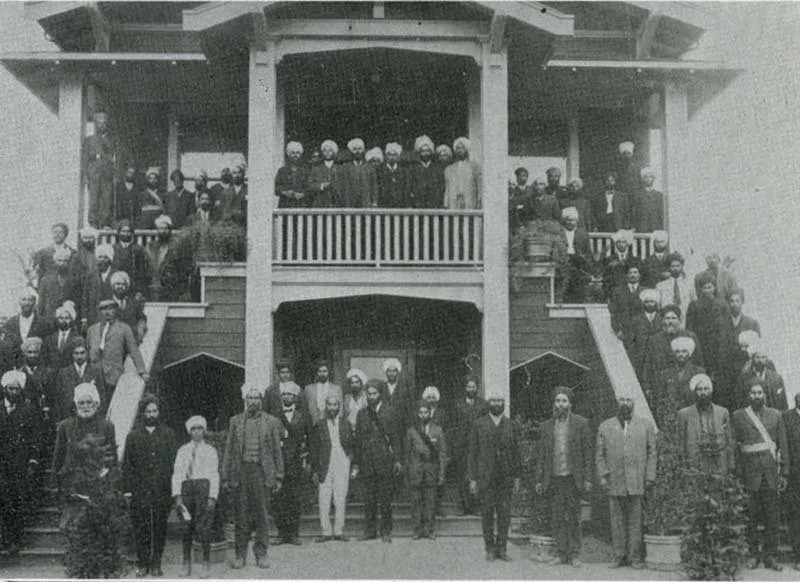
Members of the Ghadar Party at a Gurudwara in Stockton, California, USA, in 1916. Image: The Hindusthanee Student/Wikimedia Commons.
Events transpired quickly after the Kakori Conspiracy Case. By 1928, Bhagat Singh and his comrades had more or less left behind the influence of Hindu Nationalism and turned to Communism. This was reflected in their decision to change the organization’s name to Hindustan Socialist Republican Army. This was also reflected in their writings, as collected in the book, Bhagat Singh Aur Unke Saathiyon Ke Dastavez. In their articles, they criticized the masses and their leaders for their reliance on religion and emphasised the need for a classless society based on equality, which was to be achieved through a Communist revolution in the Bolshevik style.
Bhagat Singh even criticized Lala Lajpat Rai in his articles for his opposition to Communism and his old-school Hindu Nationalist politics. In one article, he took Rai to task for stopping the publication of articles by Agnes Smedly, for whose work he expressed great admiration (240). He alleged that Rai had stopped publishing Smedly’s writings because she supported Bolshevism. Singh and his comrades took an interest in the writings of other, older revolutionaries including Har Dayal, one of whose pieces advocating Communism was read by them with great interest. He even admired Savarkar and wrote about him approvingly several times (63, 126, 127). Singh’s family had known links to the Arya Samaj and that influence too persisted. It can be seen in his early writings in which he opposed cow-slaughter (112), and criticized Muslims for their “attraction” to the cultures of Turkey and Persia (57).
Instead of seeing such utterances as contradictions, we can better understand them as part of a process, without strictly fixed beginnings or an end. We cannot say at which point individuals like Singh turned from Hindu nationalism towards communism. What is more likely is that one ideology had less of an impact on their minds as time went by, without disappearing completely, while another attracted them more forcefully as their revolutionary praxis developed.
Nevertheless, when Lala Lajpat Rai was grievously injured while protesting the Simon Commission’s visit to India in 1928, and later died from his injuries, the HSRA decided to avenge his death. They killed the British police official J.P. Sanders who had attacked Rai during the demonstration against the Simon Commission’s visit to Punjab. In 1929, Bhagat Singh and his comrade Batukeshwar Dutt threw bombs in the Legislative Assembly in Delhi to protest the Public Safety Bill, the Trades Dispute Bill, and the Press Sedition Act, all of which were interpreted by them as measures to contain the growth of the Communist movement in India.
Bhagat Singh and his comrades Dutt, Sukhdev and Rajguru were all sentenced to death for their involvement in the two revolutionary acts of killing Sanders and the bomb-throwing in the Legislative Assembly. On 24 January 1930, they came to the court with ‘red scarfs’ around their necks, a celebration of Lenin Day. The same day, Bhagat Singh sent a telegram to the Third International in Moscow, which was the worldwide organization of Communists, backed by the USSR, declaring that he and his comrades supported a ‘world revolution’ and the ‘rule of the Proletariat’. They also raised slogans in the court, such as “Long Live the Socialist Revolution.” (278) The song they chose to sing was the one made famous by Bismil.
Such contacts helped Netaji build an anti-colonial network and liaison with the Nazi leadership with whose help he aimed to start an armed struggle. It was a difficult undertaking, considering Hitler was not sympathetic to the Indian cause initially and held racist views.
After Singh and his comrades were hanged in 1931, the revolutionary movement entered its fourth and final phase which started with a long lull. But it does not mean nothing happened during this period of relative quiet.
*
From 1882 to 1931, almost half a century had passed in which Indian revolutionaries conducted their activities in India and abroad. Starting with Hindu Nationalism as their guiding ideology, and Russian-style Anarchist terrorism, they became involved in Pan-Asianism, Pan-Islamism, and finally, Communism. But a successful revolution which would free India from British rule proved elusive. It took another world war for the revolutionaries to have their last chance at freeing India through an armed struggle.
By the early 30s, Netaji Subhas Chandra Bose emerged as a leading Congress leader. He began his career by assisting C. R. Das, and like his mentor, he was not opposed to the revolutionary movement. In the mid-1920s, he was arrested for “revolutionary activities,” writes Jan Kuhlman in his book Netaji in Europe, and sent to Mandalay. (Kuhlman, 2012, 11). This was the period in which, according to senior British officials, the revolutionary movement had seen a revival in Bengal, and for this they blamed Das and Bose. (Ghose, 2022, 66)
The movement had indeed been revived by Sanyal and his HRA. Revolutionaries of Bengal and Punjab were working together again after World War 1. With Bhagat and his comrades’ hanging, support for the revolutionaries peaked in the country and even Mahatma Gandhi had to face the ire of crowds for not defending them and seeking the commutation of their death sentence (186). Subhas rode the wave of anger against Congress and announced that he was hopeful of leading a new party, with socialist ideals, and a radical program of social change.
By 1933, he had reached Europe, ostensibly for medical reasons, but he started to meet senior Nazi leaders, and nationalist Indians who were living in Europe. He also met former revolutionaries such as Taraknath Das, who was associated with both the Ghadar Party and the Berlin Committee, and who had developed contacts with the Nazi leadership. Chempak Ramen Pillai also had good contacts with the Nazi leadership. Such contacts helped Netaji build an anti-colonial network and liaison with the Nazi leadership with whose help he aimed to start an armed struggle. It was a difficult undertaking, considering Hitler was not sympathetic to the Indian cause initially and held racist views. This was due to the influence of Alfred Rosenberg, the Nazi ideologue, who believed that Indians had become corrupted as a race, due to intermingling with other races and not preserving their Aryan ancestry.
Hitler believed in the same theory and wrote pejoratively of Indians in his Mein Kampf (1925). Interestingly, he also expressed contempt for Indian revolutionaries living in Berlin in the same book which shows that he was aware of them and their anti-colonial activities. He wrote: “To me, as a nationalist who appreciates the worth of the racial basis of humanity, I must recognize the racial inferiority of the so-called 'Oppressed Nations', and that is enough to prevent me from linking the destiny of my people with the destiny of those inferior races.”
Now, nearly 80 years after Independence, the BJP’s current enthusiasm for “Vande Mataram” shows its desperation to appropriate the revolutionary movement. Its parent organization, the RSS, made no notable contribution to the struggle for India’s freedom.
Although Netaji had earlier been approving of the Fascist ideology of Third Reich, he became its critic after he realised how it viewed the Indians and their freedom struggle. He protested to the Nazi leadership about their attitude to the Indians. However, he was also aware of Germany’s former regard for the Aryan theory and Hindu learning, and the help it gave to Indian revolutionaries during World War 1. In fact, when he met Heinrich Himmler, a senior Nazi leader, the latter spoke about Sanskrit literature to him (Ghose, 419).
When he arrived in Germany again after the Second World War broke out, he contacted A.C.N. Nambiar, who was Chattopadhyay’s brother-in-law, and gave him the charge of a new committee he formed to fight for India’s Independence from abroad (393). The Committee called Free India Centre, in its very first meeting, adopted ‘Jai Hind’ as its slogan, and Tagore’s Jana Gana Mana as its official song. “Vande Mataram” did not make the cut. Soon after, with the help of Rashbehari Bose in Japan, the Indian National Army was organized and handed over to Netaji to lead. (426) Much has been written about the armed struggle that took place under his leadership and does not bear repetition here.
Chandrachur Ghose writes in his biography of Subhas Bose, Bose: The Untold Story of An Inconvenient Nationalist, that Netaji was aware of the controversy surrounding “Vande Mataram,” which surfaced prominently in 1937 (525). It was opposed by the Muslim League for being “anti-Islamic” and against the “growth of genuine nationalism in India.” When Bose asked Tagore for his views, the poet said that despite having set it to music, he was no more keen on it. He argued that since it depicted the goddess Durga, Muslims would never accept it; nor would the Congress which was a “place for meeting of all religions of India” (526). In a letter to Nehru—who did not like the anti-Muslim message of Anandmath—Bose speculated that the controversy had probably arisen as the Congress leaders had sung it after their victory during elections to state assemblies which took place that year.
Subsequently, the Congress Working Committee decided during a meeting in Calcutta that only the first two stanzas were suitable for singing at public meetings. It also allowed its members to sing other songs (527).
*
When the Constituent Assembly convened in 1947 to discuss India’s Constitution, the issue of “Vande Mataram” was raised once again. The debate over it was acrimonious, and a committee was formed to settle the differences. The committee decided in 1950 to give primacy to “Jana Gana Mana” and adopted it as India’s national Anthem; “Vande Mataram” was declared India’s National Song.
Now, nearly 80 years after Independence, the BJP’s current enthusiasm for “Vande Mataram” shows its desperation to appropriate the revolutionary movement. Its parent organization, the RSS, made no notable contribution to the struggle for India’s freedom, a fact highlighted often by the Congress and other opposition parties. Appropriating the revolutionary movement helps the BJP counter this charge.
But a close look at the history of the movement shows that while its initial inspiration did come from “Vande Mataram” and Anandmath, it underwent many ideological shifts, including, notably, the turn to Communism in the 1920s. The revolutionary movement also had an international aspect and drew inspiration from global ideologies such as Pan-Asianism and Pan-Islamism. Its varied character over different phases does not allow for a monolithic interpretation, such as the one currently being attempted by India’s ruling party.
*
Abhimanyu Kumar is a journalist and writer based in the Netherlands. He co-authored The House of Awadh: A Hidden Tragedy (2025) with Aletta Andre last year for Harper Collins, India. He has written for several Indian and foreign publications as a journalist. He has also published poetry and fiction. You can find him on Instagram: @garcia_bobby123.