Resistance and Care in Nihaarika Negi’s TENFA
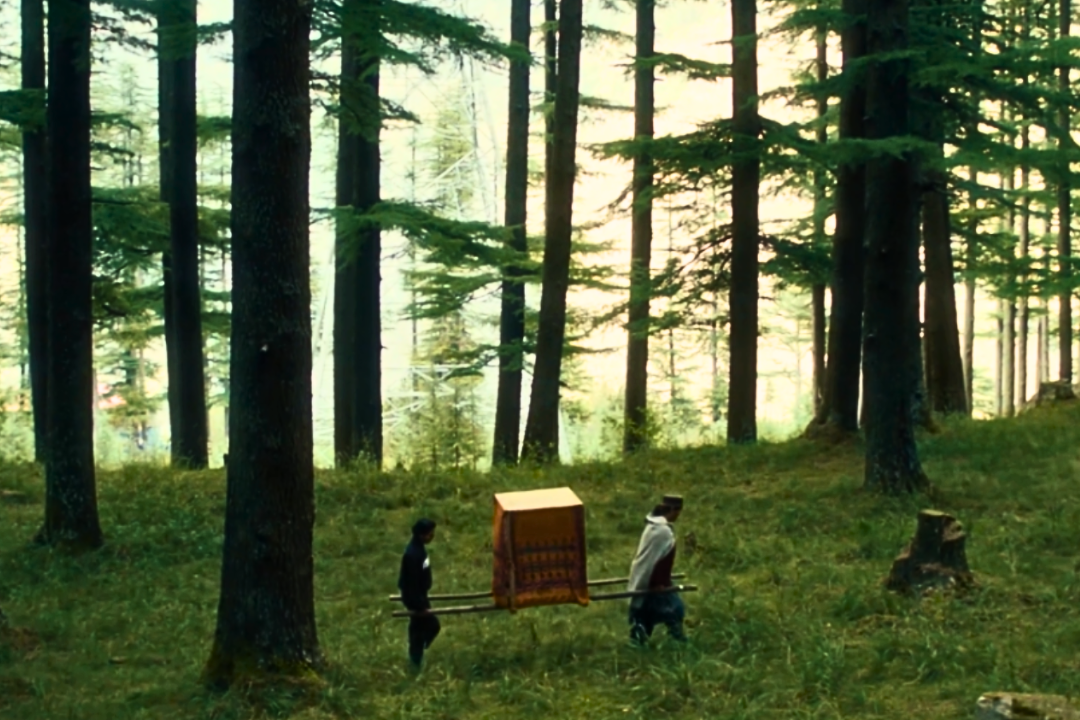
Set against the landslide-prone terrain of Kinnaur, plagued by environmental collapse and infrastructural neglect, the short film Tenfa (2026) provides a vision of hope through memory, ecology, and community.
In the opening scene of the Nihaarika Negi’s short film Tenfa (2026), we see a bitten apple exposed to the air as its flesh turns brown with time. Dolma, the village midwife, then slices away that rot to restore what can still be saved.
This small gesture becomes the film’s governing metaphor. In this sphere, care is about knowing how to intervene in decay and preserve life within damaged systems. Set against the landslide-prone terrain of Kinnaur, ecological collapse and infrastructural neglect shape everyday survival. Tenfa thus goes on to make its case for care being a form of resistance.
In Kannauri, “tenfa” means a gift exchanged in the form of medicinal plants, which makes it a gesture of reciprocity between people and the land. The underlying ethic is to take only what is needed and give back in return. That ethic is, of course, opposed to the logic of “development” that forms the film's backdrop. We see the surrounding felled forests and unstable terrain that have rendered entire regions uninhabitable. In Tenfa, as a result, medical care becomes endangered, too.
At the centre of this fragile ecosystem we meet Dolma, a government-certified midwife who has spent four decades delivering children across remote Himalayan villages. The film notes that she has assisted in around twenty births and several infant deaths. This relatively small number actually reflects how sparse life is in a region marked by outmigration, where the people are aware of the area’s literal instability.
Dolma moves through this landscape, checking in on neighbours as she sets out toward Kandar, which is still not fully evacuated. Despite her trained authority, however, Dolma finds herself handling a life-threatening childbirth without the infrastructure one might associate with modern healthcare. Landslides block the road to the nearest hospital, so the systems meant to support her and the new mother are absent. What remains is a network of memory keepers: women whose knowledge exists outside of formal recognition.
Here, Tenfa explores the gap between institutional care and ecological memory. So, when postpartum complications threaten the life of this young mother whom Dolma came to help, the latter’s training fails to offer a solution. Instead, the narrative turns toward a frail older woman whose knowledge of medicinal plants—which directly references the name of the short—takes centre stage. Yet her knowledge is incomplete, as she cannot recall the name of the herb needed to stop internal bleeding. She remembers only that it is a claw-like plant, the memory of which she holds with no linguistic certainty. In this moment, the film shifts the understanding of knowledge as not always named or easily transmitted. It only resides in experience.
The film’s portrayal of the Kinnauri tongue itself is a site of loss. The grandmother speaks a language her granddaughter does not fully understand; the older woman, in turn, is also removed from the linguistic world of her ancestors. Songs that once carried medicinal and ecological knowledge across generations and used to be sung while working or carrying Kinnauri apples down the mountains, have faded with time. What remains, as we hear, are half-remembered melodies.
Tenfa’s use of sound intensifies this sense of memories slipping away with time. The mountain songs that recur throughout the film are haunting to the extent of being spectral. By the end, these songs accumulate into a kind of collective mourning for entire systems of knowledge and ways of life. The ache settles in the viewer as an awareness of absence. The film’s narration itself begins with a heavy, funereal voiceover that gradually gives way to something lighter, even as the underlying risks remain unresolved.
Thus, care in Tenfa is fragile, but it is also adaptive. In one of the film’s most memorable moments, the granddaughter Iti—who has stopped attending school after losing her parents to an all-too-familiar landslide—suggests recording her grandmother's oral knowledge on her smartphone and uploading it in the hope that others who speak Kinnauri might help identify the forgotten herb. The gesture also makes Dolma and the grandmother uneasy, as the same technological infrastructures which made the region ecologically unstable—like the mobile towers erected across deforested land—are now tools for preservation. The film does not resolve this contradiction, though; it allows both realities to coexist.
Negi reinforces these tensions through the visual aesthetic of Tenfa. The early parts of the film occasionally move at an uneven pace, with noticeable pauses in dialogue that come with the seemingly non-professional actors. These moments sometimes disrupt the flow, but also impart a certain rawness that aligns with its community-based storytelling. In particular, the grandmother’s performance stands out in moments when her regret at realising that she has forgotten the knowledge she once carried feels more convincing than the urgency surrounding the herb she prescribes.
As the film progresses, its visual language is expressed through lingering shots of rivers moving with increased force, thanks to global warming and melting snow, which helps us understand its precarity. In one sequence, we see a crusher machine break down debris caused by industrial intrusion into this area. In another, Dolma notes how burnt grass caused by forest fires smells much like that of a cremation ground. Environmental destruction and human mortality, as viewers come to understand, are not all that different.
The same forest fires, we are told, have become more frequent, which has shortened winters and obliterated the conditions necessary for medicinal knowledge to survive. Now, there is no longer the time or the conditions for people to sit in the sun, sing, and transfer the knowledge of herbs and other oral traditions. The abandoned infrastructure of the ecoystem is a direct result of industrialisation that the locals never wanted.
In Kannauri, “tenfa” means a gift exchanged in the form of medicinal plants, which makes it a gesture of reciprocity between people and the land. The underlying ethic is to take only what is needed and give back in return. That ethic is, of course, opposed to the logic of “development” that forms the film's backdrop.
Negi also fuses fiction with documentary elements in Tenfa, as viewers see archival footage, voiceover, real locations, and community participants. This becomes another way to complicate the film’s form and its engagement with the audience. At times, this hybridity leans more toward documentary, as its narration guides our interpretation and anchors the film within a more all-around socio-political context. Yet, this hybrid form does not diminish the film’s affective power, as Tenfa links present crises to histories that persist in song and image.
In this mix, we also witness the mountains as a moral system. When the long-sought herb is finally located, some seeds are planted in the soil as the grandmother presses her head against the earth in gratitude. This act can be easily overlooked, but it forms the crux of what the film has been trying to build toward: if you take from the land, remain accountable to it. This solution is starkly opposite to the money-minded logic of corporations that exploit and abandon these fragile communities.
By the time the uncertain childbirth is resolved and the new mother is stabilised, Tenfa suggests that survival is dependent on systems that are already threatened. Dolma’s training is insufficient without the support of older, often overlooked knowledge systems, which shows how institutional frameworks can be limited. Care, in this context, is a service that requires not only memory but a synthesis with ecology and community.
In its last leg, the film turns toward collective expressions like song, dance, and some archival footage of earlier generations engaged in similar rituals. These images do not offer resolution so much as a persistent, though fading, link between past and present. If Tenfa offers anything like hope, it is the acknowledgment that these endangered systems of care can sustain life in ways that modern health infrastructures alone cannot.
Just like the apple in its opening scene, the world of Tenfa is marked by decay. By the time the end credits roll, however, the film insists that reciprocal care might keep this decay at bay—even if only for a little longer.
***
Sohini Sengupta is a journalist and writer on culture, gender, sexuality, and socio-politics. Her work has appeared in Hindustan Times, India Today, Feminism in India, Queerbeat, The Wire, and others. You can find her on Instagram @sohsaltmocha.