Surrealistic Icarus: Gopal Lahiri’s SELECTED POEMS
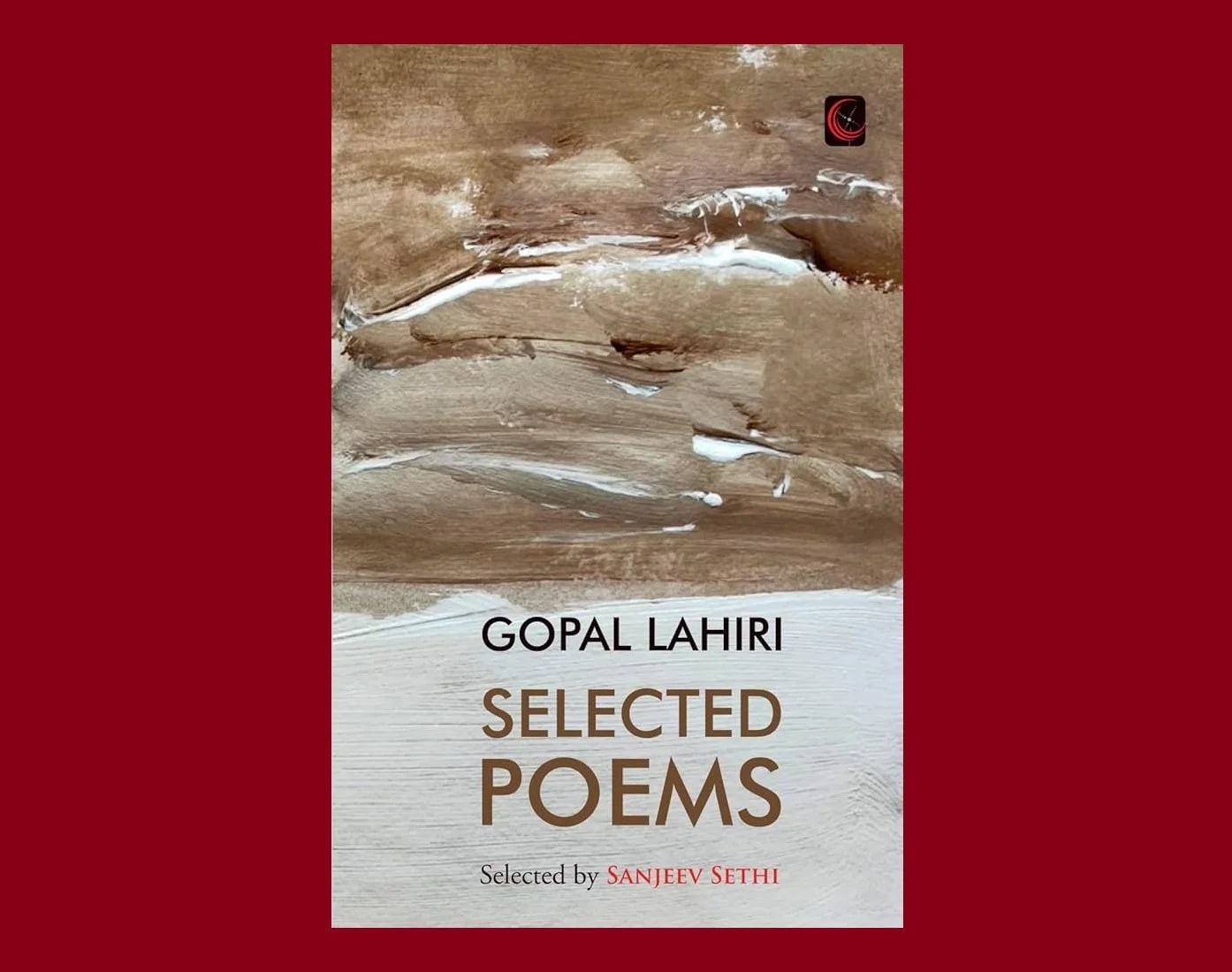
“Poetry is the diary I always carry with me.” Gopal Lahiri’s collection Selected Poems (2025) cultivates a privacy that invites readers to the poet’s second self in consciousness.
In his “The Selector’s Escritoire” that opens Gopal Lahiri’s Selected Poems (CLASSIX, 2025), Sanjeev Sethi remarks, “Selectors have to be brutal.” (9) Sethi, in compiling Lahiri’s output of over fifteen years through eight solo books, presents readers with a startling delight of introspective poetry. Lahiri offers, “Poetry is the diary I always carry with me.” (10) The selection cultivates such a privacy that readers indeed feel invited to Lahiri’s second self in consciousness.
“Crossing the Shoreline,” the opening poem, is finalised with the line, “Go and receive the self.” (13) This introduces the emotional quality and sense of departure invoked by Lahiri’s poems. Bearing a philosophical bridge into eternity, these writings feel as if they are partaking of a moment as it occurs.
This sharing of time and endless bounty is Lahiri’s trademark. As a philosophical poet, his work carries dialectics and vision that surpass sense boundaries. In “Conversations,” he pens, “Words vanish like Houdini when I need them. / The new grass opens its eyes.” (15) Aside from these lines bearing certain humanity through naturalistic observation, a dialectic between hiddenness and vision is at play. The poem further speaks, “[…] the last light in the sky stands still / where questions of faith are answered.” This feeling of departure from oneself unveils quiet certainty in movement. As time balances on its hinge, questions are answered. The reader does not know what they are. However, it is not necessary to understand the intent to gainsay the mood. The poem’s final line, “My conversation starts now,” leads to resolution within the spirit of this moment and its lapse. Thus, Lahiri’s poems insist on quietude as they offer mysterious reconciliation with time.
Movement is surreal and slow. “As I close your window a handful of sky moves from / one planet to the next,” (17) Lahiri writes in “Search”. The human impulse to recreate moments in our personal image is illuminated, “The evening sky repeats a smile that burns / and comes through unknown stars.” These final lines haunt and tease the imagination with blessings of infinity.
This haunted effect is distilled into the feeling of repetition. Could this be some kind of déjà vu? Or is it the poet recognising himself in the moment?
In “Traverse,” the line “Freedom is still a revolving truth” (32) also summons this sense of repetition. Feelings of recreating oneself are hidden within Lahiri’s “flickering secret.” In “Islands,” Lahiri jolts into creative form,
[…] making circles like vultures,
I decide to sentinel your face but
when the air grows taut and warm
I know you’ll acquiesce to all my islands. (33)
These lines feel like love poetry, yet they are representative of personal alienation from one’s own solitude, “I never own this place / now inside you my ruins sigh […]” conveys longing for a deep past.
Nostalgia runs through the verses. In “Memory of Sky” Lahiri pines, “[…] my personal ceiling, it opens another / darkness.” (59) The sentence structure is loose, conveying the need to locate and name oneself within the natural order. “I hope the whisper draws out its deeper flavor / the common humanity / sometimes even rupture in one dream, finding a quiet place at the corner,” the poem draws. These lines pull the poet into recognition of his own “common humanity.”
Chasing this commonness is reserved for a small few. In “Night Flame” we read these lines, “[…] the / chosen few collect the fire-like eyes.” (67) The essence of the visionary impulse is distilled. Solitude is captured, “[...] fireflies sew moonless poems / deep within the mother’s womb / light a fire, the city needs the flame.” By choosing fireflies to represent the poetic impulse, Lahiri grants it privacy. Tenderness seeps into the moment through these images.
Another example of this style of representation is in “Repression”:
Perhaps, the story
I’m looking for
is buried beneath the soft tiles and
in the murmuring of the ants. (69)
This stanza highlights the feeling of secrecy and the unknown within the moment. Lahiri is expressing the urgency behind poetic creation by uniting it with its repressed elements. There is also a feeling of impatience within these lines, bearing a predetermined existence for the “story” Lahiri awaits. He writes further,
Everything rinses
of voices in the room,
a set of drawing,
like an inheritance, slowly withdraw
the heartbeat of repression.
The poem’s final line, “My conversation starts now,” leads to resolution within the spirit of this moment and its lapse. Thus, Lahiri’s poems insist on quietude as they offer mysterious reconciliation with time.
The poem ends with the same word as its title, making it a cyclical experience.
In “Childhood” Lahiri writes, “[…] growing is a soft mask, a tending period.” (73) The tenderness evoked within the sentiment of maturing invites subtlety. “The long-gone days are finely hand-stitched,” says the same poem, invoking a similar emotion. Tactile sensations open the poem, “Childhood, that word – it has a smell to it / like fresh flowers in a cut-glass vase.” These lines introduce tender emotion to words themselves.
Rather than to define childhood linearly, Lahiri creates an image to invoke the sensation of nostalgia and youth. The image is a startling one because it introduces the poem with unexpected sensation attached to a process of remembering.
Later in the same poem, Lahiri draws a comparison to music, “[…] playing with sharps and flats” while continuing the imagery of flora, “[…] the leafless trees / with their skinny branches seem less / luckless.” While binding tenderness to the feeling of spontaneity, Lahiri also reminds us that maturing is a painful and frustrating experience.
In the imaginatively titled “Star’s Mouth,” Lahiri describes night as telling stories that are “achingly real / flowing into the star’s mouth” but “don’t divulge / how short it is, how crisp, how firm.” (72) This ability to draw process from sensation and time grants a unique strength to the poem. “Death is not there: I know about the woven eyes / of my childhood …” begins the final stanza. Cyclical emotion undercuts the imagery while paradox invites a relationship between opposites.
Lahiri further writes, “[…] I yield to the warmth of the flames / just so in a draftsman’s rendering / sometimes fire is so delicate and discerning.” The feeling of yielding embraces resistance that bends to the flames. These flames perhaps belong to the star’s mouth. Lahiri conceives of eternity as a rebirth into one’s tender beginnings. The star is a symbolic image representing the full sensation the poem embraces. The poet’s introversion characterises warmth and time abandoned.
In “My River,” time bears polarity. The poem’s opening image presents, “My river meanders in silence / the temple bell echoes, / in search of peace and purity.” (79) The river is patient like a slow ambulation, but the bell’s presence offers the scene awareness. Consciousness, one of the biggest mysteries of contemporary science, is presented through echoes. As echoes, awareness becomes ever-present. The mind’s exhaustive quest for the Absolute is also time’s essence.
In the poem’s third stanza, the scene is described as, “The sun peeks through the rugged rocks / cast lights over the still water; as if / a meditation on love and grief.” Nature is unified with the mind as the poet notes how emotion stands over the scene.
Lahiri ends the poem with these two lines: “No one knows the sin of height. // No one really cares for death.” The human illusion of immortality is questioned. Why is height a sin? Is the poet an Icarus who has flown too high? Obviously, the height referenced cannot be reached. Time is fearful and slow. Often, we have no conception of where it flows; we can only recognise the experience through our fear of slow loss.
The collection winds down with a series of haiku, that continue the surrealistic style of meditation that characterises Lahiri’s poetics. These verses feel quiet and meditative, yet strike with startling arrays of spontaneous thought. The essence must be distilled carefully to recognise Lahiri’s focus. The poet’s style remains steady over the years represented. No poem feels forced or longwinded. We are met with consistent images that thread into coherence.
As Lahiri’s approach to poetry resembles keeping a journal, the mood and sensations are private. The poems bear continuity and evolve in each reading. The verse is abstract enough to invite multiple levels of interpretation, leaving readers with a relaxing yet challenging meditation.
***
Dustin Pickering is founder of Transcendent Zero Press. He has contributed to Huffington Post, Café Dissensus Everyday, The Statesman (India), Journal of Liberty and International Affairs, The Colorado Review, World Literature Today, Asymptote, and several other publications. He was given the honor Knight of World Peace by the World Institute for Peace in 2022. He is author of the poetry collections Salt and Sorrow, Knows No End, The Alderman, Only and Again, The Nothing Epistle, The Stone and the Square, and several others, as well as the novella Be Not Afraid of What You May Find. His most recent book is Crime of the Extraordinary (Hawakal Publishers, 2024). You can find him on Instagram: @poetpickering and Twitter: @DustinPickerin2.