“I wanted the book to ‘sound’ and ‘feel’ like the internet” – Ria Chopra on NEVER LOGGED OUT

In Never Logged Out, Ria Chopra presents astute observations on growing up online, Gen Z, and the Indian internet, approaching these subjects with a writer’s restraint rather than a theorist’s grandiosity.
Most books about “the internet and us” arrive with predictable baggage, often skirting around indulgent ruminations on moral panic, algorithm, and the nostalgic pre-social media era. Ria Chopra’s Never Logged Out: How the Internet Created India’s Gen Z (Bloomsbury, 2025), however, sidesteps these temptations by making a quieter, more disciplined claim. A collection of eight essays, this is not a book about the dangers or miracles of the internet; it is a record of what happens when a generation grows up with no memory of life outside it. Chopra does not treat India’s Gen Z as a sociological curiosity or a market segment, but as a cohort old enough to write its own cultural history—and clear-eyed enough to do so without drama.
Chopra is less interested in announcing how the internet has reshaped identity than in tracing how it has subtly recalibrated ambition, intimacy, attention, and self-worth. The essays, originating in personal experience, move across familiar terrain—selfhood, privacy, fame, memory, desire—but Chopra approaches these subjects with a writer’s restraint rather than a theorist’s grandiosity. A debutante author, her prose is clean, alert, and largely free of the inflated abstraction that often dogs cultural writing about youth and technology. There is an unwavering editor’s instinct at work here: an understanding that overstatement weakens insight, and that tone matters as much as argument.
Through the course of 200-something pages, Never Logged Out resists the urge to scold or sentimentalize the generation its probing under the microscope. Chopra does not present Gen Z as uniquely broken, nor does she indulge the fashionable myth of innate digital wisdom. Instead, she frames the generation as one shaped by constant negotiation—between visibility and fatigue, opportunity and precarity, connection and isolation. The internet, in her telling, is not a corrupting force imposed from outside, but an environment so pervasive that opting out is neither realistic nor particularly meaningful.
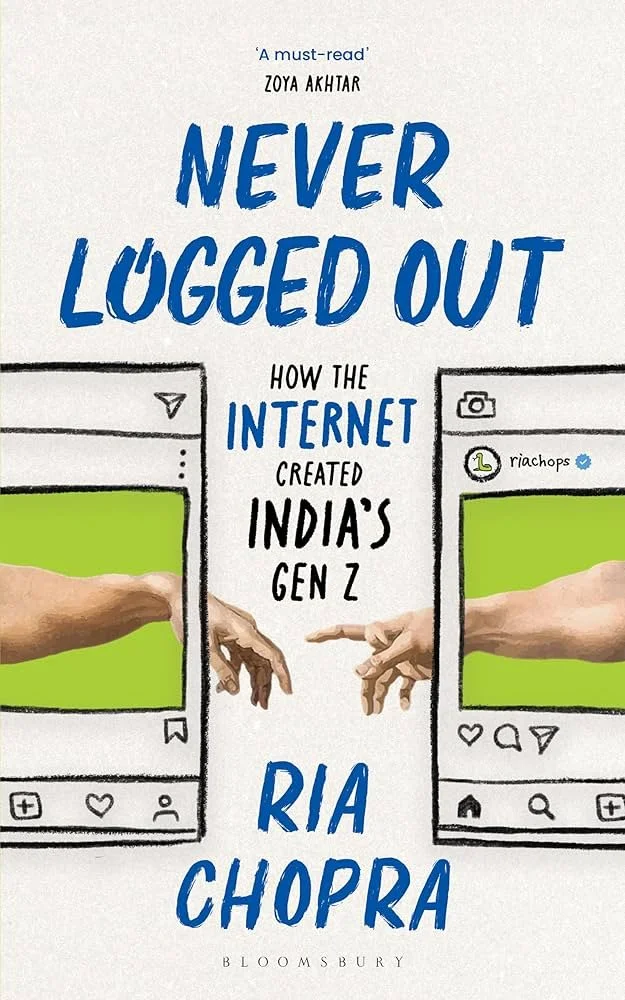
“The impact of the internet is not so black and white that a book about it can be either a warning or a celebration,” she says. “When a force shapes us so fundamentally that we have no idea who we would be without it, the only way we can come to terms with it is to celebrate who we have become while retaining an acknowledgement of who we might have been. That is the internet for me, and the book reflects that.
She adds that, “This tonal consistency, therefore, was not difficult at all—it is the truth of my feelings—but I definitely had to work hard to make sure I presented all sides of the story to the reader, and leave them to draw their own conclusions. That was something I was very conscious of—not letting my own experiences, or feelings, percolate into my narration so much that they persuade people into agreeing with me. My goal, ultimately, is to have the readers think for themselves.”
This almost-clinical precision is most evident in the essays on fame, privacy, memory and knowledge. Chopra avoids the easy shorthand of “influencer culture,” and instead examines how the internet has reorganized aspiration. Visibility, she observes, increasingly precedes achievement rather than following it. Being seen, searchable, and legible online has become a prerequisite for success across fields, from journalism and art to activism and entrepreneurship. Chopra links this shift to a quieter anxiety: the sense that if one’s work does not circulate, it does not exist. It is a modest but telling observation, and she handles it without mockery or moral panic. This particular essay’s strength lies in its refusal to pathologize the desire for attention, choosing instead to interrogate the labour—and self-editing—that such desire silently demands.
Meanwhile, on the chapter on memory and forgetting, Chopra shares, “I have this anecdote: I had a friendship fallout over something, but for the life of me I can’t remember what exactly it was. While writing that bit, it really struck me how easy it is today to look up our exact words or locations or moods from our chat histories or our photo galleries etc., but there is a chunk of our lives which doesn’t have as meticulous a digital record. The outsourcing of memory to external devices was an interesting theme to think about, and I structured the chapter around how easy is it to remember or forget anything today, and how is ‘memory’ itself different now from what it used to be.”
Chopra frames the generation as one shaped by constant negotiation—between visibility and fatigue, opportunity and precarity, connection and isolation. The internet, in her telling, is not a corrupting force imposed from outside, but an environment so pervasive that opting out is neither realistic nor particularly meaningful.
The same holds for ‘thinking’ as a concept, she says. “In a world where one of our fundamental definitions of intelligence—information recall—doesn’t matter much anymore because we can just look things up on the internet, what, then, does ‘intelligence’ mean? I posit that it means to ‘think well’, and then go into various definitions of what that may be, weaving in examples from my own life, particularly competitive quizzing.”
Never Logged Out is particularly effective in its treatment of privacy. Chopra avoids the usual data-protection debates to focus on privacy as a psychological and cultural negotiation instead. For Gen Z, she suggests, privacy is not about secrecy so much as boundary-making in a system that monetizes exposure. This is a useful corrective to the lazy assumption that young users are indifferent to being watched. Chopra shows, with quiet clarity, that the issue is not apathy but adaptation: a generation inventing new rules of self-possession in an architecture designed to erode it.
That said, Chopra’s frame—urban, English-language, culturally literate—while honestly acknowledged, is limiting. The India that emerges is one where access is assumed and fluency is a given. This is not a fatal flaw, but it does mean the book operates more as a cultural memoir of a particular class experience than as a definitive account of “India’s Gen Z.” At times, the essays gesture toward structural inequalities of language, access, and labour, but they never fully grapple with them.
On her unique vantage point and not falling for token representativeness, Chopra says, “People have described the book as an ‘autoethnography,’ a method of writing that uses personal lived experience as a way to look at larger cultural and sociopolitical movements… I tend to agree with that description. People will see themselves in this book, and as a generation of young people in India we do have a shared set of experiences. I made it a point for all my chapters to have broad themes that everyone has some or the other experience with selfhood, love, consumerism, memory/forgetting, privacy etc.
“My personal account hence serves as the vessel or example to contextualize larger shifts and changes. But obviously one person’s account can never be representative of everyone’s (that’s what my first chapter really argues) especially when it comes to the Indian internet, where both access and experience depend on so many socio-political factors such as gender, class, caste, region etc. I’ve added in statistics and research and quoted other writers and thinkers to add more dimension to the writing, and to acknowledge that my experience is only one experience of growing up with the internet in India. I hope we see more such accounts, which will serve for us to have a more holistic understanding of India’s internet.”
Chopra’s refusal to over-claim is one of the book’s strengths. She does not pretend to offer a total sociology of the Indian internet. There are no deep dives into policy, infrastructure, or platform governance. Instead, she focuses on how it feels to grow up online: the compression of time, the collapse of public and private selves, the low-grade exhaustion of perpetual awareness. In an era when non-fiction is often burdened with the expectation of solutions, Never Logged Out is content to observe—and do it well.
Chopra says she sees observation as a form of intervention. “I think many of us would have a healthier relationship with the internet if only we took a step back from time to time to pause and reflect on what we are doing and consuming online. Never Logged Out is very firmly not a self-help book. Who am I to help others, honestly, when the whole book is an acknowledgement that I couldn’t even help myself? But the idea behind it is that we all do have the mental tools to try to stabilize the breakneck fall our digital lives have become. The first step is to reckon with what has happened, and the book is a model of that reckoning,” she says.
Stylistically, the essays sometimes strain under their own associative energy. Chopra has a tendency to layer anecdote, cultural analysis, and philosophical reflection within a single movement, which can make certain passages feel dense or overpacked. Yet this, too, mirrors the subject. The internet is not linear, and Chopra does not pretend it is. She says it was both a stylistic instinct and an editorial risk she embraced deliberately. “This is simply how my brain naturally flows. I was definitely mindful that I was writing for an extremely online audience; this is a generation that can parse large amounts of information in parallel, move from one stimulus to the next at the speed of light (at the speed of internet, really), and handle multiple multimedia references.
“I wanted the book to ‘sound’ like the internet, and ‘feel’ like the internet, and hence, it flows like the internet, too,” says Chopra, “This is definitely an editorial risk because this can be a strange experience for a traditional reader, but it was a risk I took to serve the audience, and also to give myself the opportunity to play with form. It was fun! If you’ve ever heard me talk, you’d know this is exactly how my brain works with ideas in real time—multiple in parallel, tangents everywhere, with multiple rabbit-holes and associations one after the other. It was freeing, really, to be able to write exactly how I think.”
“Never Logged Out is very firmly not a self-help book. Who am I to help others, honestly, when the whole book is an acknowledgement that I couldn’t even help myself?”
Never Logged Out brings to the table a credible, young, Indian, female voice to the growing body of writing on digital life in India. Much of the existing literature either imports Western anxieties wholesale or treats Indian users as data points rather than narrators. Chopra does something more durable: she records a generational sensibility as it is still forming, without the comfort of nostalgia or the distance of hindsight.
There is also a larger editorial significance here. The book signals a shift in authorship: Chopra is not translating Gen Z for an older readership; she is asserting that this generation no longer needs intermediaries to explain itself. The book assumes its readers are intelligent and capable of holding contradiction—a welcome change from the simplifications that dominate mainstream discourse about youth and technology.
In a crowded market of hot takes about screens, attention, and decline, Never Logged Out distinguishes itself through discipline. It does not dramatize or proselytize; instead, it looks closely at the world as it is being lived now. Chopra’s achievement lies in her restraint: the confidence to trust observation over outrage, and clarity over spectacle. For Gen Z readers, the book will feel uncomfortably familiar. For older readers, it offers not explanation as much as access. Either way, the book stands as a thoughtful, self-aware record of a generation that never experienced the internet as a disruption but as a given.
Chopra is also unconcerned if the many issues dissected in Never Logged Out feel dated a decade from now. “I know Never Logged Out is presented as a look at the Gen Z Indian internet, but I think it is equally accurate to think of it as a study of human behaviour. That, I think, will stay relevant: all the parts talking about how we respond to certain situations, how we have evolved with the internet etc. Plus, of course, it stays valuable as a time capsule of this moment on the Indian internet.
“I do hope we get better with protecting children on the internet. Writing the book made me realize how unsafe the internet is for younger people now. I also hope we realize that we shouldn’t surrender all of ourselves to technology so quickly. We did that with the internet, and see where that has gotten us, and yet I see people my age do it again with AI where they are surrendering their critical thinking, their adeptness with reading and writing, and their ability to think for themselves, to this untested tech that is controlled by a few very rich people. I hope that people who read NLO are able to draw that parallel. We are on the cusp of yet another huge technological revolution, and it is on us if we do not learn from what we have already gone through.”
***
Sneha Bengani is a film and culture critic. She has written extensively on cinema, gender, books, and pop culture for some of India’s leading news publications, such as CNBC-TV18, Firstpost, CNN-News18, and Hindustan Times. Over the years, she has lived in various cities across the country but her home and heart are in Jaipur. You can find her on Instagram: @benganiwrites and Twitter: @benganiwrites.