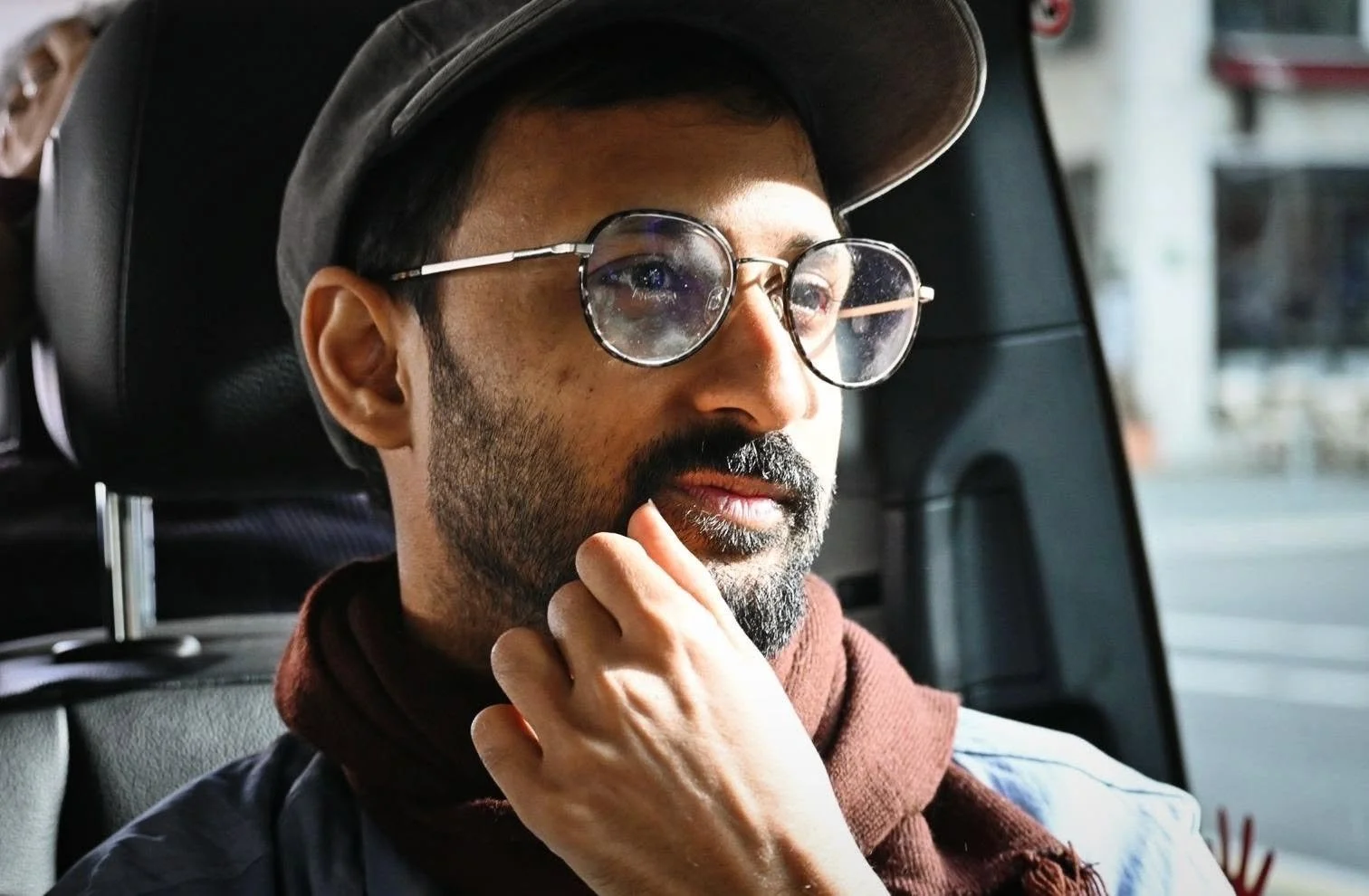
In an in-depth conversation, experimental Indian director Raam Reddy spoke about the emotional burdens of making Jugnuma: The Fable, magic realism on screen, and going against the grain of an entire film industry.
Jugnuma (2024) opens with a warm, grainy shot of Dev (Manoj Bajpayee) getting ready in the morning. He rubs an ointment into his shoulders and crosses to a shed beneath the snow-clad Himalayas. Birdcalls drift in alongside his family’s easy chatter. It seems like any other day, before Dev walks out with a pair of majestic brown wings on his back, humming to himself. He approaches a ledge, doesn't look back, and leaps off.
Director Raam Reddy is all too familiar with such a leap of confidence. After the success of his project Thithi (2015), Reddy spent years in near-isolation, writing and building an ecosystem for Jugnuma: The Fable, a film with no template in the Indian film industry. His jump, Reddy admits, wasn’t completely without fear. “I was scared throughout the process... and excited [too].”
Reddy’s call to domestic and international fame came with his directorial debut Thithi. The Kannada film won over eighteen awards in several film festivals, including the Golden Leopard—Filmmaker of the Present at the 68th Locarno International Film Festival. Long before this step into the limelight, however, the director travelled a meandering journey as an artist. He is the author of a magical realism novella, It’s Raining in Maya (2011), and has twelve short films under his belt. He recently started turning some of his teenage poetry into rap.
With Jugnuma, Reddy shifts his attention to high up to the Indian Himalayas. The film follows Dev (Manoj Bajpayee), an apple orchard owner, as he navigates outbreaks of mysterious fires in his farms. Dev also has an unusual hobby of taking flight. As the film progresses, the growing suspense over the cause of fires causes a rift between Dev and the villagers, and he is made to confront the secrets of his own ancestry.
Besides Bajpayee, Reddy masterfully orchestrates many seasoned actors in Jugnuma, including Priyanka Bose, Tillotama Shome, Deepak Dobriyal, and more. The film presents magnificent mysteries with a tender gaze of the camera; its intimate portrayal of its characters betrays the many loud narratives popular in mainstream cinema. Yet, despite its gentleness, Jugnuma does not shy away from adopting a grandiose scale to tell its story.
Jugnuma is not an independent film, being co-produced by both Indian and American labels which helped it achieve its aspired scale. However, contrary to Bollywood or Hindi language films supported by a similar production budget, it takes a rather unconventional approach: instead of the predictable plot-driven narrative structures, the audience witnesses a magic realist period drama, framed within glittering 16mm film, using English as its primary language. The pacing is slow, almost conducive for brooding, and there are no larger-than-life action sequences nor dance numbers. It is almost as if we are eavesdropping on a story being passed down from a generation to another. The result is a film that manages to evoke awe with all its sincerity.
The film opened to a packed theatre at the 35th Singapore International Film Festival (2024) with both Reddy and Bajpayee in attendance. While introducing the film, Reddy expressed that his intension with the film was to bring the audience on a spiritual journey.
After the screening, I sat down with Reddy on sunny day in Singapore—rare for December here. He was relieved that the festival season was finally coming to a close. Yet, the glimmer in his eyes betrayed the excitement he shared for the future of his film. In an in-depth conversation, we spoke about the emotional burdens of making Jugnuma: The Fable, magic realism in cinema, and going against the grain of an entire film industry. Edited excerpts:
The pacing is slow, almost conducive for brooding, and there are no larger-than-life action sequences nor dance numbers. It is almost as if we are eavesdropping on a story being passed down from a generation to another.
The Chakkar: How has it been touring with Jugnuma?
Reddy: It’s gratifying. It was a long journey to make it and I got to make it how I wanted to make it. I've been feeling a depth of emotional reaction from people that was greater than what I had hoped for. In some ways I didn't think this film would touch people, but it touched the audience deeply. It touched me and the crew as well.
I’ve also had really interesting audience interactions around the world. There was this one Q&A recently in Ireland where a lady started crying as she was asking a question, because she was so touched by the film. These moments have been a highlight of the tour, and that has happened all over the world in different ways.
The Chakkar: Did you feel a close emotional attachment when directing such an intense piece of work?
Reddy: I feel like you are emotionally attached to [a piece of art] while you make it. And then, once it’s complete, you have to let it go, because it’s not you anymore, but some form of your consciousness in it. It has its own life force, and you need to cut the umbilical cord. It’s almost like a parent-child relationship, and then the child becomes an adult and goes off to college and doesn't need you anymore. It has its own life, its own path, its own soul. So, that is necessary, and we are only there as a guardian.
The Chakkar: I am sure there’s still some emotional attachment—even as a guardian.
Reddy: It’s been harder for me to detach myself from this film than from my first, Thithi, which was slightly less personal. Thithi was more an exercise in filmmaking, whereas The Fable is more an internal exploration into deeper parts of myself. The Fable, with its layers, was created from an internal space, almost a vacuum. I didn’t interact with the world for many years while making it.
The world has changed a lot. There's this great movie called Good Bye Lenin! (Wolfgang Becker, 2003) where a person wakes up from a coma only to find that the Berlin Wall is no longer there. I felt the same while making this film. Maybe COVID was that wall for me, or maybe not. But coming up for air after so many years is fascinating.
The Chakkar: What was your life like in the years that led to The Fable?
Reddy: I was writing. A lot. And I guess every writer’s process is a little different, but for me it happens in stages.
“I care about magic realism as a literature genre, and I hadn’t seen enough of it in films. It’s a very brave genre that deals with opposites without explaining it.”
Stage one is the intention—usually a loose intention. Almost like a compass telling you which way to go. Stage two is to head roughly in that direction, but without a clear path. I went into my first and second films without a story. I organically let life develop the narrative for me.
For The Fable, I took several trips to the mountains to see what to do with my intention, which was to make a magic realism film. And that was a true headache. My first film was comedic, so I wanted the second film to be more on the mystery and suspense lines.
The Chakkar: Why magical realism?
Reddy: I care about magic realism as a literature genre, and I hadn’t seen enough of it in films. It’s a very brave genre that deals with opposites without explaining it. Another thing I realised was that most people who are ready to pick up a book are more accepting of those juxtapositions than someone who goes and sits in a film and is not used to those juxtapositions. I really wanted to challenge that norm.
So, with those loose intentions, I went in and explored the narrative elements slowly. Which is essentially stage three: You take all your work so far and weave it together to create something cohesive. Then I go into what I call the flow writing phase, where you take all your built up and incubated emotions and write the entire screenplay without stopping.
The Chakkar: How long was that stage?
Reddy: For The Fable, it was quite quick. I went into a zone, and it took me three weeks where I wrote every day with a good routine. I used to wake up at the same time and write till the same time. My dreams started to change during that period and became far more lucid. The body actually starts to slowly change because your consciousness is entirely in your head for weeks.
That’s my flow writing stage. After that, I get my first draft, which is usually garbage. It’s more like an intention on paper. To be fair, it isn't all garbage but some parts are great and some parts are garbage. And then I essentially keep reading it back and editing it until I feel ready to go into pre-production.
I’m an iterative filmmaker in the sense that I believe in the evolution of a piece of art. After the birth of the draft, you interact with it with an open mind—you keep iterating, iterating, iterating, iterating, iterating... until you feel that it’s surviving on its own.
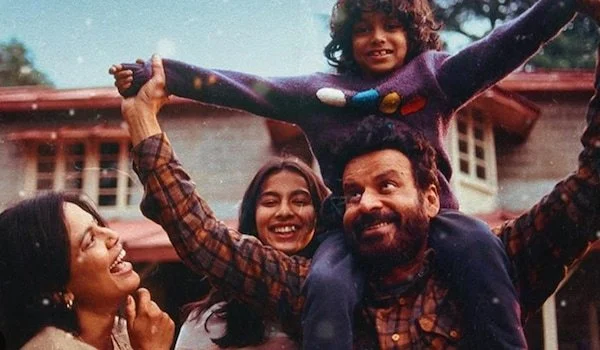
A still from Jugnuma: The Fable (2024).
The Chakkar: In these iterations, do you look for inspiration from others? Perhaps from your actors, producers or other films?
Reddy: That’s usually in the exploration phase, and sometimes in phase one and two. I watch a lot of films when I am creating my heading and guiding lights. I also try to pick films that are very different, because it helps create a new film. If you pick three that are the same, then it becomes a genre exercise. Once I've finished writing, I don’t touch any films. Actually, for several years I have barely seen any films.
The Chakkar: That sounds tough!
Reddy: Manoj [Bajpayee] ji said a funny thing after he worked with me. He said, “Method acting is something that a lot of actors do, but I haven't seen too many method directors.” And to be honest, I didn’t know I was doing it. It just so happened.
The Chakkar: Is there a particular reason why it took so long to work on The Fable?
Reddy: This film is not like other Indian films. When you’re trying to do something like that, there are obstacles in every step, because you’re trying to share a vision that hasn’t been shared before. Trying to go against the grain of an entire industry is a tiresome process.
In some ways, I had to dredge a canal. I was trying to create my own industry, ecosystem, even support systems, that could fulfil my vision. That’s why this one took so long. Perhaps if we were to try to do something like this again, ‘the canal’ is thankfully already dredged.
The Chakkar: What were some of the specific things you had to do in order to ‘dredge the canal’, or go against the grain?
Reddy: The film industry in India is changing, but also not changing. It’s changing, but you’re constantly trying to inspire and create patience in a pace that’s different. And in an industry that’s not as iterative, you need a certain temperament to be able to iterate until you’re satisfied. Typically, people get tired after one, two, three. But if you want to go to ten and keep your freshness alive, it requires a certain kind of training. This is not the type of work that is generally happening [in the industry]. So, you have to persuade people to go deeper into the processes, which is not about the person’s aptitude or skill at all, but about their habit. This took time and a lot of relationship building. Multiple top people, who are my seniors in India, have worked on this film. It takes time to convince your seniors that what you’re trying to do needs to be done in a way that they are not used to doing. And it doesn’t end there! After they’re on board, it then becomes about holding everyone together.
The Chakkar: What were some of the relationships you built through this film?
“This film is not like other Indian films. When you’re trying to do something like that, there are obstacles in every step, because you’re trying to share a vision that hasn’t been shared before. Trying to go against the grain of an entire industry is a tiresome process.”
Reddy: For The Fable, I wanted to work with actors whom I admired. Thithi was all non-actors, but this film needed people who had control. And I was fortunate to get the best actors in India with the best control. But at the same time, I also wanted to work with non-actors. So, the challenge was how to make it feel cohesive, because all the villagers in the film are real villagers. Apart from the family of four, they’re all non-actors.
I basically took on all the challenges in one film. In hindsight, I probably won't do that again.
The Chakkar: Were you ever scared in the process?
Reddy: I was scared throughout the process, and in a way, I still am... Although it’s also exciting to be in that space—to be at the edge of your capacity, because then you know you will grow.
In a sense, it has always been sort of challenging. Thithi was a 160-page screenplay set in a village where all the actors are villagers, and I had no template to follow. But after the film, people started using my film as a template. Honestly, it was gratifying that it happened to me while I was still quite young.
Thithi was challenging; The Fable was even more challenging. Perhaps in the next one I’ll be a little bit more sensible, just a little bit. But I don’t think I can be completely sensible either!
The Chakkar: What keeps you grounded while taking on these challenges?
Reddy: I think I have always finished what I’ve started. It’s a good thing, but it’s almost like a weakness too. I’m quite conscientious that way—if I have started something, I’m not turning back.
When I finish the script, the storyboard starts to look exciting. And then I see the storyboard forming, I go into prep and cast all my actors. Followed by designing the world with my HODs (Head of Departments), and seeing those designs form into something cohesive. It’s all so exciting. Shooting is always a spiritual experience because we are trying to capture something ephemeral, something new.
For The Fable, there’s a scene where the mother—played by Priyanka Bose—is singing a song which was recorded by my sister-in-law. However, when we played it during the shoot, the crew thought that Priyanka was performing it live. I won’t forget how everyone on set was awed during the first take of the song. It was brilliant, but being a greedy director I asked for a second. Halfway through, Priyanka started crying and said that there’s too much emotion, and we didn’t shoot the scene again.
I think it's very important to be sort of in tune with the energy and spirituality of that moment and allow that to guide you.
The Chakkar: So, what is spirituality to you?
Reddy: It’s something that I think about a lot. I have written a novel, made two features, and twelve short films, and the spiritual undertones have been the unifying thread between all my work. Not only in my outer narrative spaces but also in my inner growth state, spirituality has played a part.
Spirituality for me, very plainly, is the simplicity of the inner juxtaposed with the complexity of the outer. And that’s already a narrative conflict. Anyone on some form of a spiritual path is dealing with that inner-outer conflict almost on a day-to-day basis. Even though we are geared towards survival, the inner quietness is sort of the opposite of survival.
My first short film started with a quote, “To find yourself, first lose yourself”, which is an anonymous famous spiritual saying. The process of shedding is also what The Fable allegorically talks about. It’s the Eastern philosophy of “You are not the body, you are not the mind, you are not your ego, you are not your intellect, you are your consciousness” which is the core of spirituality for me.
The Chakkar: And how do you convey that spiritual inspiration in your art?
Reddy: I’ve done it in all my work in different ways. There’s this conflict in the lead character of Thithi. Almost all the characters in the film want varying things; however, the lead character is the only one who doesn’t want anything. He’s the wise one who is observes, as a witness, this entire world functioning around him. Even in my first novel, the protagonist is a five-year-old girl who's also looking at this world from the eyes of an innocent pure mind, as a witness. She does drawings where her inner world is reflected, but it is situated in the context of an outer world, which can often be violent and brutal. This very conflict has been the core conflict my whole life.
The Chakkar: How would you say this conflict evolved within you, over the years?
Reddy: I had an interesting challenge in The Fable because when I was writing it, I had certain themes or elements based on the spirituality of my life at that point. I have changed so much that, ideally, I should make one film per year.
“The process of shedding is also what The Fable allegorically talks about. It’s the Eastern philosophy of ‘You are not the body, you are not the mind, you are not your ego, you are not your intellect, you are your consciousness’ which is the core of spirituality for me.”
Holding on to an older mental space is challenging, especially because you’re constantly growing, changing, and sometimes even going the opposite way. Sometimes you are stressed by certain environments, and you’re constantly trying to shed. So, the person who wrote the film is different from the person who’s finishing the film and is now taking it around.
When I write the next one, I don’t know who I’ll be. You need to allow for life’s feedback. And that active witnessing of yourself—if it’s alive—will help you move and grow. I actually started to crystallise the positive emotions I felt so that I could go back to them and have them recreated. It was a process of stabilising positivity. I used to only write when I felt loved.
I was a poet for a while, and it started with free flow emotions, but I only wrote poetry when I felt happy. For my novel, even though I was 19 and studying economics, I never wrote it like it was my job or for escapism. I wrote when I felt like it was a beautiful day, when the wind and the leaves are flowing, and you start to feel a stirring. The stirring is the start, and the writing follows.
The Chakkar: Do you feel like it is almost harder to write when you’re happy, than to write when you're in pain?
Reddy: In fact, because I’m having some challenges with The Fable, my poetry has turned into a reflection of my reality. I'm dealing with this conflict of the inner and outer self in a higher way than I’ve ever dealt with before, because I have a big film out, and the world is different from when I started writing it. It feels like I am catching myself up. I never used to write when I was confused, but now when I revisit my poetry, I don’t feel the same lightness. After reading the poems that came from a conflicted place, I felt a bit sad, and I told myself that there are other ways to heal. So, I'm trying to go back to the process of writing when I feel good.
There’s so much weight with grief, which makes it more present. Whereas happiness is light, and when you’re in the moment, you don't feel the need to share it. But sharing it is not just for others, but for yourself. The next time you feel sad, you can go read that poem, and it’ll push you in the direction of healing. That came from you, so you have the potential to get there again.
It’s about the transference of love, which is amplified when someone else feels it with you. Basically, there is good in our hearts, and there is good in the world, so perhaps it is good to bring that out.
The Chakkar: I do tend to write more when I feel grief, so I should really start practicing your methods.
Reddy: I think everyone in this world benefits from reflection. But that can be like a diary… it doesn’t need to turn into art. The key is to capture everything. I find that to be a more mindful way of dealing with life. When you feel a stirring of any kind that is positive, try to put that into words or into images. You can put it into anything! You can put it into music, into a conversation with somebody else, into love for a family member, even into a pet. It doesn’t matter. Love breeds love. I’ve seen it and I have felt it. Even in this conversation!
The Chakkar: You have worked with such a wide range of mediums—film, novels, even poetry. How do you decide which medium to use to crystallise a particular set of emotions?
“The greatest art, I believe, is born from a place of no mind. It’s a direct link between emotions and the capsule that you’re trying to crystallise those emotions in.”
Reddy: Recently, I have started turning my poems into songs, and I’m having so much fun! I go online and lease a non-exclusive beat and make rap songs out of my old teenage poetry. This cross-pollination of mediums is not as difficult as it seems. It is society that labels somebody as something, and it’s honestly very hard to break that. It takes time to build a reputation, and most people need a reputation to get paid for what they do. But from a purely existential point of view, all you’re doing is applying your awareness into a capsule of some form. So, you just have to be attuned to the dynamics of that form: Be it street photography, which is a reactive medium; poetry, which is more freeing; or even film, which is the accumulation of it all. It’s essentially the same. You’re using your inner, I wouldn't say awareness, but emotion, and that creates art.
The greatest art, I believe, is born from a place of no mind. It’s a direct link between emotions and the capsule that you’re trying to crystallise those emotions in. But of course, there is skill, which is practice.
Take sports, which I believe is also an art form. When Stephen Curry is shooting a ball from anywhere on the court, and it goes into the hoop, it doesn’t seem humanly possible. But in that particular moment, he is not thinking, but using the mechanics of his shot, and is in a state of no-mind. Practice, which is skill education, can only supplement your emotions. After that, you need to have the ability to not let your mind interfere with your skill. And across different fields, you would find such Zen masters.
The Chakkar: It feels almost spontaneous…
Reddy: … And it’s very lovely. It feels like this thing that has moved you, you can now actually create it. And then it moves you again and again. And the joy is that you don't know exactly what’s going to come out. The idea is to allow whatever you’re feeling at that time. So, you don’t, or rather, you can’t pre-plan it. Even when I listen to music, especially classical Indian music, it’s the alaap in the beginning that I find the most emotional, because of non-form. You’re in a state of no-mind. And I believe tapping into that is more important than anything else.
In a way, with all these art forms, you’re not searching for success, and you’re not recreating something someone else did before or you did before. You are just doing it.
The Chakkar: Do you ever wonder about what kind of an artist you want to be known as?
Reddy: You know, I have. I talked about reputation previously, from a professional point of view, not as much from the spiritual. I think my first film was very different from my second film, but there’s still something that ties them together. For most of my career, I have been aware of how the things inside me sit within a career trajectory. What I’m realising now, as I’ve slept for several years and woken up when there’s no wall, that it’s no longer about your reputation. The idea of creating longer narratives is being challenged heavily now. I have realised that there are no longer artists and their reputation, there is only a good work of art. It’s about each piece. It’s about each film, which is quite freeing and I’m trying to take that positively.
But yes, the answer is: I have been aware of how my art is building up. Although, I’m not sure if I should be so aware of it. Perhaps now, I can let go of trying to build something across my career and focus more on being authentically true to my current state.
The Chakkar: Do you believe you managed to achieve that authenticity with The Fable?
Reddy: It’s a film that I made when I was in an internal vacuum. It was an attempt after learning from these masters of artmaking. I tried to play with these subtle notes of cinema while holding myself true.
I really hope that we can go against the grain. And I hope that this film will be watched widely, because anything against the grain is going to be met with a lot of resistance. But I feel fortunate to have the opportunity to do that.
***
Saksham Mehrotra is a tree-hugger who happens to make films and write. Through his work, he tries to understand the line that threads between the human desire to develop infinitely and the inherent yearning to preserve nature. He loves cinema. You can find him on Instagram @saksham.mehrotra and @sock.sam.