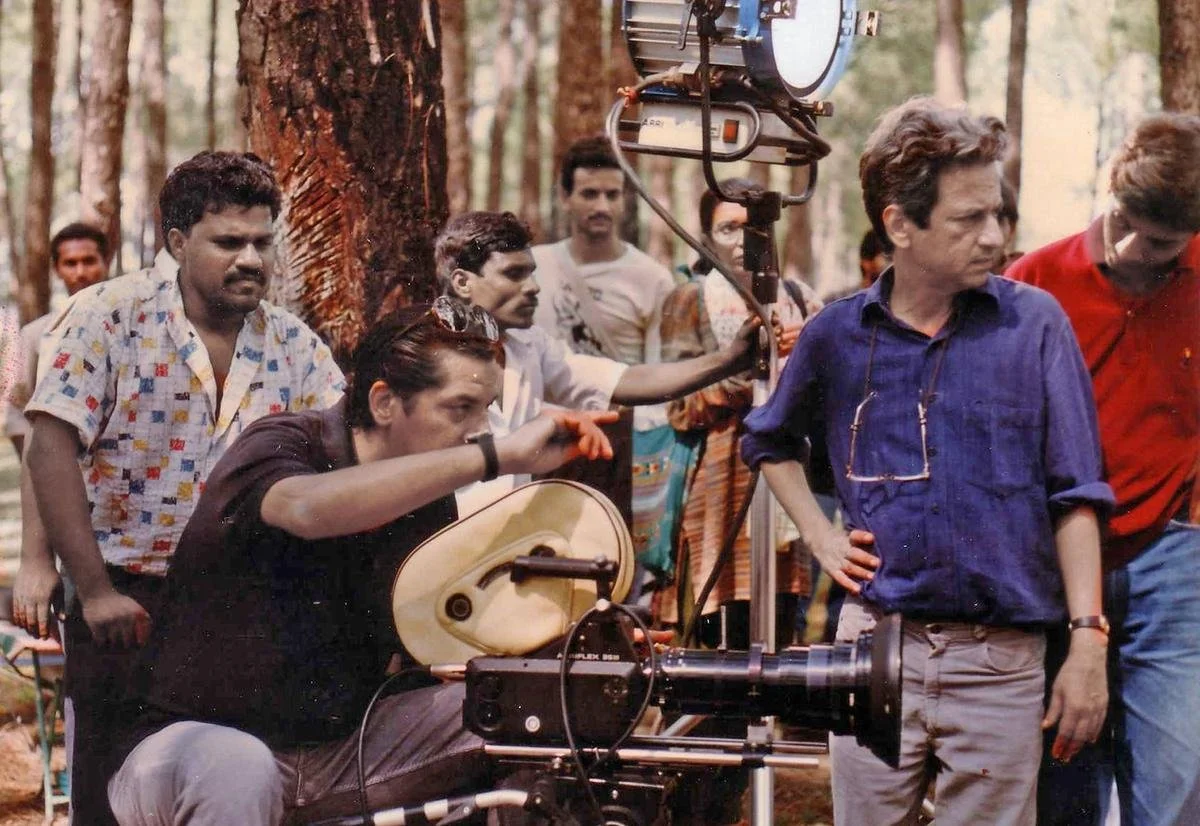
How the shared vision of body, movement, and light created cinematic magic in the work of Kumar Shahani and K.K. Mahajan.
Nation of Auteurs is curated and co-edited by Ashish Dwivedi.
Taran (Aditi) moves languidly around her mansion. Pillars, walls, a mirror, and the open courtyard trace her journey. She has a room of her own and a roof over her head. Yet these architectural elements of her home—shot in mid close-ups or from a distance—show her trapped within its confines. The home is her prison, her private sanctuary turned to a fettered space in Maya Darpan (1972). The lighting cues this sense of boredom, the static movements of a young woman in peril in a patriarchal society.
In the history of Indian cinema, there have been few auteurs as unbothered by the mainstream gaze like Kumar Shahani (1940–2024). Shahani marries the sinuous sensuality of rasa (aesthetics), integral to Indian cultural iconography, with the silent unravelling of histories—both epic and personal. His is a cinema of minutiae, always moving yet forever inscribed with subtle visual proficiency.
Shahani’s preoccupation with restrained movements of the human body and the natural elements revolve around architecture or vernal landscapes. This, in turn, is intricately tied to the cinematography of K. K. Mahajan. Mahajan’s contribution to the cinematic canon hence comes alive most in Shahani’s films like a jugalbandi, carrying forward the rich traditions of Indian arts.
Shahani’s preoccupation with restrained movements of the human body and the natural elements revolve around architecture or vernal landscapes. This, in turn, is intricately tied to the cinematography of K. K. Mahajan, whose contribution to the cinematic canon comes alive most in Shahani’s films.
In Shahani’s films, traditions clash with modernity, the self against the world. Though the paths seem linear, the characterisations are far removed from them in the service of self-actualisation in a post-independent social scenario. All this has always been a part of our social fabric, but Shahani and Mahajan suggest that the ancient and the modern generate a kind of generational tension that brushes against individual humanity—one where one person can be trapped by the interior space of the hearth and expectancies of the outside world that prevail with the burden of centuries.
Mahajan’s sense of photographing images is deeply humane, marked by pauses and ellipses, driven by a subconscious mindfulness steeped in ancient history which bleeds into the visual grammar of interpretation. Conservatism and blind adherence to customs play havoc with the lives of the characters, presented in the collaborative work of Shahani and Mahajan, which often teeters on the edges of desire.
Take Maya Darpan, the duo’s first full-length feature. This is the tale of a lonely girl who fails to understand the larger meaning of her life and has youthful desires for companionship, even as her beloved brother has escaped the confines of the feudal class. Devoid of studio lights and interior shots that were usually lit with unnatural brightness in mainstream sets, the on-location haveli of mofussil Rajasthan plays with daylight: its focus on arches and pillars and even the room in which protagonist Taran is shown are in a state of nidra (sleep), unravelling the lethargy of this young girl’s purposeless existence. These shots also convey the impaired soul of a once-decadent upper class that now latches on to property and stature. But there is rarely any emotional communication between the widowed father and the unmarried daughter on human terms; only the widowed Bua is Taran’s saving grace, speaking with empathy, while letters from her brother give Taran some temporary comfort. This familial tension creates a lifelong lacuna for all people concerned in the depiction that almost mimes the way certain people walk, talk, stand, face the wall, or even cry with muted breaths while holding onto a pillar.
Taran’s emaciated figure and monotone style of dialogue delivery portray her almost as a prisoner of her own class and gender, without any extreme act of chauvinism defining her trajectory. That silent internalisation of withdrawn emotional exchanges marks these spaces. The desert landscape around which Taran walks to bide her time is captured fluently by both Shahani’s eye for practical rhythms and Mahajan’s eye for the way this outer landscape seeps into the wounded walls of a home.
Taran’s father wants her to marry into a family that befits her status. He uses cutting words towards her current state, even comparing her to her mother who is suggested to have been unhappy in her marriage—and maybe took her own life. Taran’s father’s wishes clash with Taran’s growing attraction to a local engineer who takes a liking to her, too. In a nutshell, everything is stalled, even as Taran tries her best to find a safe space for her burgeoning desires.

A still from Maya Darpan (1972).
Here, a father, a concerned aunt, and a young woman repress their true selves to maintain their false sense of dignity or preservation of a pattern of life without any external danger. Mark the dream-like state in which Taran runs towards the railway line across the desert, or the way she interacts with her love interest. The bright yellow of the dunes and the illumination of a modest room by bulbs respectively present two states of helplessness and erotic desire in the most accessible way.
In fact, the arc of walking/wandering is an aesthetic, personal, and physical choice in Shahani’s filmography. Mahajan’s camerawork always frames the zombified sentience of Maya Darpan and the relics of post-colonial feudalism with an eye for the physiognomies of generational repression, a psychology of the past informed by a present, where even one’s home becomes a site of obliterated self-awareness, further extended by gender politics.
The final image of Taran on a boat surrounded by lush water contrasts the preceding chapters with a point of reference for her own freedom, just like her brother who left home for a normal life of work and industry and invited her to stay with him. The camera moves around the boat and the water surface in a brief interlude, revealing a point of catharsis.
Similarly, in Tarang (1984), both Shahani and Mahajan train their lenses on the movement around the tin hut of a woman, Janaki (Smita Patil), who is baring her life-story to the audience. Her hopes, dreams, and the tragedy of her widowed status are positioned kinetically, moving around the entire room. The camera and lighting capture the humidity, the tin roof, utensils, stove, the rattle and sounds of the railway line next to her dwelling and her visage, to present a piece of Bombay that is far removed from the myth-making that sometimes defends its mass of humanity. In that little space illumined by bulbs, Janaki finds some of her humanity intact, enough to express herself. Viewers respond to this tension, as they reside in a nation where there are more have-nots than haves and this is the bleak reality for them in their everyday life.
Janaki has seen moral rot, active financial corruption and the amoral gradients of class relations while working at a plush home as a maid and dai. The realistic storyline pits her position against the cutthroat world of industrialists and factory workers demanding their rights. She keenly perceives each manoeuvre and picks her own pieces of survival as one of the dead factory workers’ wife. This initiates a dance of desire and complexity that straddles class lines.
Thus, the final shot of Janaki walking, half-lit and half-shadowed besides a lake wearing a white dress like a mythic figure, brings her tale full circle to the impossibility of achieving modest dreams. She walks in a liminal state that makes us reconcile fantasy with reality. After a supposed fire takes her life, this is the moment where her central figure bridges classes and moral worlds. She is the Earth Mother in a way, both mythic heroine of her own story and a sensorial bookend to a cityscape that pushed her to the margins, while affluence is only granted to the very few. She has seen it all, and hence the colour white represents a clean slate, a dry and pure canvas on which to end her saga. She is affixed to the “personal becoming political” amid the factories and bungalows of Bombay.
She is the Earth Mother in a way, both mythic heroine of her own story and a sensorial bookend to a cityscape that pushed her to the margins while keeping its affluence within a minimum demographic. She has seen it all, and hence the colour white represents a clean slate, a dry and pure canvas on which to end her saga
In several night scenes, a dim bulb finds Janaki in a room or on the balcony facing the sea, her face representative of changing fortunes and quicksilver situations. These moments are starkly human, realistic, and almost epic in its nearly three-hour runtime. Janaki negotiates with her complex fate in those hours after the sun sets throughout the film, parallelling the darkness that envelops her own struggling life.
This distinct and intimate style of filmmaking is also evident during the song sequence “Barse Ghan Saari Raat”, which shows the internal immobility of a rich woman (Kanwal Gandhiok) in muted shades. She walks by the seaside on rocks, watches the movement of humanity from her affluent drawing room, drapes herself at night with her sari, or is looking ahead at the colourful scenery of a multi-coloured lake. Each step submerges us in a deepening gulf of depression and melancholy. The natural light of a bathroom shows us her limp legs drowned in a tub with rose petals, matching her sari’s delicate fabric in her denouement. It’s this intimacy that shows—and doesn’t tell—the collaboration between director and cinematographer. There are no extensive monologues or supporting characters to convey this deep well of grief or a voiceover, or any suicide note narrated by kindred. The six-minute song instead reveals internalised cinematic perspectives.
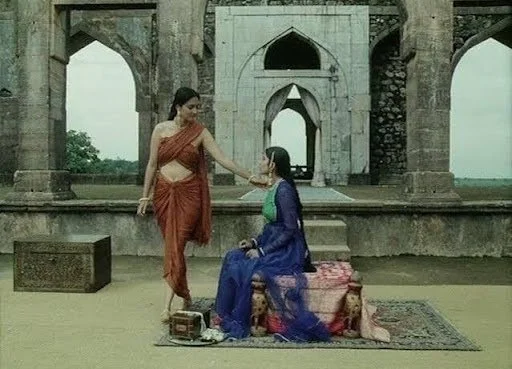
A still from Khayal Gatha (1989).
That is the power of suggestion that provide a sharp edge to Shahani and Mahajan in comparison to many traditional filmmakers. They don’t foster simplification or sensationalism to further their earnest cases. Instead, what they present in moments like these is a haunting parallel to privilege and class consciousness debasing an innocent soul’s passage in the real world.
However, the duo’s biggest claim to fame is in marrying the epic scale of myth and Indian classicisms with realistic framing, found in the exemplary world of Khayal Gatha (1989), a film that reveals layers of classical art through deft but non-diegetic cues. The echo of voices in and around monuments, birdsongs, distant ragas, the drop of water on a stone etc., encompass the narration about the khayal school of music. These are in line with oral traditions that grow visually with the thunder and rain and even the distant clouds and trees. Every creative wisdom is sourced from nature. Here, the prevalence of half-said or pithy dialogues fill in the spaces where history and myth collude. I believe that the use of natural light here, and its diffusion of naturalism affecting the spoken words or the withholding of dialogue, has never been so efficiently employed in Indian cinema as in this film (with a worthy cousin in Mani Kaul's Siddheshwari, also released in 1989).
In Khayal Gatha, this musical lens frames the mis-en-scene of an oft-repeated Indian historical legend. The legend of Baaz Bahadur and Rani Roopmati’s immortal love saga unfolds around the moisture of leaves, jungle foliage, and the deeply inclement weather of Madhya Pradesh, all presenting a panorama of Indian monsoon. Both royals were connoisseurs of classic art, and hence their tale informs the most crucial part of the myths associated with the khayal form of singing. The very word “khayal” refers to the improvisations, imaginations, and diverse modes of singing in this art form; just like the khayal, the film, too, explores this legend in its own imaginative way.
Here, darkness is the antidote to romanticised brightness of the protganists’ larger-than-life portrayals. Mahajan paints portraits of their courtship in such a painterly way that the skyline—full of clouds and architectural locations—leave the audience marvelling at the magical nature of its narration. They constitute a collective canvas with the hills, the river Rewa, and the palaces of Mandav, becoming one with classical ragas that define the aura of a bygone world. Even the drops of rain falling on surfaces amounts to transcendence because they are relieved of any obvious epical expectations of blocking for grandeur. It’s history and archaeology put together, keeping both rooted in the mysticism that suffuses legends and folklores.
The epic permutations bring to the foreground compositions of these personalities like historical ghosts. Shadows and light are continuous aspects here. They are not conventionally wrought as props used for beautification. Mahajan achieves this by using natural light, without the burdensome weight of filters or extra artificial sources of illumination. The darkest interiors and the most humid touch on the skin are not erased, but rather upheld by him and Shahani’s poetic dialogues, specifically the ones that carry us throughout the two royals’ courtship, and then the cleave of their separation during wartime. They always leave room to breathe and internalise this tragic and time-honoured tale of the passionate lovers.
In Shahani’s tapestry of faces and places, human skin is affected by weather and the changing conditions of the day. Thus, the duskiness of monsoon permeates Mahajan’s meticulous focus on the skin of these characters and their textures of the body in the presence of nature, deepening a larger probe into our consciousness. Examples of this include the image of the rudraveena, the sitar in a dark room, or of Pandit Birju Maharaj teaching a disciple the nuances of dance in daylight, or the change of the sun’s movement reflecting on sand dunes. In the final hour of the film, a tactile vision is presented as the khayal form coalesces with kathak and the Heer Ranjha myth. All of the above express the mystery of myths and the impressionistic manner in which both these auteurs bring them to cinephiles through the power of sight and sound.
The other constant in Mahajan’s early black-and-white cinematography is a spontaneous dissemination of images, with no frills attached to his crisp, clear vision. He photographs people and places naturally, with no tacky attachments to his vision like extra lighting or undue indoor brightness in rooms. It’s the alchemy of capturing pin drop silences in the frames. The textures of storytelling are distinctly Indian in their sublime presentation of the faces on screen: in the way the hands move, the eyes watch and peer, and how longing and yearning trace a line from the ancient to the modern. Take Shahani's early FTII diploma short, The Glass Pane (1966), where a train journey centred on a married couple is rife with half-uttered words. The movement of the locomotive and changing emotions make way for another taxi ride on the streets of Bombay, where the same complexity persists, its textures presented on the faces of the characters captured by Mahajan’s excellent camerawork.
The other constant in Mahajan’s early black-and-white cinematography is a spontaneous dissemination of images, with no frills attached to his crisp, clear vision. He photographs people and places naturally, with no tacky attachments to his vision like extra lighting or undue indoor brightness in rooms.
Mahajan deploys his camera similarly in Mani Kaul’s Uski Roti (1969) and Ashad Ka Ek Din (1971), where the fate of women, both in pre- and post-independence eras, are marked by absent men, self-subsistence, and a stark use of close-ups. The characters persist and survive, marred by fate but salvaging their dignity by dint of everyday labour and the paradigms of living as almost single women. Here too, rural Punjab in the throes of winter and the rainy verdure of the hills respectively mount a shared yet distinctive saga of personal evolutions.
Tracing this aesthetic line further, Shahani and Mahajan frame their women protagonists in Kasba (1991) with the backdrops of Himachali Pahari paintings. One woman moves leisurely from window to window to look out into the hills; the other walks by a river in full flow. Held in natural summer light, both are entrapped by patriarchy.
In Shahani’s Char Adhyay (1997), the verdant nature of Bengal’s trees, ponds, and interior spaces culminate with an idealistic Swadeshi revolutionary’s body lying on the seashore. It is an image that signifies the fragmentation of a nation in peril. The nation’s populace is filled with youth who lead from the front. In a lopsided gender ratio on that front, it is imperative that a woman joins the ranks and leads the revolution. In Shahani and Mahajan’s vision, then, the Bengali revolutionary is a dead woman, subverting the jingoism of Bharat Mata. She acts, instead, as a symbol of a nation trying to walk on eggshells, while becoming versed in the act of self-reliance and self-definition.
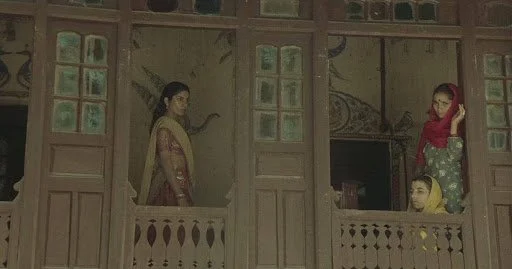
A still from Kasba (1991).
The trademark complexity of this particular filmography remains intact. Through the mis-en-scene, both Shahani and Mahajan carry a torch for making the personal uniquely political, without any polemics or diatribes. Their collective use of imagery conveys whole worlds of individuals who root themselves in their landscapes, and carry their journey towards no resolved conclusions. They go towards spaces marked pointedly by caesurae. These empty points go with a vision for histories left as ongoing chapters in a nation’s vast treasure trove.
Hence, space and time become moving entities, and yet, are also suspended by the immovable hands of mostly personal histories. We look inward precisely because Mahajan makes us go deeper into the embittered or transcendental soul of these scenarios, designed by Shahani.
The duos final collaboration Bamboo Flute or Bansuri (2000) embraces the porous ideals of documentary and feature film commentary. The film is about the titular musical instrument that keeps up with the myths and folklore central to Shahani's storytelling. The duo let their focus hover over the textures of wood, on the hands of artisans, on architecture, or on a performance by Odissi doyen Kelucharan Mohapatra to a flute-based classical piece. It’s all natural and evocative, set to the soundtrack of a national ethos where the aesthetics of music and dance transcend everyday monotony, while embracing centuries of artistic evolutions altogether.
It’s this distinctive alchemy attuned to the otherworldly and the present-day that makes Shahani and Mahajan true creative partners. Their eye for details for a land and its people is exemplary and unmatched, always ripe to be discovered by cinephiles anew. They revel in performance art, in the grandeur of artisans, in songs and dances that present an organic dynamism. Their shared vision, thus, is one of distinctive joint auteurship, and has given the Indian ethos a blueprint for the ages.
***
Prithvijeet Sinha is a proud resident of the cultural epicenter that is Lucknow. His prolific published credits encompass poetry, musings on the city, cinema, anthologies, journals with national and international repertoires, as well as a blog. His life-force resides in writing, in the art of self-expression. His debut book of poetry, A VERDANT HEART (2025), has continued his journey of distinct authorship towards new frontiers. You can find him on Instagram: @prithivijeet08.