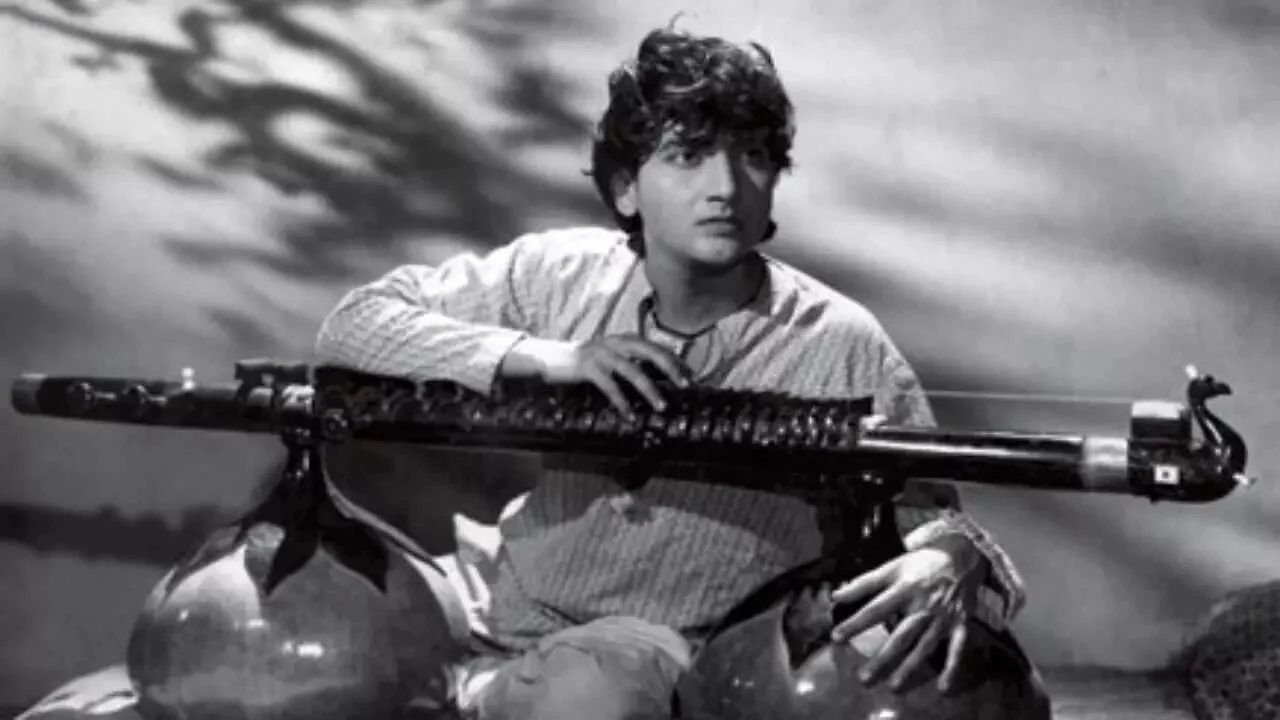
A still from Vijay Bhatt’s Baiju Bawra.
In a time for transition for the film industry and the nation, Vijay Bhatt adapted stories of religious and scholarly traditions for contemporary audiences watching on the silver screen.
Nation of Auteurs is curated and co-edited by Ashish Dwivedi.
In the opening scene of Vijay Bhatt’s Baiju Bawra (1952), Akbar’s court musician, Tansen, (played by Surendra and voiced by the legendary Ustad Amir Khan) sits deep in riyaaz, working through the raga “Puriya Dhanashree”. Royal orders forbid anyone from disturbing him. Outside his window, a crowd of commoners gather, enraptured by his music.
Like Tansen, Bhatt was a well-practiced artiste, who enraptured viewers with each showcase of his on-screen ragas. At one level, the scene is a snapshot of art crossing barriers from another era. But look closely, and you realise it is also, in miniature, symbolic of Bhatt’s career. For three decades, Bhatt played the role of a cultural revivalist, delivering the essence of Indian classical music, legends, and aesthetics to the masses without diluting the core message.
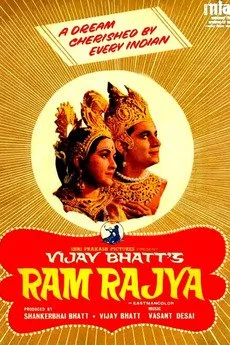
Ram Rajya (1943).
There aren’t many biographical details of Bhatt (1907—1993), with only a few specifics that people have managed to scramble together from irregular newspaper articles. We know that Bhatt’s instinct for classical revivalism can be linked to his meeting with Mahatma Gandhi in the late 1930s. Gandhi asked Bhatt to make a film about the medieval poet-saint, Narsinh Mehta, author of the bhajan, “Vaishnav jan toh tene kahiye”, which had become a fixture of Gandhi's own prayer meetings. Bhatt obliged, releasing Narsi Mehta in Gujarati and its Hindi version Narsi Bhagat, with Vishnupant Pagnis in the lead in 1940. It set the template for what would follow for Bhatt, as he mined devotional and classical traditions for stories that could speak to a nation that was in the midst of a major transformation.
In the 1940s, India was in the midst of a genuine reckoning, caught between finding continuity with its past and cutting loose to build something new. Bhatt, having founded Prakash Pictures, staked his ground firmly on the side of continuity, turning again and again to the Ramayana as a way of thinking through the present. Bharat Milap (1942), based on the Ayodhya Kanda of the Valmiki Ramayana, introduced Prem Adib and Shobhana Samarth to the public as Ram and Sita. In many ways, Bharat Milap was as much an ode to dharma as it was a warning signal. Celebrating values such as love, righteousness and sacrifice, Bhatt offered a moral compass to a country that would soon be consumed by its own tussle for power.
A year later came Ram Rajya (1943), Bhatt’s retelling of the Uttara Kanda, the last book of the Ramayana, in a tale centered around a kingdom where the will of the people—not the throne—held final authority. The timing was fortunate. Gandhi had popularised the phrase “Ram Rajya” as shorthand for his vision of ideal governance, and the film rode that wave. What made it more than box-office opportunism, though, was how Bhatt told the story. In a striking scene, he humanises Ram and Sita, as they stage an assembly of ordinary citizens—a lok sabha—and pass judgment on Ram’s decision to install Sita on the throne. This was the judgement of a democratic body, four years before India would become a parliamentary democracy.
Ram Rajya exemplified a throughline in all of Bhatt’s historicals: Unlike the period spectacles coming out of studios like Basant or Wadia Movietone, his films were not costume dramas for their own sake; they were contemporary reflections in ancient robes.
The clearest proof that the strategy worked came on June 2, 1944, when Gandhi watched Ram Rajya—the only Indian film he is known to have watched, even partially, in his lifetime. At a moment when cinema was still considered a disreputable pastime—something families of standing kept their distance from—Gandhi’s attendance did more than flatter Bhatt: it handed the medium itself a new measure of legitimacy.
By the early 1950s, Prakash Pictures was close to folding up, but Bhatt and his brother Shankarbhai made a bet that ran against every instinct of commercial filmmaking. Rather than chase what audiences already liked, they made Baiju Bawra, a film about a medieval musician Baiju (Bharat Bhushan) and built around the internal logic and vocabulary of Hindustani classical music. Bhatt wasn’t simplifying the material for a mass audience; he was trying to lift the audience up to meet it. Bhatt liberally used a fictional love story to weave the structure of the movie around, though at its core, it was an out-and-out musical offering.
The clearest expression of that ambition is a training sequence in which Baiju’s guru, Haridas, introduces him (and through him, the audience) to a succession of ragas, each rendered visually in the spirit of the ragamala tradition, in which a raga is personified as a deity or a maiden. Bhatt’s version personifies each raga as Gauri, Baiju’s muse. The character is played by Meena Kumari, which provides a lovely doubling, since she is literally the director’s inspiration as well as the film’s visual stand-in for the music itself. Bhatt commits completely to this esoteric idea, pinning his hopes on the ability of the layman to understand art rather than offering a watered-down version on the screen. Baiju Bawra ran for over 100 weeks. Its success also disproved the popular notion that one needs to play to the gallery to have box-office success.
In many ways, Bharat Milap was as much an ode to dharma as it was a warning signal. Celebrating values such as love, righteousness and sacrifice, Bhatt offered a moral compass to a country that would soon be consumed by its own tussle for power.
If Baiju Bawra was a story about an upstart but passionate musician seeking revenge against a musician who had the patronage of the emperor, Goonj Uthi Shehnai (1959) was a story of changing times. By the late 1950s, a newly independent India had its own institutions of prestige, and All India Radio had become the era’s version of the royal court, a platform that could make or unmake a classical musician’s reputation. Bhatt’s protagonist Kishan (Rajendra Kumar) like Baiju before him, is indifferent to fame for its own sake, but still has to prove himself on a public stage to be deserving of his lover.
What’s notable about Goonj Uthi Shehnai is how directly Bhatt used the film as a delivery vehicle for real classical musicians. He builds the film’s entire musical spine around Ustad Bismillah Khan's shehnai playing, just as he brought figures like Pandit D. V. Paluskar and Ustad Amir Khan to audiences in Baiju Bawra. To be honest, regular moviegoing public might not have encountered the art of these musicians otherwise. More importantly, the classical voices entering the corpus of film music ensured that these artistes didn’t remain restricted to the archives of Akashvani or other vintage record labels.
In 1953, Bhatt also told the story of Chaitanya Mahaprabhu, sttarring Bharat Bhushan as the eponymous character (in a role that also won Bhushan a Filmfare Award for Best Actor). In 1960, Bhatt presented Angulimaal, a retelling of the popular Buddhist tale, produced by the Thai Information Service to mark the 2,500th anniversary of Gautam Buddha. He never tired of excavating the past, to take a story that had lived for centuries within the confines of a religious and scholarly tradition, and give it a contemporary adaptation on the silver screen for paying audience at a cinema hall.
Bhatt never enjoyed the critical acclaim bestowed upon his contemporary auteurs like Bimal Roy or V. Shantaram. But he played a yeoman’s role in uplifting the taste of the Hindi movie audience. He also proved that cinema needn’t lead people astray; it could become a force to ignite an understanding of one’s roots. He made that bet at a moment when it was genuinely risky: commercially, culturally, and in the case of Ram Rajya, even politically. It paid off often enough to make him one of the more quietly significant figures in shaping Hindi cinema.
The crowd outside Tansen’s window, lapping up the music meant for royalty was also a symbol of Bhatt opening the window of India’s past to its own people, displaying rare acts of courage that have rarely been seen on the Indian screen.
***
Arjun Narayanan is a Chennai-based journalist and film researcher. He is the founder of Simply Stories Chennai, an initiative dedicated to keeping the city's oral storytelling traditions alive. You can find him on Instagram: @madraswallah and X: @madraswallah.