Of Body and Light: The Art of Anupama Alias Anil
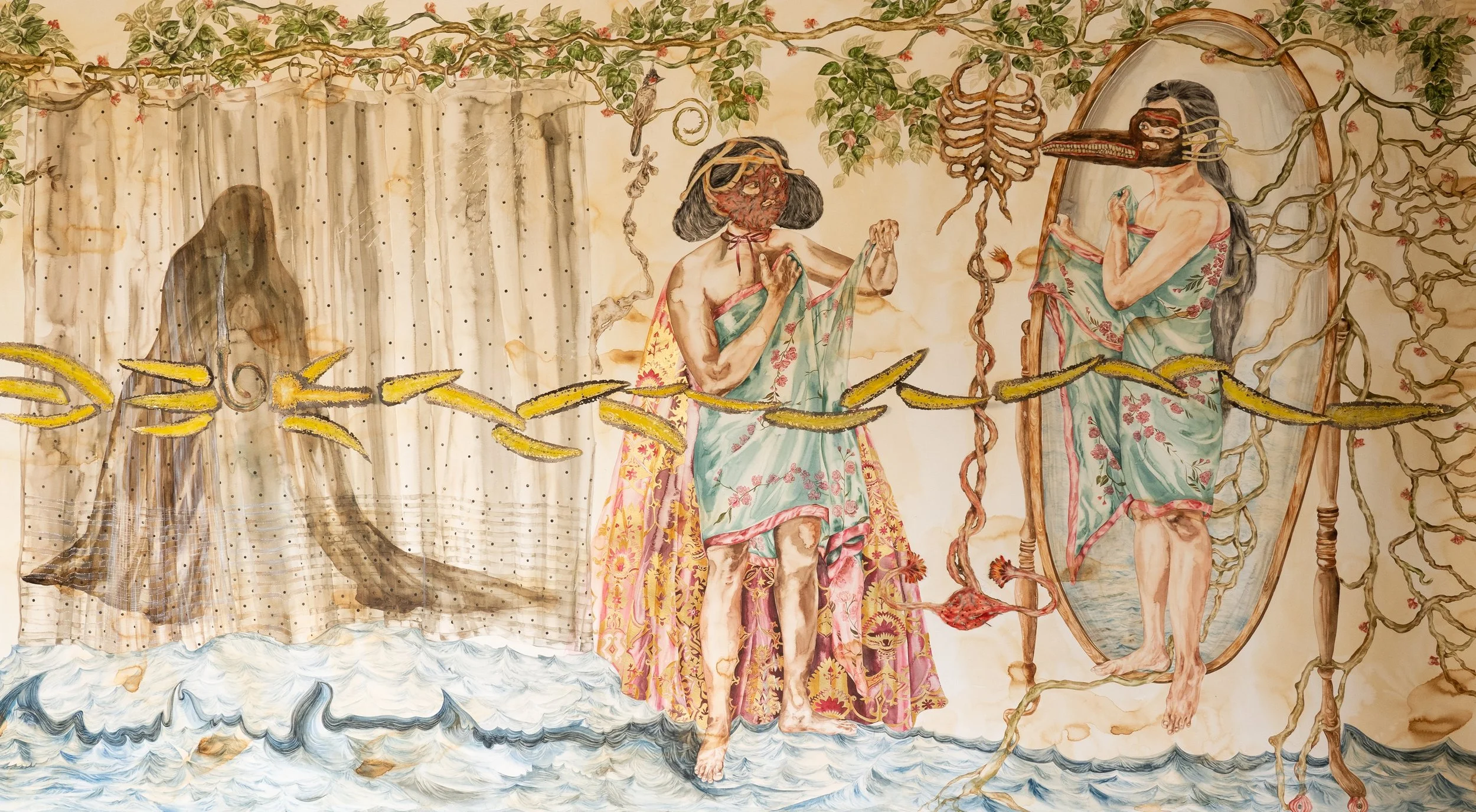
“Bhavitha” (detail) - Anupama Alias Anil
Shaped by Kerala’s mythology and folk art, Anupama Alias Anil weaves textures that introspect the gendered self.
Light interlaces through memory and temporal selves. It weaves the ones that were, and the one who seeks to emerge, in the artist Anupama Alias Anil’s solo show, “A Room for Refuge”, which was presented at the Kalakriti Art Gallery in Hyderabad in late 2025. The last line of the curatorial note by Shruti Ramlingaiah read, “where the room is the space of a breath”. This is a nod to the artist’s studio space which shapes her practice. The note gathered the viewer towards an experience that constricts even while it provides release. It comes in various ways: the breakability of bones, the fragility of touch, and the unbearable tenderness of a body that seeks over and over again to find re-emergence against the deluge of mortality.
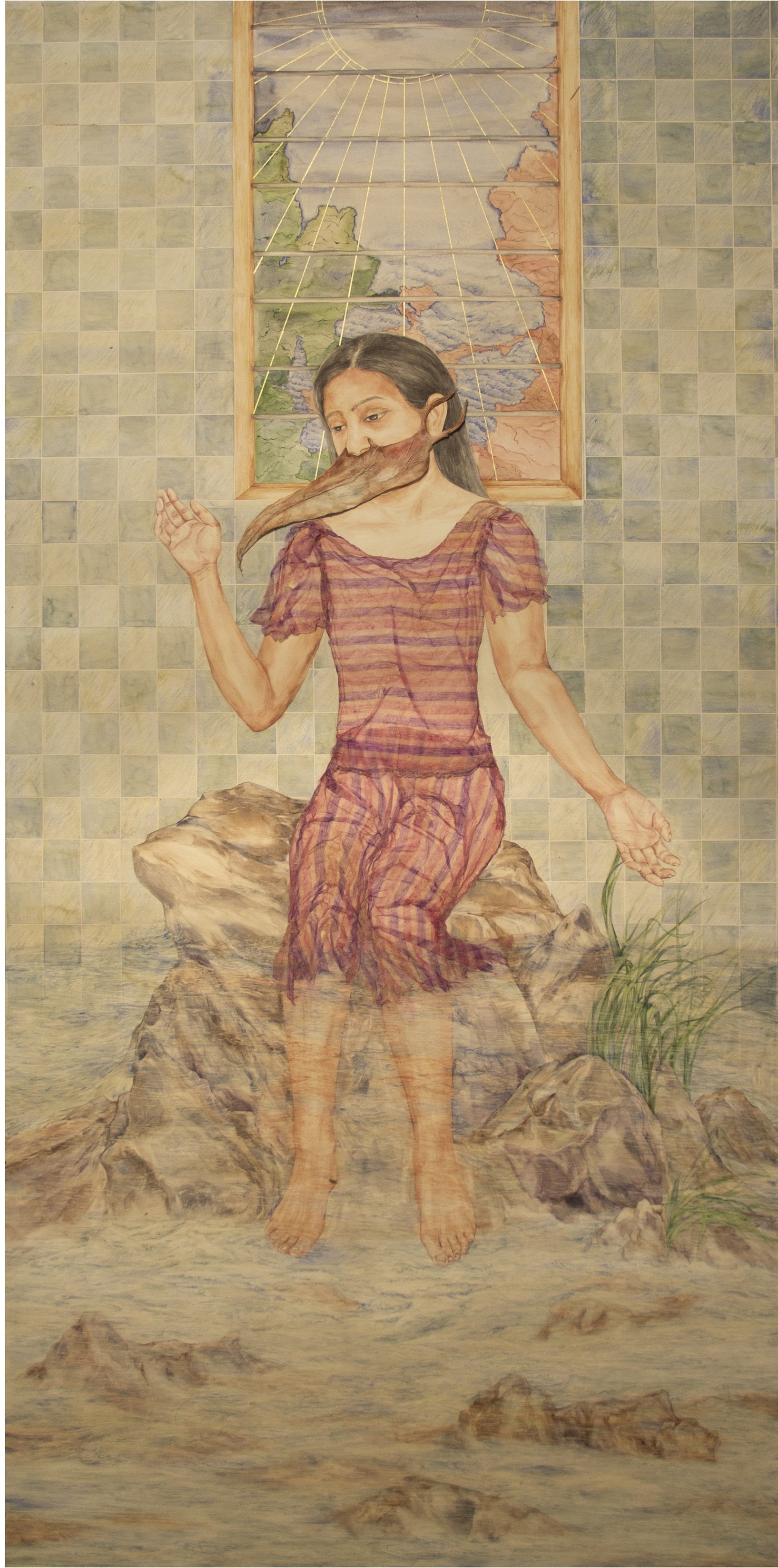
“Island of Hope II” - Anumapa Alias Anil
The works at the exhibition ranged from large scale murals to assemblages, landscape paintings, portraits and bronze sculptures. They were testaments to the studio space where the artist experiments with medium and self-expression. As one entered the show, the first portrait was Island of Hope II (2021). Approximately 5ft in length, a lithe figure, resembling the artist, is poised in a Christ-like gesture, holding her ground amongst a flood pooling around her feet. Sun rays shone through the window. One is held by the stillness of the figure, her resilience, and the implication of a halo from the sun’s rays.
But the mask upon her face tenderly disrupts one’s bearings. The mask, resembling a bird’s beak, conjures impressions of the historical plague doctor’s mask, often used in personified portrayals of Death. Anil told me that the beaked masks made their way into her art inspired by the African masks she encountered at the Louvre in Paris, when she was visiting for an internship at the École Supérieure d’art et de design Marseille-Méditerranée (2017). The alter-ego figure in Island of Hope II with the beaked mask thus heralds a folkloric and mythological presence.
The death-like beak, in disrupting one’s view, does not abandon. On the contrary, it becomes an invitation to examine one’s own sense of grounding amongst a deluge. Perhaps the figure enveloped by the sun’s rays, with arms and fingers poised like Christ, reminds one of the framed Sacred Heart of Christ prints in Syrian Christian homes. This is where the layers of Anil’s interweaving practice unravel. One realises that each art work is a palimpsest of art histories and personal memories. In this work, memories of navigating Kerala’s 2018 floods encounter the Sacred Heart within a self-portrait.
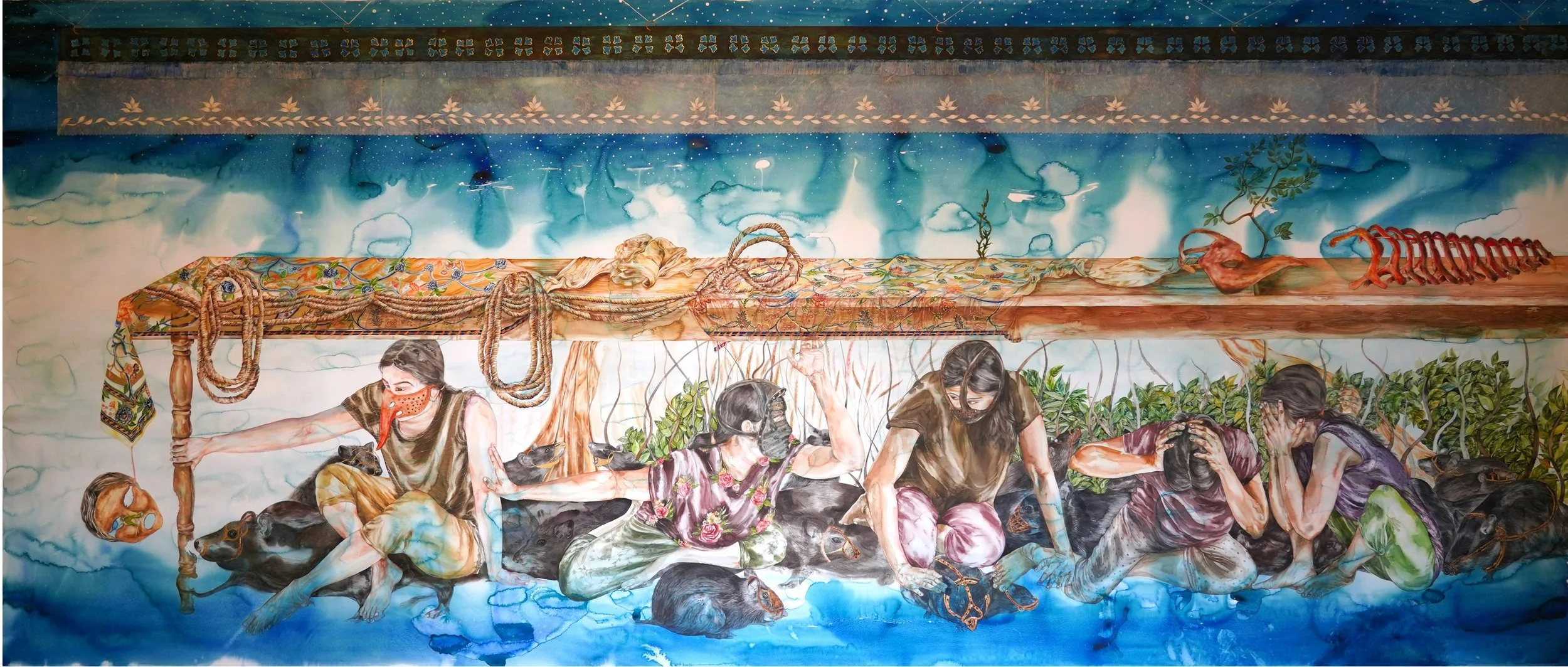
“Hidden meaning of the last meal” - Anupama Alias Anil
Historical church mural elements frame the female figure in emotional turmoil beneath a disarrayed dinner table. This may be read as a deliberate ploy in the examination of the Christian woman, groomed to express her femininity in a specific way within the Kerala society.
Opposite this portrait, a large mural subtly evoked another often-spotted image in Syrian Christian homes, that of The Last Supper. This mural, like other paintings and assemblages in the show, was held together by five fragile human bodies—all of them, a woman. They crouch beneath the disarrayed table which is draped in fine cloth. Titled, Hidden Meaning of the Last Meal (2019), Anil’s alter egos in this mural confront decay, destruction, and disturbed mental peace, in gestures and poses that mimic those of the twelve apostles. In this mural, the masks return. One lies beside the soft floral table cloth, like a talisman of the disturbed self. On the other end, another plain mask lies suspended from a thread. Rats scurry amongst the masked figures under the table, all trapped in anguished gestures. On the far right, a rib cage lies on the table. Lace fashioned out of rice paper frames the mural at the top of the painting.
When I first confronted the mural, it is the destitution of the different selves of the woman as self-portrait, as alter-ego, even as a projection of my own self that I see in them. The artist seems to be telling us something by replacing the figure of Jesus and his apostles with the singular female figure. Anil told me that apart from the Christian imagery of homes, the mural paintings from St. Mary’s Cathedral church in Angamaly, have influenced the rice paper motifs across the top of the mural.
The mural paintings of St. Mary’s Cathedral, Angamaly, are influenced by West Asian art from the Byzantine period. In them, divine figures are many in number and painted two-dimensionally to illustrate Biblical scenes. Their faces are expressionless, yet haloed to signify their divinity. Renaissance art, on the other hand, emphasised life-like images of divine figures. Anil told me that Dutch and Italian artists she encountered in her father’s Great Artists magazine collection inspired the figurations. Even amongst the Renaissance artists, she pointed out that Dutch painters humanised the divine figures.
In her mural, Anil juxtaposed these human emotions of anguish by creating a figurative moment that draws from each of these histories of Christian art. Historical church mural elements frame the female figure in emotional turmoil beneath a disarrayed dinner table. This may be read as a deliberate ploy in the examination of the Christian woman, groomed to express her femininity in a specific way within the Kerala society.
In Sonja Thomas’ book Privileged Minorities (2018), the researcher discusses the paradoxical reality of Kerala’s Syrian Christian women. While the community actively educates women and enjoys an upper class/caste position in society, women are bound by strict restrictions of marriage and sexual morality codes. They are further curtailed in mobility and often not allowed to travel without the presence of a male family member. Perhaps the recognition of these oppressions shape Anil’s anguished woman, too.
Anil does not overtly mention these forms of restrictions, but alluded to them in her stories of inspiration. She told me that her gendered introspection is informed by her reflections of the lives of women in her neighbourhood, including the stories of her mother, grandmothers and aunts. She added that they (the women) know of the kinds of patriarchy they navigate everyday—they don’t draw attention to it, but find ways of working around it. One of the projects, Cape of Good Hope (2021) (not shown at this exhibition), is a collaboration with the Kudumbashree women of the community. (The Kudumbashree project is an initiative by the Kerala government to provide self-help groups for women to enable community support in economic gains and self-governance.)
In other works, the dregs of a personal self under scrutiny take curious shapes. The beaked mask in Island of Hope II is made of cotton, flattened and painted in a dull red. Anil said that the fascination of wet cotton being pliable is also akin to the mucus fluidity of menstrual blood.
Wet cotton, often painted red, is a material that resurfaces in almost all her works. They take the shape of trapped bees and pressed flowers in her memory notebook, The Script of Memory (2025). They morph into dismembered body parts in her mural. In the assemblages including Memory of Memories (2025) and Masked Realities (2025) they transform into surreal organs and organisms that signifies the lives and layers of memories to the artist.
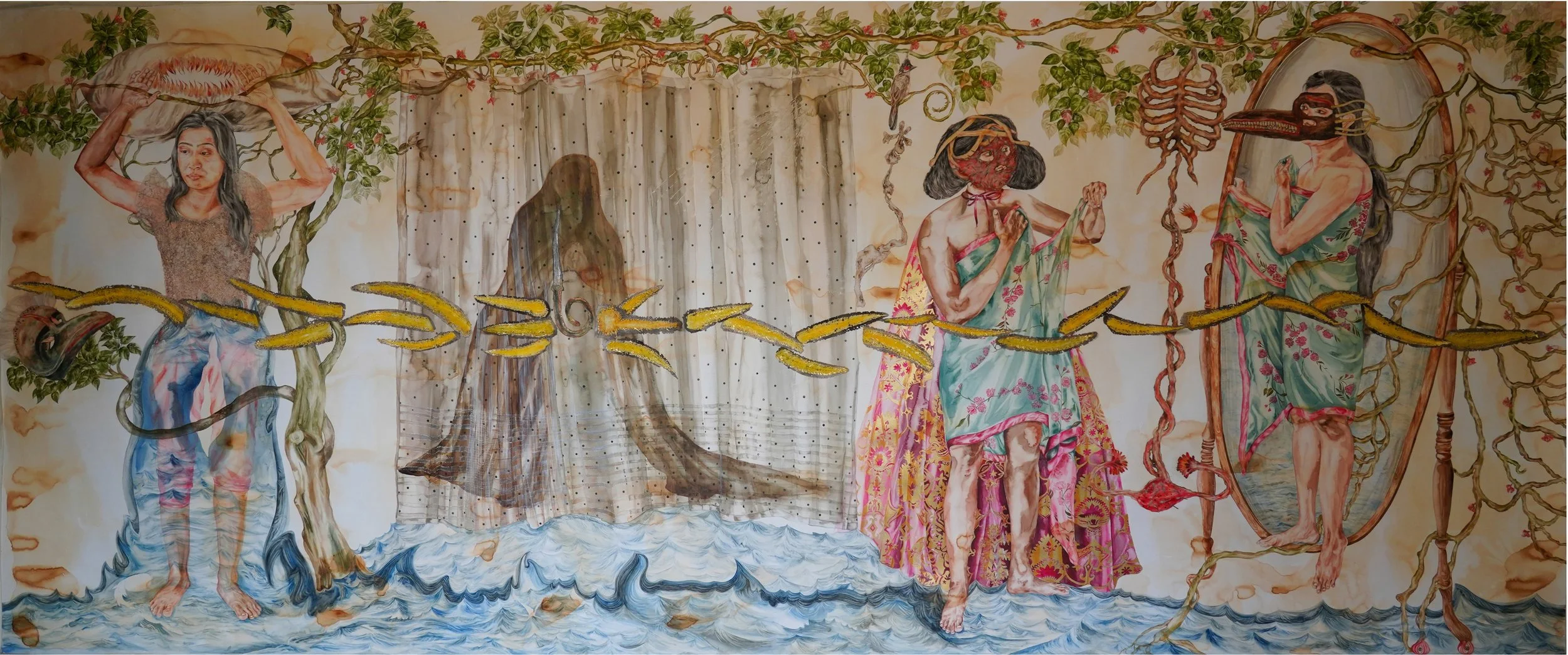
“Bhavitha” - Anupama Alias Anil
Anil’s theme of the search for self repeatedly turns to folklore to draw out a play between performance and narratives of the self in figuration. In the Island of Hope II self-portrait series, the cotton-drenched beak covering the face of her alter-ego anchored Anil’s show, highlighting the tussle with self, memories, and histories. Anil told me that the mask was also inspired by the forces within Theyyam, a performance folk tradition of Kerala, where persons of a lower caste become deified and conjure spirits of possession who are venerated. I cannot help but draw parallels to the Christian woman in Kerala, who beneath her mask, desperately seeks to hold her fragmented selves together.
When I enquired about the indelible presence of the alter-ego, Anil spoke about Bhavitha, her alter-ego, who makes a continued appearance across her paintings. In Bhavitha (2019) (not shown at the solo show) Anil paints this character in various stages of contemplation, negotiating with the acts of dressing and undressing. The first figure is clothed from below her waist by water; the second is completely shrouded; and the third figure is masked, staring into the mirror, holding up a long piece of pink and blue floral drapes. These figures are gender-ambiguous, and the artists describes these stages of the “expressing” figure – Bhavitha as “disidentifying” in their exploration of gender and femininity.
“Disidentifying” is a term in performative theory that Josè Esteban Muñoz, queer theorist, uses to describe the act of negotiating with a majoritarian public sphere in the expression of one’s queerness in opposition to the norm of the society. It is interesting that Anil uses the term “disidentifying” to describe the work, because her negotiation is not simply of queerness in terms of sexuality, but that of a femininity that negotiates with Indian (more specifically, one formed by a Kerala Syrian Christian) notion of cis-heteronormativity. This may be one reading with respect to engaging with the question of performing selves.
This is the genius of Anil: when one least expects it, horror turns tender, the fragility of life, held by bones and spines, receive a gift, some room to breathe. In unmasking, they heal even when surrounded by the macabre spectres of patriarchy—and its violence.
The other reading is sinister even as it is hopeful. For me, as a non-binary viewer confronting different shades of the same Syrian Christian patriarchy, other forms of unravelling occur. The fragmentations of self deeply textured in Anil’s works point to an emergent self, to the act of unmasking the horror that is softly contained within the performance of perfection. Her hagiographies sanctify a fragmented self which trickles into the triptychs of Masked Realities (2025) and the Untitled (2018) series of three bronze sculptures. In these sculptures, hair and vines conjure surreal creatures and are immortalised in pride. In the assemblages, the same selves lie suspended in clinically suffocating tubes. The body, severed, stitched, and braided is displayed in its fragmented attempt to hold its masked selves. In the interstices, the façade crumbles.
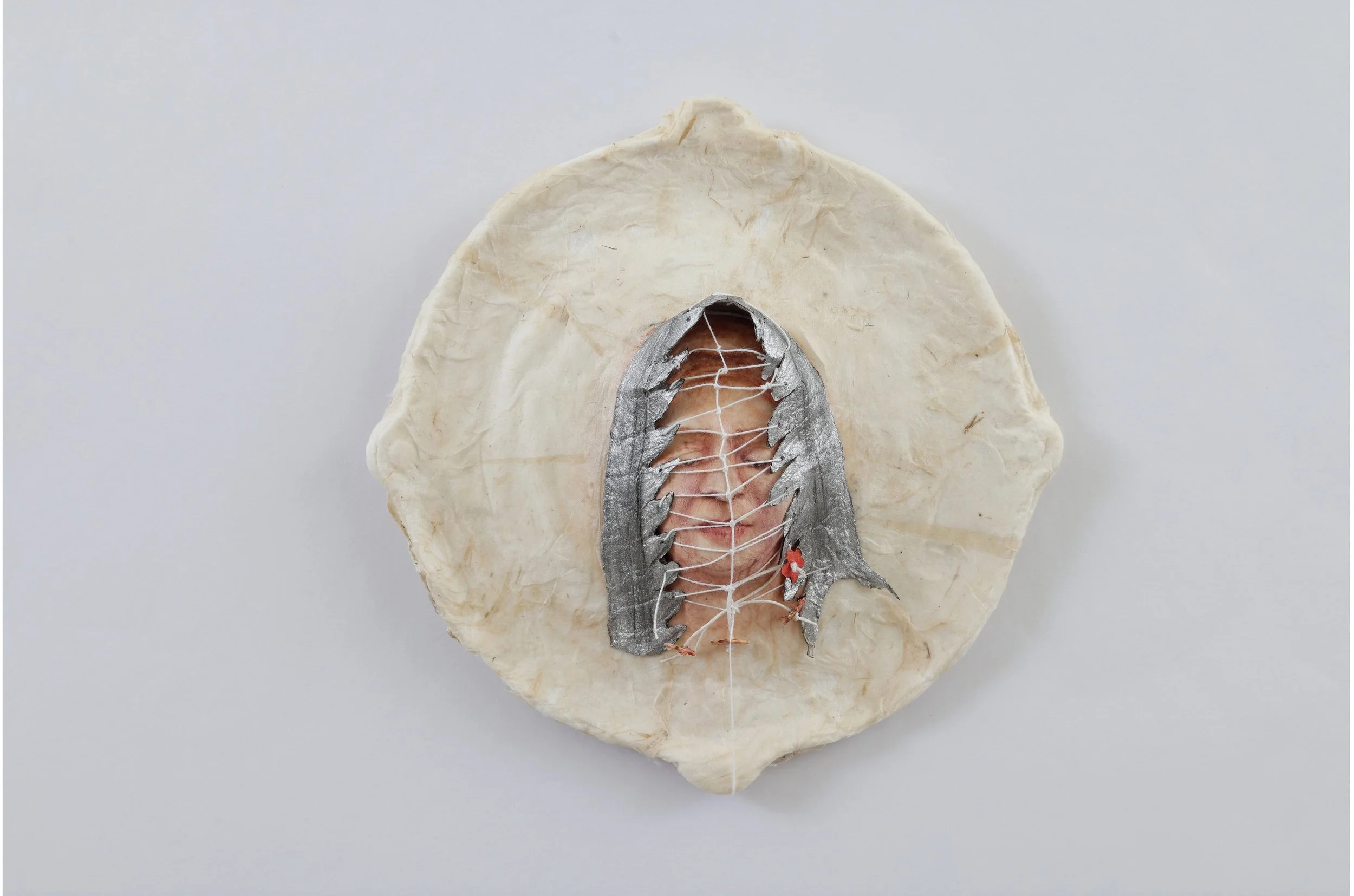
“Masked Realities (6)” - Anupama Alias Anil
This is the genius of Anil: when one least expects it, horror turns tender, the fragility of life, held by bones and spines, receive a gift, some room to breathe, as the curatorial note resounds. In unmasking, they heal even when surrounded by the macabre spectres of patriarchy—and its violence, dare I say.

“Witness of Emberes” - Anupama Alias Anil
These pieces nod to the searching self, which oscillates between a philosophy of introspection and an acute awareness of the body’s dismembering. Her landscapes form large and haunting expressions: The terrain is wild, and Anil appears as an unclothed, gender-ambiguous figure. In some, they are engulfed by bare shrubs, in yet others, the figure is tethered by womb, cut open. Washed in burnt sienna with the slightest hints of purple, and touches of ochre, the paintings recall antecedents of soft Japanese washes.
I asked Anil of the deep loneliness within the work, but she was quick to correct me. No, it is solitude, she said. And so, I see, light interludes within these symphonies of solitude. In the far distance—often shaped by accidents on the canvas—there is always a glimmer of hope. They are shaped like rib cages. And if you look closely into the womb, there are hands, caught in the act of weaving invisible threads.
We may wonder about the kind of feminism captured here. Is the artist and her alter-ego crumbling, or crushed in the weights of becoming? Or is it a feminism where one is invited into a tender, messy, overwhelming, and deeply messy journey, searching for light through the shattered winter trees and footsteps of others? The spaces in the canvas that softly burn bright, lets the pieces find existence, and rewrites the silent patriarchies of a Christendom into a female gaze.
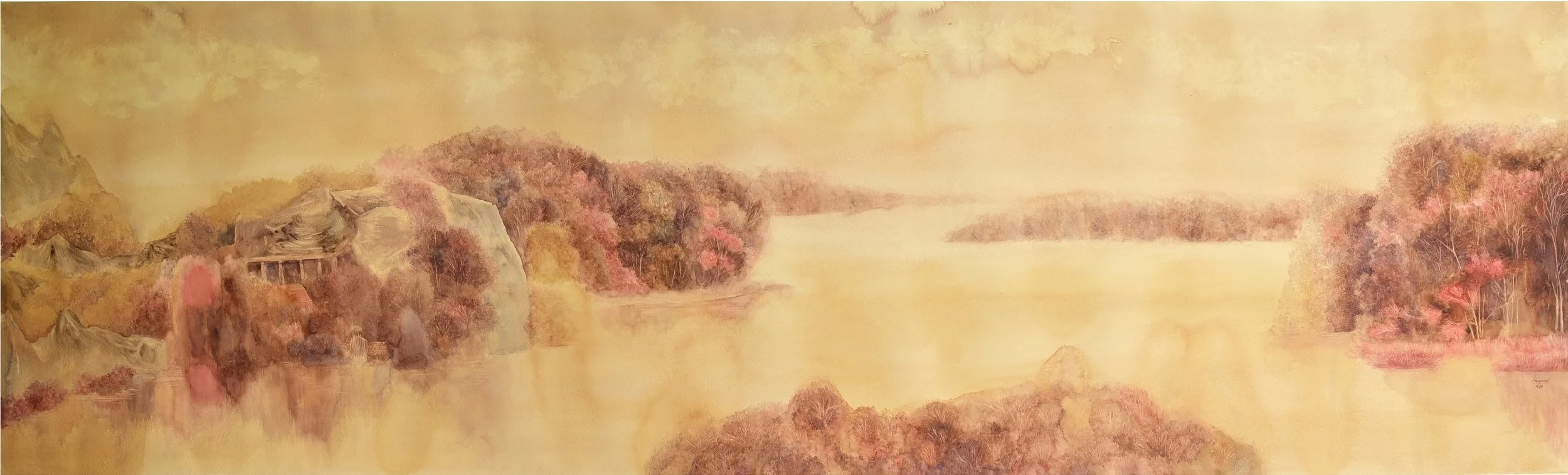
“The fire of dissolution” - Anupama Alias Anil
Perhaps, as in Memory of Memories, her mouth is stitched. But in the Witness of Embers (2024), a non-binary body embraces the light. From the soft washes of flooding water in Island of Hope, to the burnt landscapes in Fires of Dissolution (2025) the self seeks a kind of respite.
In the end, through conflict and surrender, one discovers release in light burnt landscapes that glow liminal through the canvas. Anil deftly refigures the language of folklore and Christian art histories into a deeply personal feminist revisioning. In communing with her art, we are invited to partake in this transformation.
***
Anna Lynn is a guest faculty at EFL University. She holds a PhD in Comparative Literature, and her areas of interest include women's writing, art and cinema. The anxieties of a queer heart are a constant muse and as the Woolfian stream passes, she presses watered images into writing. You can find her work on Sunflower Collective, LiveWire, Gulmohur Quarterly, In Plainspeak, and her blog www.seagirlstories.wordpress.com. Anna is on Instagram: @seagirlstories and @lettersinthemargins.