A Man, Unfinished
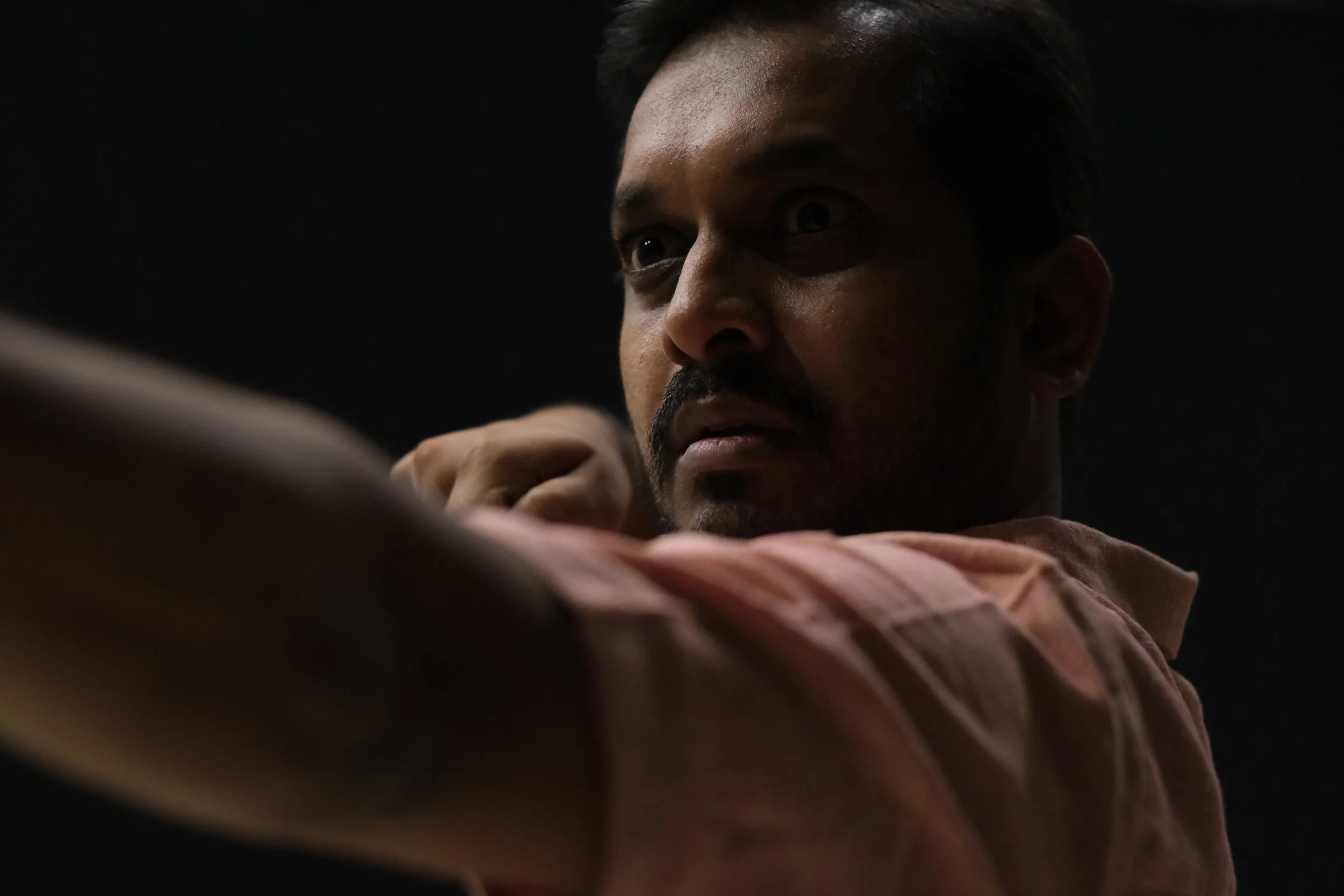
Vivek Vijayakumaran in Adhura. Photo credit: Hari.
In the solo play Adhura, Vivek Vijayakumaran explores how, even as we idolise historical and mythological figures, life tests the ideals they embody. Do these tests still liberate us, or do they become burdens that make it harder to make choices?
While watching Adhura—a solo Hindi play by the Bengaluru-based Our Theatre Collective—I was reminded of the power of theatre to hold a mirror up to a compromised society. Perhaps this is why the play has been the Collective’s longest-running show, completing 53 performances across the country. Written by Vivek Vijayakumaran and Suranjay Patil, and guided by Anish Victor, Adhura is a deeply personal story centred on the lone protagonist, Sanket Patil (performed by Vijayakumaran), interwoven with contemporary themes of migration, political inaction, and data security.
The play follows Patil’s journey from an idyllic childhood to a life of constant movement, in search of a better future. Like every young Indian, he aspires to a prestigious engineering degree. Raised on the heroic tales of freedom fighter Bhagat Singh and Mahabharata’s Karna, Patil carries with him their ideals of resilience, sacrifice, and perseverance as he navigates the challenges of his journey.
However, these ideals are put to the test when Patil confronts reality. He explores how, even as we idolise historical and mythological figures, life tests the ideals they embody. Do these tests still liberate us, or do they become burdens that make it harder to make choices?
Though the themes addressed—middle-class expectations, online personalised targeting, and the ‘incompleteness’ of a half-actualised life—may seem disparate, a common thread runs through: in each sphere, Patil’s agency is thwarted, until courage only appears to be stuff of mythology.
When Patil is worn out by having to compromise on his ideals, he reflects on how society only honours great men in stone, not in deed: “Aksar hamare jaise log hi sambhalte hain humko. Mahapurushon ko sambhalna hame nahi aata, unko bana dete hain aadarshon ke putle, unke vicharon ko bhaari lohe mein galakar phir khada kar dete hain raasto mein landmarks ki tarah.” (Often, it is people like us who hold ourselves together. We do not know how to handle great men. We turn them into statues of ideals, melt their thoughts into heavy iron, and then erect them on our roads, like landmarks).
In contrast with these lofty ideals, Adhura also examines middle-class expectations. For Patil, success is transient. He undergoes training at Kota to crack the IIT exams, only for that dream to fall through. He falls in love only to have his choice questioned by his father. As a data analyst, he finds himself with minimal say in higher-level decisions, yet remains part of the system.
One scene captures his dependence on approval. Eager for his father to accept the woman he loves, Patil speaks with enthusiasm, confident his father will come around. But as Patil’s father rejects his choice, his hands drop to his sides, disappointment flickers across his eyes before he looks away. The surprise is performed not as shock but as resignation—a pattern repeated throughout the play, of Patil trying, but failing to bring about change.
The failure is not personal but structural because he operates within a system. Patil works as a data analyst in a company where he has little say in the data security policies. In a striking confrontation with his boss over being asked to compromise customers’ data, he first refuses softly, arguing with logic and calm. When he isn’t heard, he pushes back—his voice rising, face flushed, indignation blazing in his eyes—engulfing the auditorium with a sense of helplessness.
Often, Patil is left unheard, unfinished. He wrestles throughout with a sense of incompleteness, (the title of the play means ‘incomplete’). He has to contend with the gap between his external reality—a life of societal expectations, an average career, and complicity—and his inner longing for the choices he was never allowed to make. After the altercation with his boss, Patil reflects on his defeat: “Jab sahi aur aasan ka farak dhundla hone lagte hain toh ham sabko fase huwe, dabe huwe rehan acha lagta hain shayad aazadi ghulami se zyada darawani hoti hain” (When the difference between right and what seems easy begins to blur, we find it easier to remain trapped, to remain oppressed. Perhaps freedom is more frightening than slavery).
The performance has no sets. Vijayakumaran carries the play on his shoulders with his acting prowess. Vijayakumaran and Suranjay Patil’s script, too, is richly descriptive, with its vivid ‘word painting’ of Sanket Patil’s village, his dilemmas, and his inner turmoil. An example of this is when he describes his village house: “Hamara purana khet wala ghar, ghar ke peeche kuaan, kuaan ke bagal mein mitti ka bada sa dher tha jis par main chadhkar baithta.” (Our old house by the fields. Behind the house was a well, and beside the well was a big mound of earth that I would climb onto and sit every day.) Though the script depicts Patil’s mental health sensitively, a content disclaimer for a scene of attempted self-harm would help. The varied themes add layers, but it is quite a bit to unpack in 60-minutes.
After the performance, Vijayakumaran said that some audience members did not want to speak for a day or two before responding, and, at other times, simply hugged him without saying a word. Other audience responses included people talking about how they saw their own lives unfold on stage. “Some connected strongly with the journey from one place to another, others with love, dilemmas, choices, or even the mental health dimensions of the piece,” Vijayakumaran said.
At its core, the play juxtaposes Bhagat Singh’s valour with Patil’s despair. Early on, Patil reminisces about childhood puppet shows of Singh, recalling the freedom fighter’s unflinching courage in the face of execution. In contrast, towards the end of the play, Patil is consumed by guilt and despair over his inability to act against wrongdoing, and attempts to take his own life. This makes the audience reflect on what has changed between Bhagat Singh’s time and ours. Why does speaking out and taking action against wrongdoing seem so much harder when the consequences become personal?
Adhura asks us what we sacrifice when our outrage at political injustice is restricted to social media, and forces us to question the cost of exploitative systems. Though the themes addressed—middle-class expectations, online personalised targeting, and the ‘incompleteness’ of a half-actualised life—may seem disparate, a common thread runs through: in each sphere, Patil’s agency is thwarted, until courage only appears to be stuff of mythology. The stripped-down performance (no sets, one actor on stage) drives this home: Patil’s inability to effect change is impossible to look away from, a life forced to reckon with the ideals it was raised on.
***
Sravasti Datta is an independent journalist. She has a Master's in History from Calcutta University and a diploma in broadcast journalism from the Asian College of Journalism, Chennai. Her writings have been published in The Hindu, 30 Stades, Deccan Herald, The News Minute, among other publications. She can be found on Twitter: @sravastid and Instagram: @sravastid_journo.