In Class with Nature
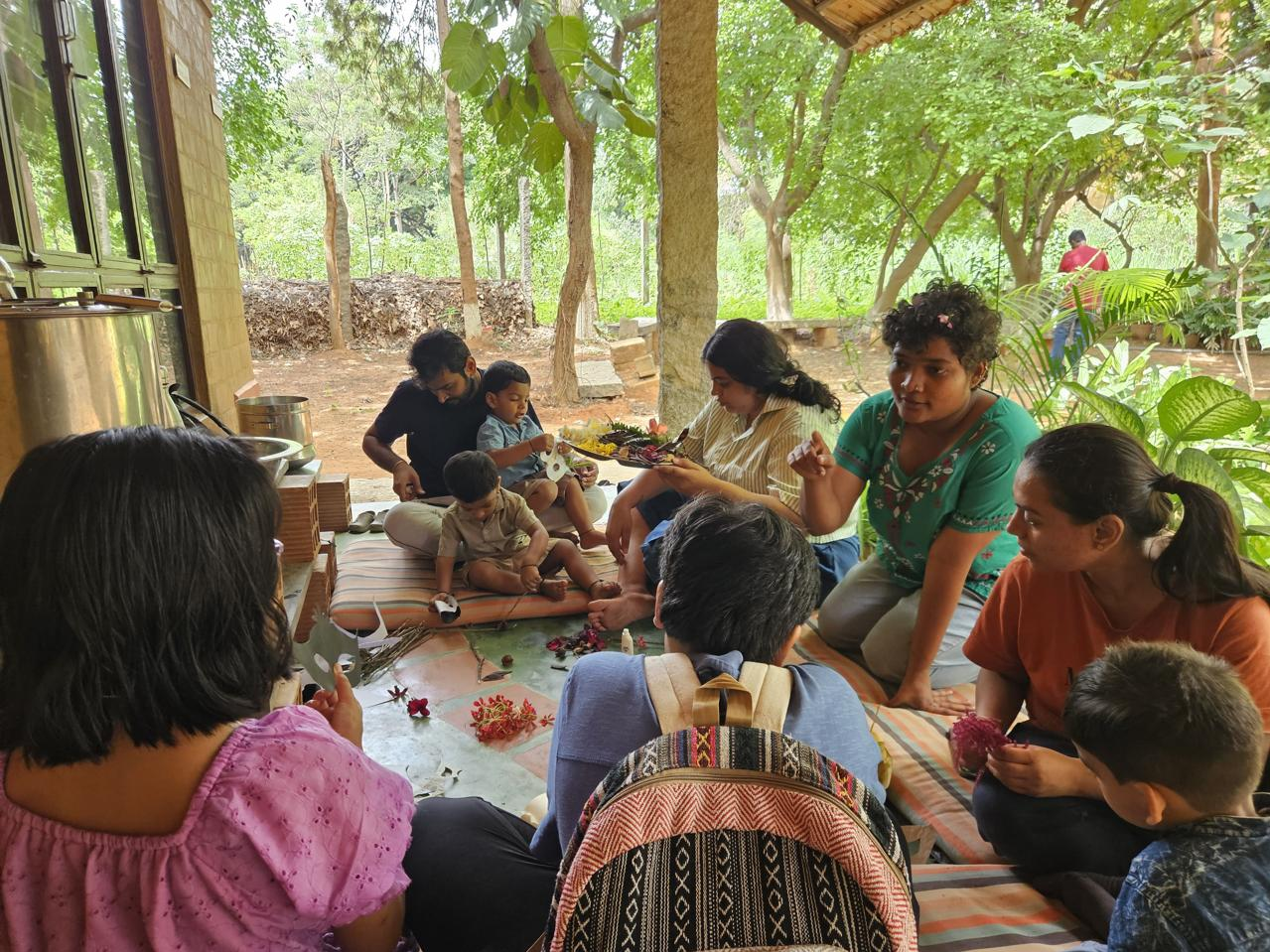
An art workshop organized by Teach for Nature. Photo courtesy: Bhoomi College.
At the Teach for Nature Fellowship, classrooms turn into ecosystems, where children learn about nature—as much as they learn from it.
On a sunny, June morning in Bengaluru, Fellows at the Teach for Nature programme sat on the floor alongside a group of children, surrounded by fallen leaves, flowers, coloured pens, scissors, and glue. Within minutes, the children pasted the leaves and flowers onto bookmarks and paper masks. Among these Fellows was Dr Priyanka Garg, who once worked as a doctor in the UK, but worries about global climate trends made her decide to pursue a path of a part-time nature educator.
“Even though I was in a good profession, what I was doing didn’t align with the sense of climate anxiety I was experiencing,” she says. An Instagram post about the Teach for Nature Fellowship brought Garg to Bengaluru “The Fellowship seemed to be a shift in the right direction.”
The Fellowship—which has sent its members to schools across India, from Karnataka to Rajasthan—was conceptualized by educationist Seetha Ananthasivan. The programme was launched in January 2024 to fill a gap where young people lacked opportunities for formal nature education training. It is hosted by Bhoomi College in Bengaluru, on a lush, 4-acre plot off Sarjapur Road, and supported by the KNA Foundation for Education, a registered Public Charitable Trust.
Neha Jain, Teach for Nature Fellow (batch of 2025-26), heard about the Fellowship when she was working on her project, Climate READY, which nurtures young climate leaders in low-income communities. “The Fellowship aligned with my goals: practice of sustainability in everyday life, connection with like-spirited people, and the chance to work with the community on the ground,” says Jain.
During her Fellowship, Jain facilitated and designed a unique lesson at Shiksha Niketan in Tilonia, a school for rural children in Rajasthan’s Ajmer district. On November 2, 2025, children assembled solar lanterns under the guidance of rural women trained as solar engineers by Barefoot College. But this was not an ordinary art and craft session; it was a practical, hands-on experience, bridging nature and community.
Over the past few years, the impact of educators like Jain and Garg is reflected in how the education is received by the young students. According to testimonials in the Teach for Nature Annual Report, one student in Bengaluru even refused to kill insects after learning about the fig wasp, while government school children in Chhattisgarh turned fifty-minute nature walks into two-and-a-half-hour explorations.
In Bengaluru, the KK English School has hosted Fellows for three years. Their principal M.A. Khan compares the work of the Fellows to “KYC” (Know Your Customer) by flipping it to “KYN” (Know Your Neighbourhood). “Children engage with nature around their neighbourhood,” says Khan. “Students recognize the natural pattern and the blended colours of nature in leaves and barks of the trees.”
Khan says the impact can be seen in kids’ behaviour: “Our students don’t pluck plants and flowers. The last student to leave the class switches off the lights and fans. They do all this without being told.” Khan adds that parents of these children have reported similar shifts at home, with children conserving energy and water instinctively after learning about these concepts in school.
Meanwhile, Sreevidya KB, Principal of the girls’ high school Bangaloreblaze, has hosted Teach for Nature Fellows to conduct ‘Nature Connect’ sessions at her school for the past two years. “The Fellows conduct field work with the children by familiarizing them with nature. They ensured the children get firsthand experience in gardening and in the basics of entomology.”
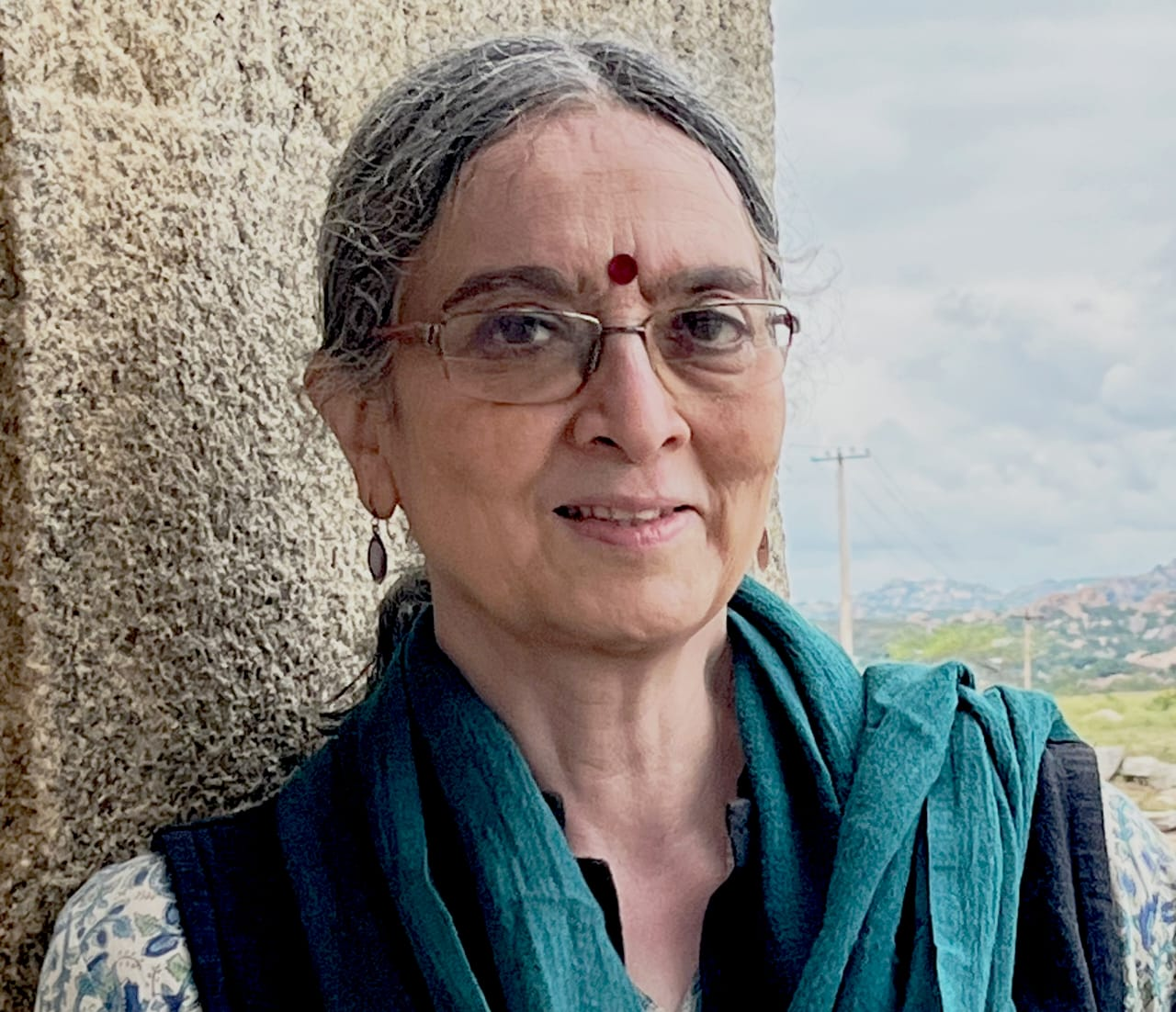
Seetha Ananthasivan. Photo courtesy: Bhoomi College.
Sreevidya adds that textbooks cannot create meaningful experiences of engaging with nature in the same way. The Fellows, therefore, were useful in making the children imbibe that love for the natural world. Speaking about the impact of this kind of learning, she adds, “Experience gained in such sessions cannot be evaluated by grades.”
The Teach for Nature Fellowship recruits young educators for a free, three-month residential intensive, followed by seven months of paid placement in schools. Ananthasivan, who has fostered consciousness about sustainable living for nearly three decades through her Trust, established institutions including the Prakriya Green Wisdom School (1999), the Bhoomi Network (2008), and Bhoomi College (2012).
“The approach is to teach in an interconnected way and not in silos of disconnected topics,” explains Ananthasivan. “The campus’s biodiversity and experienced faculty serve as a place of learning.”
The curriculum revolves around four core themes: connecting with nature, systems-thinking teaching methods, practical education (food, water, waste management), and what Ananthasivan refers to as inner and outer ecology. Inner Ecology explores the connection between health, the body, and nature. Systems Thinking analyses special cases, like the unintended consequences of the Indira Gandhi Canal on Western Rajasthan’s water architecture. Experiential Learning includes daily nature walks led by naturalist Jaya Rakesh K., and theatre exercises like “imagining walking on lava and egg shells” to heighten sensory awareness, conducted by Murtuza Khetty. Practical Skills sessions involve modules on reviving millets, cyclic water systems, and responsible waste management.
Garg describes the training as immersive. “Every morning we are out on a nature walk. We usually observe and journal what we see.” She says that the Fellows engage older children with concepts of systemic change, while the focus for the younger students is to help foster a connection to nature.
“The concept of outer and inner ecology helps children understand that everything is interconnected and interacts with each other—then there is more life, more aliveness.”
The Fellowship has seen rapid growth in recent years. The inaugural 2024 cohort of 20 fellows reached over 3,000 children across 26 schools. By 2025, 17 new fellows joined, bringing the total to 26, currently engaging roughly 6,000 children in 45 schools around the country.
However, some challenges remain. Ananthasivan points out persistent hurdles in scaling the model. “In government schools, we face problems in getting permission, while private schools ask for free services of nature teachers—not viable in the long run.” Also, nature education is often relegated to peripheral importance in the conventional curriculum, making recognition difficult.
Jain talks about the logistical struggles: “Scheduling, getting space and holdings for these experiences. Even at a personal level, adapting into that space was a learning process.”
Ananthasivan stresses that schools with infrastructure for sustainable living like solar energy, water recycling, and zero-waste campuses offer a “lived experience rather than book-based learning.” She also highlights the need to teach the “invisible aspects of nature.”
“It is difficult to teach about nature in the usual way because most of it cannot be seen. One needs to use their imagination,” Ananthasivan says. “The concept of outer and inner ecology helps children understand that everything is interconnected and interacts with each other—then there is more life, more aliveness.”
Despite obstacles, the vision of the Fellowship remains clear: to turn classrooms into ecosystems where children learn about nature as well as from it.
***
Sravasti Datta is an independent journalist. She has a Master's in History from Calcutta University and a diploma in broadcast journalism from the Asian College of Journalism, Chennai. Her writings have been published in The Hindu, 30 Stades, Deccan Herald, The News Minute, among other publications. She can be found on Twitter: @sravastid and Instagram: @sravastid_journo.