Gajar Halwa
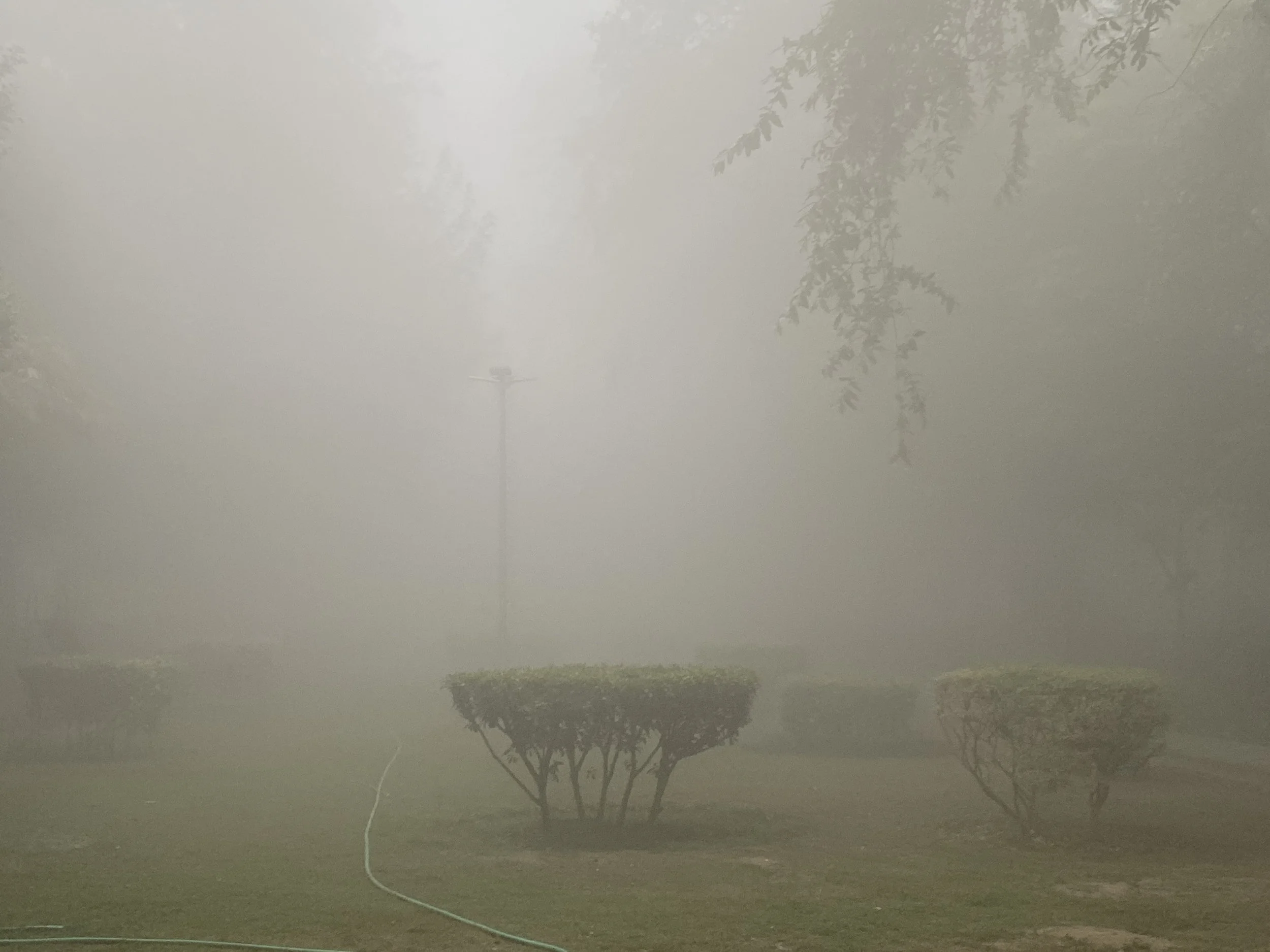
Photo: Karan Madhok
Short story: “Some flowers bloom even when they shouldn’t. This one grows in cracks, drains, broken walls. Shameless little thing. You can forget about it, and it’ll still be there tomorrow.”
Dadi Ma rinses the carrots in the colander.
The milkman’s cycle bell rings later than usual now. The foggy morning moves slowly without the everyday rush of Akbar’s clanging at the gate. Papa’s Nokia had already gone off by half past five, but winter holidays mean no one taps my head to hurry or demands I pull on my navy socks before my toes are even warm.
I plop down on the mat beside Dadi Ma and reach for the biggest carrot to grate.
“Bibi, wash your hands first.” She swats my knuckles away.
I run into the courtyard, pour water over my hands, and hurry back inside. The room smells of burning choke.
“Quick! It’s over 250! Slippers!” Papa hollers, and the three of us scurry to the corner. We clear the way for him. And for you.
The tubelight has surrendered to the surge. Papa reaches for the six-foot wooden staff that leans permanently against the wall. He heaves open the left window to a tangle of overhead wires and the leaning electricity pole that feeds the neighbourhood.
“Not right in the middle of morning tea,” you complain, rubbing your arms.
“Make do for now, Anjum. I’ll bring Mustaqim later today to hook a double wire.” Papa mutters to you. “For now, we pull from Attarsuiya. This phase is dead.” He thrusts the wood into the chilly sky to hook the katia onto the live lines. A jagged spark spits from the window, and then the current arrives.
You watch the bulb overhead until it steadies. “It’s holding, Nammu,” you say. “Close that window now. Don’t let the fog steal the heat we’ve got. I’ll put on the tea. Belal, here—take this.” You press a crumpled twenty-rupee note into Belal’s palm.
“But, Ammi! M.A.D. has just started on Pogo.” Belal doesn’t look away from the television. “It’ll be over when I get back.”
“Then don’t dawdle. Run along. Get the jeera biscuits and come straight back.”
“Can I get a cream roll?”
“Get three. One for each of you,” you say, tapping his shoulder. “Biscuits are 12, three cream rolls are 9. That’s 21 rupees. Give him the 20 and tell him we’ll give the remaining 1 rupee tomorrow.”
Belal pulls his woollen cap low over his ears and disappears down the stairs. Just a short, shivering walk past the timber yard is the bakery where warm cream rolls sit beside rows of rusks and biscuits.
You turn away from the grey light of the street and place the coil heater near the refrigerator. The fridge is propped against the wall like an exhausted animal. The hinge had given way months ago after you had heaved it down in one furious shove.
The switchboard’s grimy faceplate had wrenched open that afternoon. The fridge’s tilt left just enough space to press the heater against the wall. It is easier that way to boil milk, make tea, and roast sweet potatoes in the room without braving the cold kitchen.
Papa warns you to be careful. Only use the heater when the voltage is steady, he says.
A heavy steel dish sits on the mat. Dadi Ma slides a carrot down the metal teeth—skritch, skritch, skritch—working it down to a tiny nub.
“Where did you learn this from, Dadi Ma?” I ask, handing over the carrots one by one.
“By watching my own mother,” she says. “The winter your father was born… Allah, the celebration! We grated twenty kilos of carrots. I sat there from fajr until the afternoon, just grating. The whole of Hasan Manzil ate my gajar halwa for three days until ghee ran down their fingers.” She nudges me with her knee. “Now go open your book, Bibi. Otherwise, your Ammi will create a fuss later that I made you do all the work.”
“I want to start my holiday homework, but I don’t have my copies,” I tell her. “Papa will buy the bundle from University Road tomorrow. He says wholesale is cheaper.” I pick up a fresh carrot and press it against the sharp steel teeth of the grater.
I press the root harder against the metal. The grater catches, a dry, stuttering vibration that travels up my arm. It is the same friction I felt on a summer afternoon when the carrom striker died on the wood. We had run out of boric powder.
The end of summer vacation was looming, and with the game stalled, we turned to the only thing left.
“The winter your father was born… Allah, the celebration! We grated twenty kilos of carrots. I sat there from fajr until the afternoon, just grating. The whole of Hasan Manzil ate my gajar halwa for three days until ghee ran down their fingers.”
Belal, Ismail, and I huddled over the newspaper on the floor to play our favourite game. We were hunting, scouring the ads for food—fat yellow mangoes, crispy samosas, dripping jalebis, tall glasses of orange Rasna. Whoever spotted the treat first, whoever bit fastest, won.
“Mine!” Ismail stabbed his finger at a chocolate cake. He grinned, his cheeks puffing like tiny balloons.
“Cheater! I saw it first!” Belal wailed.
We gobbled down the feast. Outside, the summer sat still and unyielding.
In the summer of 1989, an eight-year-old girl threw mugful after mugful of water across the hot stone slabs. Her little sister pulled at her frock. “I’m hungry!” The stone soaked up the water faster than the girl could throw it.
Just behind the Hasan Manzil house, there once stood a pink, limewashed two-storey structure. Its wooden door opened into a small courtyard where the earth cracked in pale lines. By evening, everyone slept outside. Inside, the rooms held on to the day’s heat long after the sun had gone.
I propped my chin on the ledge of the middle window. The heat had simply moved indoors. It was the only window the termites hadn’t reached. From my purple stool, I watched the street below.
Outside, in Jaleel’s timber yard, the tall fig tree cast its shade over the carts stacked with wood. Akbar was there, sitting amongst the woodcutters and other cart-pullers on a wooden cot with their lungis hitched up above their knees. When Akbar wasn’t pulling our rickshaw through the early mornings to drop us at school, he was here, pulling carts of fallen logs.
Two decades ago, when the rain came and the fig tree’s shade had turned heavy and dark, a middle-aged man slipped through Jaleel’s timber yard and climbed over a kutcha house. He pressed a blood-soaked cloth to his left eye and sprinted through the narrow streets of Attarsuiya, his pink limewashed house fading into the rain-washed haze behind him. He darted through the arched alleyway, turned left into another lane, and passed the biscuit bakery, making his way toward Ahmadganj.
As Akbar stood to walk toward the entrance, he saw me gazing from the window and waved at me through the stagnant air. I waved back, grinning. Jhingur sat there in his small wooden shack, selling tobacco, cigarettes, and betel leaves. He was a man of around forty, nicknamed after the insect for his spindly limbs and grasshopper-thin frame.
Behind me, you sat on a chair with a plateful of rice in your lap, picking stones from grains. You promised chana dal and mango chutney for lunch—a reward for the raw mangoes I’d scavenged from the schoolyard dust. You tossed a fistful of the hard, white grains into your mouth as you always do.
The afternoon was a slow, airless heist. The grid had gone silent hours ago. Sweat welled at the bump along your left hairline and trickled down. The bump was not always there. It came later. It came after you loved.
I turned back to the window, and my gaze returned to the figs. I imagined biting into the fruit. You had told me once that if eaten daily, the larvae inside them would rid me of my spectacles.
Suddenly, your voice split the July afternoon.
“Get away from the window! The cart-pullers will screw a randi like you for ten rupees!”
I darted across the room, eight years old, and climbed onto our rickety bed. The mattress was thrifted—slept on by another family before us. New things were always one owner away. The jute poked through in places, needling my skin. New things were always one wound closer.
Papa had taught me the rule: Match the first three letters, then look down. I opened the dictionary and followed the alphabet. R-A-N-D-I.
One Saturday in the courtyard, when Dadi Ma had pulled her bamboo fan from Belal’s hand, you snapped the tip off a green bean and muttered it under your breath, then, too.
Randi.
Randi.
Randi.
The dictionary jumped from Ranch to Random.
I lay back. The hot air dragged against my limbs.
Randi wasn’t there.
I wasn’t there.
“You little devils, watch the pot!” Dadi Ma shouts as Belal and Ismail run through the courtyard into the room.
“I’d be more upset about the milk than you two burning.”
“I won’t be upset either if you die,” Ismail says, sticking out his tongue.
Papa had taught me the rule: Match the first three letters, then look down. I opened the dictionary and followed the alphabet. R-A-N-D-I.
Dadi Ma snorts.
Ismail blows a raspberry and runs toward you.
The two sisters once ran like this through another courtyard, the younger one tugging hard at the elder’s hand. “Churaiya barf, Anjum Appi!” she kept saying stubbornly.
“If Abba gives us a rupee, we’ll get one.”
Their mother was not there. She had gone to the talkies with their father’s niece from Pakistan. The older sister put the mug down and led her back inside. Hot air rose from the stone slabs, and cooler air settled.
The steam lifts from the cup as you pour the hot tea. You push a few jeera biscuits onto a saucer.
“Belal,” you say, peeling a boiled egg, “take this to your Dada. And don’t spill the tea.”
Belal balances the saucer over the cup and hurries out onto the veranda. He holds it away from his sweater.
You slide a cream roll toward me. “Eat your breakfast before it goes cold.”
“Bibi,” Dadi Ma says, rattling a tin. “What all did Madam give you for the holidays?”
“Lots!” I say through a mouthful of cream roll.
Dadi Ma shows me how to pinch the cardamom so it pops. “Fractions. Electricity. A shoebox model of a banjo. Computer viruses. And in English…” I stop to pry a stubborn pod apart.
“An essay on my name.”
“Hmph.” She snorts. “New headaches every day from these English schools. Write your essay, Bibi. I’ll find a box.”
“I will. But I don’t know what my name means.”
She’s bent over the fridge, rummaging. “Bibi Khadija was Huzoor Sahib’s first wife,” she says, straightening up with a bowl of khoya. “The very first to accept the faith.”
“But what does it mean?”
“I just told you.”
“No, not ‘Bibi Khadija’. ‘Khadija’.”
Belal and Ismail settle cross-legged in front of the television. One tears his cream roll in half while the other dunks a piece of last night’s roti into his tea.
The milk begins to bubble.
“Bibi,” she mutters, turning back to the fridge. “I will ask the Maulvi and tell you. Now let me work.”
The bubbles stay at the rim for a moment before going away like the sparrows that hopped into our courtyard on a summer noon, dipping their beaks into the water.
The western wall of the courtyard was lined with pink morning glories while wildflowers sprouted from the cracks. Dadi Ma had planted them in heavy limestone planters long before we came to Hasan Manzil. After five years in your mother’s house, Papa had bootlegged us home one evening while Dadi Ma was away in Ajmer.
One morning, I tilted the steel mug over the soil, careful not to splash the little petals.
“Bibi, what are you doing?” Dadi Ma called.
“Watering it, Dadi Ma. See how pretty it’s looking today?”
The western wall of the courtyard was lined with pink morning glories while wildflowers sprouted from the cracks. Dadi Ma had planted them in heavy limestone planters long before we came to Hasan Manzil. After five years in your mother’s house, Papa had bootlegged us home one evening while Dadi Ma was away in Ajmer.
She chuckled. “That one? That’s behaya, Bibi. You don’t need to do anything. It grows without asking.”
I paused, still holding the mug. “But don’t all plants need water?”
“Some flowers bloom even when they shouldn’t. This one grows in cracks, drains, broken walls. Shameless little thing. You can forget about it, and it’ll still be there tomorrow.”
I looked at the pink flowers again. Beside them, a steel drum sat on a stone slab, raised on bricks. If one climbed up and looked inside, mosquito larvae wriggled there year-round.
At times, the drinking water line mixed with the sewer line. The water turned murky yellow and reeked of faeces. You washed the utensils here under the sky, using the clean water from the drum.
Each morning before Akbar banged on the gate, I poured water from the drum into a small saucer for the sparrows. I left it under the shade of the pink flowers.
There was no shade on the veranda. The pink climbed onto your face as you sat under the April sun, scrubbing my navy tunic. The water was heated all day in the tank on the roof. Beside you, the AC exhaust spat heat into your face, scorching your fair skin. My school badge pressed into your thumb until the metal left a dent.
That dent was a twin to the ones on the AC, which was a carcass. In the winter, mice used the vents as a highway. Mustaqim Chacha had promised to swap it as soon as a fresh unit arrived in his scrap yard, just as he had done for the refrigerator and the ceiling fan.
You retreated inside, fanning the last of the veranda’s heat from your skin while the AC rattled in the window. The courtyard lay just beyond, one room away.
“Hey, keep it down, or you’ll scare them off,” a boy’s voice called from behind me.
Our lanky neighbour, not more than fifteen, was squinting in the sun. From his terrace, he had a full view of our courtyard.
“I want to keep one as a pet,” I said, grinning.
“Get the colourful chicks from old Nakas Kona,” he said, fiddling with his kites. “Two rupees each. They won’t fly away.”
I traipsed back into the room, nine years old, pleased that the sparrows had drunk from my saucer.
Then I saw your face—eyes wide with fury. “Your father will chop you and dump you in the gutter if he catches you whoring around with the neighbourhood boys.”
“Sparrows… Ammi. Shalab bhai said I should get—”
You cut me off with a hiss.
“The Arabs do the right thing. They bury their daughters at birth. Now I understand why!”
At birth, Papa had named me after the Prophet’s first wife.
On the morning of August 8, 1998, you were rushed into Safiya Suhail’s clinic. You told me you were only 17 then.
You said no when Papa begged you to get rid of me. He had no money for a baby.
But at 12:20 a.m. on August 9, I clawed into your life.
“Is she fair as milk?” Dada asked.
The milk turns pale orange as Dadi Ma tips the grated carrots into the pot.
“Carrots will take time, Bibi. Go bring your books.”
Away from the heater, the air is cold. The door is ajar. I reach to shut it just as Dada walks in through the veranda, you close behind him, carrying plates of dal and aloo-matar.
“I’ll bring the hot chapatis, Abbu,” you say.
“With desi ghee,” he says and then looks at my feet. “Where are your socks?”
I reach into my school bag to pull out my maths book.
“I was sitting near the heater, Dada. With Dadi Ma.”
“If you catch a cold, bitiya, you will miss full attendance.”
At the Parent-Teacher meeting, Mrs. Shikha Srivastava leaned forward with a smile and said, “Mrs. Anjum, this full-attendance certificate is actually for you. It’s the mothers who wake up at 5 a.m. every day, after all.”
Papa chuckled beside you and said, “Yes, yes, ma’am. Very true, very true.”
You sat cloistered in your hijab and nodded at English sentences you only half-understood. A smile crossed your face when my teacher praised how neat my uniform always was.
Not all clothes were kept that way. The pyjamas were soiled at the knees. Inside the pink house, a man stood pressed against the wall, cracking raw rice between his molars. Feet up, feet down: he paced in place.
“Abba, churaiya barf!”
He huffed and dug out two fifty-paisa coins. The sisters darted into their lane, scattering houseflies as they raced toward the archway.
A big fly circled and landed near the yolk smear on a May afternoon.
The toppled refrigerator gaped. The plug dangled halfway out of the socket.
“I’ll throw your pigs out along with her, Nammu!” Dada bellowed at Papa.
“Abbu, please, go inside,” Papa pleaded.
Your face was flushed pink from the heat.
The heat drove them toward the archway for churaiya barf. The girls walked home sticky-fingered, sucking the red and orange syrup from the ice. “Abba!” the younger one squealed, breaking into a run. “Look! Mine is orange!” Their father was still pacing—feet up, feet down—raw rice grinding between his molars. There was nowhere to go.
“Ammi! … Ammi!” Belal yelped, rushing toward you.
The fruit jam jar lay crushed. You shrieked at Papa about the fan and the milk, your face flushed and slick. Ismail hid beneath your dupatta.
Papa gripped your hair. “Shut up, you whore! You’re the cause of this!”
“This is my house, Anjum!” Dadi Ma hissed. “Go back to your mother’s, you mad woman!”
Milk spread across the floor. Curd splattered the door.
You pounced on her.
Then came the scream.
Papa smashed your head against the iron window frame.
A bump rose instantly, swelling under your hair.
There was no time for anaesthesia.
The hammer had snapped back, and a fragment of hot brass from the ruptured cartridge struck his left eyelid. The eye was hastily bandaged as the man hurried to a nearby clinic.
“Be careful,” he told the doctor as the needle went in. “Don’t ruin the shape of my eye.”
The membrane punctured, and the internal heat reduced the firm structure to a thick, pulpy mass.
“It’s a mush now,” Dadi Ma says, stirring the carrots. The milk has almost gone, and the carrots have turned gooey, sticking together and pulling away from the sides of the pot. She adds the khoya. The brown lumps crumble and disappear.
“Be careful,” he told the doctor as the needle went in. “Don’t ruin the shape of my eye.”
The membrane punctured, and the internal heat reduced the firm structure to a thick, pulpy mass.
“Bibi, quickly get some sugar from your kitchen,” Dadi Ma says, tipping in the last spoonful. “Mine is finished.”
You pass the doorway toward the courtyard.
“Ammi, Dadi Ma wants sugar.”
You don’t answer. You keep walking.
“Bibi, you bring it,” Dadi Ma mutters, crushing the cardamom seeds. “No one else will.”
The sun pushes through the clouds. In the courtyard, you hang the wet clothes on the line.
I run to the kitchen. The sugar jar is tucked behind the mustard oil bottle. I grab it and turn, but my elbow hooks the glass. The bottle wobbles before it topples. It hits the floor.
A sharp, bone-dry snap splintered the air.
This firecracker-like sound shook the sky of 1991, sending a murder of crows into flight. A ten-year-old girl bolted down the stairs.
“Guddu!” an old woman wailed as she struck her chest. “Get up! Guddu, get up! My Guddu! Ya Allah, my Guddu!”
The girl peered through the cracked door. Necks craned from doorways. One by one, neighbours stepped out of their houses. Wajju Chacha murmured, inna lillahi wa inna ilayhi raji’un, under his breath.
“Somebody help my son!”
Guddu lay motionless on the ground, face down in the drain. The murky grey water swirled with fresh blood.
A slow, yellow tongue creeps toward the drain as the seed oil spreads across the cold floor. I run back inside and pull out my maths notebook. If you see me doing my homework, you won’t be so mad, I think.
I hand over the sugar jar hurriedly and settle on the mat.
“Bibi, here, place this under your book,” Dadi Ma passes me the newspaper as she sweeps the carrot tops off the mat with the side of her palm. “Don't ruin my mat with your ink.”
I turn to the page of fraction sums. I like fractions. The numbers get smaller if you do them right. I look at the little 3 sitting above the 4 and the 2 sitting above the 3.
Dadi Ma drops five spoonfuls of her grainy homemade ghee into the pot. The room smells like toasted butter. The wooden spoon goes thwack-scrape, thwack-scrape against the metal sides. Then she pours the sugar and cardamom.
I try to focus on my fractions, but the carrots are sizzling now, making a sound like a tiny, constant rain.
A steady patter dripped from the roof when Subinspector Kalicharan banged on the door the next day. He stepped inside, tapping his truncheon against the ceiling.
“Are you Sultan Ahmad’s wife?”
“Yes, sahib,” she answered.
“Where is he hiding?”
The woman didn’t answer.
He pointed his stick at the girl. “How old?”
“Ten.”
“Name?”
“Anjum.”
A steady patter dripped from the roof when Subinspector Kalicharan banged on the door the next day. He stepped inside, tapping his truncheon against the ceiling.
“Are you Sultan Ahmad’s wife?”
“Yes, sahib,” she answered.
“Where is he hiding?”
He jabbed the ceiling again, and the rainwater collected in the plastic poured down on him. He recoiled, cursing as he stormed back into the street.
The girl had refused to leave her mother alone. Meanwhile, before the sun had cleared the trees, her younger siblings had been hurried onto the passenger train bound for a small village twenty kilometres away.
The sunrise dissolves into evening.
Dadi Ma scatters a handful of raisins over the orange-brown halwa, then sprinkles chopped almonds on top.
“Belal!” You sit under the quilt. “Shut the door properly. Ismail will catch a cold!”
The wooden door, swollen from monsoon rains, resists. Belal has to lean his shoulder into it, dragging the wood until it rasps across the floor like a saw. Beyond it, in the open veranda, the bathroom and kitchen crouch on the right, under the cold sky.
You crack groundnuts in your lap. Snap. Pop. You hand the nuts to Ismail. You press a single grain of pink salt onto your fingertip, and he licks it away.
“Cover your heads!” Papa bursts into the room. “Mustaqim is coming up.”
You throw a shawl toward me.
By the time Mustaqim Chacha ducks through the doorway, it is already over my head.
“Nammu Bhai,” he says, going straight for the window. “Three men were in Attarsuiya this morning, checking meters house-to-house. That’s why the Rani Mandi phase was out all day.” He reaches for the window and pulls it open.
“Yes, I heard. I got the heavy-gauge wire like you said.” Papa drags out the toolbox from under the bed. “The old one couldn’t take the voltage.”
Mustaqim Chacha picks up the long staff, leans out, and hooks the katia off the main pole. He doesn’t wait for the pliers. He pulls the wire inside and tears the plastic casing off with his teeth.
“A new fridge has come in, Nammu Bhai.” Mustaqim Chacha bites off a strip of black electrical tape. “Major-saheb is shifting to a new posting, so they sold it for peanuts. They only bought it in 2007—hardly two years of wear. There are two tiny dents on the side, but that’s it. Otherwise, it’s a showroom piece for just three thousand rupees.”
The machine was a block of industrial steel that had arrived on a flatbed truck. It cost fifty thousand rupees—money from timber, money from pistols, whichever came last.
The girl’s father bought the collar press machine to start over. He took his neighbor, Guddu, as a partner.
A few days ago, they had a heated argument.
“Even the timber cops had fixed rates,” Sultan spat, kicking the dented metal tin. The raw rice ground between his molars. The girl sat cross-legged beside the machine, stacking the steel collar moulds into towers and knocking them down again. “Now I’m haggling over pennies with a rat.”
“Then go back to filing triggers,” Guddu sneered, wiping grease from his hands. “See how long you can make country iron before the police kick your door in.”
The moulds rattled when the tin struck the floor. The girl steadied the top one before it fell.
“I dealt with honest thieves back then.” Sultan stepped closer. “They didn’t bill me a hundred for a fifteen-rupee tin. You think I don’t know what machine oil costs?”
“I do all the running!” Guddu shot back. “You don't step out of your rathole!” He stood up, chest squared. “Go bust your ass in the sun and do your own haggling with shopkeepers.”
The girl added another mould to the tower.
“Haggling over eighty-five rupees?” Sultan lunged forward and grabbed Guddu by the collar. “You swindling fuck. Eighty-five thousand rupees! You conned me into selling my roof for dirt, and now you play me for a puppet?”
Guddu stumbled backward into the girl. The tower collapsed between them. A steel mould struck the girl’s knuckles.
“Go back to the mental asylum,” Guddu sneered, brushing him off. “You drunkard lunatic!”
“Then go back to filing triggers,” Guddu sneered, wiping grease from his hands. “See how long you can make country iron before the police kick your door in.”
The moulds rattled when the tin struck the floor. The girl steadied the top one before it fell.
I stare at the numbers. I should know this. A blacksmith has a 10½-metre-long iron rod. He uses 2⅔ metres for a gate and 3¾ metres for a window grill. The remaining rod is cut into three equal pieces. What is the length of each piece?
I need a common denominator for three and four. I know it is twelve. I try to convert the fractions.
“Bibi, make space,” Dadi Ma tells me as she pours the thick halwa into small bowls.
I put my notebook away. “Only one word problem is left, Dadi Ma. It’s hard.”
“Your father will help you with it later,” she says. “Nammu?”
“Yes, yes, Ammi,” Papa answers. He is crouched by the fridge, holding the yellow tester. He is checking for earthing.
“Give this one to Mustaqim,” Dadi Ma instructs, tapping the rim of a bowl. “And when you go downstairs, take this to your Abbu before the ghee freezes.”
Papa takes the bowls.
“Ammi, what happy occasion is the halwa for?” Mustaqim Chacha asks Dadi Ma, eyeing the bowl. “Is there a special celebration today? Some big news?”
“No special celebration, Mustaqim,” Dadi Ma tells him. “Just the last of the winter carrots. But you are right—in the old days, the Nawabs only served this in their courts for grand celebrations. A wedding, or the birth of a son. You only spend this much milk for a big day.”
“Bibi,” Dadi Ma murmurs, pushing a bowl toward me. “Go ask your Ammi if she will eat.”
I hop across the mat toward you. “Ammi, Dadi Ma is asking—”
You don’t look up from the nuts in your lap. “What?”
“We made halwa.”
“That naagin plays her tune for one morning, and suddenly you’re sitting there grating carrots!”
“But…but…I finished my maths homework.”
“One day of homework and you think you've become a collector? That budhiya couldn’t care less about your maths. She just wants you rolling her rotis.”
“No, no, Ammi. Dadi Ma even gave me a box for—”
“Randi!”
I scuttle back to my corner. Dadi Ma huffs and holds out a bowl. “Bibi, here, you have your halwa.”
She puts it down on the newspaper spread across the mat.
“How are your studies going? You’re going to come first in class again, aren’t you?”
Mustaqim Chacha’s voice booms cheerfully across the room.
“Yes, Insha’Allah. I finished all my maths homework. Only one sum is left for Papa to check. Then Papa has to explain conductors and insulators to me.”
“Good, good. Keep studying hard and make your Papa proud.” Mustaqim Chacha beams.
He moves his heavy boot to reach for the toolbox, accidentally kicking the edge of the newspaper under my bowl. The paper ruffles and folds upward.
“Bibi, watch your food,” Dadi Ma warns.
“Sorry,” I mumble. I flatten my palms against the paper, smoothing the page down. My eyes trace the large advertisement printed under my hand, wishing Belal, Ismail, and I could just sit together and eat the delicious gulab jamuns shining in the picture. Across the columns, I see the name of a city, Changchun, and then a number.
I do the maths.
“Nine-year-old! Ammi! She is nine!” I want to tell you!
I squeal inside, scooping up a spoonful. The raisins burst between my teeth.
Mustaqim Chacha squats beside the open switchboard, tightening another screw. He asks Papa to switch the main off for a moment. Belal wipes his fingers on his sweater before you swat his hand away. You crack another groundnut between your fingers and hold it out for him.
I fish out another raisin and pop it into my mouth.
9-YEAR-OLD BECOMES YOUNGEST MOTHER. A nine-year-old girl in Changchun, China, has given birth to a healthy baby boy via Caesarean section. Authorities confirmed the birth occurred after the girl was admitted to a local hospital eight months pregnant... Continued on page 4
Sweet.
I blow on my spoon.
Very sweet!
Look, Ammi, look! I am no longer the youngest randi in the world.
***
Khadija Rehman (she/her) is an Indian writer who was selected for the 2021 International Writing Program at the University of Iowa. Her work has appeared in the IWP anthologies Crosswalks and The Heartworm, in Eunoia Review, Bright Flash Literary Review, Teesta Review, Flash Frontier, and The Journal of Undiscovered Poets. She often writes about love, violence, longing, and despair.