For Many Kashmiri Craftsmen, “Skill isn’t alone to survive”
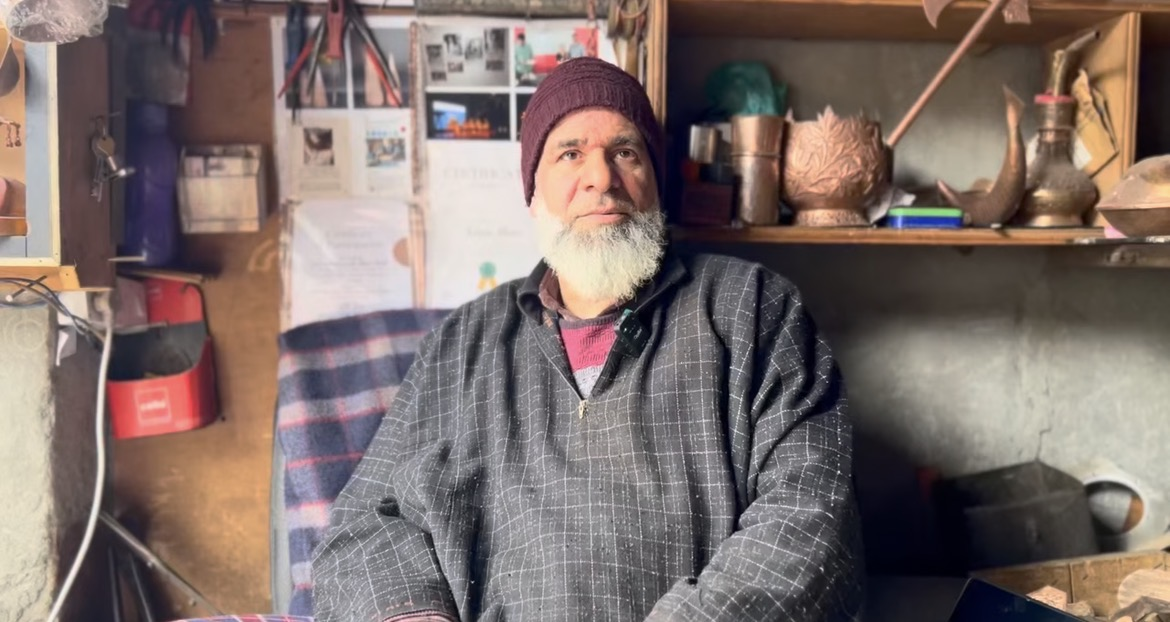
Photo: Ayat Adil
In Kashmir, many rare and lesser-known forms of craftsmanship are slowly disappearing. The work of skilled and committed remains unseen, unsupported and increasingly undervalued in a changing economy.
Mohammad Aslam has been a metalsmith in Srinagar for 35 years. His kaarkhana (workshop), tucked away in downtown, reflects decades of labour, experimentation and patience. Traditionally, metal kaarigari in Kashmir has focused on making household items such as utensils, vessels and Samovars. These objects were functional and widely used, but Aslam felt limited by the narrow definition of what metalwork could be.
“I always wanted to do something beyond utensils,” Aslam said. “I felt the craft could go further, but there was no clear path.”
Early in his career, Aslam began experimenting with decorative items. He started making chandeliers, table lamps and flower vases, objects that were rarely produced by local metal craftsmen. The shift required new designs and longer working hours, and there was no guarantee the pieces would sell.
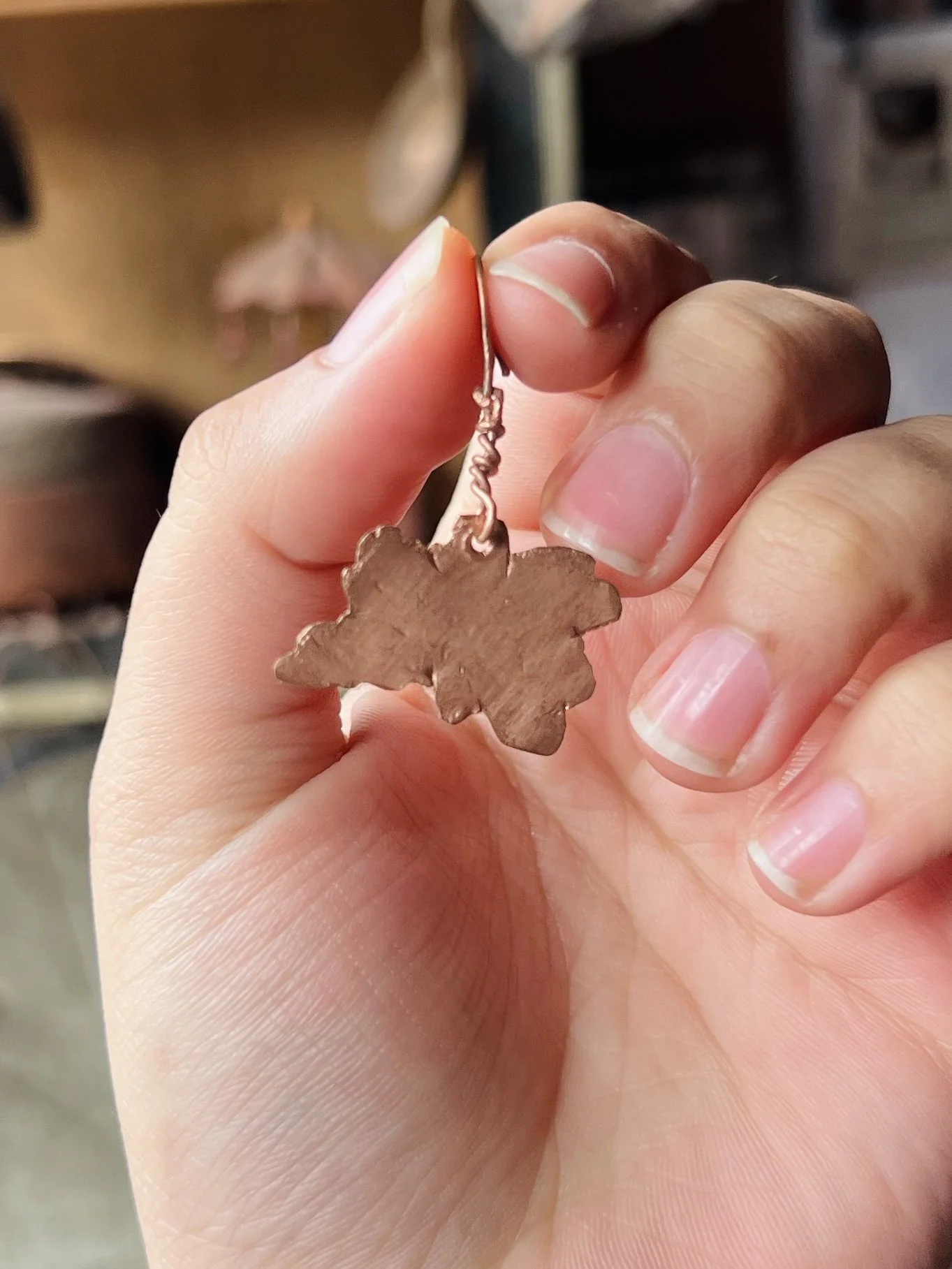
Photo: Ayat Adil
“It wasn’t easy in the beginning,” he said. “People were used to seeing only a certain kind of metalwork. Many didn’t understand why I was trying something new.”
Over time, Aslam’s work began to draw interest from customers looking for unique, handmade pieces. Encouraged by this response, he decided to take an even bigger step. Using traditional metalworking techniques, he began creating handmade jewellery, something that had not been commonly done in Kashmir. Rings, pendants and earrings slowly took shape in his workshop, each piece carefully shaped and finished by hand. The jewellery, Aslam said, received a positive response from those who saw it, though the audience remained limited. “People liked it when they saw it,” he said. “But not many people got to see it. That’s always been the problem.”
Alongside jewellery, Aslam also began making metal replicas of Kashmir’s cultural symbols. These included small models of the Khanqah-e-Moula shrine, shikaras from Dal Lake and the chinar tree. Each piece reflected a deep connection to place and memory, while also offering something new. “I wanted to show that our craft can change with time,” Aslam said. “It doesn’t have to stay stuck in one form.”
Despite years of work and innovation, Aslam’s reach remains limited. Most of his pieces are sold locally, often through word of mouth. He rarely gets opportunities to display his work at exhibitions, national craft fairs, or cultural events.
In the old neighborhoods of downtown Srinagar, where narrow lanes still carry the memory of Kashmir’s craft traditions, a quiet struggle is unfolding. Behind small workshops and shuttered shops, many rare and lesser-known forms of craftsmanship are slowly disappearing. This is not because artisans lack skill, training or commitment, but because their work remains unseen, unsupported and increasingly undervalued in a changing economy.
Kashmir has long been known for its handmade crafts, from copper and papier-mache. For generations, these crafts were part of everyday life, and a steady source of neighbourhoods were organised around specific skills, with acknowledge passed down from one generation to the next. Today, however, many artisans say that while the language of heritage is still used, real support for craftsmen on the ground has steadily declined.
The biggest challenge, artisans say, is no longer learning or preserving skills, but finding space for handmade work in a market dominated by mass-produced goods. Cheaper factory-made items, often sold as “handicrafts,” now fill local markets and online platforms, leaving genuine handmade work struggling to compete.
“When you don’t get platforms, your work stays invisible,” said Aslam, “no matter how good it is.”
Without wider exposure, sustaining both income and motivation becomes difficult. Like many artisans, Aslam worries about the long-term future of his work and whether there will be anyone to carry it forward.
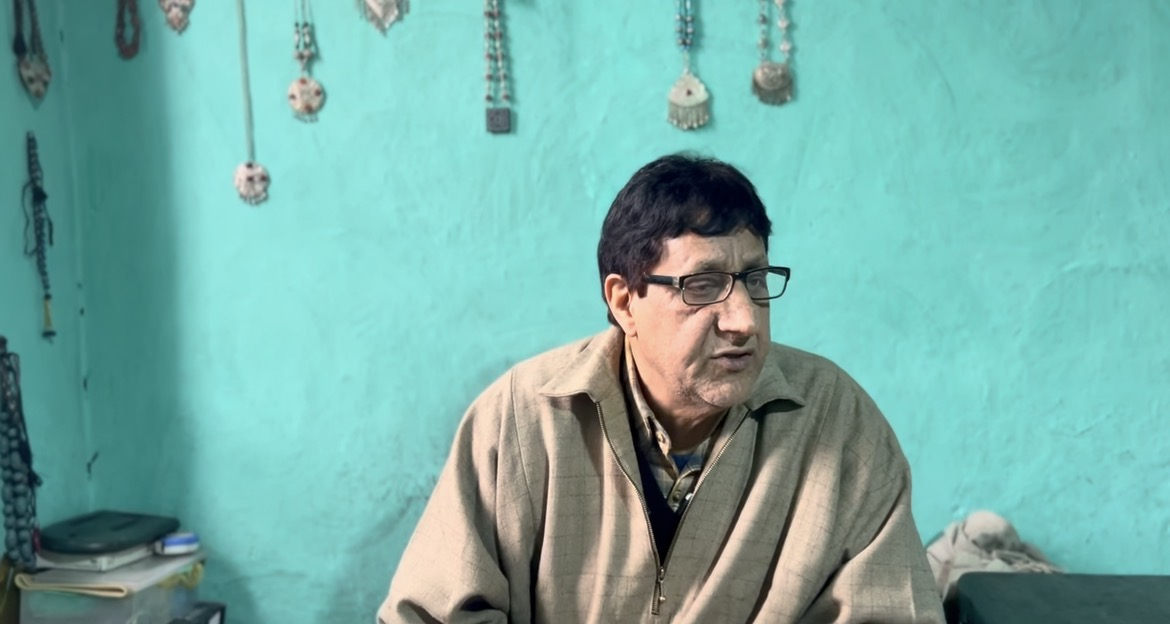
Photo: Ayat Adil
A similar sense of uncertainty surrounds the work of Muhammad Hanif Bhat, a Manaari artisan who has spent nearly 33 years working with turquoise stones. Bhat learned the craft from his father and continues to practice a technique that is now rarely seen in Kashmir. The turquoise stones Bhat uses are sourced from Ladakh and require a long and careful process before they can be turned into jewellery. First, the stones are burned until they turn white. Only after this step is colour applied, giving the stone its final appearance. “The process takes time and patience,” Bhat said. “You cannot rush it. If you do, the stone gets damaged.”
The jewellery made from these stones is entirely handcrafted and known for its weight and authenticity. However, the heaviness of the stone also limits what can be produced. “Because the stone is heavy, we can’t make large ornaments,” he said. “That reduces the options, especially when customers want lighter jewellery.”
Bhat believes he may be the only artisan in Kashmir still practising this method. Instead of pride, however, this thought fills him with concern. “Sometimes I think about stopping,” he said. “There’s very little appreciation left for this work.”
Artisans and craft observers say the decline of such crafts is not simply the result of changing tastes. Rather, it reflects long-standing neglect and weak support system. Many craftsmen have limited access to exhibitions, design programmes, or consistent markets. Government and institutional efforts, they say, are often short-term and fail to address deeper issues. At the same time, mass-produced items have flooded both physical markets and online platforms. These products are cheaper and easier to sell, making it difficult for handmade work to survive.
The biggest challenge, artisans say, is finding space for handmade work in a market dominated by mass-produced goods. Cheaper factory-made items, often sold as “handicrafts,” now fill local markets and online platforms, leaving genuine handmade work struggling to compete.
“When people see similar-looking items at lower prices, they don’t ask about the process,” said Hakim Sameer Hamdani, a Srinagar-based architectural historian and heritage researcher associated with the Kashmir chapter of the Indian National Trust for Art and Cultural Heritage. “They don’t realise the difference between factory-made and handmade.”
Many artisans argue that innovation has always been part of Kashmir’s craft traditions. Crafts were never static, they say, but evolved with time and demand. What is missing today is recognition and support for those who try to adapt while staying true to traditional methods.
Another major concern is the loss of interest among younger generations. Without stable income or respect for the profession, many young people are choosing different career paths.
“If there’s no future, why would they continue?” Aslam asked. “Skill isn’t alone to survive.”
Yet, some artisans and craft advocates believe that the future of Kashmir’s traditional crafts does not have to be defined only by decline. With growing interest in sustainable and handmade products across the world, there is potential for the crafts like metalwork and Manaari jewellery to reach new audiences. Digital platforms, design, collaborations and craft focused tourism could help connect artisans directly with buyers who value authenticity and the story behind the handmade work.
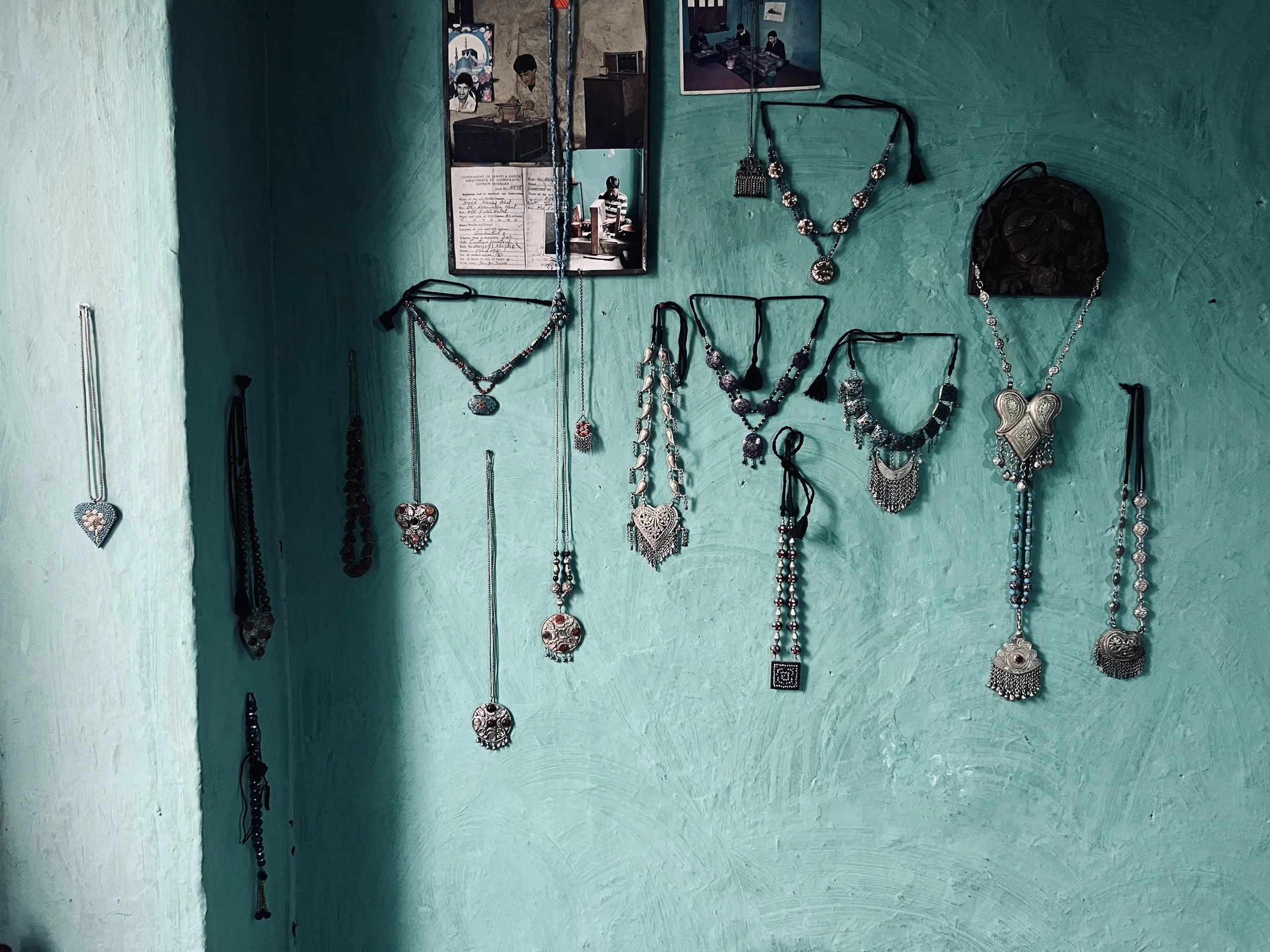
Photo: Ayat Adil
Younger designers and cultural organisations have also begun exploring ways to reintroduce traditional techniques into contemporary products. These include institutions such as the Indian National Trust for Art and Cultural Heritage, which have worked on documenting and promoting Kashmir’s craft traditions while encouraging collaborations between artisans and designers. By combining old skills with modern design sensibilities, craftsmen like Aslam and Bhat could find new markets beyond local neighbourhoods. However, this transition would require sustained institutional support, better access to exhibitions and training programmes that help artisans adapt without losing the integrity of their craft.
For many craftsmen, the hope lies in visibility. If their work can travel beyond the narrow lanes of Srinagar’s old city and reach wider national and international platforms, the crafts that once defined Kashmir’s cultural identity may still find a place in the future.
For artisans like Aslam and Bhat, the struggle is not about holding onto the past, but about securing a future for their work. As Kashmir’s craft landscape continues to change, they warn that without serious effort to support and promote handmade work, many traditions may fade away, living behind only memories of what once existed. It will require the stability of proper platforms, fair pricing, and genuine appreciation for these crafts to survive. “When a craft dies, it is not just the work that is lost,” Bhat said. “Years of knowledge, experience, and patience disappears with it.”
***
Ayat Adil is a freelance journalist and a master’s student at the AJK Mass Communication Research Centre, Jamia Millia Islamia, New Delhi. Her work focuses on society, culture, and politics, with a particular interest in stories from Kashmir and the wider South Asian region. You can find her on Instagram: @_ayatadilbhat and X: @adil_ayat1571.