Guts
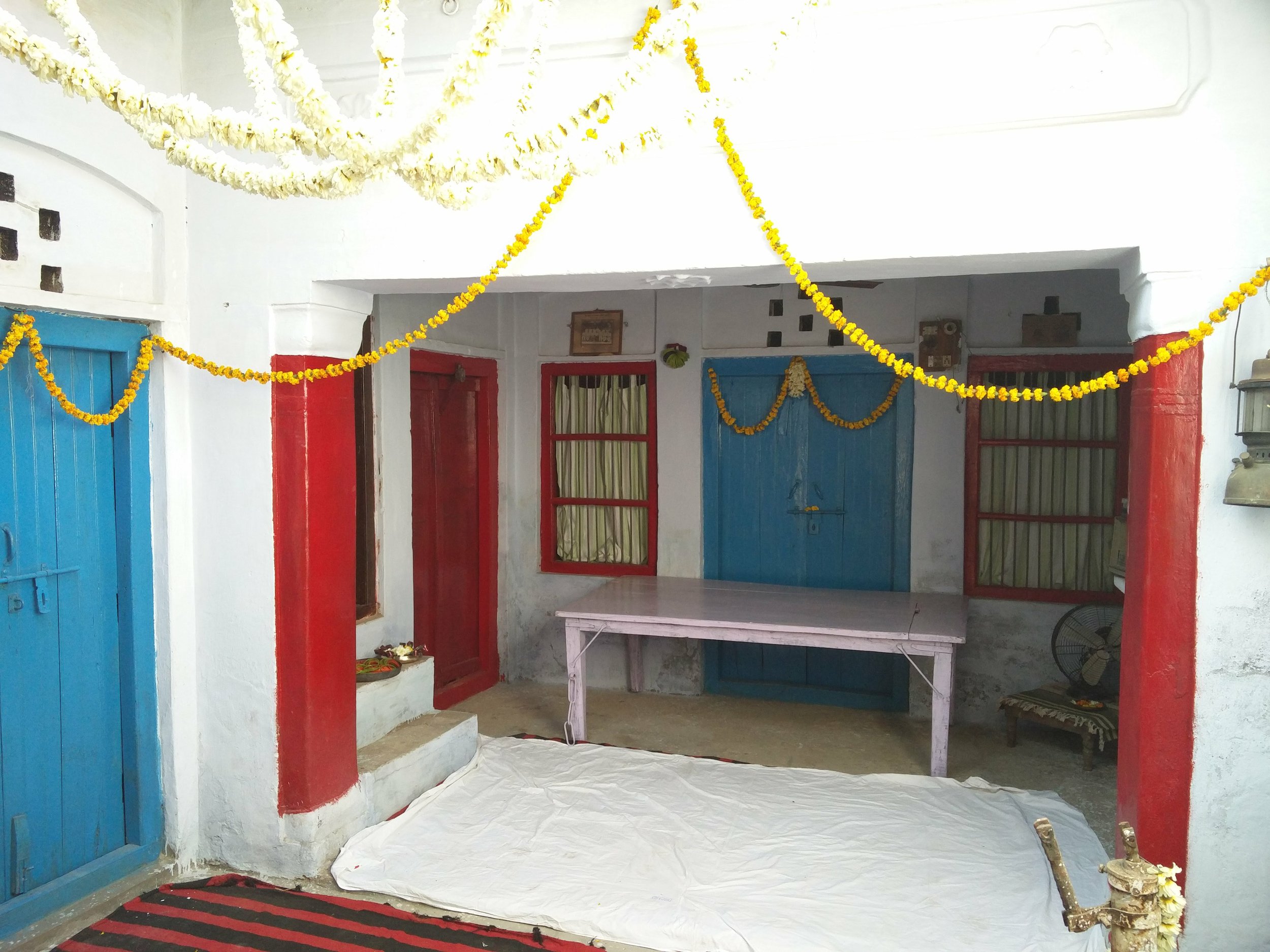
Photo: Prachi Sharma
Personal Essay: ‘My father pauses in every retelling of this tale. He wants me to see it. A man in the uniform of an Indian working for the English, in a village courtyard in the late 1920s, his face turning to one side from the force of an open palm. The villagers watching. The Daroga’s hand going to his cheek. A pigeon somewhere on the roof, taking off.’
— for my father, who remembered.
It has taken him until retirement to finally begin telling this story. It is a Sunday afternoon in October. He sits in the living room of the house in Likabali, in a quiet town in Arunachal Pradesh, in the chair near the window, the one where the light falls on his left shoulder in the morning and slips off it by 4 in the afternoon. He is in his 60s, and has the slight stoop of a man who spent his working life leaning over student notebooks.
He has asked me to write this down. He has never asked me this before.
I take out a notebook, because the laptop will make him self-conscious. This is the kind of thing I notice, and the kind of thing I do something about. When I was 17, choosing between an electronics seat at a good college and an electrical seat at a better one, I sat with the two admission letters on my desk for 11 days. But my father always reminded me to take my time.
So, I took my time. I am a person who takes her time.
Today, my father is not that person. He starts before I have opened the page.
“People in those days had guts,” he says. “Real guts. Not what we have now, where we measure every sentence twice before we let it out.”
*
My father’s grandfather—Babuji, which is what we call him, though the proper word is Pardada, and nobody uses it—was the headman of Koopa and three neighbouring villages on the road between Sadabad and Mathura. It was the time when our country still belonged to other people. Babuji’s name was Kaanaram Sharma. I have to put this down because in our family nobody says it anymore; he has been Babuji for so long that his name has gone the way of his face, into the place where unphotographed people go. He had eight sons, three daughters, thirty acres of land, and what appears to have been a complete inability to refuse anyone who asked him for anything.
If a farmer visited in the dry months and said his children were hungry, Babuji would walk him out to the back fields and point at a portion and say, Take what you need. His wife, my great-grandmother, was named Shanti, and I will use her name, because she earned it. Shanti would protest at his generosity. She would ask, You have eleven children of your own, what will be left for them? He would tell her that God provides for those who provide for others, and she would respond, God has not been to this house lately, and they would not speak for two days, and then he would give away another portion, and she would set out his food for him anyway, because that is what she had married into.
There was, in this time, a Daroga whose name my father does not give me, a big square man, an Indian, who worked for the British and behaved as the British behaved, which was the worst thing an Indian could do in those years, and the most common. The English officers and the local landlords and the Daroga ran a quiet operation of extortion that everyone in the village understood and no one spoke about.
My father says, God comes in one way or another to help true people. He says it the way Shanti must have spoken it about the land. As a settled fact, as the day’s weather.
Babuji could not stop the extortion. He was the headman, not a god. But he could do small things. He could let a villager cut timber from the forest at night and look the other way. He could let a man take feed for his cattle from the edges of the farms and not ask where it had gone. The English would ride through the village in the morning and see nothing missing, because Babuji had taught his people to take only as much as would not be noticed.
This is the part of the story I find most interesting, and I tell my father so. He nods—but he is eager to get to the slap.
*
There was, in the next village, a man who had bought a girl. My father says this without pausing, the way he says any other fact. It happened then and it still happens now in some interior parts of the north, he says, and this is true; I have read about it in the papers myself. The man brought the girl home and the village knew, the way villages always know.
The Daroga came to Koopa to investigate. He decided, for reasons my father does not bother to explain because the reasons of men like the Daroga were never the real reasons, that Babuji had arranged the whole thing—that he had taken a cut, that he had blessed it, that the headman of Koopa was a procurer of girls. The Daroga stood in the courtyard of our family house and said this in front of Babuji's people. For some time, Babuji attempted to explain. He was a patient man with patient men. But the Daroga was not a patient man, and at some point, he said something—my father does not know what; nobody who was there ever told my father what—that made the courtyard go quiet.
And then Babuji slapped him.
This is where my father pauses in every retelling of this tale. He wants me to see it. A man in the uniform of an Indian working for the English, in a village courtyard in the late 1920s, his face turning to one side from the force of an open palm. The villagers watching. The Daroga’s hand going to his cheek. A pigeon somewhere on the roof, taking off.
They arrested him, of course. They took him in a horse-cart to the jail in Mathura and the Daroga said, loudly, that he would not come out.
But Babuji had spent thirty years giving away portions of his land, and the village remembered. Babuji’s sister—my father’s bua—knew people. She walked the road to Mathura herself and used her connections. She got the message to the right man. The head official in the area was an Indian, a quiet supporter of the freedom movement, and he had heard already of the headman in Koopa who gave his fields away to the hungry. The villagers came too, in their own slow way, not as a delegation but in twos and threes through that week, vouching for him at every door they could find. Between the bua’s networks and the village’s word, the papers were signed.
Three days later, Babuji returned home.
My father says, God comes in one way or another to help true people. He says it the way Shanti must have spoken it about the land. As a settled fact, as the day’s weather.
*
He remembers a small, old woman with a brown shawl and a brass box in her lap. He remembers that the box smelled of tobacco and rosewater and something else underneath, something old, like a cupboard that had not been opened in a long time.
Babuji loved his eldest son the most. The boy’s name was Kehri, and by the time Kehri was in his 30s and had children of his own, he grew sick. My father does not know with what; in those years people simply got sick, and the doctor, who came on a bicycle from Sadabad, gave them the same brown medicine for every ailment. Kehri died in the second week of the rains. After that there was nothing left in Babuji.
He stopped eating properly. He chanted Kehri’s name in the mornings and in the evenings and sometimes through the night. His sons would go to him and say, Eat, and he would look at them as if they were strangers asking him for directions.
Within six months, he died in the same room where Kehri had died, on the same charpoy, calling out the same name.
My father is quiet for a moment.
Write it down properly, he finally says. Don’t make it sad. He was not a sad man.
*
My father’s father Kishan—my grandfather—was the second-eldest of the eight sons Babuji left behind. He was, by every account I can gather, a different kind of man entirely. Where Babuji gave things away, Kishan built things up. He was not a saint. He was a businessman, and he was the only one of the eight brothers who had any business sense at all. This was his gift—and the curse, that ruined his relationship with the rest of them.
Kishan started in his teens. He saved the money he had been granted to buy candies or kites or behave like a teenager—as my father remembers—and invested it in sheep. Four of them. He fed them and bred them and sold their milk, and sold more sheep milk, and within two years he had 11, and within four he had sold them all and opened a shop in the front room of the family house.
There was no shop in Koopa. There still is no other shop in Koopa; if you want sugar or salt or a tin of biscuits you walk the two kilometres to Sadabad. So, Kishan’s shop, which started with a sack of lentils and a tin of mustard oil and a small steel scale, grew within a year into a room that kept everything from a sewing needle to a first-aid kit, and people came to it from three villages over.
He was eighteen. The other brothers were farming, watching.
*
When Babuji died, the property was divided. In our village, this is done by a method I find difficult to describe to those who haven’t witnessed it. The youngest brother chooses first. Then the next youngest. Then the next. The eldest gets whatever no one else wanted. I have seen my own father go through this with his brothers, decades later, and I have watched him receive a stony patch of farmland and a leaking storeroom, because that was what was left.
Since Kehri was dead, Kishan was last to choose. He chose a mud house with two rooms, because his shop was already in one of them and moving it would have killed the business. He chose a strip of farmland on the far side of the village, near the dry channel. And he inherited—as a kind of bonus item that nobody else would touch—his widowed aunt.
Her name was Savita. She had been widowed at ten. Married younger than that, of course. After her husband’s death she had gone to live with her brother, Babuji, and after Babuji’s death, the eight brothers had agreed she was somebody else’s problem. Savita chewed tobacco, and had begun chewing it at some point in her long widowhood. She was past sixty by the time of the property division, which means she had been a widow for over fifty years, and the small brass box of her tobacco leaves went everywhere with her. The other brothers had no interest in the cost of keeping that box refilled.
This, in retrospect, is what I cannot get past. A girl widowed at ten, spending 50 years in the strange house of her adopted family. Tobacco, eventually, because fifty years of insult and isolation leave a mind that needs something to chew on besides itself. Until a family meeting where seven men decided she was an item to be inherited.
Kishan brought her home on a bullock cart on a cold December morning. My father, who was four at the time, remembers it. He remembers a small, old woman with a brown shawl and a brass box in her lap. He remembers that the box smelled of tobacco and rosewater and something else underneath, something old, like a cupboard that had not been opened in a long time. Kishan lifted her down from the bullock cart himself. He told her, You will live with us as long as you live, and you will never be without your tobacco. She didn’t respond. She had not been spoken to like that in fifty years, and she did not have the words ready for a response.
She spent 14 years in their home, and died in the courtyard, under the sun, with her brass box in her lap. My eighteen-year-old father was the one who closed the box after her.
*
The farmland that Kishan had been given was the farthest from any source of water, which meant he had to pay other farmers to use their tube wells. So, three years later, when his two younger brothers came to him with a proposal, he was willing to listen.
They came in the evening, after the shop had closed. My grandmother—my father’s mother, whose name was Saroj, and I will use it—brought tea on a tray. The brothers sat on the floor against the cool wall. They told him that they are building a new tube well on the eastern boundary. The land is good there, they said, and the water table is high. If you contribute, we will put your name on it as a partner.
To have your name on a well, in a village, is a kind of immortality. The well outlives the man. Children point at it and say, That one was built by so-and-so. Kishan understood this. He looked at his brothers, who were eating his wife's cardamom biscuits, and he believed them.
This was the thing about him that my father ensures that I put down. He kept believing them. After everything, he kept believing them.
He went to the iron box where he kept the shop’s earnings and he counted out four hundred and twenty rupees, which was a great deal of money in 1961. He gave it to his brothers. They left. The well was built that summer.
But his name was not on it. When he went to use the water, he was told he could wait until everyone else had finished, which in practical terms meant his crops would be dead by his turn. When the government later issued a subsidy for the well’s construction, his portion of it was kept by his brothers. He never asked for it back.
She told them she had met a man with a beard. She told them he had hit her with a wooden spatula on the back of her head and told her it was not yet her time. He had said to her: Go back, your son is still a small child.
The first time my father told me this, I asked him why Kishan did not fight them. Your grandfather, he said, was a naïve man in some ways. He understood compound interest without a calculator. He could lend money at interest and tell you to the paisa what you owed him after eleven months. But he never quite understood that his brothers were not on his side. He kept expecting them to be. This, my father said, was the one thing he never learned.
*
Saroj was fourteen when she married him. She was, by the time I knew her, a small woman with a will and a voice that could carry across two fields, and the stories about her are the stories I find I want to write down most carefully, because they are the ones my father remembers least. She kept the house. She worked the farm. She sat in the shop when Kishan went to the fields. When my father was two, and his younger brother was on the way, and Kishan decided to replace the mud house with a brick one, it was Saroj who slept in the barn with the children and Savita, while Kishan slept inside the half-built shop to guard the inventory. She slept in a barn for the better part of a year. She gave birth in that barn. The midwife came from Sadabad with a lamp.
Saroj died when my father was two. Or three. The priest came. The villagers gathered. The body was washed and laid out in the front room of the brick house Kishan had built, the one where the shop had moved to its own annex by then, and the funeral procession was about to begin, when she sat up.
She told them she had met a man with a beard. She told them he had hit her with a wooden spatula on the back of her head and told her it was not yet her time. He had said to her: Go back, your son is still a small child. She lived another forty-odd years after that, almost into her seventies.
She died in 1996, of nothing in particular, on a Tuesday, in her sleep.
I asked my father once if he believed her claim. But he said that the question was not whether to believe the claim, but what to do with it, now that it had happened, and what he had done was simply to keep it as one of the facts of his life, the way other people keep the date of their wedding. His mother had been to the other side and been sent back for him. That was all.
*
My father was born on the fifteenth of January, 1954, in the brick house Kishan had built, in the village of Koopa, on the outskirts of Agra, on a clear cold night when, as far as anyone could tell, nothing else of importance was happening anywhere in the world.
They named him Satya Prakash — Light of Truth. He was the eldest son. There had been a daughter before him, my aunt Pushpa, but in 1954 in our part of the country a daughter was a thing endured, and a son was a thing celebrated, and so when Satya came into the world the house filled with relatives and the courtyard filled with sweets and Kishan, who was not given to displays, sat down on a charpoy and did not get up for a long time.
He was, from the beginning, a child who wanted to read. This is not a small thing in a farming family in the early 60s. There were no books in the house, except what came home from school. There was no electricity in Koopa. There was a single oil lamp in the room he shared with his brother, and at night, after Saroj had brought him his food and taken away the plate, he would sit cross-legged on the floor with the lamp on a small wooden stool beside him, and he would read until the oil ran out. The lamp made a small steady sound, like breath; he learned to read inside that sound.
Kishan did not stop him. This is the thing my father wants me to understand. Kishan had been married at 14 and had buried his own father in his thirties and had taken on six brothers and a tobacco-chewing aunt and a shop and a farm and a life he had not chosen, and somewhere inside all of that he had carried, quietly, the fact that he had wanted to study and had not been able to. When his eldest son turned out to be a child who wanted to read, Kishan simply stepped out of the way. He never asked Satya to help with the farm. He never asked him to mind the shop. He let his son have the one thing he himself had been denied.
He was the kind of teacher who taught the way teachers taught a thousand years ago, before teaching was a profession—selflessly, with the simple intention that what he knew should pass to the next person, and not be lost. He still teaches like that. He has never quite understood that other teachers do not.
My father is not a man who cries easily, but he is close to it now. He says, your grandfather gave me my life. He says it twice, to make sure I write it down.
*
When Satya was fifteen, and the question of college had become a present question and not a future one, his uncle Shyamlal—Kishan’s third-younger brother, the loudest of the eight, the one whose name was on the well—came to the brick house one evening. Saroj brought tea. Shyamlal drank it without thanking her, the way he always did, and then he told Kishan that it was time to stop this nonsense about college. The shop was growing. The farm needed a younger hand. Other boys his age had been working for years. What was Kishan trying to prove?
Satya was in the next room. He could hear them through the wall. He was fifteen years old and had not yet been south of Mathura.
Kishan was quiet for a long time. My father remembers the quiet, because, he thought, in that quiet, his life was ending. He thought Kishan was working out how to agree. He thought he was about to become a boy who would mind the shop and marry at 20, and never see the Taj Mahal. He sat against the wall, with a book in his lap that he was no longer reading, and he waited for the sentence that would end him.
What Kishan finally said was this: He is not your son, Shyamlal. Don't tell me what to do with my son.
Shyamlal left without finishing his tea. He did not speak to Kishan for two years. Kishan would continue to be denied water from the well. The crops would continue to suffer.
Kishan never told Satya what it cost him. Satya only found out later, the way sons find out these things, in pieces, from his mother. He told me this part himself, only once: “I went to college on my father’s silence.”
*
Satya woke at five. He studied until eight. He walked to the village school, and came home, and studied until the sun went down, and then lit a lamp, and studied until ten. He sat with Kishan for an hour each evening and asked if there was anything he could do to help, and Kishan, every evening, said no.
Satya never rebelled against this routine; he was the kind of child for whom rebellion would have been a waste of time, time he could’ve better spent learning something.
Sometimes, I question if these stories are true. If Babuji really slapped the Daroga, or whether he only raised his hand in threat. Whether the man with the beard and the spatula was really there, or whether Saroj only dreamed him in the moments before she came back.
He became the first graduate from Koopa. There had been no second when I was a child, and I do not know that there is one now. He became a teacher, and he was the kind of teacher who taught the way teachers taught a thousand years ago, before teaching was a profession—selflessly, with the simple intention that what he knew should pass to the next person, and not be lost. He still teaches like that. He has never quite understood that other teachers do not.
*
It is evening now. My father has been talking for four hours. The light has moved off his shoulder and the room is dimmer than it was. Saroj’s photograph is on the shelf behind him. It was taken in her later years, when she is around sixty. She is looking past the camera at something to the left.
I ask him why he is telling me all of this today. Because nobody else will write it down. He says this without further drama, the way he says most things.
The villagers who walked to Mathura for Babuji are dead. The bua who used her connections is dead. Savita is dead. Saroj, who came back from the dead the first time, did not come back the second. The brothers who cheated Kishan out of the well are dead. Shyamlal is dead. Somewhere, the Daroga, presumably, is dead.
If I do not write it down, my father says, then in one more generation it will be as if none of these people had lived. The slap will not have been slapped. The well will not have been built. Savita will not have been brought home on the bullock cart. Saroj will not have sat up at her own funeral. None of it. Just a few names on a family tree, with no flesh on them.
So, I am writing it down knowing that I am not telling it the way he told it. He told it in Hindi, with English words sprinkled in for the things Hindi has no words for, and Hindi words sprinkled in for the things English has no words for. He told it sitting in a chair near a window. He told it as a man who had loved these people. I am writing it as a woman in a different city in a different decade who has loved a man who loved these people. It is a different kind of knowing, but it is only the kind of knowing I have, and it is what I have to work with.
Sometimes, I question if these stories are true. If Babuji really slapped the Daroga, or whether he only raised his hand in threat. Whether the man with the beard and the spatula was really there, or whether Saroj only dreamed him in the moments before she came back. Whether Kishan, lying in the half-built shop at night, ever once thought of what his life might have been if his brothers had loved him. I do not know. I cannot know. The people who could tell me are gone, and the one who is left is my father, and what my father has is what I have written here.
It will have to be enough.
People in those days had guts. That is how he started, four hours ago, and I think he is right. But I think also that what he means by guts is not exactly courage. I think he means that they did not wait. Babuji did not wait to weigh the consequences before he slapped the Daroga. Kishan did not wait to be sure his brothers had really cheated him before he forgave them, again and again. Saroj did not wait to be invited back from the dead; she simply sat up. The bua did not wait to be asked; she walked.
They acted out of whatever it was inside them that did not seek permission.
I, who am writing this down, am a person who does not act that way. I sat with two admission letters for eleven days, or so I have always told myself. I weighed every sentence of this. I am weighing this one.
I wrote earlier that I sat with two admission letters for eleven days. That is not entirely true. I chose in five minutes, at the allocation desk, before I had time to think. My father asked, Are you sure. I said Yes. I have been telling myself the eleven-day version for so long that I forgot. When it mattered, I did not wait either.
***
Prachi Sharma is the founder of The Sapling Press, a cross-continental children's publishing imprint where every author is a kid. A tech engineer alongside her publishing work, she writes about grief, memory, and family. Her work has appeared in KQED, IndiaWest, India Currents, MyndStories, and others. You can find her on Instagram: @prachisharma_1509 and @thesaplingpress.