First Snow
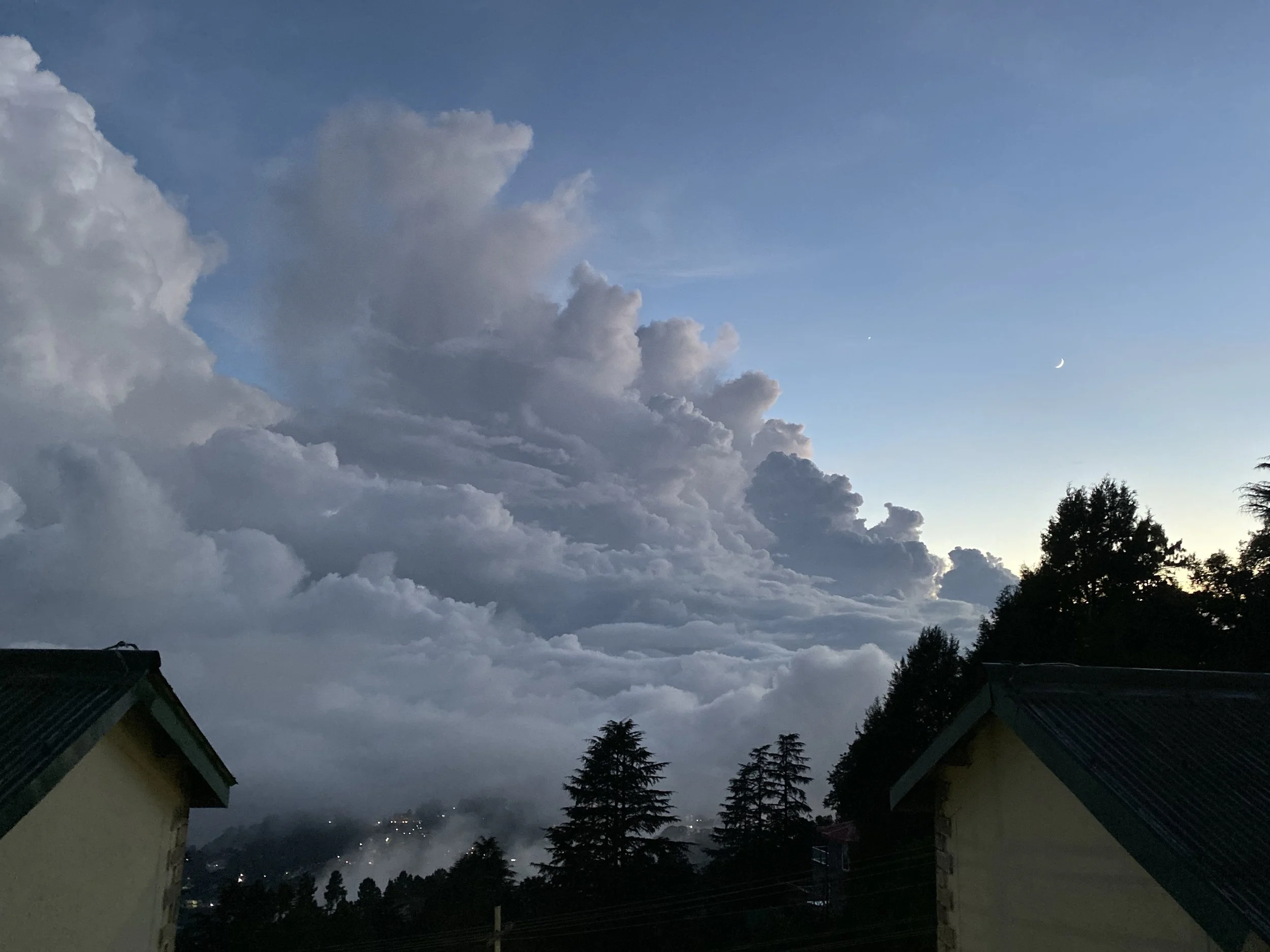
Photo: Karan Madhok
Short story: “Now, Lady, Miss: Please take the flowers and lean into your husband, like this, as if you are falling into him. Just a little. That’s why in English they say, ‘falling’ in love, no? Bas, gir jao unpar!”
The photographer said that he wanted to start the shoot with a “natural pose”. Dilip wasted no time in putting an arm over Aradhna’s shoulders to pull her closer into him. He beamed a teethy smile, a smile that Aradhna thought he could produce seemingly on command.
But Aradhna was confused. What could possibly qualify as ‘natural’? Earlier that morning, she had been seated on the passenger seat of the Innova beside Dilip, staring out the window at the smoky countryside after a departure at dawn from Delhi, hardly able to wipe a tired frown off her face. Was that her natural state?
Or was it the mischievous energy she was consumed with after their coffee stop? As Dilip drove up the wavy mountain roads, she had leaned over and softly nibbled on his earlobe, shrieking with laughter when he asked her not to distract him. He had pointed at the Flying Hanuman pendant that hung over the rear-view mirror. “Not in front of Bajrang Bali.”
Or was she her natural self now, a staid expression after being slightly-inconvenienced by the photographer’s request, shivering on this cold afternoon after a sudden drop of mercury in the mountains? Her only solace was her fiancé’s tight embrace, which he offered generously, as if he had unlimited reserves of body heat to spare.
“Lady,” the photographer looked up from the camera and gestured a few pleading fingers up to her. “Smile please, Lady. Natural pose.” He was only a few feet away, but had to shout at her over the steady stream of tourists that blitzed past in their scooters and cars.
The photographer had introduced himself as FD—“because my customers call me Fixed Deposit”—and asked them to meet outside the gates of an old protestant church near a famous row of dhabas on a popular walking path called ‘The Aath’. Aradhna had done her research already, learning from her favourite travel vloggers that this path went round and round across two circles in an eight-shape, or like a pair of spectacles. The church was painted in a nitid, cream colour, with a triangle-shaped façade inside a lawn beside the path.
FD clicked the photos and then looked up again. “Okay, let’s do the next pose,” he announced, speaking in a staccato, impatient Hindi. He was a tall, lean man, who moved with a lithe grace, so that it almost seemed to Aradhna that he had no backbone, no joints, just a slender form floating through the thin mountain air. He reached to the cardboard box of outfits he had brought along for the photoshoot. “Next set are the Garhwali costumes.”
Dilip was again quick to react. He pulled out a long, black velvety kurta, with a yellowish pattern stitched diagonally from his shoulder down to its bottom tresses. FD helped Dilip with the leather waist belt and handed him a wooden facsimile of a rifle, which Dilip swung lightly from one hand to the next. “Yeh hui na baat,” he said. Now we’re talking.
“Why does a Garhwali man need to carry a gun?” Aradhana asked.
“Lady, he is a pretending to be a daku,” FD said. “He’s a dacoit who will kidnap the village girl. That’s you. The sunlight is good right now, so we should take all our photos as quickly as possible.” FD pulled out another black costume, a pre-stitched lehenga-choli set, with similar yellow patterns across the waist and the hems of the lehenga. Aradhna’s prop was a clay water pot.
“So, in this scenario, he kidnaps me while I go out to get water,” Aradhna asked as she put the dress over her head “and then we are supposed to fall in love?”
“So many questions, Babe,” Dilip slithered closer to Aradhna and lowered his voice. “You look sexy like a village girl.” He reached over behind her and pressed the muzzle of the fake gun against Aradhna’s dress, over her butt.
“Ayyo!” she exclaimed, and then glared at him with the reluctant arcs of a smile.
Dilip grinned back; he knew that a part of her enjoyed this thrill; she would be excited, too, to be finally out on holiday together, their first overnight trip, just days before they were to be formally wed. He felt it in every little brush of their gloved fingers against each other, every cold hug, every toy rifle poked against her dress. It was all the final stages of their months’ long foreplay. He knew this in the way she kissed him now, more tongue, more open mouth, more saliva, in the way she exhaled warm breath down his neck. He knew that the time was near, that she had thought about this night as much as he had.
“Okay,” Dilip announced to FD, “The Garhwali gangster is ready. Where’s my Basanti?”
Aradhna picked up the pot and placed it under the crook of her arm. Dilip put his forearm around her neck and held the gun with the other hand, its muzzle pointed directly into the camera.
Click. Click.
“Very good,” FD said. “You are a beautiful husband-wife. So many people come up here for their honeymoon.”
It was all the final stages of their months’ long foreplay. He knew this in the way she kissed him now, more tongue, more open mouth, more saliva, in the way she exhaled warm breath down his neck. He knew that the time was near, that she had thought about this night as much as he had.
Dilip smiled and looked at Aradhna, and then back at the photographer. “It’s not our honeymoon.”
“It’s not?”
“It is a… what do we call it?”
“Premoon,” Aradhna said.
“Premoon. I have some important work after our wedding, so we thought…”
“We thought to come see the snowfall here, and have a premoon,” Aradhna finished for him.
FD nodded. “Good, good, very good. Haan, it’s supposed to snow anytime now. Good you came. The photoshoot is important, that’s all. No big difference if you do it before or after the wedding.”
Dilip and Aradhna took off their costumes “Dikshaon!” Dilip brandished the gun in the air one last time, pointing at a langur ambling lazily on an oak tree above them.
There was one more set left. “Please come here, by the church gate. Christian pose.” He led Dilip and Aradhna to the black, metal gate and railings that enclosed the church building and the grassy lawn that surrounded it. Dilip moved to the stone steps outside the gate. Aradhna followed slowly behind.
From his box of props, FD now handed Dilip and Aradhna new outfits: for Dilip, a black dinner jacket to wear over his sweater, along with a clip-on necktie; for Aradhna, a sleeveless white wedding gown, which, he instructed, she would have to change into in the church bathroom. “This is the most popular lady’s costume!” FD said.
Aradhna walked past several small groups of other tourists scattered around the church lawn. In the toilet cubicle, she stripped out of her jacket and sweater and T-shirt, and threw on the white dress—the ‘Christian dress’—over her head. She had seen portraits of her parents’ wedding, of course, with her mother in a white gown at a church in Agra. Growing up, Aradhna had attended so many weddings of her elder cousins and aunts, astounded as they walked down the aisle to their awaiting grooms, running her hands over their puffy shoulder pads, playing with the veils that covered their faces. She knew that her mother would be overjoyed to see pictures of her in the white dress, too—even if it was only for the photographs.
Soon, Aradhna would be covering herself by a different veil; her wedding to Dilip was less than a week away, and her future mother-in-law had already gotten her fitted into a bright, orange lehenga. She had been gifted a new set of gold bangles, gold earrings, and a choker. “Anything for our perfect dulhan,” Dilip’s mother had said.
Dilip’s family had insisted to take responsibility for all of the wedding’s expenses—which also meant that the ceremony would be conducted as per their customs. Despite Aradhna and Dilip’s early apprehensions, their respective parents had needed little convincing to accede to their interfaith union. Both were the first of their families in recorded memory to choose their own marriage partners, without any intervention from their elders. For Aradhna, there had been no need to advertise for suitable grooms in the Sunday newspapers, no hunt for boys who were also members of the Church of North India.
There had been no need for Aradhna’s father to reveal his salary to anyone; although, when he first met Dilip’s father, he inevitably squirmed at the big “What do you do for a living” question?
“I drive a car,” Aradhna’s father had said, and avoided further eye contact before adding, “for someone. My employer’s car.”
“Oh?” Dilip’s father had nodded. He was a short, stout man, but stood with his chest proudly protruding forward, as if he towered over everyone else in the room. “You’re a driver? That’s… that’s a noble job, too. You help keep so many people safe.”
“Yes, yes,” Aradhna’s father had replied. “And my employer is a very big man. He works with the United Nations. My wife works for him, too. He tells us that this his family has lived all around the world, but they have never tasted anything like her paneer lababdar.” He reached over with a glint of pride towards Aradhna’s mother, who blushed at the compliment.
“And our daughter can cook a little, too,” Aradhna’s mother added.
Dilip’s mother walked into the room carrying a tray with six cups of chai and a plateful of hot, oleaginous pakoras. “Fresh from the frier. Have, have. We’re all family now, there’s no need for formalities,” she instructed. Like her husband and Dilip, she, too, spoke in Delhi’s very own dialect, a Hindi flavoured with Punjabi musicality. “So, you like to cook?” she asked Aradhna’s mother. “That is really wonderful. And the fact that you can turn a hobby into work. Just wonderful.”
Aradhna’s mother smiled and took a tepid sip. “Oh, it’s nothing like that, ji. Don’t we all have to cook? And the job is whatever our boss asks us to do. Cooking, cleaning, watching the kids...”
Both were the first of their families to choose their own marriage partners, without any intervention from their elders. For Aradhna, there had been no need to advertise for suitable grooms in the Sunday newspapers, no hunt for boys who were also members of the Church of North India.
“Uh, huh,” Dilip’s mother said, and Aradhna saw her give Dilip’s father a silent, understanding glance. “Good, good.”
Dilip’s father coughed and interjected. “And our daughter, Aradhna—she’s also our daughter now, isn’t she?—she speaks such good English! Dilip showed us her Reels. Did you send her to a convent?”
Aradhna’s parents smiled. “Yes, yes, ji,” her mother said. “We are humble people. But a good education is important, isn’t it?”
On their way home later that evening—the three of them tripling on Aradhna’s father’s motorcycle—Aradhna’s mother quipped that the pakoras had been delicious, but far too spicy. “These Punjabis can’t help themselves,” she sniggered.
“Well,” Aradhna’s father gestured to Aradhna in the middle, “Our daughter is about to become a spicy-pakora Punjabi, too.”
“And what’s wrong with spicy pakoras?” Aradhna asked.
Aradhna’s mother rebalanced herself on her seat. “She’s right,” she said. “It’s okay, no? At least they aren’t Muslims.”
Aradhna ignored her mother. But religion was bound to be on their mind, with each pressing reminder of the wedding. Over the next few weeks, Dilip’s mother had taken Aradhna to meet astrologers who demanded to see her birth certificate, and vaidyas who suggested the best deep-breathing techniques to help her bear a son. She giggled, embarrassed in front of her future mother-in-law. “Not yet, Auntie,” she had said.
“‘Auntie’ nahi. You can call me ‘Ma’, now.”
And about two months before the wedding, Dilip’s mother gifted Aradhna the orange-and-gold lehenga, which she watched Aradhna try besides the tailor. “You will just be glowing in this,” Dilip’s mother had said. Aradhna saw herself in the mirror, and she agreed: the lehenga was, indeed, the most-striking she had ever worn, with an intricate design of turquoise blue flames firing across the orange pattern, and the brighter glow of gilded gold by its borders.
There was no gold on the white dress that Aradhna slipped over herself in the church toilet. But, even if they weren’t having a Christian ceremony, Aradhna knew that Dilip would briefly see her at their premoon photoshoot as she had seen so many brides growing up: in a facsimile of a white wedding gown, a woman in a church ready to say her I dos.
Dilip’s ‘Christian’ costume cost him little hassle. He put on the dinner jacket, and clipped on the tie. “How do I look?” he asked FD.
“Smart. Total James Bond.”
Dilip looked up to see Aradhna walking out of the church gates, wearing a sleeveless dress that stretched down to her ankles, the type he had seen women wear on American TV sitcoms. He suddenly imagined the awwww of the live-studio audience at the first reveal of the bride, and he understood that he was meant to be moonstruck.
“You look so beautiful,” he whispered when she reached closer.
Aradhna rubbed her bare upper arms. “It’s too cold for this.”
FD seemed to have sensed her discomfort. “Chalo, chalo, let’s do these ones quickly, no? It could snow any minute. Now, Lady, Miss: Please take the flowers and lean into your husband, like this, as if you are falling into him. Just a little. That’s why in English they say, ‘falling’ in love, no? Bas, gir jao unpar!”
The flowers were fake, a bouquet of multicoloured plastic roses. Falling, Aradhna smirked to herself, but felt too cold to argue any further. She lifted one foot and leaned with her shoulders into her fiancé. Dilip looked nice in this jacket, she thought. She was sure that he had a real suit at home. Many real suits, perhaps. She knew that she was marrying into a rich family, a family that, in her father’s words, was far above their own aukaat. “Our status is nothing like theirs,” he had said. But she had decided long ago to not think of these status differences: whose aukaat was what and all that.
As they posed for the final set of photos, Dilip hugged her closer and took a whiff of those imaginary flowers. He laughed out loud enough to make Aradhna giggle, too, and she knew she had made the right decision, that he was the man she could grow old with.
She was sure that he had a real suit at home. Many real suits, perhaps. She knew that she was marrying into a rich family, a family that, in her father’s words, was far above their own aukaat. “Our status is nothing like theirs,” he had said.
“Okay, smile please? Lady, just give a little smile, no?”
Aradhna turned to Dilip and muttered softly, in English, “Has he ever tried holding a smile for so long?”
A few more commuters passed by on scooters, many slowing down to stare at Dilip and Aradhna in their outfits. Dilip was suddenly aware of being observed, of the men on the motorcycles who would look at his fiancé’s slim shape in the white dress. They would hear her speak in English and take a second, curious look back at her.
Dilip remembered that, after Aradhna and her parents had visited for pakoras, his mother had privately marvelled again at about how educated their new bahu seemed to be. “Chalo, it will be nice to have a daughter-in-law who went to a convent,” she had said to Dilip. “Maybe you’ll learn a little English, too. And then our grandchildren will be sharp like her.”
“Why are we talking about grandchildren, Ma?” Dilip had asked.
Dilip’s father, who at that moment was reclined comfortably on the sofa, chimed over the sounds of the steaming rice cooker, “And are you going to give my grandchildren these church names, too? What is her father called? Paul? You’re going to have a baby and call him Ball, Shawl, Doll, also?”
“It’s a name, Papa,” Dilip snapped. “What kind of name is ‘Dilip’?”
His father snorted. “Just make sure they are not teaching you too much Jesus Mary Joseph, do you understand?” He coughed, and waited for the next ring from the rice cooker. “Well, at least he’s a Paul and not a Parvez, huh?”
Dilip didn’t respond. He had learned to ignore his father’s quips; his parents had been surprisingly unnerved when he’d told them that he wanted to marry a Christian. Why fight the little battles when the war was won?
Outside the church, Dilip tugged Aradhna in for a closer hug.
“Sir,” FD called again. “Look here, Sir. Smile please. Last photo.”
They smiled. Click.
*
Afterwards, Dilip and Aradhna at bun-omelettes at a small dhaba nearby, the first in a row of four little shops around The Aath. A half-dozen small tables were laid out outside the dhabas, each packed with tourists like Dilip and Aradhna, many of whom—Dilip assumed—had left the warmer plains for this hill station, perhaps also desperate to catch the sight of a snowfall for the first time in their lives. There were other young couples, and families that brought along toddlers snuggled into warm beanies and mufflers, and groups of young men whom Dilip caught high-fiving each other over the hilarity of a shared video on their phone. Dilip asked the proprietor of the dhaba about the weather. “It will snow, soon,” said the older man as he whisked eggs by the stove nearby. “Just keep a lookout.”
On the table to Dilip’s left, a woman sat alone, her nose deep into a book, and a porcelain cup of chai in front of her. Dilip watched her from the side of his eye: she was perhaps in her late-40s, dressed in a denim blue jacket. She had wheatish-brown skin and her black, shoulder-length hair was coloured with conspicuous streaks of purple.
The woman lifted her eyes from the book, and Aradhna jumped on the opportunity. “Hello.” She spoke in English. “It is so nice to see someone reading here. Everyone else is only busy on their Instagrams.”
The woman looked up. “I’m a little too old for all that,” she said with a wry smile, and closed her paperback. They introduced themselves to each other. The woman’s name was Roshni. “Is this your first time here?” she asked.
She had a deep voice, and spoke in an English that gushed fluently out of her tongue, as if she hardly needed to translate it in her mind before she spoke. Dilip assumed by her accent that she was an Indian raised somewhere abroad.
“Yes,” said Aradhna. “And you?”
“I work for an NGO down in the valley. Just a few hours’ drive—so I visit The Aath for Bhaskar Uncle’s chai often. The mountain air is something special, isn’t it?”
He had never been able to visualize Aradhna naked, with her eyes rolled up in ecstasy under him, over him, besides him. It felt too dirty, he thought, too disrespectful to sully her even in his imagination.
“You come here alone?”
“I’m all alone,” Roshni smiled.
Dilip rolled his eyes and looked away. The sun was beginning to set, turning the blinding white sky into a mesmerizing orange shade. He wished for the night to fall quicker, to walk back to their homestay. He wished he could finally share a bed with Aradhna, get under the same blanket, turn off the light, and in the freezing cold, pull her closer into himself.
He could hardly imagine any further. Dilip had fantasized about his first sexual experience for months. And yet, he had never been able to visualize Aradhna naked, with her eyes rolled up in ecstasy under him, over him, besides him. It felt too dirty, he thought, too disrespectful to sully her even in his imagination. There were enough nameless women on the internet to fill in the space: blue-eyed blondes whom he could forget the moment he relieved himself. With Aradhna, however, he knew it would be different. The anticipation was something new, a feeling he still could barely comprehend beyond its contours, like when a weak internet connection left the photos on his phone in blurry infancy.
He could hardly believe that his first time would be before he got married—even if it was by just a few days.
Dilip finished his bun-omelette, but Aradhna ate slowly, continuing to talk to the woman. He knew that this was typical of her: she could hardly help conversing with anyone of the English-educated class, anyone holding a book, or speaking in a foreign accent. She was always the first to volunteer directions to lost white-skinned tourists in Old Delhi. She would adopt their accents in echolalia and then ask them a hundred more questions, as if to display that she, too, knew the big words.
Even the first time he had seen her, Aradhna had held a heavy book in her head, pressed close to her hooked, aquiline nose, as she grabbed on to handle above her to keep balance on the rapidly-swaying Magenta Line train. It was evening, and a bustling new crowd jumped on board, pushing Dilip closer to her, so close that he inadvertently nudged her book out of her grip. She caught it in time, and Dilip apologized. He looked at the cover and attempted to pronounce the author’s twisty, foreign name.
“He’s Russian,” Aradhna told him.
“You know Russian?”
“Oh, no no. Look,” she flipped through the pages, “it’s translated to English.”
“What a big fat book. I wouldn’t need to go gymming if I carried this around. You read this for fun?”
“Yes…” she smiled “… but it’s not always fun.”
After an exodus of passengers at the next stop, Dilip asked her what she did for a living, and Aradhna replied that she was a phone banker. “You must speak really good English, then, no?” Dilip had asked. “Maine toh bas Hindi Medium se kaam chalaya hai.” He told her that the only reading he ever did were the subtitles during superhero films. She laughed. He liked the twinkle in her eye when she talked about her job, and the confidence in her stance, as if she was unbothered by the masses of men hoarded inside the train around her.
He had introduced himself with his full name, “Dilip Chandok.” He had boasted that he usually drove his car home from work, that he was only on the metro today to avoid the rush-hour traffic, that he was an excellent driver—the best drunk-driver, in fact, among his group of friends. Then, he immediately laughed out loud, amused by his own outrageousness.
Before she exited at the next stop, Dilip asked for her Instagram profile. He found her pretty, but waited show her photo to his friends. “She’s a little dark,” he told them, almost a week later, “but still beautiful, no?”
When she reached home after that first meeting, Aradhna felt a little unusual, too: she’d learned from years of experience growing up in this city to avoid conversation with men like him, men who carried themselves with the self-assuredness that the world somehow revolved around them. He could lose a little weight, too, she thought. But she had loved the carefree spark in his voice. She felt like pinching those chubby cheeks when he laughed.
They met for chai the following week, and then for a movie the week after. When she insisted to pay for the popcorn and Coke combo, Dilip told her that he admired that she made her own money. When Dilip cancelled a date the following week to take his aunt for an X-ray, he messaged an apology, to which Aradhna responded that it was always important to put family first.
She didn’t meet his family until months later. She learned that Dilip’s father ran a business of the manufacture and wholesale of woollen goods. Now, Dilip followed his father every day to the factory, too, speaking to managers and distributors, wrapping scarves around his neck, testing the hardiness of gloves over his fingers.
In the cold of the mountains, Aradhna was draped in those wholesale woollens, too: socks, beanies, gloves, scarves. “These are all from his factory,” Aradhna told Roshni at the dhaba. They turned to Dilip, but he was lost in the glow of his screen, scrolling up, and up, and up again, until a small smile formed over his otherwise lifeless face.
“So, when are you two getting married?” Roshni asked.
Aradhna rubbed her gloved palms together. “In three days.”
“So soon! Are you excited?”
“Who wouldn’t be?” Aradhna said. “Well, the proper shaadi is in three days, but there will be so much before that. Mehendi, cocktail… And Dilip’s family is having a kirtan tomorrow.”
“That sounds exhausting. I just couldn’t do it. Seems like too much work just to make your parents happy.”
Aradhna pursed her lips in confusion. “No, no… This is our shaadi! What work do we have to do? Just sit there and enjoy. Isn’t that so?”
“Good for you.” Roshni finished her chai, tucked her book under her arm, and stood up. “It was good to meet you,” she said, and then added with a wink. “Maybe you’ll pop out an egg crate of children by your next trip here!”
Aradhna laughed back with a surprised shriek. “Children?” She turned to see Dilip’s reaction, but he didn’t look up from his phone.
*
The room at their homestay was heated, but the attached bathroom sent shivers down Aradhna’s body. It had gotten dramatically colder after sunset; and yet, no snow. She had been confident about the weather predictions, but now, with plans to drive back to Delhi the next morning, she wondered if they would catch the snow in time.
She clattered her teeth and slipped into the new grey, satin nighty she’d purchased for this night. The dress was sleeveless with thin shoulder straps, and a deep cut into her cleavage. The hemline ended far above her knees, with a thin pattern of frills hugging her around her thighs. She looked in the mirror, at her body in the way that Dilip would soon see it: the bruise on her left kneecap, the moles and rashes on the side of her neck. She lifted her feet to look at the flaky, dry skin on her bare soles. Her cross—the silvery-metal pendant, tied to a silvery-metal chain—fell down her neck, settling into the valley of her cleavage. Aradhna took it off and folded it into her toiletries pouch in the bathroom. It wouldn’t be appropriate to have it hanging so close between them tonight.
The nightie had come in a set, with a grey, satin robe, which Aradhna put on, covering her arms and legs almost down to her ankles. She jacketed it close over her torso, smiled to herself in the mirror, and went back to the bedroom.
It was warmer in here. Dark, except for a small lamp by Dilip’s bedside. He sat under the covers in a lime-green T-shirt, staring into his phone. He had brought a bottle of whiskey from Delhi and was now sipping it neat from a glass on the bedside table. A light, grizzly beard had grown around his cheeks. She imagined how the stubble would scratch her face when she kissed him.
“Hi,” she said.
“I just got the photographs,” he looked up at her nighty. “Oh—you changed.”
Aradhna smiled and sat by the foot of the bed. “I bought it online,” she said, her hands fiddling with the centre front of her robe. “Better than going to the shop where the uncles are always staring at you.”
When she folded her legs in, Dilip’s eyes fell to her bare knees, to her dusky brown skin. He imagined following the brown glow up her thighs, down her waist, around her breasts.
“Did they come out well?” Aradhna asked.
“What?”
“The photos.”
“Oh yes. Most of them.”
It had gotten dramatically colder after sunset; and yet, no snow. She had been confident about the weather predictions, but now, with plans to drive back to Delhi the next morning, she wondered if they would catch the snow in time.
Aradhna leapt closer to Dilip on the bed, and he turned his phone screen towards her. She flicked through the attached photographs, pursing her lips as she studied each one. She looked the ‘natural pose’, where they both had managed to hold warm smiles as they stared at each other. The Garhwali pose made her laugh, where Dilip pointed the fake gun at the camera, and Aradhna held her mouth agape in mock-horror.
Dilip reached over and kissed her on her neck, and then moved his mouth towards the mole on her collarbone. He knew that she could smell the whiskey on his breath, but the last time he had given her a tipsy kiss—at a trendy Japanese bar in Vasant Vihar—she’d told him she liked the scent.
“Get inside the blanket,” he said. “It’s cold.”
“What happened here?” She turned the screen to him to show their final, Christian pose, where Dilip looked goofily at the camera in his suit, but half of Aradhna’s frame was blocked by the body of another man walking uphill in the opposite direction. They could only see this man’s back turned towards the camera. He carried a backpack and had his head slouched down, deep in meditative thought.
“Oh, yes,” Dilip sighed. “FD told me that this one had a photobomb. That’s what they call when a wrong person comes in your photo. A bomb.”
“I know what a photobomb is, Dilip. Didn’t he send you any other photos?”
“He just emailed me these, and apologized for the bomb.”
“So, call him and ask.” Aradhna shifted away from him. “You’ve been sitting on your phone this whole time and you didn’t ask him?”
“It’s late now, Babe. I’ll call tomorrow morning.”
“We’re leaving tomorrow morning. You have your ceremony tomorrow.”
“Kirtan.”
“Yes. Call him now, so we can it reshoot it. And what if it begins to snow?”
Dilip put his phone down. “You want to do another photoshoot? In the snow?”
“It will be pretty, no?”
“Didn’t you see the video from Manali? It snowed so much that all the cars got stuck in traffic for five, six hours. Thousands of cars.”
“We have to try.” Aradhna stood up off the bed and closed the robe tighter around herself.
“We have some good photos already yaar…”
“Not all of them.”
Dilip took a deep breath and reached over for another sip of his drink. The strong, bitter taste soothed him. They were together tonight, he reminded himself. They were alone, and together.
“Oh, yes,” Dilip sighed. “FD told me that this one had a photobomb. That’s what they call when a wrong person comes in your photo. A bomb.”
Now, there was a new silence in the room, a silence that seemed to itch into Aradhna’s skin. With her back to Dilip, she took off her robe. Dilip caught a glimpse of her bare back, her neck, her shoulders, and the thin straps of her nighty, before she slipped under the blanket.
Aradhna rubbed the insides of her knees together. Now, all she wore was that nighty and her underwear. She wondered if, under the covers, he had changed into his sleeping shorts, too. She knew that he was just an arm’s length away. Suddenly, she ached for his touch. She shuffled her shoulders, hoping that he’d creep up closer, that he’d put an arm over her, and then press himself against her back.
“Why are you annoyed about this little thing?” Dilip asked.
She tutted. “You are on your phone all day—and can’t make a little call to that fraud photographer.”
“Phone all day? What do you mean?”
Aradhna turned around to face him.
“At the dhaba, when that auntie with the purple hair was talking to us, you couldn’t even look up.”
“Babe…” Dilip clicked his tongue. “You… You just want to talk to these hi-fi people all the time. What can I say? I’ll tell her about my woollens? What business do I have with your conversations?”
“We’re getting married. Your business is my business.”
“Aradhna…” Dilip softened his voice and moved a little closer. He wanted to feel her breath pacing up, close against his face. “Why are we fighting tonight. Tonight, you know, it’s our night… We didn’t come here to argue, did we?”
“No. We came here to see the snow.”
Dilip shook his head. “So, the weather is my fault, too?”
Aradhna turned away again, placed her phone on the bedside table, and closed her eyes. She attempted to steady her breath and keep her body still, even as she could feel her heart palpitating. Dilip was right there, she reminded herself, separated only by the demarcation of the folds of the blanket. His lips, his cheek, his chest, his shorts, his warmth.
She heard him waddle out of bed, heard the clinking of glass, a pouring of whiskey, a sip, a smack, a gulp.
Aradhna gulped, too, and took a deep breath. She reached a hand over to clutch the pendant around her neck, but only felt her bare, cold skin. Sleep now, she told herself. They would be married by the end of the week. There will be many more nights.
*
It didn’t snow the next morning, although the temperature dropped considerably as Aradhna and Dilip waited by the church. FD had answered Dilip’s morning call, and when he arrived, he substituted the previous day’s banter for a formal, professional approach. Once again, he brought them their church outfits. Aradhna took photos of herself in the white dress in the church toilet, before heading out for the photoshoot. FD didn’t repeat his instructions to the young couple, and they changed out of the outfits a few minutes later.
Before he left, Dilip shook FD’s hand and offered a contrite apology for waking him so early. “She had insisted,” he said.
“You better get used to that, Bhaisahib,” FD said. “After the marriage…” He let the rest of his words wisp away in the air.
She attempted to steady her breath and keep her body still, even as she could feel her heart palpitating. Dilip was right there, she reminded herself, separated only by the demarcation of the folds of the blanket. His lips, his cheek, his chest, his shorts, his warmth.
The fog cleared up as Dilip drove down the winding mountain road, their Innova rapidly rushing toward lower elevation. Aradhna swiped through the morning’s photos that FD had forwarded them, while Dilip talked to her about the kirtan, which would be celebrated only among the groom’s family. He was determined to continue in English this morning—in Aradhna’s convent language. “Is your family going to have any Christian ceremony too…?”
“No, nothing today.”
“So, I’ll drop you home, and then… see you at the cocktail party tomorrow?”
“Yes.”
“And in two days, Babe—we’ll be married!” Dilip reached a hand over to squeeze her shoulder, over her sweater. Aradhna sat frozen, but the touch brought Dilip back to a snap-shot of the night before: of her grey nighty, of her bare neck and shoulders, of the brief sight of her unrobed.
Aradhna kept her eyes on her phone, satisfied with how she looked in the new photographs, wearing a practiced smile in the white gown. In the photograph outside the church, the caliginous morning mist had added a charming sense of mystique to the world around them, clouding over any other people, vehicles, or trees in the periphery. They had been alone, together.
Then, she scrolled to the selfies she’d taken in the toilet that morning, wearing the white dress. She had set the camera down at herself from different angles, holding expressions of varying degrees, narrowing and widening her eyes, offering her purse-thin lips to the camera. She zoomed into one where she held, a small, seductive smile, and edited it with a black-and-white filter.
She realised that she hadn’t posted anything new on her Instagram page during this trip. In her Notes app, a caption lay unused for the video she had imagined in the bliss of playing in the snow for the first time.
Dilip had read her mind. “Too bad we didn’t get to see the snow, no?” he said. “But this is just a few hours’ drive from Delhi. Maybe we can come back next year.”
“Uh huh.”
Dilip glanced over to see Aradhna’s phone screens, and her photos in the Christian dress.
“You looked really good in that,” he said, turning his eyes back on the road.
“Hmm.”
“But you’ll look even lovelier in the wedding lehenga… Ma told me about it… And all that jewellery.” He reached over and gave Aradhna a peck on the side of her forehead. “Meri perfect dulhan.”
Dilip waited for a response, but Aradhna remained silent. He opened his mouth to speak again, but quickly choked his words back. Theek hai, he thought, silence, it is. He felt his ears pop as the car made its descent, like the feeling of sitting on an airplane as it rapidly plunged down to Earth. When the car hit a bump on the road, he watched the Hanuman ornament swing and flop under the rear-view mirror.
They touched the valley an hour later, where it was warmer, and Aradhna relaxed when she felt a beam of the sun slant through the car window to brighten up the side of her face. From down here, she could see the mountain town she’d left behind, now standing small and secluded, a lifetime away.
***
Karan Madhok is a writer, journalist, and editor of The Chakkar. He is the author of MONKEY! (2026), Ananda: An Exploration of Cannabis In India (2024) and A Beautiful Decay (2022), all published by the Aleph Book Company. His work has appeared in Epiphany, Sycamore Review, Gargoyle, Fifty Two, Scroll, The Plank, The Caravan, the anthology A Case of Indian Marvels (Aleph Book Company) and The Yearbook of Indian Poetry in English 2022 (Hawakal). You can find him on X: @karanmadhok1 and Instagram: @karanmadhok.