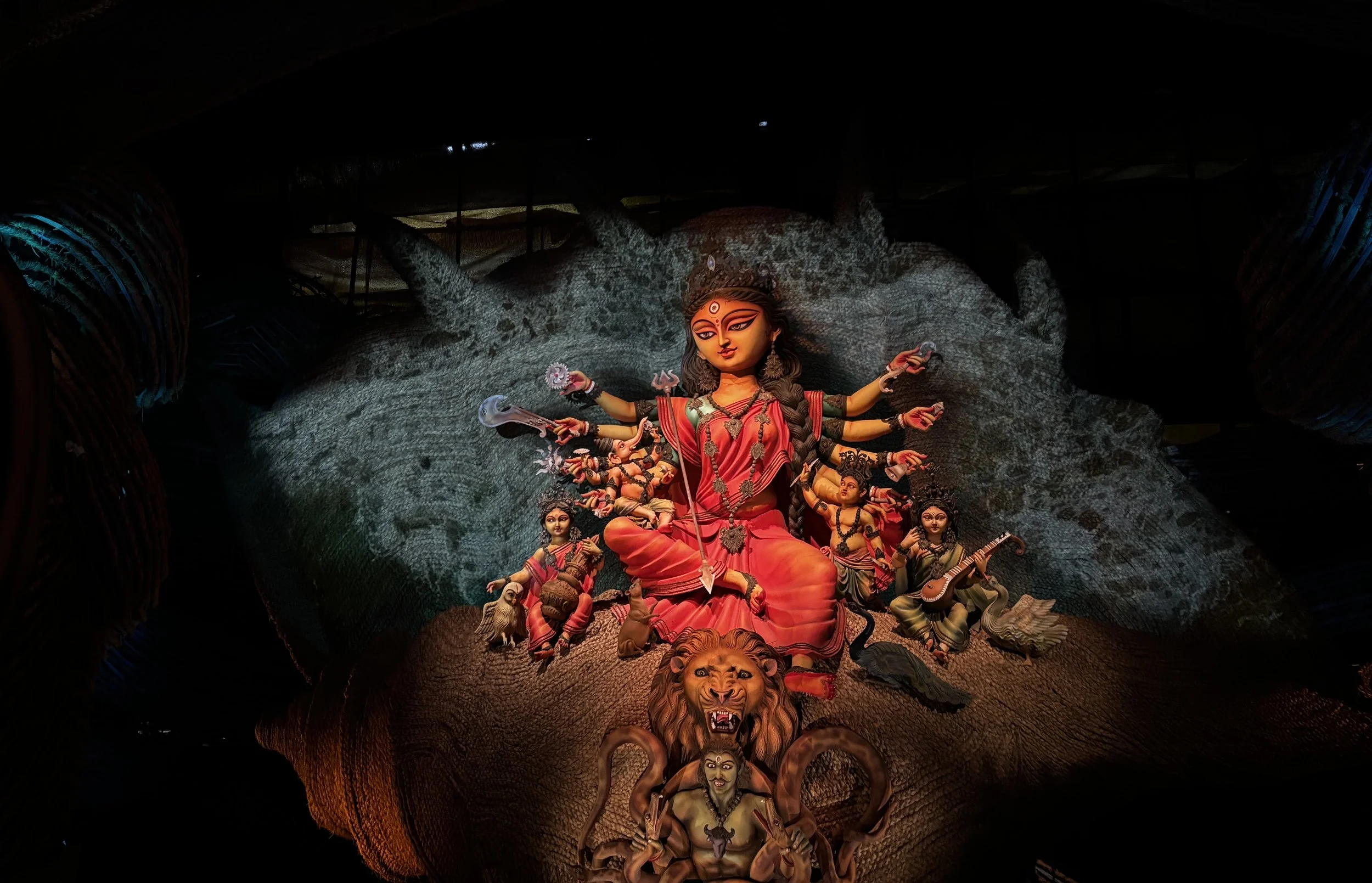
Photo: Sujoy Sarkar
In its efforts to truly understand Bengali culture, the BJP government must accept that it will gain nothing by asserting its influence over Durga Puja pandals. Any attempt to politicise and constrain their artistic freedom diminishes the distinctive flavour of the spectacle.
The month of Ashvin in the Bengali calendar marks the homecoming of goddess Durga, who is said to have travelled from Mount Kailash with her children to visit her maternal family. The Divine Feminine takes the form of Mahishasuramardini, the ten-handed deity who defeated Mahishasura and restored peace in the heavens.
Until the 20th century, the festival and its celebration were exclusive to the zamindar community. Its form and character have since evolved alongside broader political and social changes. Following the introduction of the Indian College of Arts and Craftsmanship, a few artists began to adopt Western realism in crafting their idols. In its endeavour to influence the workings of the pandals, the colonial administration championed teaching the scientific principles of drawing an object. Their teachings did not stop at such idols—it also played a role in realistic portraits of political figures, among other works.
The Sarbojanin puja emerged in 1910, a pandal open for everyone irrespective of their caste or family background. Two key developments led to its introduction. Firstly, Durga Puja inside zamindar households created a visible class divide, since participation was limited to the extended family and friends of the host. Secondly, and perhaps the most disruptive change was the growing prominence of community clubs. After the 1905 Partition, Swadeshi Samitis multiplied and these clubs already had members along with a fixed meeting place, which became the site of Durga Puja. Additionally, their grassroots presence enabled the club to raise funds from the neighbourhood families. It also gave the puja committee a secretary, a treasurer and an annual committee which provided a formal structure to the celebration, seen as a departure from the private arrangements of the zamindars.
Over 1,500 clubs in Kolkata hosted a Durga Puja pandal in 2026. Several reasons account for this proliferation, all rooted in the social, economic and cultural shifts Kolkata has undergone over the six decades since the Left came to power. Durga Puja pandals are more than a religious site because they have increasingly become spaces for artistic expression. The idol is no longer the sole centre of attraction—the design and structure of the pandal intend to bring a chosen theme to life, and this is clearly a shift that has gathered momentum over the past few decades.
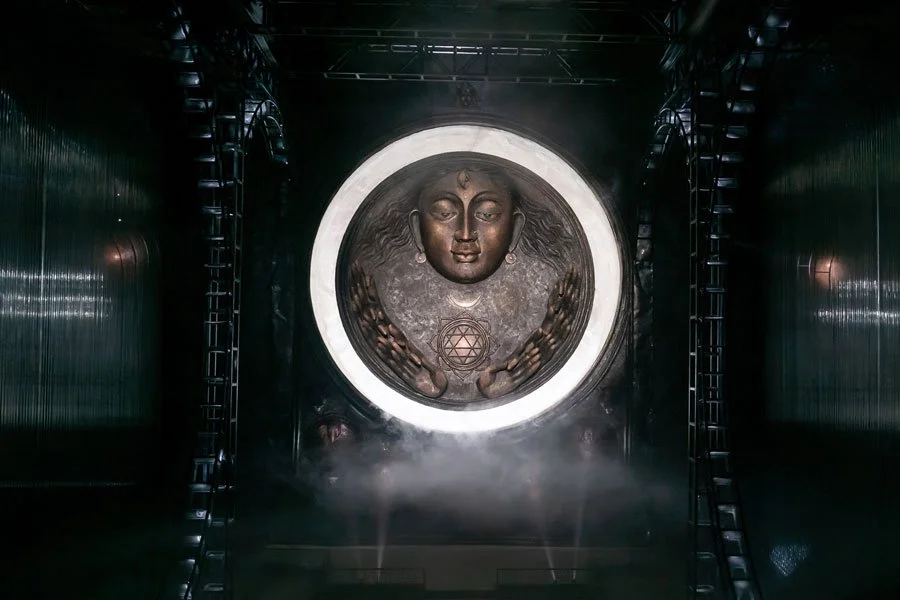
Tala Prottoy 2024. Photo: Sujoy Sarkar
I was introduced to Tala Prottoy in 2024 when artist Susanta Shibani Paul’s Bihin (The Void) had become one of the most talked about installations of the season. The work emerged from the artist’s search for the goddess as a formless, infinite source of existence, an idea that challenged the conventional representation of the Idol through a human-like form. Much of the pandal was enveloped in darkness as I walked through it alongside thousands of others with the absence of light heightening the sense of anticipation. After a long passage through the installation, we arrived at an elevated space where the goddess appeared in a strikingly unconventional form: a face framed by open hair which was accompanied by ten palms, five on either side arranged like a colossal coin. Smoke and carefully manipulated light partially obscured the installation as if they were lending the idol an almost otherworldly presence.
While Tala Prottoy stands out for its highly abstract approach, there are numerous pandals which explore pressing ecological, geopolitical, historical and social issues. This particular artistic experimentation flourished in part within a cultural environment that the former government actively sought to promote. The Durga Puja Carnival, introduced in 2016, was one such initiative that brought together the idols of prominent pujas for a public showcase. Its post-Puja timing is particularly significant to create a space in which the idols could be appreciated not only as objects of religious devotion but also as works of art.
Durga Puja pandals are more than a religious site because they have increasingly become spaces for artistic expression. The idol is no longer the sole centre of attraction—the design and structure of the pandal intend to bring a chosen theme to life.
In summer 2026, the Bhartiya Janata Party [BJP] recorded a historic, contentious victory in West Bengal, upending the long reign of the incumbent Trinamool Congress [TMC]. With the shift in regime, it was inevitable that this largely neutral public space would reflect the ideology of the BJP government. Undoubtedly, there has been no shortage of such instances. One of the earliest flashpoints was the attempt by the state authorities to remove Left-wing bookstalls in Jadavpur. This incident drew considerable public attention; however, several other bookstalls were denied permission this year without a clear reason. Some of these stalls have been a fixture of the Puja landscape for over four decades, and remain an intrinsic part of the festival’s cultural ecosystem. Meanwhile, the RSS had little difficulty securing space for its own bookstalls outside several pandals, raising questions about the consistency with which permissions were granted.
In another instance, the government was forced to retreat its announcement which restricted vendors from serving meat in the vicinity of pandals in the face of widespread public opposition. While much of the commentary focused on the public outcry, the implications for the vendors themselves received less attention. For them, geography plays a significant role in determining what is available to sell, and Kolkata’s proximity to the coast has made the fish bhetki fry an integral part of its food items during Durga Puja.
Any account of this year’s Durga Puja would be incomplete without addressing the unfortunate incident at the Chorbagan pandal, where 19 people died in a stampeded at a pandal. The chief patron of this event was none other than the nephew of West Bengal’s BJP chief minister, Suvendu Adhikari, and Adhikari was seen to have visited the hospital where the victims were admitted.
I’ve observed a change in the management of entry at several pandals where VIP queues were converted into general-entry lines. For visitors, this was a welcome measure, as it appeared to improve the flow of people and make access more convenient. Behind all these changes however lies a clear sign of political influence, which has considered public safety to be secondary. Since the BJP government came to power, the reshuffling of police personnel across three successive rounds has altered the administrative landscape. One notable instance concerns Devendra Prakash Singh, who was transferred out of the city a few weeks before Durga Puja and recalled immediately after the Chorbagan incident.
The stampede will remain a dark stain on the government’s record, with its ramifications likely to extend well beyond the immediate aftermath. More specifically, it has unsettled the public’s perception of Durga Puja as a safe space for celebration. Every year crores of people take to the streets to visit pandals, often with their families as this experience counts as an inseparable part of the festivities. The incident has shaken that sense of security, and as a consequence, forced puja-goers to confront the possibility that a routine evening of pandal hopping could end in tragedy. For families, the question of whether their loved ones will return home safely is a deeply unsettling one and one that should never have to accompany a celebration so integral to the city’s cultural life.
The BJP government must first reckon with the sheer scale and cultural significance of Durga Puja before attempting to reshape its traditions. Another development that warrants scrutiny in this direction is the replacement of puja committee heads with BJP leaders across several prominent pandals. These include Suruchi Sangha, Tala Prottoy, New Town Sarbojanin and Sreebhumi Sporting Club, associated with former West Bengal minister Sujit Bose. Such changes may be viewed as an attempt to consolidate political influence over some of the city’s most prominent pandals.
At the same time, control may also take a different shape and it can be experienced in the way the government influences the themes that organisers choose and the narratives that artists are encouraged to present. Suruchi Sangha’s decision to centre its theme on the life of Shyama Prasad Mukherjee offers a case worth examining in this context. He founded the Bharatiya Jana Sangh, the political predecessor of the BJP, in turn making his legacy an important part of the party’s ideological history. The choice raises a broader question: Since the political influence over puja committees will keep growing, where does institutional patronage end and artistic autonomy begin?
The pandals are beneficiaries of a crowd that can quickly pass verdict on whether a landmark pandal has failed to live up to their expectations. It is this collective, critical public that ultimately determines what Durga Puja means to Bengal, and their perspectives cannot be so easily directed by political machinations.
This concern must be understood against the BJP government’s recurring attempts to bring institutions and their members under its influence, often at the cost of this autonomy. When such influence extends to cultural spaces, the stakes are particularly significant. The attempt to shape the pandals and the art they exhibit may appear to offer a means of rewriting their cultural significance. However, the most consequential stakeholder in this tradition is not the committee that administers a pandal, it is the public that experiences it. The pandals are beneficiaries of a crowd that can quickly pass verdict on whether a landmark pandal has failed to live up to their expectations. It is this collective, critical public that ultimately determines what Durga Puja means to Bengal, and their perspectives cannot be so easily directed by political machinations.
Conceptualising a pandal and bringing that vision to life is often a year-long endeavour. A few of them, such as the Chetla Agrani Club, have reportedly spent as long as two years working on a single installation, only to see it dismantled after the brief duration of Durga Puja. Both the organisers and the artists are conscious of this impermanence and continue to invest considerable time and effort in their creations.
There is however, an interesting restraint in the way these works are presented to the public. Spectators may walk the entire length of a pandal and adore it, yet may not find a single board naming the puja committee or the artist. The artists in effect are aware that their works will be tested against lakhs of individuals without the assurance of any recognition. They accept that their works must stand on their own merits amid the immense competition at Durga Puja.
In its efforts to truly understand Bengali culture, the BJP government must accept that it will gain nothing by asserting its influence over the pandals and the artists. This crowd thrives upon extraordinary experiences which hints at seeing something entirely novel, far removed from the realities of everyday life. It is this appetite for the extraordinary that pushes artists to imagine new worlds year after year. Any attempt to constrain that freedom risks diminishing the very spectacle that makes this celebration of the goddess so distinctive.
***
Sujoy Sarkar is a Bengaluru based technology and data protection lawyer. His work is shaped by a sustained interest in how institutions such as technology, state power, and art govern and influence everyday life. You can find him on Instagram: @sujcookedanotherone.