Photo: Karan Madhok
Whether in his role as director for ‘Art for Change’ or in the experimental directions of this own work, Ladakhi artist Isaac Gergan leans on art to connect with the beauty of the Himalaya.
When he was just a teenager, the artist and facilitator Isaac Gergan became fixated with the highest point he could sight in Mussoorie, Uttarakhand, and then he chose to climb it. He was in boarding school at the time, and the decision was a serious risk, flouting many restrictions and taboos, even endangering his young life.
Decades ago, this incident would’ve been classified merely as a daring prank, in a long line of juvenile escapades, amounting to little more than a laugh and a “remember when…?” anecdote. But when he looks back at this foundational memory years later, Gergan is able to frame the adventure as the young man curious for the higher view, the stranger perspective, the gift of more beauty in the Himalayan landscape.
Gergan grew up in beautiful places, from his homeland Ladakh, to Mussoorie, to Darjeeling, to Shillong, to Pennsylvania, to Vancouver. It is back in Landour, Mussoorie, where he spends much of his time now, reconnecting with the beauty of the mountains around him.
“I’ve grown up with beauty,” he says. “It is part of my identity. I relate naturally to something that is beautiful… It drives me to go see and explore and be curious about things, and I think that’s another element that has shaped me. Because if I wasn’t curious, I wouldn’t try to climb that mountain, or get to the top of the building to see the view.”
Nowadays, Gergan serves as the executive director of Art for Change Foundation, a Delhi-based organisation that has centred art as a medium for social collaboration, fostering engagement between artists and communities across the country for nearly two decades. Gergan joined the organisation in 2017, and much of his work has focused on developing programmes for Art for Change and leading residencies and workshops for artists from India and beyond.
Through art, Gergan believes, there can be space, “where we need not necessarily dilute our own beliefs or positions, but have a posture to listen to the other: Where are they coming from?”
Art for Change was co-founded in 2007 by the Indian artist and educator Stefan Eicher. Since its inception, the foundation has organised 37 residencies for Indian and international artists, held over 70 exhibitions, art melas, classes, workshops, and studio tours to promote emerging artists.
“The early years of the foundation focused on the interaction of art with many social aspects, including infanticide, gendercide, selective abortions happening across the country, raising awareness about housing crises, tuberculosis, or the survivors of sexual abuse and trafficking,” says Gergan. “It brought the conversation to more audiences, and focused also on the capacity of art to make us think about humanity or human dignity.”
Part of Gergan’s work also spotlights the ability of art as a medium to look at diversity and differences between communities, thus incorporating artists to converse in interfaith dialogues, or the diversity in nature and environmental ecosystem. Through art, he believes, there can be space for considering differences to be aspects to celebrate, rather than cause divisions, “where we need not necessarily dilute our own beliefs or positions, but have a posture to listen to the other: Where are they coming from?”
In most cases, artists would come together to share community stories through their work, make art, and discover mentors. Each programme ended with an exhibition to showcase the artwork to the larger community, with hopes to foster further dialogue about the issue. “That’s the art for change,” Gergan says. “How does art look at society and focus on things like beauty and truth, right? That something can be beautiful or intrinsically true, regardless of where it’s coming from.”
Much of Gergan’s artistic foundations were built in his high school days in Mussoorie (Full disclosure: I attended the same school and have known Gergan since childhood) where he began to see how art could be applicable almost everywhere. “I always ended up in art, whether it was for getting out of trouble, for whatever reason. I had a good teacher at that point as well. I think he played an initial role in pushing me towards art. So, it was a combination of things.
“I never thought of it [art] as a profession, but I was always interested in variety of things. Language, sciences, history, philosophy, social studies, the great outdoors… Art was a medium in which you could essentially talk about anything. If you want to have a scientific approach in your artistic practice? Very possible. Languages, literature… It’s a place where many things can come together. Two things that don’t necessarily belong together can be brought together in art. Geography and fashion, let’s say. That’s what really interesting when I develop programmes, we can see opportunities where other approaches wouldn’t. I saw art as a space where all of these interests could be merged.”
It is with this core mission that the Arts for Change residency now attracts a wide diversity of artists, too: the emerging and the established, with a balance of gender, age, and different mediums in the visual arts. Along with the artists residencies, Art for Change also runs the Mountain Retreat in Landour and other parts of the country, in which participants have included many of those outside the traditional arts world, from a wide variety of professional backgrounds like education, healthcare, and entrepreneurship. “This is for anybody,” Gergan says. “These are people who are often on the brink of a burnout, especially in the bigger cities, working long hours. For them, it’s an important 3-4 days break to realign and be rejuvenated in the mountains.”
Art for Change has a presence in Delhi, where the programme was originally founded, and as a cultural (and national) capital, serves as a city that attracts artists from all over the country. These artists, Gergan says, “are highly talented, but don’t always have the means or the space to work as they wish,” and he supports many such artists through mentorships and exhibition opportunities. But beyond the capital, the residencies have spread across much of the country, and particularly to the Himalayan regions that are close to Gergan’s heart, in collaboration with organisers in Nagaland, Manipur, Uttarakhand, and more. Earlier this summer, Gergan was able to bring a residency back home to Ladakh for the first time.
The retreat is focused on five things: rest, being in nature, the creative element, the aspect of being in community, and thinking about purpose—the act of, not just what we’re doing, but the why question.”
I ask Gergan the why question, too: Why did he choose the path he did?
“I was not thinking of my career,” he confesses. “I was not thinking about how I would earn with art, how I’m going to make a living out of it. Partly, I think that has got to do with my family as well: I have two older brothers who are in more steady fields so to say. So, I didn’t have as much burden of family responsibilities and had a little bit of freedom. Partly, I think it’s also owed to my education, my college, of the ability to see the world through the lenses I have picked up along my journey. It made me an adventurous person—I like travelling, going to places, staying curious.”
His paintings resist easy generalisation but find a cohesive core at their heart, as if he is speaking in a variety of different languages to communicate the same message. “I was looking at the vast visual heritage of the Himalaya, and saying that they shouldn’t remain as heritage; this should also be contemporary.”
College took Gergan to the Emily Carr University in Vancouver, where he completed his BFA. Here, he moved towards a high abstraction phase, but upon his return to Ladakh and to the contemporary art community in in the region, he realised that if he continues exclusively down this line, he could imagine long years of isolation. Instead, he attempted different experimentations informed by the rich Himalayan visual heritage and found close connection with the artistic community in India.
Since then, he has been working with many organisations, developing programmes, facilitating events, and but ensuring to find time on his own artistic practice. “As much as possible, I choose the opportunities that allow me to also have a focus on my own work.”
In his own work, Gergan has experimented with the same diversity of thought that has shaped much of his worldview, whether it was in his acclaimed 2017 photo-series After the Elusive Light featuring portraits and landscapes from Ladakh, or his many directions in fine art. His paintings resist easy generalisation but find a cohesive core at their heart, as if he is speaking in a variety of different languages to communicate the same message. “I was looking at the vast visual heritage of the Himalaya, and saying that they shouldn’t remain as heritage; this should also be contemporary,” Gergan says. “So, I’m still interested in bringing of traditional and historical to a more contemporary conversation through art.”
Gergan’s last major commission was a series of 10 paintings in which he took, essentially, 10 different directions of artistic styles, all in the context of this Himalayan visual heritage. These included some patterned designs looking at textile, woodwork, and architecture, design considerations like the biophilia effect (the hypothesis that, through our human eyes, we are most likely to have a cognitive response to the colour green of nature), some concepts of Tibetan traditions including more contemporary styles of Thangka, and heavy abstraction and what may seem like doodling—or subconscious mark-making, which, he describes as, “You aren’t fully there, but you’re still making something.”
“The advantage in art today is that what we’re influenced by is very diverse. We have at our fingertips the western influences and Indian contemporary and historical influences. So, we can pick and choose. This is good, but it can also be confusing.”
He encourages artists to take advantage of the community, to build salons of inspiration across various schools of art and artistic practices. “Artists are too often working in silos,” he says. “I feel art has become progressively more individualised, and there’s actually benefit to even being connected to a larger conversation.”
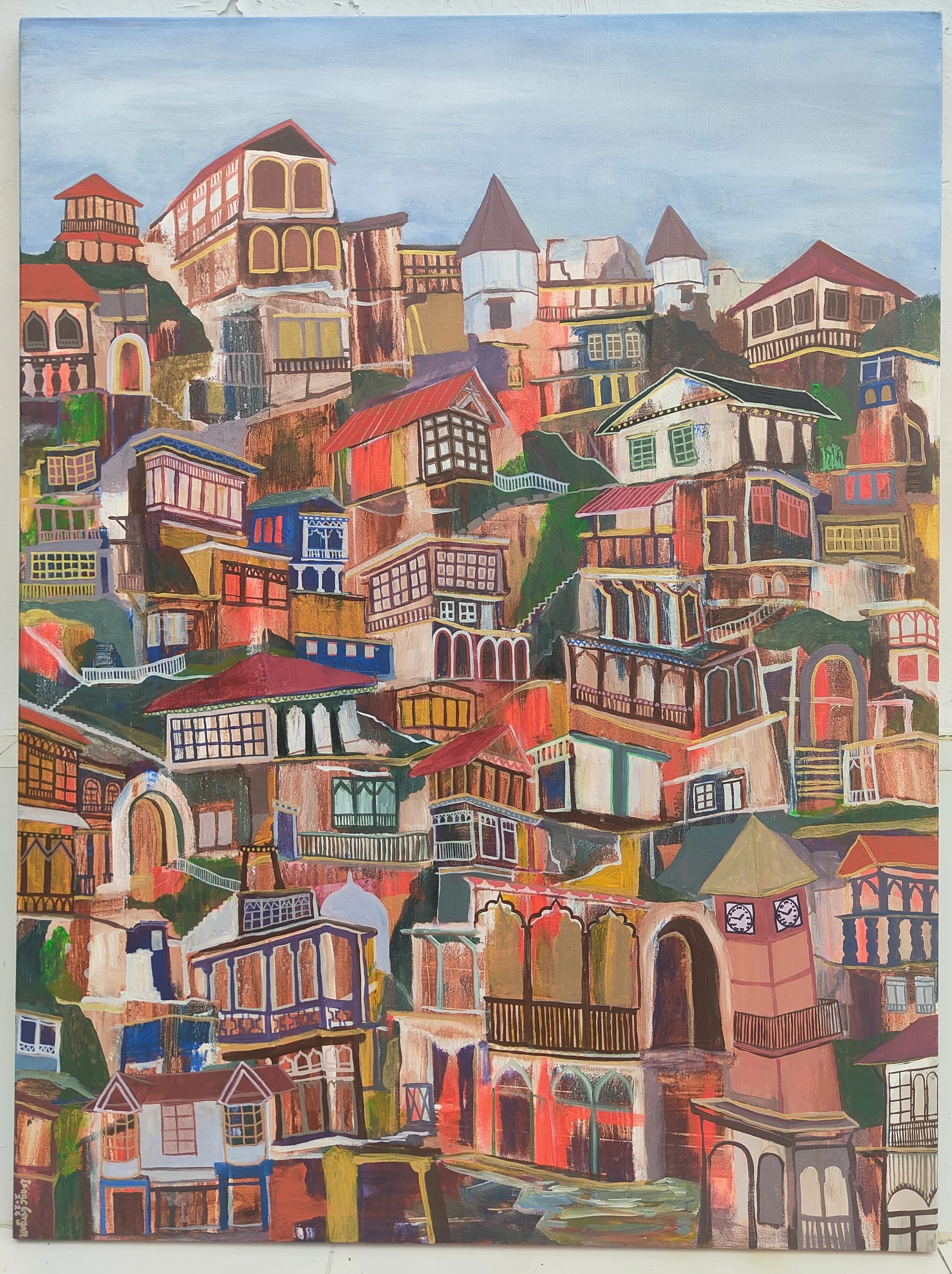
“Landour Bazaar” - Isaac Gergan
His current work between photography and painting is dealing with further abstraction and bringing in some aspects of relational anchors. Along with the work of a mentor, he says he is also experimenting with some expressionism. “My latest work up in Ladakh was around the concept of the spaces that we occupy,” Gergan says. “What does that look like? The places that we grew up in, the topography—how do they influence the way we walk, for instance? It’s very connected to the places we grew up in. If it was a flat place, we would walk a certain way. If we grew up in the mountains, we walk differently. How is the space different to you, to me, or to any object? How does that candle in front of us, or the view outside our window, subconsciously affect me?”
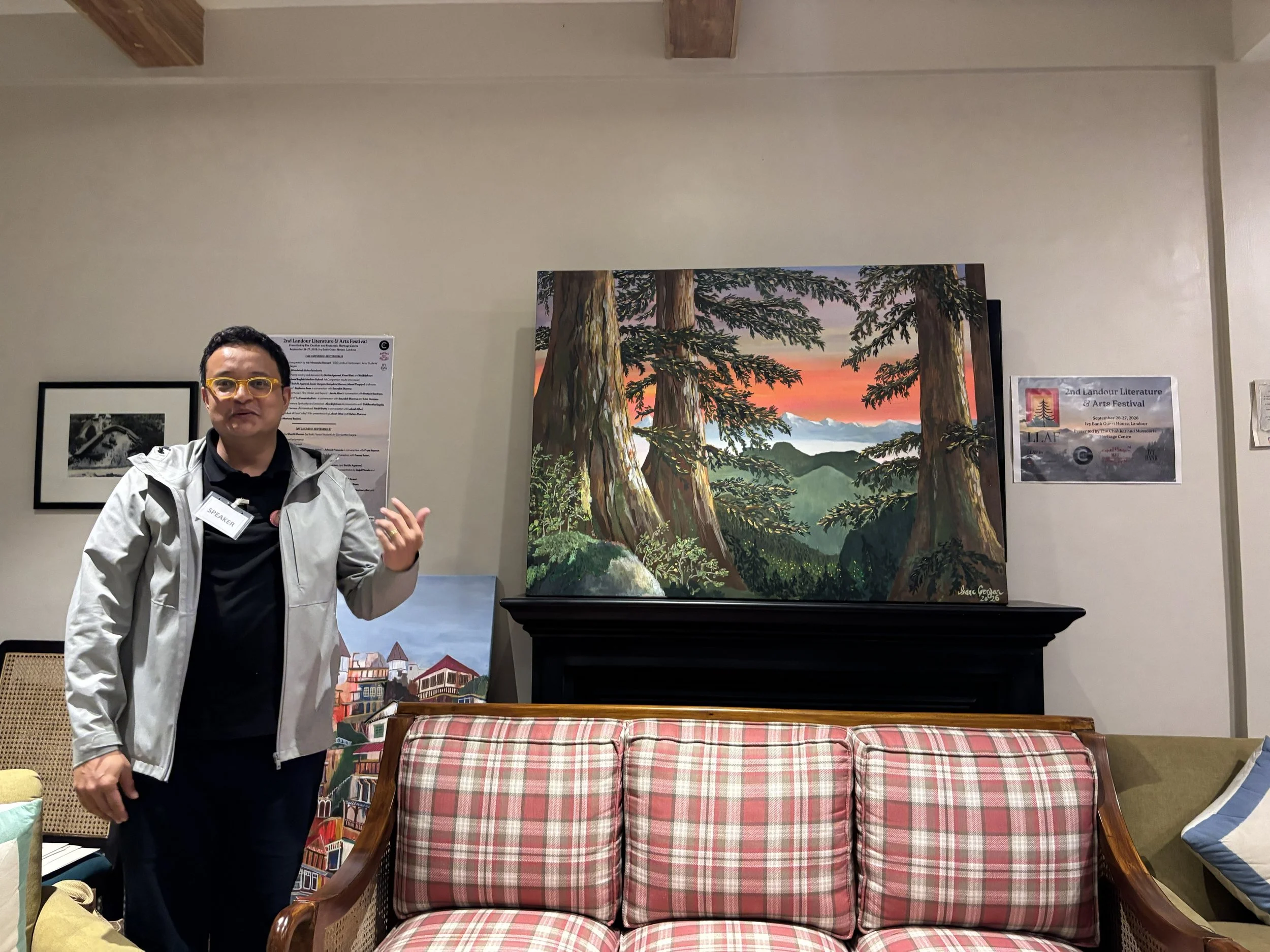
That view outside the window and beyond in Landour is of the Himalayan horizons, of the highest snow peaks, of the picturesque Mussoorie bazaars, of the Doon Valley far below. It’s beautiful, and we cannot help but land back to the question of the beauty that has shaped the perspectives of those of us occupying these spaces. Gergan returned to live in Landour decades after his childhood here, reclaiming one of the spaces that shaped his perspective after many years in the urban scapes of New Delhi. And as his first major act of creative expression here, he painted two works for the Landour Literature and Arts Festival [LLAF] in September inspired by the region: a vista looking out at the snow peaks through a forest of deodars and oak trees, and a cubist interpretation of the winding, rising, multi-dimensional alleyways that make up the Landour Bazaar.
These are two very different reflections of Mussoorie, and perhaps only a trained eye would be able to identify the Gerganesque streak that connects them. What I find is a vibrancy of colours in each, an optimism of his return to the beauty of the Himalaya.
Gergan credits the impact of culture and community, too. “There is a culture element that I experienced growing up in the mountains, in the way we converse, the values of the community that are here, as opposed to living in Delhi or in another city. Also, growing up in my school with an international community played a huge role, as I was able to connect with different people and different challenges from childhood. The diversity there positioned us for the diversity that we have in the world.
“The pulsating aspect of a place is its community, and (the Landour Bazaar) is just bustling with life and stories and history. I think those are aspects that are conveyed through colour, the lines, the energy in the lines, those are the elements. And, of course, the placid view that we get to see in the other painting is more about looking at what we appreciate: the silence, the quiet, the forest, the light, the everchanging sky here. The latter is something that’s not familiar to me. It’s not my territory, but I think being here is definitely going to bring in a lot more nature in my work.”
And perhaps, Gergan’s lifelong curiosities will lead him to higher views, from the tallest of towers in the highest mountains, to unlock a beauty that can only be expressed through art.
***
Karan Madhok is a writer, journalist, and editor of The Chakkar. He is the author of MONKEY! (2026), Ananda: An Exploration of Cannabis In India (2024) and A Beautiful Decay (2022), all published by the Aleph Book Company. His work has appeared in Epiphany, Sycamore Review, Gargoyle, Fifty Two, Scroll, The Plank, The Caravan, the anthology A Case of Indian Marvels (Aleph Book Company) and The Yearbook of Indian Poetry in English 2022 (Hawakal). You can find him on X: @karanmadhok1 and Instagram: @karanmadhok.