Painting the Bardo: The Art of Pema Tshering
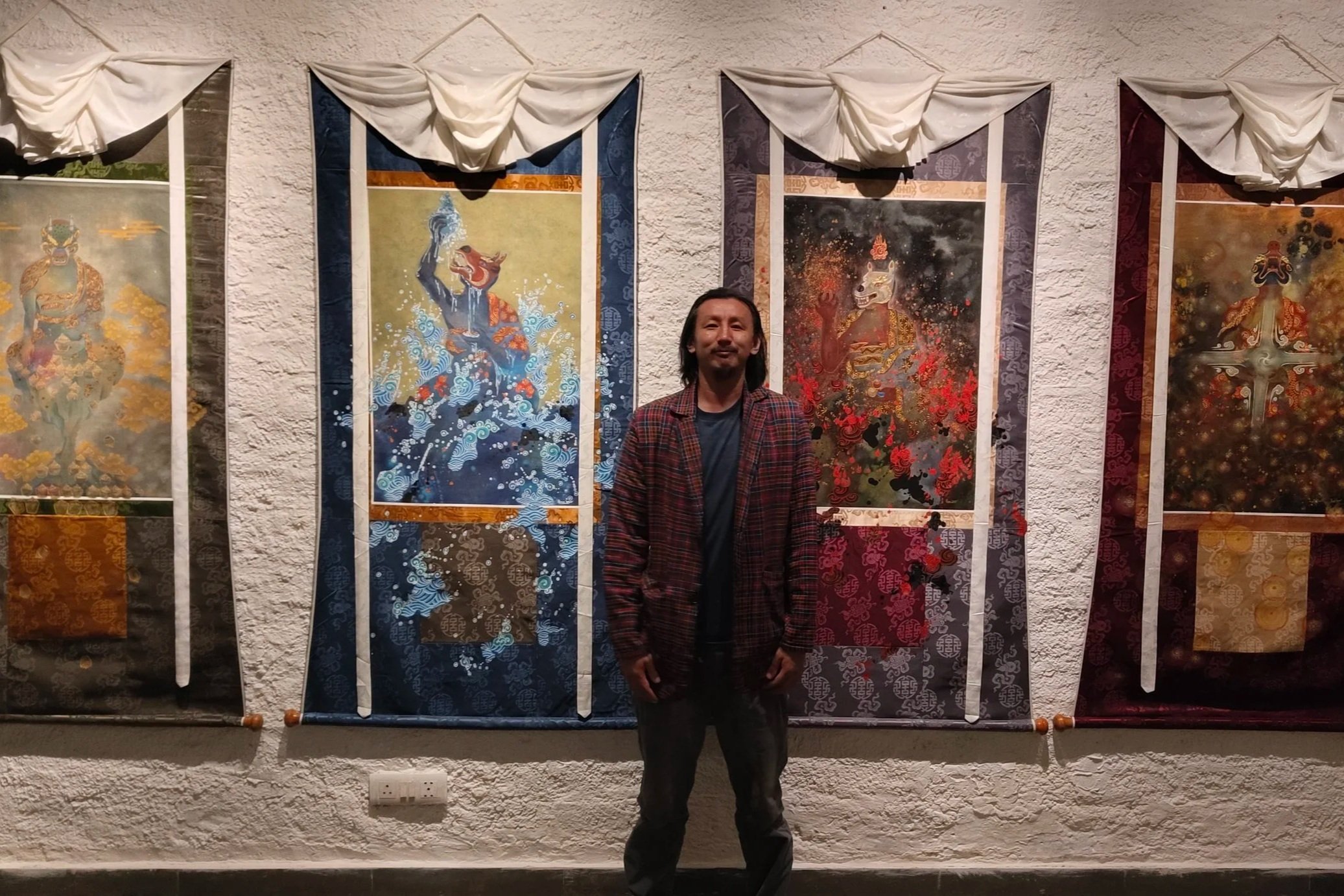
Pema ‘Tintin’ Tshering. Photo: Amritesh Mukherjee
In his series In Between Dreams, the paintings of Bhutanese artist Pema ‘Tintin’ Tshering ask the question of what lies beyond what we can see, in the space between understanding and mystery.
At New Delhi’s Threshold Art Gallery, “Buddha with the Passions Surrounding” greeted me right away. A serene, monumental Buddha dominates the centre of the canvas in the artwork. His form, rendered in deep terracotta and saffron, has a warmth like a still sun at the heart of a storm. Draped in a patterned robe like traditional thangka brocades, he sits in a meditative posture, holding an alms bowl near his lap.
Surrounding him are dozens of smaller animated figures—deities, demons, monks, musicians, ascetics—each immersed in some act of passion or impulse. One with a camera. Another with a football. One playing guitar. Another writing in a book. They have animalistic, monstrous faces, all rising from a sea of swirling orange and black clouds, painted in wavy, flame-like patterns that suggest both fire and desire. These eddies of energy climb toward the Buddha, but he remains unperturbed.
Above him, a golden sun and a pale crescent moon hang at opposite ends of the horizon, symbols of cosmic balance. The sky, gradient from smoky grey to ochre, is thick with drifting, red-tinted clouds, as if the passions themselves have taken celestial form. This intermingling of the traditional with the modern is central to his sensibility, a recurring theme in the work.
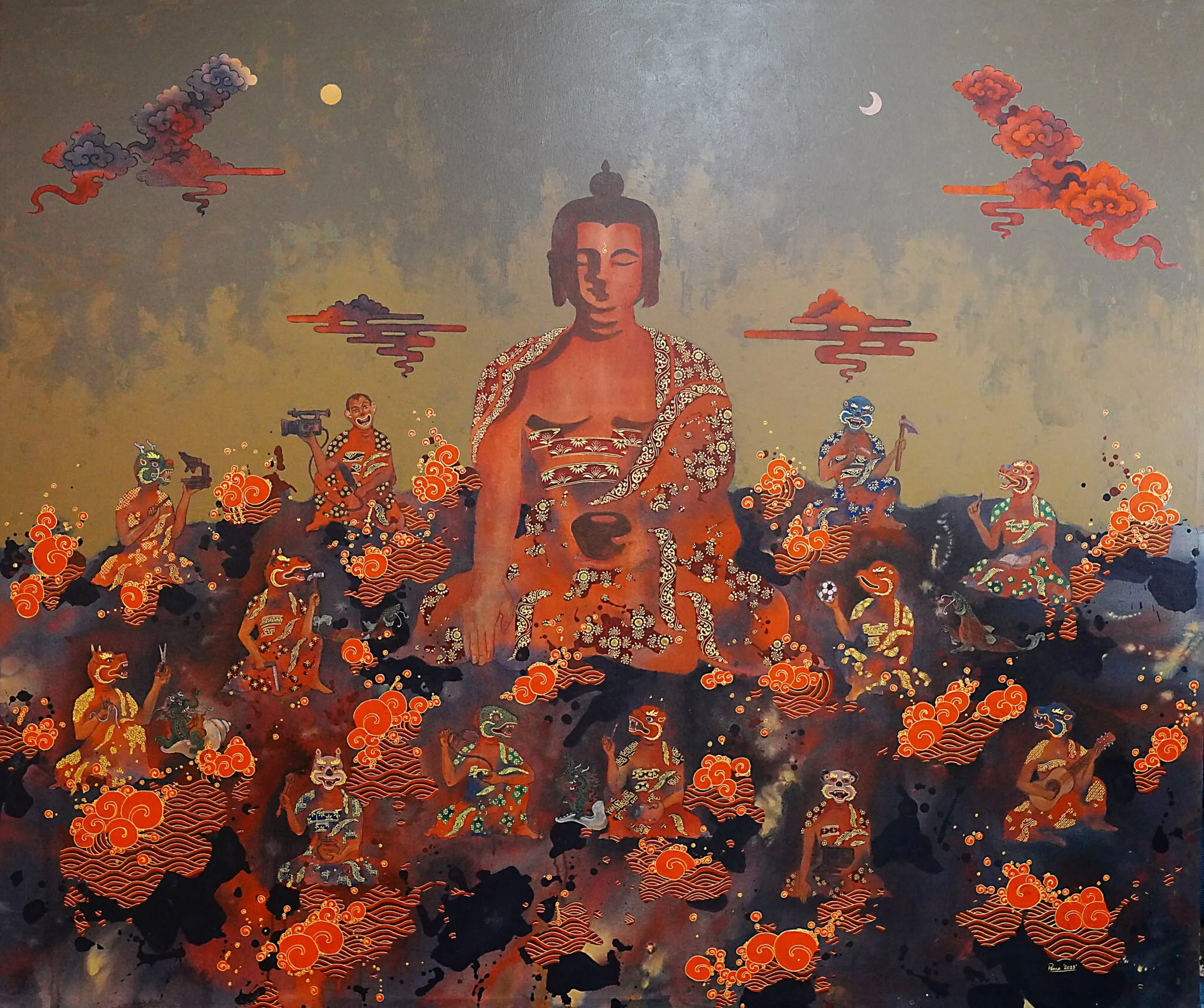
“Buddha With the Passions Surrounding” - Pema ‘Tintin’ Tshering
“I like to keep a certain level of experimentation in my painting,” says the Bhutanese artist Pema ‘Tintin’ Tshering, “so the work can grow.” The painting was a part of Tshering’s first exhibition in India, In Between Dreams, hosted by the gallery from September 17 to October 7, 2025. His paintings, Tshering says, are “more spiritual. People tend to calm down when they see it. Maybe it’s the energy from the painting. I like to think that the paintings are more than symbols—the feeling you feel when you see them is more important.”
He’s not wrong. While heavy on imagery—Buddhas, deities—the paintings evoke something difficult to articulate, a serenity that resists language, something closer to physical sensation. Like sinking into warmth after a long, cold day. Or walking through flowers at dawn, when everything is still possible.
It’s a universal sentiment, echoed across religions and philosophies, something transcendental. “Even if people don’t understand the Buddhist imagery, they can still feel the clinging, the emotions, the universality… There’s no one path, one interpretation, one way of looking at things. That’s the joy of art.”
Tshering is a tinkerer at heart. He’s worked with different formats, from paintings to sculptures to videos. “When you have a concept, sometimes the form finds you,” he says. “An idea stays with you, evolves, matures. You need time for it to grow. It’s powerful both ways—a concept can become a sculpture or a painting. You just have to follow it. The fun part of playing is to make the work come alive, to give it movement. If something is created intuitively, it evokes an intuitive response.”
In “Bardo-Transit,” a half-human, half-mythic figure sits in a meditative pose, its ribs visible, hands gently cupped, coiling around its torso and legs are golden, patterned forms, and rising from its crown is a cluster of fierce animal heads—dragon, lion, garuda, and other hybrid visages, all rendered in gold—from which hundreds of red threads erupt upward, converging toward the ceiling like beams of light or ascending energy with a few spilling downward to the floor, fanning outward in a ritual-like arrangement.
The piece makes the exhibition’s central idea tangible: bardo as the ‘in-between.’ Tintin explains, “This series, In Between Dreams, is my way of practicing the teachings of impermanence and illusion.” The figure seems to embody consciousness in passage: rooted to the material world, simultaneously reaching upward toward release. The Sungki threads act as pathways for awareness, moving between dimensions. In Bhutanese Buddhist practice, Sungki are consecrated cords used for protection and for connection between the practitioner, the deity, and the teacher.
Here, Tshering reimagines them as energy conduits, their red colour connotating life-force and karmic vitality, while the upward sweep suggests liberation through dissolution. The animal heads, representing the wrathful deities of the Bardo Thödol, are aspects of the self, representing instincts, fears, and primal drives that must be recognized, their shared body indicating the unity of these impulses within one consciousness.
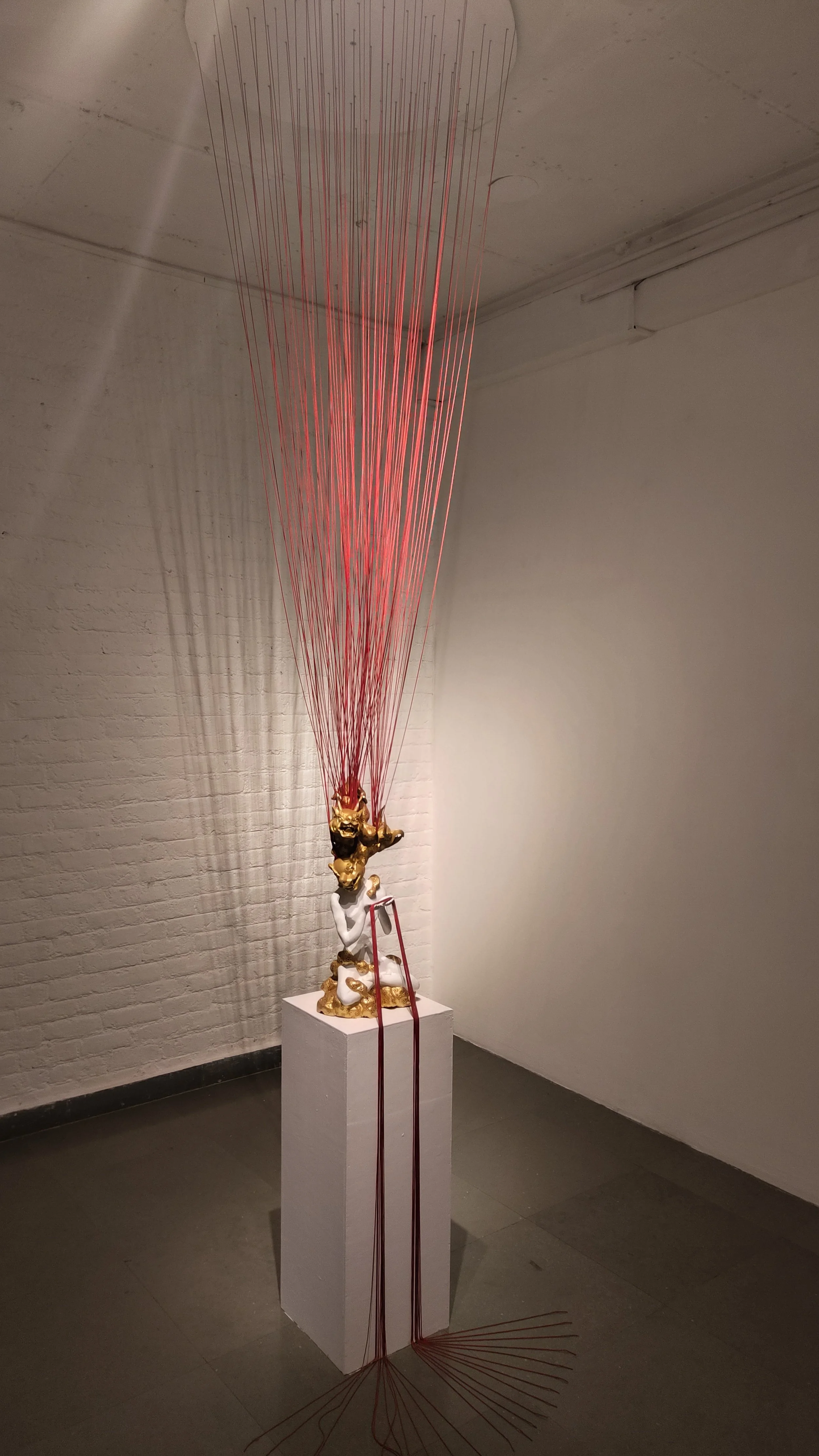
“Bardo-Transit” - Pema ‘Tintin’ Tshering
The piece “Hold On,” a meditation on the fragility of attachment, features a gold-painted hybrid creature suspended mid-air by a single wire, gripping a white, pillow-like form. Small red, flower-like protrusions bloom along the creature’s spine and limbs, adding a visceral texture, somewhere between wounds and blossoms. The pillow references sleep and dreams, a metaphor both literal (we hold pillows in our most defenceless state) and symbolic (the comfort of illusion, the habits, or identities we clutch in fear of letting go). In Buddhist language, it represents clinging, the grasping that perpetuates the cycle of rebirth.
The figure’s hybrid, otherworldly form situates it within the Bardo: neither human nor divine. Those red, seed-like forms along the body may symbolize karmic imprints that bind consciousness to the material realm. Their placement on joints and the spine makes them feel like energy nodes, burdens literally carried by the figure.
It’s a universal sentiment, echoed across religions and philosophies, something transcendental. “Even if people don’t understand the Buddhist imagery, they can still feel the clinging, the emotions, the universality,” says Tshering. “There will always be different interpretations, and that’s fine. There’s no one path, one interpretation, one way of looking at things. That’s the joy of art.”
Of course, Buddhist imagery and spirituality reverberate across his paintings, reflecting his own attitudes toward religion and divinity. The painting “Deities” visualises the split-second transcendence described in the Bardo Thödol, the moment when the dying consciousness faces beams of divine light. Against a smoky, grey-gold expanse, a wrathful face emerges from swirling clouds, its mouth open, as if releasing a storm of luminous particles. From this fierce visage, a constellation of light rays, mandala rings, and glimmering forms rises through space. Gold motifs ripple like dissolving clouds, while threads of red, white, and blue slice through the haze. The entire composition feels suspended between dissolution and illumination, a world folding in on itself even as it simultaneously expands into the infinite.
Talking about this piece, Tshering says, “When you die, they say you see deities like a beam of light passing through you. I try to visualise that moment.” The painting captures the paradox of recognition and fear at the threshold of consciousness. In Buddhist belief, these “deities” are flashes of one’s own awakened awareness. Tshering translates that metaphysical event into visual language, with the wrathful face below seeming to signify the ego’s final resistance, while the rising light conveys release.
“Cosmic Dance” reimagines the Bhutanese cosmic mandala as a universal celebration. Around a luminous vortex at the centre, twelve red, leonine figures whirl in rhythm, their bodies fluid, their gestures forming a circle. Gold and blue rings ripple outward like waves of energy, while smoke-like tendrils rise from the dancers’ heads, merging with the darkness beyond.
It’s a celebration, a reintegration of the sacred mandala with the vitality of earthly life. The twelve dancers reference the zodiac (a universal circle of beings) symbolising that all living forms participate in the same cosmic rhythm. A static spiritual diagram, therefore, becomes, in his hands, a living festival of movement. In this dance, there is no separation between divine and human, art and ritual, only the endlessness of existence.
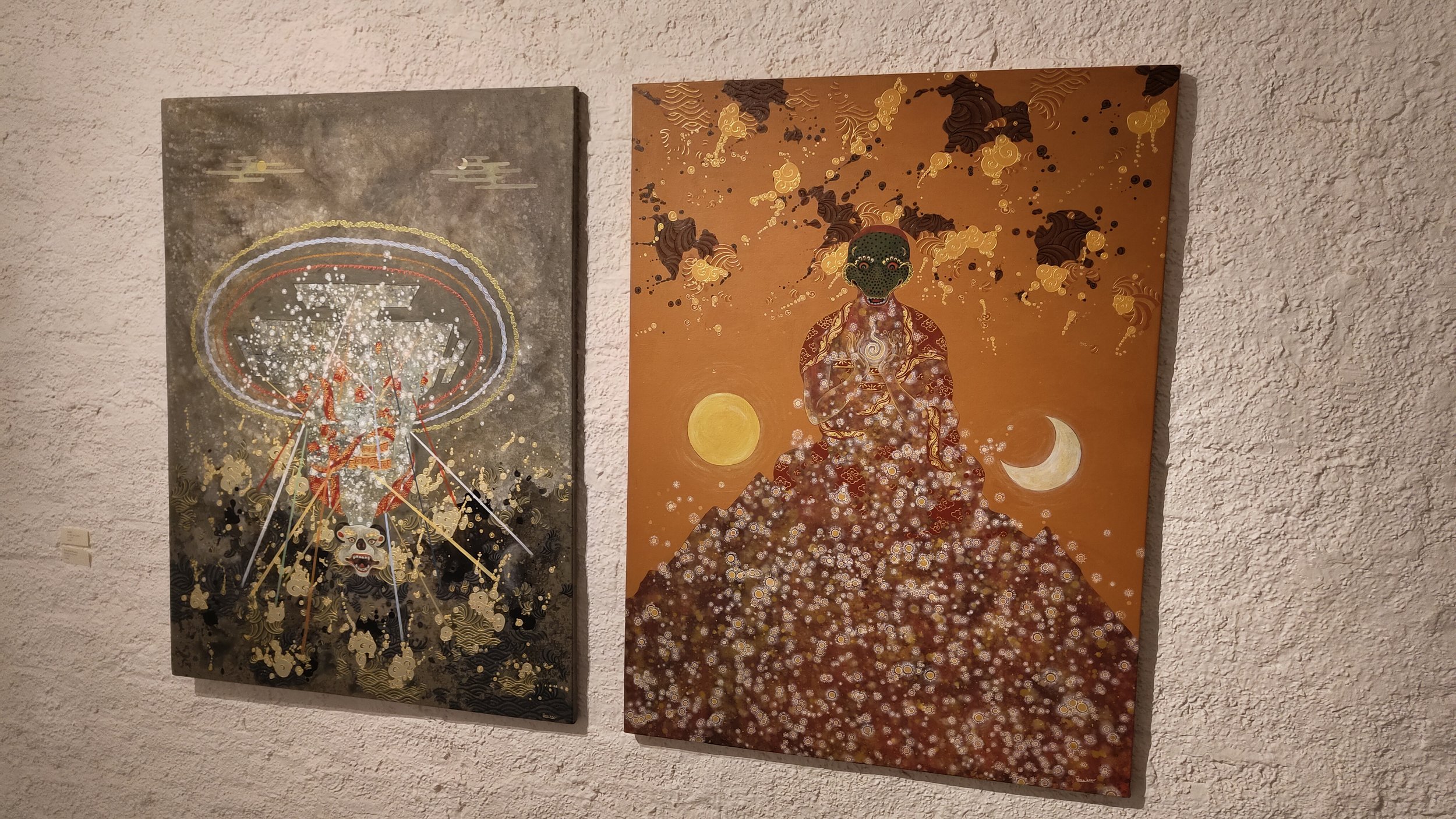
“Deities” (L) and “Primordial Presence” (R) - Pema ‘Tintin’ Tshering
In “Primordial Presence,” there’s a moment of awakening so still it feels suspended between worlds. The figure, robed in golds and browns, seems to rise from a mountain of light, its body dissolving into a field of shimmering dots. Above, the sky folds into earth tones, the sun and moon hanging together. The hands cradle a spiral of luminescence at the heart, a pulse that draws the eye inward, while clouds swirl across the upper plane like drifting thoughts in meditation. Everything in the composition, from the stillness of the mountain to the airy scatter of light, has the rhythm of cosmic scale. “Sun and moon together are a symbol of enlightenment, but I draw them hidden or reflected—because enlightenment isn’t always where you expect it,” Tshering says.
The painting reflects the state a Buddhist practitioner trains for over a lifetime, and the ability to recognise the clear light (’od gsal) that appears at death. Tshering translates that teaching into imagery with the mountain as unshakable mindfulness: the sun and moon as presences of wisdom and compassion, the burst of light as the mind glimpsing its own true nature. The scene is one of sudden awareness of eternity within impermanence, that delicate threshold where dissolution is clarity, where enlightenment is stillness so absolute it can hold the entire universe in a single breath.
Tshering translates that teaching into imagery with the mountain as unshakable mindfulness: the sun and moon as presences of wisdom and compassion, the burst of light as the mind glimpsing its own true nature.
While describing his painting “Samsara,” Tshering says, “In the teachings, they point to the moon, but all we could see was its reflection, not the moon itself. There’s reflection, but no sun—and that story inspires much of my work. I’m exploring the dream-like state of life—how illusion itself becomes expression. You don’t know what is up or down in a dream-like state. When you are in a dream, you don’t know if it’s real. I want the paintings to evoke that same, slightly uncomfortable feeling, the sense of illusion that life carries within it. It’s a visual language I like to play with.”
Tsering's influences extend past Buddhist tradition. Surrealist and impressionist artists inform his work, evident in how he renders the familiar strange, the concrete dreamlike. Nietzsche once wrote: “To live is to suffer, to survive is to find some meaning in the suffering.” In other words, whatever we do is, in some sense, an act of understanding—every choice, every motion a question we ask life, hoping it answers back.
“Art for me,” Tshering says, “is a pursuit to understand why I create and what life means. I’m exploring how creativity itself can be a path to enlightenment. I’m not trying to show a definite truth—I’m still learning, still open. The ultimate truth is beyond religion. My curiosity is to understand it through my art. My work is inspired by enlightened beings who attained realisation through their craft. I think of myself as both an artist and a spiritual practitioner. When I paint, I’m learning the text of the afterlife in a language I can understand—visuals. In Bhutan, monks meditate for enlightenment. I paint for the same reason.”
Standing in that gallery, surrounded by his paintings, I think I understood what he meant. Each canvas, each installation reaching upward asks the question of what lies beyond what we can see, existing in the bardo, in the space between understanding and mystery. Existing in the dream-like state we call life.
***
Amritesh Mukherjee is a journalist, writer and editor. He doesn’t know what to do with his life, so he writes. He also doesn’t know what to write, so he reads. Outside of his day job, he vociferates on his bookstagram. You can find him on Twitter: @aroomofwords.