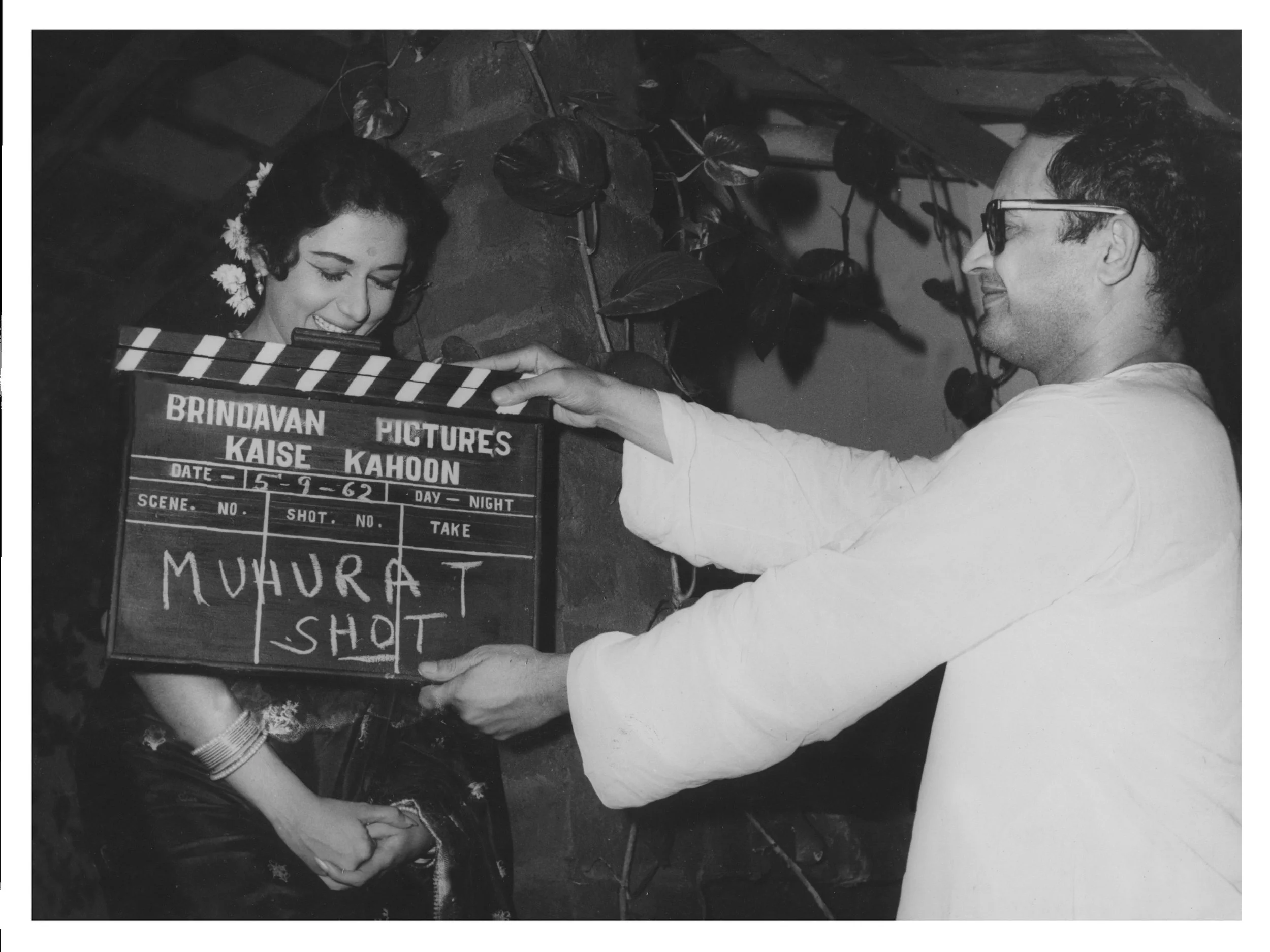
The ‘Muhurat Shot’ from Kaise Kahoon (1964). Photo courtesy: Ashish Dwivedi.
Welcome to ‘Nation of Auteurs’, a series composed of critical essays by academics, filmmakers, historians, and cinephiles to examine the deep diversity of Indian film auteurs and illuminate the country’s wider cinematic landscape.
Nation of Auteurs is curated and co-edited by Ashish Dwivedi.
Cinephiles in India are familiar with the greats, with Satyajit Ray and Mani Ratnam, Guru Dutt and Raj Kapoor, along with modern stalwarts like Sanjay Leela Bhansali, Zoya Akhtar, and Yash Chopra. But against this spectral range of filmmakers, there are auteurs who often fly under the radar, a list that includes pathbreaking filmmakers like Debaki Bose or Baburao Painter, Vijay Bhatt, John Abraham, Kanu Behl, Ram, and Lijo Jose Pellissery.
This editorial series emerges out of a simple, yet significant purpose to highlight these auteurs. It is not an attempt to undermine the vision or philosophies of some of the most legendary filmmakers produced by the country, but is an effort instead to step away from the established canon of filmmakers and auteurism that functions in a mode of recycled celebrity. What I imply here is that we have concentrated enough on a section of Indian directors— unravelling their authorships, their collaborations, the aesthetics of their cinemas, their relationships to genres and stars, their involvement in film festivals, etc.—but done so often at the expense of overlooking manifold sections of artists who come to represent the diversity of filmmaking which exists within the wider cinematic landscape of India.
These are filmmakers who embody the richness of Indian filmmaking paraphernalia and, thereby, emerge out of disparate sub-geographies, systems of language, and filmmaking frameworks. Some of them are extremely popular, yet critically understudied—for instance, Ramanand Sagar or Priyadarshan—while some are both unpopular and undervalued within mainstream imaginations—like Phani Majumdar, Amar Kaushik, or Indra Kumar. Instances of this imbalance of intellectual curiosity and engagement with one section of filmmakers against others is both frightening and empowering: the former because it does become a reflection of the current condition of Indian Directorial Studies; the latter because it allows thinkers of cinema to initiate critical or philosophical interventions toward placing lesser-known, lesser-discussed, or marginalised filmmakers at the centre of conversations pertaining to film authorship.
Because the more we talk, the more voices we may unravel and liberate.
Of course, significant analysis has been produced on many Indian auteurs, like including Wimal Dissanayake and Malti Sahai work on Raj Kapoor (1988), H. S. Chandalia on Khwaja A. Abbas (2014), Jai Arjun Singh on Hrishikesh Mukherjee (2015), Shoma Chatterji and Rinki Roy Bhattacharya on Bimal Roy (2017), Amrit Gangar on Sohrab Modi (2008), or Rauf Ahmed on Mehboob Khan (2008), to name a few. Another pioneering work on arthouse filmmakers by John Hood (2000) functioned as a stepping-stone for extending more critical dialogues beyond Satyajit Ray, and collectively view a range of Ray’s contemporaries as products of a shared psyche yet with distinctive subjectivities and sensibilities.
At other instances, film journalism became preoccupied with its obsession of hagiographies. One may never be able to directly state that filmmakers are not subjects of conversations, but one can certainly counterargue about the nature of discussions that have unfurled about auteurs and filmmakers. Most writings on filmmakers have either been discussed vis-à-vis questions of biography or through a very conventional, almost hackneyed, perspective on authorships.
The evaluation of filmmakers as auteur through such romantic, almost impressionistic, lens was not completely wrong; in fact, it drew elements from French film criticism of the 1950s that later became renowned for its conceptualisation of the auteur theory—or politique des auteurs (policy of the authors). The theory usurped the centrality of the screenwriter, thereby creating space for the filmmaker as the author of a film. Early proponents of the theory, such as Alexander Astruc and François Truffaut, argued that because the screenwriter only offers what could be called a film’s blueprint, s/he cannot be deemed its author. The author indeed, to them, is the filmmaker who takes the screenwriter’s blueprint and brings it to life, with his vision and meaning-making capacities. But the pioneers of auteur theory overlooked the material, industrial, creative conditions of modern filmmaking, an aspect which was even addressed by André Bazin, who was otherwise a spiritual mentor to the French film critics.
Later in the 1970s and early 1980s, with the rise of poststructuralism, the entire meaning of “author” shifted. The author was declared dead, if one recalls the essay by Roland Barthes. The author was no more identified as a singular point of genius, but rather as a constellation of multiple geniuses, and whose text (or work) began functioning within the context of Urtext or intertexts. In literary criticism, this implied a radical shift towards the reading of a text in relation to a nexus of texts both within and beyond the systemics of its organic development.
What follows is eclectics: of arguments, of voices, and most importantly, of auteurs from all brackets of Indian filmmaking. From arthouse proponents to neglected commercial auteurs, and beyond into the animation and independent circuits, the series aims to herald a range of filmmakers.
These conversations eventually entered the discourse of cinema, and through the criticisms of thinkers like Richard Corliss, Christine Saxton, and Bruce Kawin, film authorship became to be constructed in terms of the nature of filmmaking. We therefore witnessed a major movement from politique des auteurs towards politique des collaborateurs (the latter is an interesting term coined by Richard Corliss). It stirred a critical landscape for the consideration of cinema as a collective artform, and the filmmaker as a point of intersection where multiple collectives could converge and negotiate their authorial centrality. Looking at film authorship from the vantage frameworks of collaboration allowed other distinctive authors of cinema to exercise an authorial credit that initial auteur criticism had deprived them of, for instance writers, editors, actors, producers, music composers, cinematographers, production or costume designers, etc. As an author of traditional artforms such as poetry or the novel, the filmmaker was driven to similar deconstructions: he was either approached as a tangible anchor of countless subjectivities and textualities, a collective auteur, or just a collaborator.
These novel developments in the field of film authorship, unfortunately, have not reached us, and it is hoped that this series could create a wider critical avenue where such perspectives could be extended and, at times, upended in the future. For most part though, the series will be interested in unpacking the first question of unravelling the auteurs of India, and most of the essays that would feature here would be considering auteurs from a romantic lens. This may seem counterintuitive, but the development of Indian Directorial Studies needs to begin with discovering and rediscovering filmmakers.
This is where the series stitches its bypass. By attempting to look at a fresh range of filmmakers, the essays here eventually participate in the process of raising more critical conversations about the filmmaking modes of these directors and which could become a subject of future research for academics and thinkers of cinema. The series has been envisioned as a step towards the diversification of a field which deserves to outgrow itself from the grips of popular and legendary tastes, and enter certain discourses that might be uncomfortable or ambiguous, but are desperately needed for its emancipation.
What follows is eclectics: of arguments, of voices, and most importantly, of auteurs from all brackets of Indian filmmaking. From arthouse proponents to neglected commercial auteurs, and beyond into the animation and independent circuits, the series aims to herald a range of filmmakers—and this range is not limited to the auteurs it discusses. It expands into the nature of authors it invites, and this becomes another riveting aspect about the series. The series is composed of writings by academics, filmmakers, film historians, educators, journalists, postgraduate students, and cinephiles, and thereby becomes extremely heterogenous in its opinions. Each author brings with them a private approach to viewing films and constructing film author(s), and this is where the strengths of the series eventually lie.
I hope the readers of The Chakkar enjoy reading through this panorama of conversations and engage with the arguments the authors pose, and perhaps take some of these conversations forward in their careers or lives as aficionados, critics, thinkers, philosophers, theorists, and viewers of Indian cinema.
While working on this series, I came across a rare, almost unseen shot of the legendary filmmaker Guru Dutt, holding a clapperboard before the actress Nanda for the ‘muhurat shot’ of Atma Ram’s 1964 film Kaise Kahoon. In Indian film cultures, these muhurat shots or ceremonies have always held an indispensable position—these were an inauguration of sorts, almost like a celebratory way of communicating a film’s nascent steps to fruition, a hope of good blessings for the film’s critical and commercial reception. I seek these blessings too, as I inaugurate this special series, hoping that this Clap! into action stirs the readers’ minds.
***
Ashish Dwivedi is a doctoral researcher at the University of Southampton, specialising in the cinema of Guru Dutt. His research spans an interdisciplinary, cross-referential interest across early popular Indian cinema, studio cultures, and stardom studies, with a broader interest in animation studies, archival studies, and modern literary theory. His work has been published in a range of academic and popular magazines, including Afterimage, Senses of Cinema, Film-Philosophy, and Silhouette Magazine. You can find him on Instagram: @a__shi.sh and @next.door.critic.