Loops
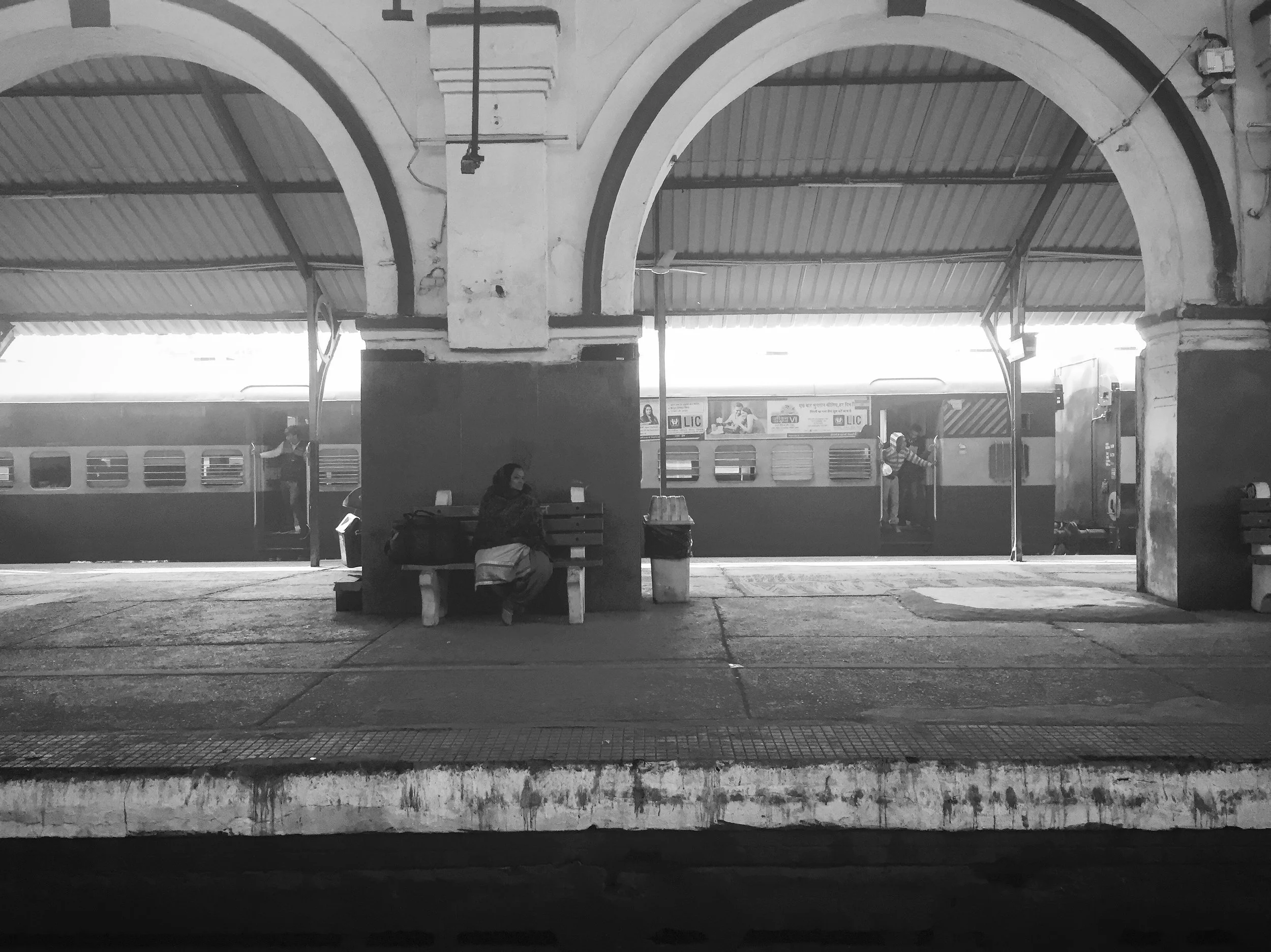
Photo: Karan Madhok
Fiction: ‘Nandita’s arrival in our lives was similar to a new season dawning upon the hills. It was a slow, effortless glide, almost organic. It looks as if it had always been there, only we had begun to feel its newness by degrees.’
The soft mauve from my cardigan rose like smoke, and its little curls filled the room. I felt intoxicated by the fragrant mauve-coloured fumes. The bobbles on the sweater turned into tiny mauve butterflies. So many of them! They wafted in semi-darkness. I gasped at this marvel.
But when some of them rested gently on my arm, I began to feel their glacial sting, their arctic bite. Suddenly, the rhythmic metal-on-metal interlude came to a halt. I woke to the gentle sway of the train.
Something pale brushed the tube-light above the berth and vanished quickly before I could see its shape.
The wheels sighed and there was stillness. I craned my neck to look outside. For a moment, I wasn’t sure if it was dawn or the muted station lights in a cloudy evening. I must have slept really well. My shawl had slipped from my shoulders, and its loose folds offered no defence against the spiky cold that crept in, sly and unsolicited, through the slightly open window. I was still holding the knitting needles, but my grip was somewhat loose and they felt warm to the touch. The yarn was still caught between my fingers. I collected the mess in my lap and quickly pulled down the latch.
January.
In the side compartment of my handbag lay a thin brown envelope, its edges softened by repeated touch. I had opened and reopened it so many times. Its fold line now obeyed the command of my fingers without resistance. The letter inside had the name of a place I had never been to, a school I had never seen, and a time I was expected to arrive. It nudged me towards a future I would have to step into, alone, while my mind kept drifting back to a past that had begun to unravel, one loop at a time.
I collected my shawl closer again, along with my anxiety and excitement, wrapping it firmly this time, tucking the edge beneath my chin. I felt my breath against my cheek. Warm, comforting, fragrant from the naphthalene. I had pulled the shawl out from the chest where it had remained snug all summer. I sat up straighter, blinking at the station: The foggy window-glass had blurred the view, and it looked like some impressionistic painting of blotches and dots, indistinct yet with forms quite legible. Outside, a tea-seller’s call rose and fell. Vendors moved like shadows in the mist. And in some time, my mind drifted away to another painting, not as smudged as this, in the shanty quarters of Dehradun.
This memory appeared like a graph with stray patterns that took shape gradually, if only one had the patience to work through it with needles and skeins. I have always loved the way the yarn moves between my fingers at each brief tug. How they formed little knots around the needle. The soft pull, the obedient loops, the slow yet sure growth of something whole.
People say knitting is about patience; I think it is all about faith. One begins with nothing but a loose skein and two clueless needles, believing that if you move your hands in the right rhythm, the mess will surrender into a beautiful shape. In our five years of marriage, I have knitted various patterns, collected from magazines, from ancient matriarchs’ coffers, from neighbours’ kids’ sweaters. My drawer was full of fray-edged, yellowed, silverfish-nibbled pages of several issues of the Hindi-translated Russian magazine, Soviet Nari, and on each page was etched a graph of excellent craftsmanship of wool and needles. My own handiwork was not as intricate. But it was patient and woven with love. Stubborn rows of wool—each loop a silent gratitude for the life we lived.
We were domestic in the way people in the town understood the word: I cooked, Sashank read, we took slow walks after dinner. Our marriage made me believe that love must look a lot like knitting—a habit, a rhythm. I knitted every evening sitting in our verandah, overlooking the busy street speckled with school-going children, hawkers, vendors, familiar faces. Sometimes, he would tend to the variety of hybrid roses he had planted in clay planters. Sometimes, he would sit nearby, reading the newspaper, sharing snippets from it every now and then.
People say knitting is about patience; I think it is all about faith. One begins with nothing but a loose skein and two clueless needles, believing that if you move your hands in the right rhythm, the mess will surrender into a beautiful shape.
It had been a perfect picture of contentment. The absence of any child in the frame never affected its wholeness.
The train sighed forward, like an elderly man rising off his seat, reluctant, yet sure of its destination. The winter fields sped past in streaks of brown and gold. I leaned my forehead against the glass and let the winter bite.
*
It was customary in our town to welcome newcomers, and so, we invited Nandita on a Sunday. I noticed a string of tiny silver bells that jingled at her wrist as she tried to tuck away a wisp of disobedient hair from her temple. We spoke of books and the weather. The three of us had so much in common, it was almost uncanny. She spoke of her first impressions of the town. And before leaving, she excitedly shared her mother’s special recipe of stuffed parathas. That was the beginning of a beautiful friendship.
Nandita’s arrival in our lives was similar to a new season dawning upon the hills. It was a slow, effortless glide, almost organic. It looks as if it had always been there, only we had begun to feel its newness by degrees. She came to our town after summer break, a new hire in the English Department of the school where Sashank worked. She was younger than me by some years and brought with her the kind of energy small towns often mistook for brusqueness. She had a brisk way of speaking, a fondness for bright colours, and the ability to make friends without trying.
In no time, she became a part of our two-person-universe, like those pineapple pastries that became our tea-time staple after she first introduced them. Her smile, the pearl drops, the scarlet dress. She carried a box of those pastries from the only bakery in town worth visiting.
By the end of that first Sunday, it seemed like she had been a part of our verandah conversations all along. The echo of her presence stayed long after she had made her departure. It filled some void I never realised existed in our home. She stopped asking where things were kept. She arranged the cups in the shelf with their handles turned, the way Sashank preferred them. Once, as I reached for the tin of tea-leaves, she handed me the little clove container. “Your drug, Ma’am,” she tittered. I admired how quickly she had learnt the grammar of our little world.
Nandita had confided in me that she had never been a knitter. And yet, she had the hunger to learn. “It is so much better to learn it in the 3D, rather than pause-play all day a YouTube tutorial,” she had remarked, fiddling with yarn. “These DIY videos are of little use, I tell you.”
Sashank looked up then, smiling faintly, as if he had been anticipating that exact complaint. “She learns faster by watching,” he said, as if to himself.
Nandita laughed, a brief approving sound, and adjusted her grip on the needles without looking at him.
She reached for the sugar pot, then paused.
The echo of her presence stayed long after she had made her departure. It filled some void I never realised existed in our home. She stopped asking where things were kept. She arranged the cups in the shelf with their handles turned, the way Sashank preferred them.
“Two spoons,” Sashank said, his eyes still fixed on the newspaper. Lightly surprised, Nandita smiled, “I keep forgetting that you notice everything,” she said. I felt amused, almost proud, of his attentiveness.
Teal against ivory, her fingers looked like performance poetry that was being enacted before a spellbound audience. Delicate lacework in neckline and wrists, its filigree showed Daedalian patterns of light and shadow in tantalisingly sketchy fragments.
Sashank stood behind her, stirring his cup. His sage green and beige formals highlighted his olive skin, emitting a charisma which had not yet doused in five years of conjugality. Chagall’s Over the Town flashed across my mind. This awry strand of involuntary imagination puzzled me and I laughed at myself. Carefully manicured nails where a dainty ruby floral ring adorned a finger, her hands knitted away.
She was such a keen learner. Her loops were unhurried yet confident. Just like her knots that slipped effortlessly into her needle, she too slipped into our routine without friction. Once when I forgot to water the dieffenbachias, she did. “They droop if your attention is slightly diverted,” she said, gently clapping her palms to brush off the soil.
Sashank glanced at the plants, pleased, “You have an eye,” he told her. I agreed. I had always trusted people who noticed small things.
*
The small-town breeze carries more than just the odour of frying onions. It carries contagious whispers, too. A harmless chat at the local tailor’s, a lingering moment at the temple premises. At first, they were like distant temple bells—soft, almost melodic in their harmlessness. By the time they reached me, their sharpness had diluted, but new details added to provide density and flavor, like a pinch of ajinamoto for that perfect meatiness: “They’re too close…” “He gives her lift often, doesn’t he...,” “You know how these things start…” Sometime, the whispers would be more pointed. “Be careful. You must learn how to nip things at the bud…”
These remarks were extra snacks during our evening tea rituals. “The town’s not yet ready for friendships like ours,” Sashank sighed in his usual pensive manner, pouring more tea into our cups. “The place lacks entertainment. That’s what it needs most.”
She would drop by after school. He would bring her on his scooter. Once, while pouring tea, he mentioned a staff meeting at school. “Friday, not Thursday,” Nandita interrupted, smiling mildly. “Right. Friday.” Sashank nodded. It was the absence of explanation that amused me, as if they shared an invisible calendar not everybody understood. And this is why, maybe, this seemingly ordinary moment has managed to stay with me.
Nandita usually carried a newspaper clipping, a black-and-white graph for a hand-knitted cardigan she thought I might like, and her favourite, and by that time mine too, pineapple pastries. We three would chat away, with her observing me, dazed, as I knitted without looking at the yarn. “It’s hypnotic,” she cooed, watching my almost mechanical hands fiddling with the needles. “You must have been a poet in another life.”
Once, while I groped for a dropped needle near my feet, I heard her laugh in the kitchen. It wasn’t loud. It was the sound of something being adjusted into place. Sashank came out of the kitchen, his laugh now softly settled into an amused smile, stuck at the corner of his lips.
As the evenings grew shorter and nights began to descend sooner, he would often volunteer to drop her home. When he returned, her perfume would stick to his back, where she sat behind him.
Curious, one day, I asked her its name.
“Twilight Mauve”, she replied.
“Twilight Mauve,” I repeated.
“It suits evenings,” he said lightly, without looking at either of us.
I offered to teach her. She took to it quickly—far quicker than I had expected. Her fingers, nimble and eager, made the needles click in a rhythm that felt almost like ours, Sashank and mine, the quiet domestic beat of our days. She would scoff at her mistakes, undoing her loops without complaint, starting again with renewed care and patience. We would become the young college girls without a care in this world. And he, my understanding, considerate man, would leave us alone to be ourselves for some hours.
Sometimes, when the three of us spoke at once, my sentence would fall away without anyone noticing. They would finish a thought together, and for a fraction of a second, I would feel like someone who had entered a room a little late. The thought amused me. This was what harmony looked like, I told myself.
One Sunday, I took her to one of the oldest shops in Paltan Bazar, the one visited by Sashank’s parents and their parents. Lakshmi Handicrafts. We all got our woolen clothes from there. Winter was slowly descending like a secret. The lane where this shop was situated was lined with fruit stalls. The narrow lane lay immersed in their mixed fruity fragrance. Suraj Bhaiya, the shopkeeper, began to exhibit his best ware, and we, like excited children before a giant wheel, gasped at every piece.
We both particularly liked a Kumaoni handloom shawl that felt extra-terrestrial. Intricate patterns made by seven different colours formed its border, while little mirrors were sewn intoits body. But the price disappointed us. “Le lijiye, Bhabhi. Haath ki kaarigari hain, mehnat lagti hain,” pushed Suraj Bhaiya. Nandita, who understood the labour of handmade products, never bargained.
By that time Sashank had arrived, his left arm carrying a helmet, he saw me caressing a mauve sweater. A man of very few words, he gestured me to buy it. I reasoned that I already had two new cardigans whose price-tags had yet not been pulled off. Nandita was holding the Kumaoni and occasionally grazing her cheek against its soft surface. She spoke, as if pacifying herself, “Next month, this is going to be mine, as soon as my salary is accounted. Till then, good-bye, dear Kumaoni,” she said with an innocent laugh.
Nandita requested Suraj Bhaiya to put the shawl on hold, and even paid him a small amount in advance. Her stubbornness fascinated me. I teased, “God forbid! If the Kumaoni shawl were to be a man, I wonder how fiercely you’d have fought for him!” The lane resounded with our peals of laughter.
*
“The town’s not yet ready for friendships like ours,” Sashank sighed in his usual pensive manner, pouring more tea into our cups. “The place lacks entertainment. That’s what it needs most.”
Clement Town. All the streets were decorated with colourful fairy lights and glittery paper ribbons. It was Rasika’s wedding. The twenty-four-year-old radiated in her crimson bridal lehenga-choli-odhni. I ran to embrace her. I handed her the shagun ka lifafa and with my blessings. When she touched our feet, it was quite a sentimental moment. Unshed tears glistened in our eyelashes.
And as we were heading toward the elaborate buffet, I caught a glimpse of Nandita, smiling at me. She was clad in that Kumaoni shawl. Her auburn hair left open, a mass of carelessly yet carefully kept mane cascading down her slender back. She was wearing a nose-stud that evening. Did some star accidentally lose its way and fell down on that wedding night? She gently grabbed my arm and took me to a corner. “Father sent me some money. And the rest I managed with my tuition fees,” she confided in me excitedly.
Ethereal Nandita! I felt like a proud elder sister. Her patience and determination impressed me to my core. “So, Ma’am, when are we resuming our knitting classes?” she chirped. I gave her a warm hug. The fragrant smoke from the holy pyre, the incantations, the marigold flowers that decorated the makeshift pillars—everything was auspicious, everything sacred. It reminded me of my own wedding with Sashank and my arrival to his town, where Rasika’s mother became my guardian. It had been an arranged alliance, but this is how destiny designed everything to a perfect rhythm.
In the midst of all this, I was not unaware of the prying eyes, the gazes that spoke too much, the stares that were too loud. We stayed till Rasika’s vidaai and left when it was almost dawn, as the lazy sun slowly crept out from the cloudy folds.
A few days after the wedding, I found the mauve cardigan carefully folded in our bed. By now, I had learnt to read his silent ways. I quickly tried it on and went to show it to him. He was found performing his evening ritual—solving some mathematical equation at his study.
He lifted his head and his eyes softly smiled. I managed to mumble in his bear-like embrace, “Why did you have to buy it? There are already two new ones.” But the fuss soon evaporated in the night air.
Our days continued like a blessing. More books filled our shelf. More plants arrived and decked our narrow verandah. Petunias, geraniums, African violets. Nandita expressed her love for Kafka on the Shore. She explained, her hands sketching shapes in the air, how cats talked and fish rained from the sky. None of it felt absurd to her; she rhapsodised, two little flames in her eyes, “There’s magic in it, the inevitable folded into a dream sequence.” But Norwegian Wood disappointed her. “Too much sadness without any magic,” she lamented.
Her eyes dazzled with the prospect of discovering shimmer in every story she read. Maybe that was what drew her so effortlessly into our lives. She fit our space as if she had already been written into our script from the beginning. She became another name for abundance, for light.
*
I met Suraj Bhaiya at a fruit stall. He was bargaining with the vendor over the price of oranges. His voice broke the monotony of the usual market-place chatter when he saw me. “So, Bhabhi. Sashank Bhaiya finally got the Kumaoni, kyun?”
He paused, eyes glinting with pride. I froze, half listening, as the oranges before my eyes appeared suddenly too bright.
Sooraj Bhaiya laughed, remembering the conversation. I blinked trying to steady my mind. “How do you convince a man so blindly in love with his wife? Kya karta? De diya.”
“Also, the cardigan you had admired…” his grin widened with satisfaction.
I fiddled with the edge of my shawl, tugging and rolling a tassel between my fingers. What did he mean, ‘finally got it?’ Surely it couldn’t… “Kitna samjhaya,” he continued, “Arre, Bhabhi’s friend had already paid me an advance. But he was so adamant.”
Suraj Bhaiya laughed, remembering the conversation. I blinked trying to steady my mind. “How do you convince a man so blindly in love with his wife? Kya karta? De diya.”
The colour of the Kumaoni shawl briefly danced before my eyes, its tiny mirrors caught the sun’s light, a spectral Starry Night unfurled in broad daylight. I managed to whisper, my voice raspy with unprocessed emotions. The words came out precariously, like someone trying to hold on to something in stormy waters, “How many Kumaoni shawls were there in your shop, Bhaiya?”
In the few suspended seconds between my question and his reply, my hope felt like a child holding her breath, watching a coin flip in the air.
“Arre Bhabhi, I had told you na. Don’t you remember? It was an exclusive piece. One only, bas.” He reassured, “Don’t worry, Bhabhi. It’s yours. Only one piece in the whole town.”
I pictured Sashank’s calm calculating hands. Growing up, I had been quite dull in Maths, scoring only forty-five out of a hundred in my boards. But I loved knitting. And I took a genuine interest in art. I knew that if a loop came off the needle, one must immediately mend it. A single slip, and you have a hole in the pattern—ugly, undesirable, noticeable. It takes patience to undo everything to begin from the beginning. And some simply leave it just like that.
Lakshmi Handlooms’ rusty hoarding… pineapple pastries… hybrid roses… laces and filigree… silver bracelet… teal and sage… the mirrors in the shawl… Everything motioned before my tired eyes like a storm caught on canvas, yet it all looked like a canvas I might have seen or imagined. A photomontage of moments I was a part of and yet wasn’t.
*
I had been counting stations without knowing why. At Deoband I stopped. A painted lady suddenly entered the train compartment, frantically beating its wings against the frosty glass window. The butterfly’s bright orange-white spots and black edges looked prismatic against the fleeting grey landscape. As it struggled, it sprinkled some of its luminous powder, fine filaments of colour and light, visible in the dull daylight.
For a moment I thought of lifting the latch. But before I moved, it slipped through a crack and was gone.
I stared at the window, a patch of condensation settled again. This time it was shaped oddly like a face. I wiped it with my palm. Someone outside shouted for chai. The compartment shuddered for some brief seconds, then stilled. I wondered if I had packed my poncho-brooch or left it in the drawer at home.
***
Labiba Alam lives in Assam, India. She writes both in Assamese and English, and translates from Assamese. Her academic work meets at the crossroads of myth, memory, and resistance. She holds a PhD. in English literature. Her poetry and short stories reflect the banal and the everyday. You can find her on Instagram: @la_rockpaperscissors.