‘Charulata’ and The Unseen Woman
‘To exist fully as an artist and human, one must be seen, heard, read, and acknowledged’: Farah Ahamed explores Satyajit Ray’s Charulata through the lens of Simone de Beauvoir.
In her short story, The Woman Destroyed, (1967) Simone de Beauvoir’s protagonist Monique utters the words, “I am no longer anything.” She says this when she feels redundant as a wife and mother; she feels she is not worth anything because the roles she fulfilled are no longer necessary to her husband and son. Through Monique, Beauvoir suggests that when a woman’s existence is defined by recognition from “others”—the consequences of withdrawal of it or failure to receive it—are an existential crisis. A woman undergoes a sense of loss. that of her ‘being’.
Charu, the protagonist of Satyajit Ray’s 1941 Bengali film Charulata, based on Rabindranath Tagore’s 1901 novella, The Broken Nest (Nastanirh), suffers a similar dilemma. She feels she has not been recognised by those in her environment. Ray regarded Charulata as one of his most important works, a film with “the fewest flaws” which he would make “exactly the same way”, suggesting it fully realised his artistic intent. This echoes the film’s central argument: to exist fully as an artist and human: one must be seen, heard, read, and acknowledged.
‘Being seen’, or not ‘feeling seen’, is a common notion in modern parlance. But what does it mean to be seen? Is it just about fulfilling a role, as in Monique’s case? Or about being listened to? Or is it something more?
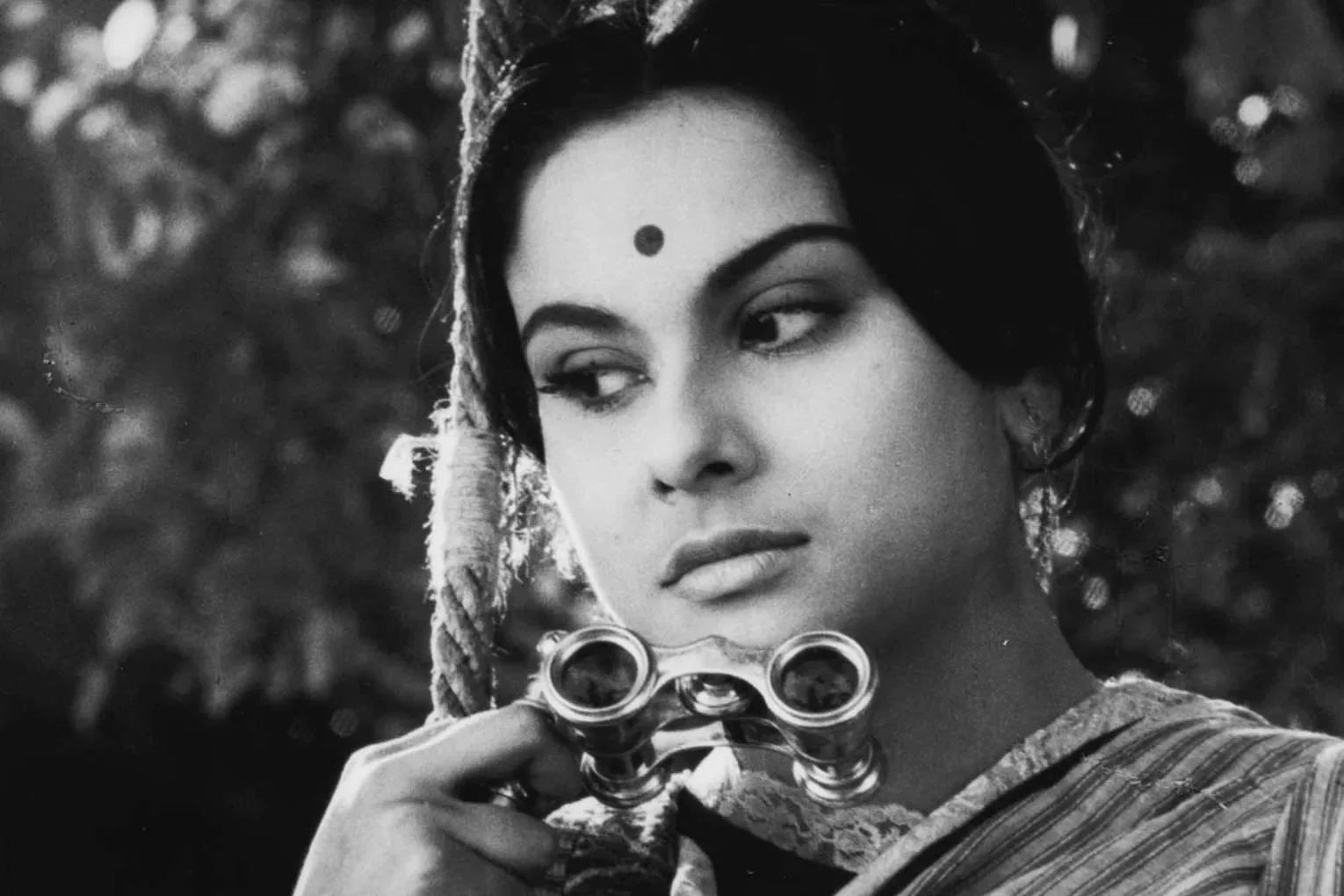
The opening sequence of Charulata follows Charu, as she moves from room to room with a pair of opera glasses. Through the jaali in the windows, fractured light falls in patterned fragments across the interior of her home, as she watches figures on the street who foreshadow her own life: A blind beggar crying out as he passes with his dog, a group of men carrying a table calling for people to make way, and a man hurrying with an umbrella under his arm, absorbed in his own world. These images are accompanied by filtered sounds, which reach her, but from which she is excluded: The beggar’s cries, the men’s voices, the faint cuckoo calls, and the muted rhythms of housework. In one of the rooms, a bird cage swings from a hook on the wall; like Charu, the bird is a spectator through the bars of its prison.
Ray’s interplay of sight and sound suggests that seeing and listening do not guarantee recognition. Scene by scene, he explores Charu’s crisis of visibility, including gaze, voice, writing, and making artefacts. Charu watches her husband Bhupati with anticipation, while he remains self-absorbed barely noticing her presence.
The film explores gaze, framing, optics, light, and space while also studying Charu’s desires, invisibility, voice, and creativity. In Beauvoirian terms, Charu’s anxiety is existential: she is unseen, and her existence has been denied its full ‘disclosure’.
For Beauvoir, life had ‘concrete meaning’ when one’s existence is recognised. When viewed through Beauvoir’s lens, Ray’s Charulata becomes a meditation on seeing and being seen. The film explores gaze, framing, optics, light, and space while also studying Charu’s desires, invisibility, voice, and creativity. In Beauvoirian terms, Charu’s anxiety is existential: she is unseen, and her existence has been denied its full ‘disclosure’.
Clearly, Charu has a role to play in her husband’s life as his wife. She attends to Bhupati’s needs, manages the household, and sustains its routines. However, even while she does this, Bhupati does not recognise she craves emotional, creative, and intellectual nurturing. He is focused on himself and pre occupied like the umbrella man. Even though Charu says, “Oh, I’m used to it now,” her unacknowledged presence within the marriage, in Beauvoir’s terms, is akin to her existence not being affirmed: Charu’s ‘joy of being’ is reduced to simply functional.
When Bhupati’s cousin Amal arrives in the middle of a thunderstorm, there is a shift in Charu’s listless mood. A deepening of friendship between in-laws is not unusual in the Indian context, until Ray shows Amal and Charu exchanging more meaningful glances. This marks Charu’s first instance of reciprocal recognition. Unlike Bhupati, Amal acknowledges her presence as person with talents and ideas and they have discussions about literature. However, in one conversation he says to Charu, “A woman can't understand the female mind. Only a man can.” On the one hand, Amal humiliates her; on the other, it is also possible that it is not her and all women that his remarks are aimed at, but his own need for self-aggrandisement.
For Beauvoir, being seen by a man, or any ‘other’, is not enough. For her, life is meaningful for a woman when she is not validated or defined by the other, but when she can define herself through her own choices. She describes this as a type of freedom.
Ray explores Charu’s growing desire for Amal. In an emotionally intense scene, while sitting on a swing, Charu looks intently at Amal and sings Tagore’s “Fule Dhole Dhole” and “Ami Chini Go Chini”. Here, him listening to her voice becomes a form of recognition: to be heard is to be acknowledged. On the swing, as the camera moves with her, Charu appears suspended between Amal and Bhupati, between captivity and freedom, between angst and joy. Ironically, Amal says to her, “All of life is like a rhythm. Birth, death. Day, night. Happiness, sorrow. Meeting, parting. Like the waves on the ocean, now rising, now falling. One complements the other.” Charu’s dualities of being seen and unseen is part of this rhythm, too.
In later scenes, Charu hums the tune and sings phrases from the song she’d sung to Amal earlier. These moments are what Beauvoir would say represent a ‘thickening’ of existence into embodied pleasure. Ray offers us a view of Charu as a dynamic personality with potential for freedom; where being seen in the full rhythm of life includes mutual recognition and joy.
Ray presents Amal’s recognition of Charu’s creativity, her writing and reading as another form of acknowledgement. Encouraged by Amal, writing becomes Charu’s attempt to exist beyond her domestic limits. He reads his work to her and praises her writing. Together they discuss Bankim’s female characters. Through the short exchange, Ray highlights Charu’s thoughts about her own appearance and her lack of self-worth become apparent. Societal standards influence Charu’s ideas where beauty is a measure of value, not just an attribute.
She says, “What descriptions! His women are so beautiful! So much perfection isn’t right. They make me feel ugly. They’re all so beautiful. Mrinalini's beautiful, Radharan’s beautiful, Saibalini’s beautiful, Kapalkundala’s beautiful...”
Amal replies, “And Kundanandini?”
Charu responds, “She's beautiful too, but not perfect.”
Amal says, “Lutfunnessa’s not perfect either. She’s too tall and her lips are bit thin.”
And Charu concludes, “And she’s dark-skinned.”
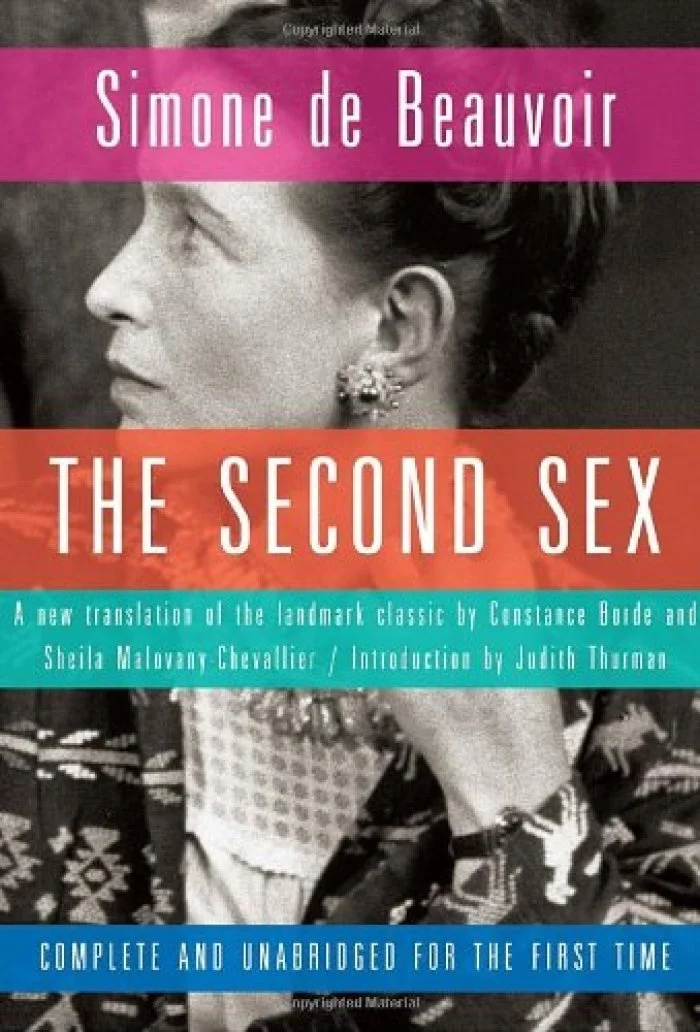
In The Second Sex, (1949) Beauvoir argued that it is because women are constructed as “the Other” in relation to man, that women often judged themselves harshly. They evaluated their bodies, beauty, and worth according to external standards—those of men. She explained how a woman “is led to make herself object” and taught to view her appearance as something to be assessed, compared, and perfected.
Here, him listening to her voice becomes a form of recognition: to be heard is to be acknowledged. On the swing, as the camera moves with her, Charu appears suspended between Amal and Bhupati, between captivity and freedom, between angst and joy.
Charu’s self-perception is negotiated by cultural narratives of femininity, where to “be seen” is to be judged, and to judge oneself accordingly. Instead of existing as a person in her own right, Charu is caught in what Beauvoir describes as living as an ‘object for others’, which is a barrier to her freedom.
When Charu’s writing is published in a popular journal, Bhupati’s friends congratulate him and carry him on their shoulders, as if the success was his doing. Charu, meanwhile, receives no acknowledgement beyond the few words mentioned in passing. In the film, men discuss politics, literature and philosophy and the printed word is recognised as valuable and contributing to social, intellectual, and cultural sensibility. Yet for Charu, validation remains filtered through Amal and Bhupati. Ray exposes the gendered structure of their society and household, in the way Charu’s existence is mediated by men. For Beauvoir, this is akin to Charu’s existential dependency.
Ray highlights how Charu’s embroidery and paan-making are also ways in which she expresses her creativity and need for acknowledgement. She stitches slippers, folds paans, and offers them to the men in her lives. Her gestures are tactile, intimate forms of communication through which Ray materialises her inner life. These embody Beauvoir’s idea that freedom must take “flesh and blood” form, even when recognition remains uncertain.
As the film unfolds, Charu’s gaze toward Amal intensifies into longing. When Amal decides to leave, his letter triggers an emotional outburst from Charu which leads to a distancing between her and Bhupati. In the aftermath, Bhupati’s later recognition arrives too late. In the final freeze frame, as the tanpura score rises in a mournful crescendo, their hands nearly meet, leaving recognition unrealised. Charu sees herself for who she is and defines herself on her own terms.
It is a mere glimpse of Beauvoirian freedom.
In his adaption Ray made a departure from Tagore’s original story. In the source text, Charu and Bhupati’s marriage is completely shattered. After discovering Charu’s feelings for Amal, Bhupati is devastated and decides to leave Calcutta to take a newspaper job in Mysore. Charu begs him to take her with him; Bhupati refuses, but changes his mind at the last minute, and offers to let her come. However, Charu responds with a chilling, definitive: “No, let it be.” The end is a permanent rupture.
In Ray’s hands, the story is more nuanced. He depicts a more delicate, psychologically complex resolution. Bhupati leaves the house in grief and when he returns later that evening, Charu opens the door and stretches her hand out to him. Bhupati hesitates and extends his. Ray freezes the frame before their hands can meet suggesting an altered future where they will stay together, and either remain emotionally detached, or evolve to a better understanding.
The protagonists are portrayed differently under Ray’s lens, too. In Tagore’s novella, Bhupati is a somewhat oblivious but gentle husband. After Amal leaves, Bhupati desperately tries to mend his marriage, and even secretly attempts to write poetry to please Charu. In contrast, Ray’s Bhupati is portrayed as a tragic, short-sighted political idealist, blind to his wife’s needs. Similarly, while Tagore portrays Amal with more explicit flaws as manipulative and aware that he is taking advantage of Charu’s financial generosity and affection, Ray renders Amal as a charismatic, enthusiastic, and somewhat naive bohemian, whose behaviour is fuelled more by youthful thoughtlessness than malicious opportunism.
Most interesting is how differently Ray handled the character of Charu. Tagore wrote Charu as trapped and reliant on others. She tolerates Amal’s childish tantrums and exploitative demands because she is desperate to feel seen and needed. Meanwhile Ray’s Charu, played by Madhabi Mukherjee, has a quiet dignity. She is keen for Amal’s attention and enjoys their witty exchanges and playful interactions. She is shown as a woman with some agency and psychological freedom within the constraints of her domestic sphere. In the text, Charu’s writing is motivated by the jealousy of Amal being published. When her own work is published, Charu is surprised, but her primary motivation remains winning Amal’s validation. However, Ray emphasises Charu’s intellect as a core feature of the film. Her love for literature exists before Amal’s arrival, and she is shown as searching for books by Bankim. Her transition from a ‘reading subject’ to a ‘published writing subject’ represents her intellectual awakening.
Tagore’s Charu is also bound by guilt and social taboo. Her passion for Amal is coloured by ideas of societal respectability and shame. On the other hand, Ray’s Charu is freer. Ray visualises her desire with radical cinematic sensuality. In the garden swing scene, as the camera moves with her face, Ray captures her emotional longing suggesting a more progressive and unapologetic acceptance of female desire and freedom.
For Beauvoir, a woman’s freedom begins when she ceases to be defined as ‘the Other’, since “man defines woman not in herself but as relative to him.” Instead, a woman exists as a subject in her own right beyond the male gaze. Ray grants Charu such moments unobserved by male characters, allowing viewers access to her interiority. She is shown her lying on her bed musing, sewing, and applying makeup. As the light shifts during the day, the viewer is also presented with altered visibility. The scenes build toward a sense of Charu’s creative and intellectual possibility beyond the household. However, this only occurs after a rupture between Charu and Bhupati, triggered by Amal’s departure. Charu’s tragedy lies in the fact that the conditions for her full existence emerge only through loss. Bhupati offers Charu partnership in the business and the opportunity to pursue a literary publishing career.
Yet, through Beauvoir’s lens, the real tragedy lies in the fact that Charu has glimpsed what freedom means but does not have means or conditions to sustain it. She briefly felt ‘seen’ and ‘heard’, by Amal while writing, singing, and in their interactions. When Amal leaves, she is unable to have the same interactions with Bhupati. Beauvoir would express that the real tragedy is in this gap between possibility and lived reality.
Being seen is about having the freedom to be creative on one’s own terms, being able to value one’s own work and potential, irrespective of the other. In Charulata, Ray explores mutual recognition as desire, curiosity, and connection; while Charu makes attempts to be ‘seen’ and ‘heard’, she does not ultimately evolve as a character who understands her true worth outside the paradigm of her cultural, patriarchal conditioning. She feels that her existence must be validated and appreciated by men. This is because only men move in public spaces, they are the ones engaging and contributing. In Charu’s world, the role of the woman is confined to the domestic space; a woman lives her entire life in a golden cage, unless a man allows her an entry point into the external world.
[Pritam] believed that being a writer was paramount, and being a woman, with societal dictated roles was secondary. Unlike Charu, she did not crave the approval of men, but like Beauvoir she believed that freedom—the actual liberation of a woman—took place internally.
For Beauvoir, the act of being ‘seen’ for Charu requires validation of her as a woman with emotional, intellectual, and creative needs. She would be ‘heard’ in recognition of her voice in conversation, while singing, and writing. Even her paan-making and embroidery are attempts to become visible. Being unseen and unheard would be an erasure for Charu. Beauvoir insists that there must be agency and a life beyond men. She writes: “To emancipate a woman is to refuse to confine her to the relations she bears to man.”
Ray’s film ironically closes with Beauvoir’s words also echoing for Charu: “My life: it is both intimately known and remote; it defines me, and yet I stand outside it.”
While Charulata is a story of its time, Beauvoir’s notion of what it means to be seen and heard continue to resonate with contemporary ideas of freedom and creative expression. Along the same perspective, I am reminded of Amrita Pritam, a Punjabi poet, who coincidentally was writing at the same time as Beauvoir in the 1950s. Like Beauvoir, Pritam chose to live her life on her own terms and based on her own choices. She was the first woman to receive the Sahitya Akademi Award in 1956 and the first Punjabi woman to be felicitated with the Padma Shri Award. She wrote about subjects that pleased her, love, loss, the violence of Partition, grief, and patriarchy, and she did not care for society’s opinion. For Pritam, her identity as a woman was not a priority. She believed that being a writer was paramount, and being a woman, with societal dictated roles was secondary. Unlike Charu, she did not crave the approval of men, but like Beauvoir she believed that freedom—the actual liberation of a woman—took place internally.
A woman’s personality matured to an extent where she experienced freedom: she did not need permission from the ‘other’ but became capable of achieving it herself. In those circumstances, she did not crave recognition or validation either, because seeing herself, as one might in the mirror—without comparison or assessment—and accepting that reflection, was enough.
In one of her most famous couplets, Pritam writes: “Jahan bhi azaad ruh ki jhalak parde / Samajhna wo mera ghar hai” Wherever you catch a glimpse of a free spirit, know that is my home. Maybe that is what it means for a woman to be free, to know freedom. To recognise that, especially at a time, when women’s voices are being silenced and erased, her spirit is unbounded, her creativity and voice are uniquely hers, her body is her home and the only validation she really needs is her own. She must continue to write, sing, make music, paint, embroider, dance and express herself and never, ever stop.
***
Farah Ahamed has been published in Ploughshares, The White Review, Los Angeles Review of Books, The Massachusetts Review, World Literature Today, The Markaz Review, and elsewhere. She is the editor of Period Matters: Menstruation in South Asia (Pan Macmillan India, 2022), described by Book Riot as an “essential” book “about the female body that dispel[s] misconceptions.” She is a human rights lawyer and lives in London. You can read more of her work here. She is on Instagram: @farah_ahamed_author and X: @FarahAhamed.