The Unsettling Politics of Violence and Music in ‘Dhurandhar’
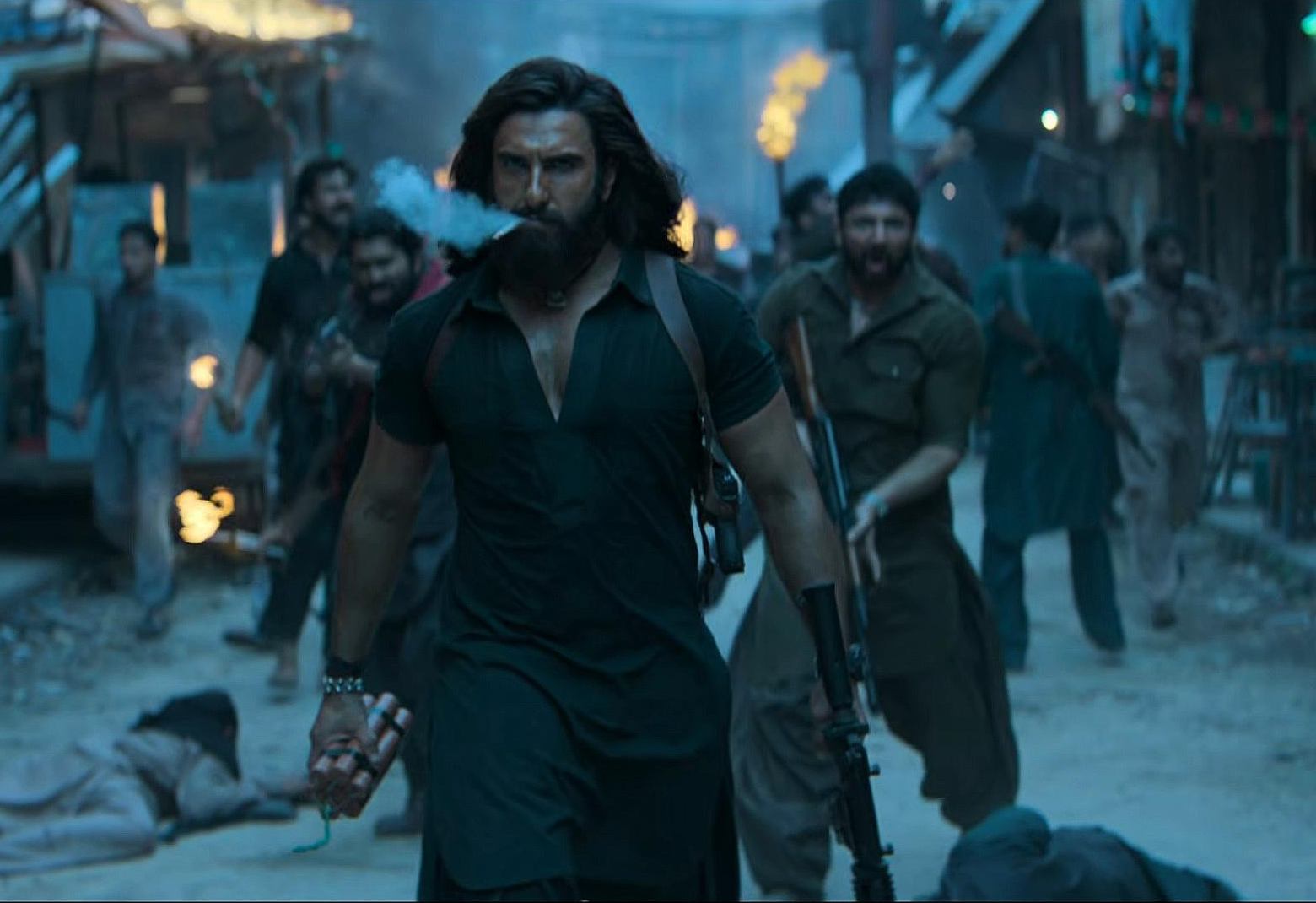
With brutal carnage presented with celebratory beats, Dhurandhar: The Revenge pushes viewers towards a stony insensitivity, creating a sense of heightened tempo and exhilaration without moral recoil.
The most unsettling part about watching Dhurandhar: The Revenge (2026)—Aditya Dhar’s sequel to the 2025 hit—wasn’t merely the gruesome violence on screen, but the reaction of the audience that filled the theatre. Dilated eyes stuck to the screen like glue, hands clapped eagerly, feet tapped to the groove of the background music, all while horrifying scenes of murder and mayhem were unleashed. In a scene where a character plays football with a severed head, I wondered if my repulsion was an over-reaction, or had my fellow spectators turned numb, insensitive to the horrors on screen.
It was in this context that I was reminded of English soldier-poet Wilfred Owen’s (1893-1918) poem “Insensitivity” which had the following lines:
Having seen all things red,
Their eyes are rid
Of the hurt of the colour of blood for ever.
And terror’s first constriction over,
Their hearts remain small-drawn.
Their senses in some scorching cautery of battle
Now long since ironed,
Can laugh among the dying, unconcerned.
In this particular stanza, Owen—a winner of the Military Cross for campaigns in Joncourt—speaks of those soldiers who have become desensitised to violence because of all that they have had to endure. The speaker argues that such individuals lose their imagination and their sense of pity. Their scorched, cauterised, or ironed consciences can exhibit a certain indifference and rigidity, which render them unresponsive to violence. It can be argued that veteran soldiers or secret agents on assassination missions become more efficient precisely because they can override their emotional responses during critical moments of conflict.
Owen, however, himself a veteran of several battles, did not consider such insensitivity as something precious and admirable. Instead, in the concluding stanza, the speaker reproachfully states
But cursed are dullards whom no cannon stuns,
That they should be as stones.
Wretched are they, and mean
With paucity that never was simplicity.
In Dhurandhar: The Revenge, no attempt is made to communicate any ethical perspective. People are burnt, hammered, blown, stabbed, dismembered or beheaded, almost as if one is witnessing a pantomime of puppets. Every blow of the cleaver is matched by pulsating music, so that the horror of the action is reduced to a state of ludic charade
Dhurandhar: The Revenge is a watershed moment in the portrayal of on-screen violence, in how it desensitises us with systematic persistence. The film is particularly dangerous and deplorable because it functions on the basis of a kind of sensory dissonance which pushes the viewers towards the stony insensitivity which Owen had chastised, by draining away from them the kind of fear, agony, and horror that spectacular scenes of violence should naturally unleash. Instead, they are made apathetic to these visuals, irrespective of the people against whom such violence is inflicted.
From the very beginning of the film, each violent sequence is matched by high tempo music, generally associated with the exhilaration of dancing at a nightclub or workout sessions in a gym. The music dilutes the spectre of violence, and transforms it into something fascinating and enjoyable, by creating a kind of dopamine rush (Ferreri et al, 2019; Etani et al 2018; Liu et al 2018) associated with pleasurable activities to lull the horror of the spectacle. This is radically unlike the scene in Godfather where Michael kills Sollozzo, to the faint sound of a train breaking to a halt, or the way in which the bloodbath takes place in the final episode of Mirzapur, Season 1, without any overpowering background music. The Godfather’s climactic sequence of assassinations is juxtaposed with Catholic rituals and liturgical prayers, associated with the baptism of a child in order to emphasise the contrasting diabolical nature of mob-violence in the United States. Ironically, the same music that accompanies bloodbath is also used to accompany the birth of an infant, further underscoring the absence of moral considerations or commensurate affects from the entire audio-visual spectrum.
In Dhurandhar: The Revenge, however, no attempt is made to communicate any such ethical perspective. Instead, people are burnt, hammered, blown, stabbed, dismembered or beheaded, almost as if one is witnessing a pantomime of puppets. No act of violence, however heinous, seems out of place. Every blow of the cleaver is matched by pulsating music, so that the horror of the action is reduced to a state of ludic charade, without any moral recoil. The film deliberately combines scenes of brutal violence with peppy, high-octane music to ensure that the natural affective response to murderous mayhem of any kind—even if it is for the sake of the nation and protection of innocent lives—can be muted in favour of an outpouring of dopamine and adrenaline (Schaefer 2017; Georgiou and Galatos, 2025). It is designed to evoke thrill and pleasure, as opposed to abhorrence or horror. Episodes of violence are punctuated by “Ramba Ho”, “Oye oye”, “Tamma, Tamma”, “Rasputin”, and other familiar Indian and foreign songs, so that the horror of the visual can be negated by the seduction of the aural, creating that affective dissonance which paralyses ethical analysis. Therefore, even as the screen becomes ravaged by gruesome bloodbath, spectators may be seen to chime to the music without any critical response to the unfolding scenes of carnage.
In this context, it is important to distinguish between Dhar’s use of music and violence and that of a director like Quentin Tarantino. Tarantino’s use of violence is often layered with allusive references to cinematic violence visualised from other films of the genre which have inspired him. He thus presents a sense of metafictionality that is often underscored by the deliberately exaggerated scenes that make one conscious of cinema as art, rather than faithful representation of ground reality. One can refer to the ear-cutting scene in Reservoir Dogs (1992), in which the criminal Mr. Blonde mutilates the captured police officer’s ear with a razor, while the peppy “Stuck in the Middle with You” cheerfully plays in the background. The ironic mismatch between action and music subverts audience expectations of a conventional interrogation in a crime film, while also highlighting Mr. Blonde’s sadistic amorality of Mr. Blonde. It also creates a distance between audience and action in order to highlight the constructed nature of the cinematic violence. Interestingly, the mutilation of the ear is not actually visualised, but only indicated through the officer’s terrible screams, which are counterpointed by the upbeat music. The Dhurandhar films, in contrast, aim to present undocumented reality without any sense of pastiche or homage. While Tarantino’s use of music creates a kind of ironic defamiliarization and emotional distance, Dhar uses music for generating an intensified alignment with the violence itself.
The music in the Dhurandhar films is loud enough to drown out other ambient noise, and plays with echo and reverb across multiple scenes to keep the audience in a positive state. The English lyrics are almost indecipherable and are supposed to drive viewers towards an economy of visuals without words, where adrenaline and testosterone are all that matters. This desensitisation also becomes evident from the sequence where gruesome images of a gang-war in Lyari between Pathans and Balochs is juxtaposed with scenes of serene golf courses in Karachi, where statesmen are putting balls and sipping tea. It must be noted that the gang war scenes are actually inconsequential for either the plot or the thematic foci. One does not need to visualise people being beheaded by the metal shutters of a shop, or a chain or corpses being hung from lampposts, to offer a panoramic depiction of a city blazing with violence. But the film deliberately showcases all that while a high-pitched vocals play in the background, creating a sense of heightened tempo—even fun, maybe—without any indication of either horror or repulsion.
Like its predecessor, Dhurandar: The Revenge was a blockbuster, becoming one of the highest-grossing Indian films of all time within weeks of its release. Despite its label as a lightly-veiled propaganda film, most viewers rushed to movie halls around the world seeking fun, hoping to be entertained. But, entertainment that encourages desensitised enjoyment of violence contributes to the creation of a society where ethics and sensitivity are deemed expendable, in favour of machismo and megalomania. The Dhurandhar films, thus places Dhar alongside directors like Sandeep Reddy Vanga (Kabir Singh, Animal) as an aesthetic orchestrator of the Indian Manosphere.
This toxic masculinity creates a compatible veneer, over which the repugnant political message of the film is sprinkled with ease. Incidentally, this message is communicated through the character of Brigadier Jahangir (Suvinder Vicky, who had apparently tortured hundreds during the Liberation War of Bangladesh in 1971. Jahangir is the father of Major Iqbal (Arjun Rampal) an instrumental character to the plot of the film, a ruthless ISI agent who is presented as one of the main figures behind terrorist attacks against India. Iqbal’s interactions with Jahangir become a tool for disseminating the political propaganda of the film, justifying the asphyxiation of dissent by projecting the bogey of anti-national conspiracies.
The Dhurandhar franchise thus becomes a classic example of media as ideological state apparatus which buttresses the dominant power-structures of the state, through a careful process of occlusion and obfuscation.
As Jahangir watches the swearing in of Prime Minister Narendra Modi, he lashes out at Iqbal by claiming that all the funds sent to opposition parties, socialists, NGOs and even universities have failed to bear fruit. The scene identifies the whole of the anti-BJP opposition as lackeys of Pakistan, singles out the socialists as being anti-India, identifies NGOs as being a security threat, and even tags universities as aligned with terrorists. In this way, the film manages to endorse many politicised claims of the ruling Indian government and the Bhartiya Janta Party against the opposition parties and their many ideological hostilities to socialists, the governmental crackdown against NGOs for being critical of its policies, and the violence and repression doted out against universities and their dissenting student bodies, as evident from the assaults against students and faculty members at JNU, Jamia, Jadavpur University, and the recent student protests at Jantar Mantar.
Furthermore, the film also claims that the government’s demonetisation effort was crucial for stalling the financial networks of terrorists and their distribution of fake currencies (despite RBI data revealing that 99 per cent of the demonetised was currency returned, signifying miniscule impact on black money and fake currencies). Of course, the film has nothing to say about the around hundred people who died on account of the consequences of demonetisation, the approximately 12 lakh workers who lost their jobs, the damaging blow suffered by the GDP and untold suffering arising out of liquidity shortage. Dhar’s justification of demonetisation as an anti-terrorism move wilfully ignores the abject failure and mass suffering associated with the project, and thus substantiates its role as propaganda.
Alas, the viewer, whose senses have already been lulled by that fusion of violence and music in the film, is hardly in a position to critically judge between truth and propaganda, and how one masquerades as the other. The Dhurandhar franchise thus becomes a classic example of media as ideological state apparatus which buttresses the dominant power-structures of the state, through a careful process of occlusion and obfuscation.
Dhar is perfectly within his rights to write, direct and produce a film like this which capitalises on the existing zeitgeist to scoop up record profits based on jingoism, machismo, and gullibility. He is part of the tradition heralded by Nazi-era filmmakers like Leni Riefenstahl, Karl Ritter, Veit Harlan, Herbert Gerdes, and the many literary and cinematic apologists of the European empires. In course of time, his empire will also fall. What matters is whether we will fall prey to the bloodlust and lies that such films sell, or whether we will be prudent enough to resist them.
***
Abin Chakraborty is an established academic who has published in magazines and journals including Cafe Dissensus, Madras Courier, Setu, Borderless, Kitab, Acumen etc. He is also the co-founder of Plato's Caves and the editor of Postcolonial Interventions, an online journal. You can find him on Twitter/X: @AbinChakraborty, Instagram: @platoscavesonline, and (Instagram) and Facebook: @Plato's Caves Online.